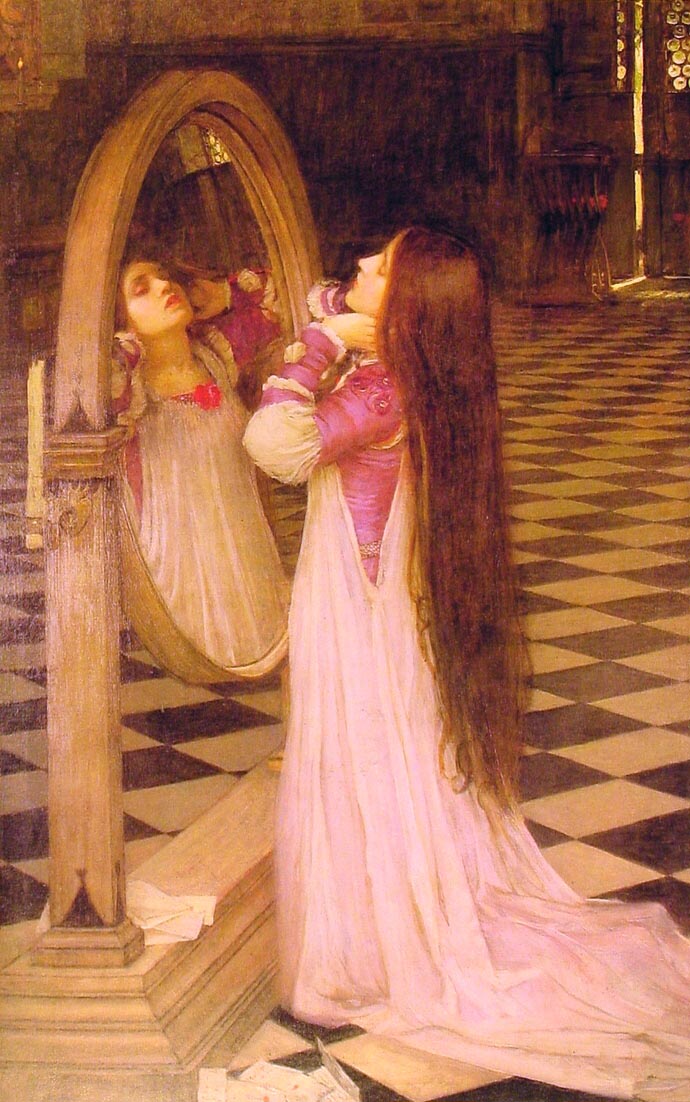
Image source: wikiart.org
Mariana and the Victorian Imagination
In “Mariana in the South,” John William Waterhouse returns to one of the most haunting figures in Victorian poetry: a woman suspended between hope and exhaustion, between the promise of love and the drag of waiting. Mariana is not presented as a heroine of action but as a mind in slow motion, a person whose inner life has become the primary drama. That premise suited Waterhouse perfectly. Few painters of his era were as adept at turning stillness into narrative, or at making a single room feel like an entire emotional climate.
At first glance, the painting offers a clear scenario. A solitary woman stands before a tall oval mirror, lifting her hands to her throat as if fastening a clasp, loosening a ribbon, or checking a necklace. Her long hair pours down her back like a curtain. The floor spreads outward in a bold pattern of dark and pale tiles, pulling the eye into depth. The background is dim, with a strip of bright opening at the right that hints at daylight and distance. Yet the longer you look, the less this feels like an ordinary moment of dressing. Waterhouse turns the everyday ritual of self arrangement into a quiet crisis. The mirror becomes a stage, the room becomes an enclosure, and the figure becomes both actor and audience to her own longing.
This is a painting built for viewers who enjoy reading pictures the way they read poems. Its story is not delivered through dramatic gesture or obvious incident. Instead it emerges through atmosphere, through the tension between warm color and heavy shadow, through the uneasy dialogue between the woman and her reflection, and through the way space itself seems to measure time.
The Literary Source and the Meaning of “Mariana”
Waterhouse’s Mariana belongs to a lineage shaped by Mariana and its later counterpart, a southern variation in which the same emotional condition is intensified by heat, color, and a sense of languor. In Alfred, Lord Tennyson’s verses, Mariana is defined by repetition: days that resemble one another, a landscape that echoes her mood, and a refrain that makes longing feel like a loop rather than a road. Waterhouse translates that poetic structure into visual form. Instead of repeated lines, he gives us repeated shapes and rhythms: the oval of the mirror, the cascade of hair, the alternating tiles, the soft fall of fabric, the tight circle of her arms near her throat.
The title matters because it frames how the scene should feel. “In the South” suggests warmth, brightness, and perhaps even sensuousness, but Waterhouse complicates those expectations. The palette glows, yet the mood is not radiant. The setting hints at sun beyond the room, yet the woman remains inside. The south becomes not a paradise but an amplifier. Heat can be soothing, but it can also intensify restlessness, making stillness feel heavier. In that way the location is not merely geographic. It is psychological, a way of naming an environment that magnifies the body’s awareness of time.
Mariana’s story is often read as a meditation on absence, on the way a promised arrival can become a form of imprisonment when it never occurs. Waterhouse does not need to show the absent figure. In fact, the absence is most powerful precisely because it is not pictured. Everything in the room seems organized around what is missing.
The Room as a Container for Time
The interior is more than a backdrop. It behaves like a container that holds emotion in place. Dark wooden surfaces press in from behind, absorbing light rather than reflecting it. The far wall does not open into narrative detail, it closes like a seal. This turns the room into a kind of pause, a space where time pools.
Against that heaviness, the tiled floor provides a sharp, almost mathematical structure. The alternating diamonds recede with insistence, like a visual metronome. Such floors often suggest order, ceremony, or institutional space, but here the pattern can also be read as the steady, indifferent ticking of days. Each tile is distinct, yet the pattern repeats, which mirrors the condition of waiting: each day arrives new, each day resembles the last.
At the right edge, the bright opening offers a thin promise of elsewhere. Waterhouse keeps it narrow and distant, so it functions less like an escape route and more like a reminder. The world exists beyond this room, but Mariana remains bound to the ritual of looking and thinking. That small strip of light is not freedom. It is temptation and contrast, a way of making the room’s enclosure feel more complete.
Composition and the Quiet Pull of the Mirror
The composition is built around a dialogue between two vertical presences: the woman and the mirror. Both are tall, slender, and centrally weighted. The mirror’s oval head forms a halo like frame around the reflected face, turning the reflection into a second character. This is crucial. The painting is not simply a portrait of a woman. It is a portrait of a woman confronting her own image, and therefore confronting her own story.
Waterhouse places the viewer so that we can see both her profile and her face at once. This creates a subtle split. The profile belongs to the physical person in the room. The reflected face belongs to the inner self, the self she is trying to read. Because reflections can be both truthful and deceptive, the mirror becomes a symbol of uncertainty. Mariana can look, but can she know. She can adjust her appearance, but can she adjust her fate.
The mirror also introduces a sense of performance. Even alone, she is being watched, by herself. That can be comforting, but it can also be cruel. If hope has faded, the reflection becomes a witness to that fading. Waterhouse’s genius is that he makes this psychological dynamic visible without any overt theatrics. The painting whispers, it does not shout.
Gesture, Breath, and the Language of the Body
Mariana’s hands rise to her throat, a gesture that can be read in multiple ways. It might be the practical act of fastening a collar or necklace. It might be a nervous adjustment, the small movements people make when they are trying to settle themselves. It might also be a protective gesture, hands hovering near a vulnerable point, as if the body is bracing against a thought.
Her head tilts slightly upward, exposing the neck, which adds a sense of openness and fragility. She is not hunched or collapsed. She still holds herself with a kind of dignity. Yet the pose is not triumphant. It feels suspended, like a held breath. That suspended quality is one of Waterhouse’s most effective tools. When a figure seems caught between motions, the viewer begins to imagine what happened just before, and what will happen next. Here, what happened before is likely another long span of waiting. What happens next is uncertain, which is exactly the emotional state the painting wants to maintain.
The length of her hair intensifies this sense of time. Hair is a natural measure of duration. It grows slowly, it records seasons, it suggests years. By painting it as an unbroken fall down her back, Waterhouse gives Mariana a visible timeline, a physical manifestation of the long stretch of her loneliness.
Color and Fabric: Warmth that Does Not Comfort
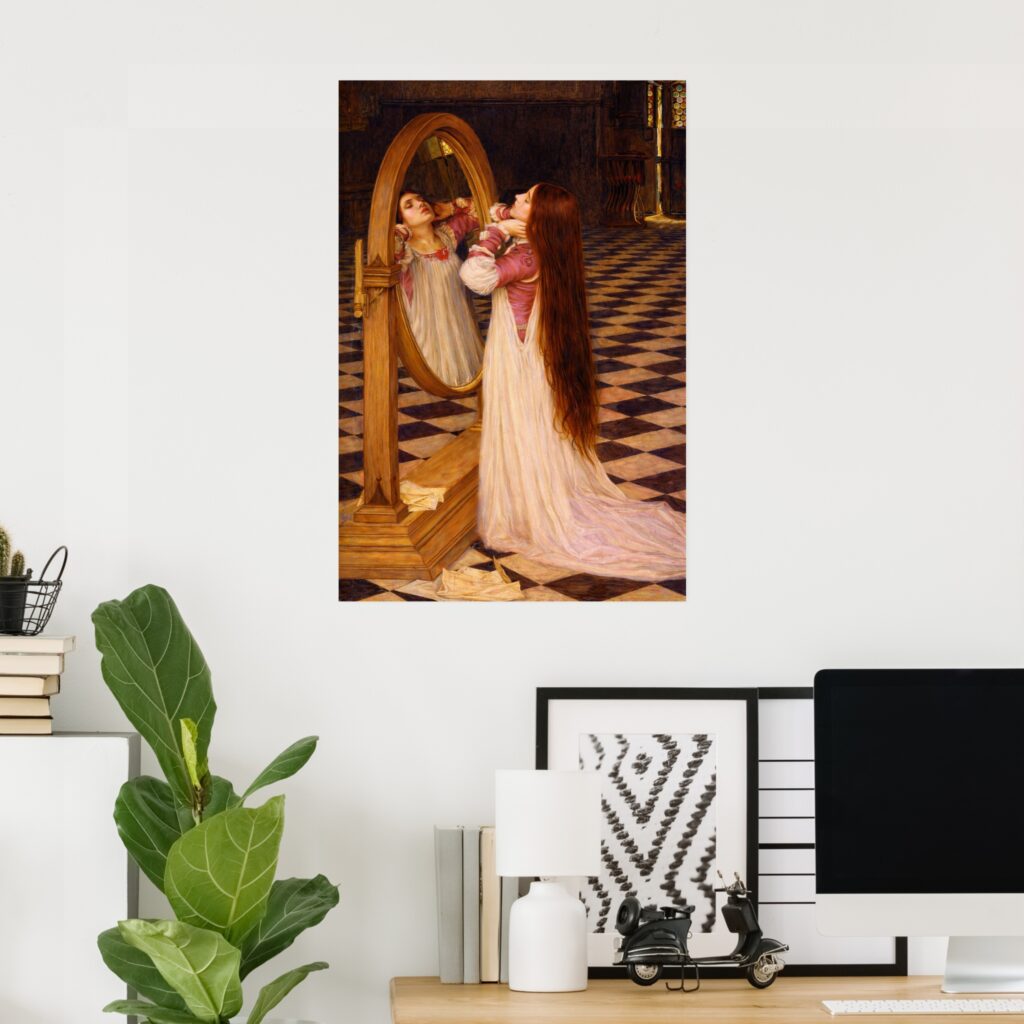
One of the most striking aspects of the painting is its warm, honeyed atmosphere. The scene is steeped in gold and amber, as if the light itself has thickened. Mariana’s dress, with its soft whites and pale pinks, catches that warmth and turns luminous. The bodice is a richer pink, more saturated than the skirt, and it draws attention to her torso and breath. The skirt drifts downward in a wide, gentle spill that feels both elegant and weary.
Waterhouse uses fabric to speak about emotional weight. The train that pools behind her suggests duration and accumulation. It is beautiful, but it is also heavy, a garment that behaves almost like an extension of mood. The whites are not crisp. They are warmed and softened, making the dress feel lived in rather than ceremonial. This matters, because it keeps the painting from becoming a costume piece. Mariana is not merely dressed as a medieval dream. She is embodied, present, caught in a real interior moment.
The pinks add another layer of meaning. Pink can signify youth, tenderness, romance, or vitality. Yet here it does not brighten the mood. It reads like a memory of feeling, a color that remains even when the emotion it once represented has thinned. In that sense, Waterhouse’s palette becomes psychologically precise. Warmth is present, but comfort is absent.
Light, Shadow, and the Southern Atmosphere
The lighting suggests a place where sun exists, perhaps strongly, but does not fully enter. The room seems to glow rather than blaze. The illumination is diffused, as if filtered through distance or through architectural barriers. This creates an atmosphere of languor, a slow warmth that can make time feel syrupy.
Shadow dominates the rear of the room, and the contrast between the dim background and the luminous figure isolates Mariana like a thought separated from the rest of the mind. The mirror catches a different quality of light than the surrounding space, which subtly elevates the reflection. The reflected face appears almost dreamlike, as though it belongs to a parallel plane.
That separation is vital to the painting’s emotional effect. Mariana is physically present, but mentally elsewhere. Light becomes a metaphor for attention. What is lit is what her mind circles. What is dark is what she cannot reach, or refuses to enter, or has forgotten how to inhabit.
Objects and Clues: Letters, Silence, and the Trace of a Narrative
Near the base of the mirror stand, there are scattered papers. They may be letters, notes, or fragments of correspondence. Waterhouse often uses such details to hint at narrative without pinning it down. Papers on the floor suggest neglect, distraction, or emotional fatigue. They can imply that messages have come and gone, or perhaps have not come at all, leaving only drafts, unsent words, or old promises.
The mirror stand itself has a solid, almost architectural presence. It feels like furniture built to last, which contrasts with Mariana’s fragile sense of future. Objects in the room seem stable. Human promise is not. This imbalance is part of the tragedy. The world continues to hold its shape while her life feels postponed.
Even the floor participates in this storytelling. A checkered pattern is often associated with thresholds, games, and decisions, with squares that might suggest choices. Yet Mariana stands still upon it. The grid of potential becomes the grid of stasis.
The Mirror as a Psychological Stage
Mirrors in art frequently symbolize vanity, truth, deception, or self knowledge. Waterhouse uses the mirror in a more complex way. It becomes a psychological stage where identity is questioned rather than confirmed. Mariana’s reflection is not simply her likeness. It is her emotional face, the part of her she might not show to anyone else.
The reflected face appears soft, absorbed, slightly distant. It carries a dreamy resignation. Meanwhile her body, seen in profile, performs a practical action. This split can be read as the conflict between outer routine and inner collapse. She continues to do what one does, to dress, to adjust, to stand. But inwardly she is elsewhere, locked into the thought of absence.
The mirror also creates a loop. If Mariana spends her days waiting, she may also spend her days looking, measuring herself against time, asking what has changed. The mirror offers evidence of change while offering no solution. Each look confirms that time has moved, which can deepen despair. Waterhouse captures that cruel logic with extraordinary restraint.
Waterhouse, the Pre-Raphaelite Legacy, and the Revival of Medieval Feeling
Waterhouse is often associated with the later currents of the Pre-Raphaelite Brotherhood and with the broader Victorian fascination for medieval and literary subjects. What distinguishes his approach is the way he balances decorative beauty with emotional gravity. He embraces rich color, elaborate costume, and poetic themes, yet he grounds them in a believable psychological moment.
In “Mariana in the South,” the medieval or romantic aura is present in the flowing hair, the elegant dress, the suggestion of an older interior, and the emphasis on a solitary female figure as the central emblem. Yet Waterhouse refuses to let the painting become mere pageantry. The emotions do not feel staged for legend. They feel intimate, familiar, almost modern. The painting becomes a bridge between the Victorian love of story and a more inward, psychological realism.
This balance is part of why Waterhouse remains so compelling to contemporary viewers. The surface is beautiful, but the beauty serves meaning. Decorative elements are not distractions. They are carriers of mood.
Waiting as Drama: Love, Absence, and the Weight of the Unseen
The painting’s central theme is waiting, and waiting is one of the hardest experiences to represent because it lacks action. Waterhouse solves this by making waiting visible through materials, posture, and space. Mariana’s stillness is not empty. It is heavy with what is not there.
The absent beloved, or the absent future, becomes the true subject. The viewer senses a story without being told it outright. This open endedness is powerful. It allows many kinds of longing to enter the painting. It can be read as romantic abandonment, but it can also be read as broader emotional isolation, as the feeling that life has paused while the world continues elsewhere.
The southern setting adds a further nuance. Heat can induce a dreamy state, a slowing of the body, a sense that movement requires effort. In that context, Mariana’s stillness can feel both forced and natural, as if the environment itself collaborates with her mood. The tragedy is not simply that she waits, it is that the world around her seems to encourage waiting.
Why the Painting Feels So Memorable
Part of the painting’s lasting impact comes from how it orchestrates contrasts. The room is dark, the figure is luminous. The floor is rigid, the dress is fluid. The moment is ordinary, the feeling is profound. The mirror offers clarity, yet it deepens uncertainty. These contrasts keep the image alive in the mind.
Waterhouse also understands the emotional power of partial information. He gives us just enough narrative evidence to make us curious, but not enough to close interpretation. That keeps the viewer engaged. You return to the image and notice different things: the scattered papers, the narrow slice of light, the way the reflection differs from the profile, the improbable length of hair that feels like a symbol as much as a physical fact.
In the end, “Mariana in the South” succeeds because it makes an inner condition visible without reducing it to a single explanation. It remains poised between story and sensation, between literature and lived feeling. Mariana is not simply a character from a poem. She becomes an emblem of the human experience of waiting, and the way the self can become both companion and captor when the world refuses to answer.