Image source: wikiart.org
Overview and first impressions
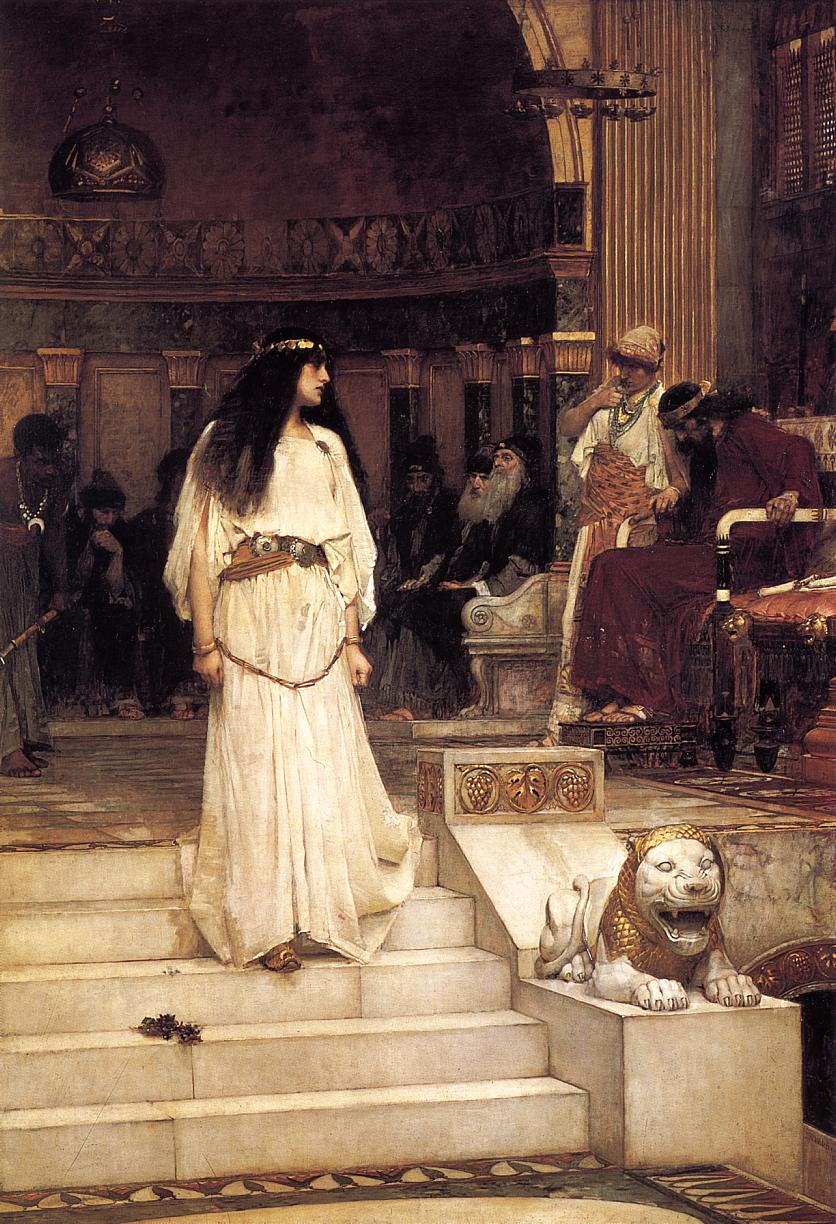
John William Waterhouse’s Mariamne Leaving the Judgement Seat of Herod (1887) captures a single, suspended moment that feels both theatrical and intensely private. A young woman in luminous white steps down from a raised tribunal space, her body angled forward as if compelled by fate, yet her face turned aside in a last, searching glance. Around her, the architecture and the watching figures create a pressure of judgment that is almost physical. The scene is not painted for action’s sake. It is painted for consequence.
Waterhouse was drawn again and again to women at turning points: the instant where an inner decision collides with an outer sentence, where beauty becomes a form of vulnerability, and where the surrounding world seems to close in. In this painting, the drama is built from contrasts: whiteness against shadow, youth against authority, motion against stillness, innocence against the weight of spectacle. Even if you do not know the story, you can feel what the image is saying. Someone has been judged. Someone is leaving. The room remains, heavy with power.
The story behind Mariamne and why it matters here
Mariamne, often known as Mariamne I, was a Hasmonean princess and the wife of Herod the Great. Their marriage, shaped by politics, suspicion, and ambition, became legendary as a tragedy of love entangled with paranoia. In many retellings, Mariamne’s dignity and pride intensify the cruelty of her situation. She is not shown as pleading or begging. She is shown as enduring.
Waterhouse chooses a moment after judgment rather than the judgment itself. That choice is crucial. Courtroom scenes can become about argument, accusation, and spectacle. This scene is about what judgment does to a person. The viewer is made to walk with Mariamne, to witness the shift from a public decision to a private reckoning. The emotional core is not Herod’s authority but Mariamne’s isolation.
This focus aligns with Waterhouse’s broader interests. He often paints literary and historical heroines as figures whose inner lives are legible through posture, gesture, and atmosphere. The narrative is present, but it is filtered through mood. The painting becomes less an illustration of an event and more a portrait of a psychological state.
Composition and staging: the architecture of judgment
The composition is built like a set. The space rises in tiers, with the steps acting as a visual and symbolic threshold between judgment and exile. Mariamne occupies the foreground, placed where the viewer’s eye naturally lands, and the steps create a strong diagonal that guides attention down and outward. This diagonal suggests departure, but it also suggests descent, not only physically but socially and emotionally.
Behind her, the court is arranged in a shadowed semicircle. The figures sit and stand in a dense, dark cluster, their faces partially obscured by dimness and distance. This crowd becomes a single mass of observers, a kind of collective verdict that extends beyond the official sentence. Waterhouse turns the audience into atmosphere: a human darkness that frames the bright figure leaving.
To the right, the elevated seat of authority anchors the scene. Herod appears slumped, not triumphant, with his posture reading as weary, conflicted, or morally dulled by the machinery of power. That ambiguity matters because it prevents the painting from becoming a simple morality play. The ruler is not a cartoon villain. He is a man trapped in the posture of dominance, surrounded by opulence that feels like a cage.
The architectural elements intensify this. Columns rise like bars. Drapery and patterned surfaces offer luxury, but the luxury looks oppressive rather than comforting. The room is magnificent, yet the mood is airless.
Mariamne’s figure: dignity under pressure
Mariamne’s dress is the painting’s most immediate statement. The whiteness reads as purity, but it is not fragile purity. It is sculptural, weighty, almost classical. The fabric falls in long, steady folds, giving her a monumental presence. Waterhouse often uses drapery to communicate character: the way cloth hangs can suggest confidence, fatigue, sensuality, or restraint. Here it suggests solemn dignity.
Her accessories matter too. The belt and jewelry introduce an Eastern, courtly richness that links her to the world of power even as she is cast out by it. They also draw attention to her waist and the line of her body, emphasizing that she is both a political figure and a woman being watched. Waterhouse frequently explores how female beauty is treated as a public object, and this scene is saturated with that tension. She is visibly the subject of attention, yet she does not perform for the gaze. Her expression is guarded, her mouth set, her eyes turned in a direction that implies thought rather than surrender.
The way she holds herself on the steps suggests a controlled forward motion. This is not a collapse. It is a forced departure carried out with composure. In narrative terms, she is moving into danger. In emotional terms, she is moving into loneliness. Waterhouse makes that loneliness visible by isolating her in light.
Light and color: white as a moral and visual spotlight
The painting’s color structure is built on a strong contrast between warm, muted darkness and the cool clarity of Mariamne’s dress. The background is full of deep browns, smoky purples, and subdued golds. These hues evoke dusk, interior candlelight, and the hush of a chamber where power is exercised behind stone walls. The palette feels antique and heavy, like tarnished metal.
Against this, the white dress becomes a spotlight. It catches the light in a way that turns Mariamne into the painting’s conscience. This is not merely a technical device to make the central figure stand out. It is a moral strategy. The brightest object in the room is the person being condemned.
Waterhouse also uses subtle color echoes to keep the harmony intact. Warm golds in her belt and jewelry resonate with gilded details in the architecture. The pale stone of the steps links to highlights on faces and fabrics in the court. These connections prevent the white from feeling pasted on. Instead, it reads as a natural presence, like a flame within a dim room.
The overall atmosphere is restrained. There is no dazzling chromatic extravagance. The emphasis is on tonal drama, on the slow, inevitable pull from light into shadow.
Gesture, gaze, and the psychology of spectatorship
One of the most unsettling aspects of the painting is how it stages looking. Mariamne is looked at. She looks away. The court looks on, but their faces are not individualized in a way that invites empathy. They are witnesses more than characters. Their attention becomes part of the judgment itself.
Herod’s position reinforces this dynamic. He is placed in a posture that suggests both authority and emotional withdrawal. He is physically near, yet psychologically distant. This distance is important because it implies a breakdown of intimacy. If the story includes love, it is a love curdled into suspicion. The ruler’s closeness to Mariamne does not protect her. It traps her.
The attendants around Herod heighten the sense of ritual. Their clothing and stillness imply ceremony. Mariamne’s movement becomes the only human warmth, the only sign of life continuing within a space that has hardened into law.
This psychological reading connects to broader Victorian interests in the moral theater of history. The past becomes a stage where themes like innocence, corruption, and power can be examined at a safe remove. Yet Waterhouse makes it feel immediate. The scene’s silence is modern. It resembles the quiet after an argument when the decision has already been made and nothing can undo it.
Symbols and details: the lion, the steps, and the carved world
The stone lion in the foreground is not a casual ornament. Lions traditionally symbolize power, kingship, guardianship, and domination. Positioned near the steps, the lion becomes an emblem of the state’s force, a reminder that authority is not only spoken from a seat but built into the architecture itself. The lion’s open mouth reads as a permanent roar carved into stone, a silent threat that does not need to move.
The steps are equally symbolic. Steps in art often represent transitions: from innocence to experience, from safety to exposure, from privilege to punishment. Mariamne’s descent is staged so that each step feels like a measure of distance from the world that condemns her. The stone is pale and smooth, which emphasizes how exposed she is. There is nowhere to hide on those bright surfaces.
The patterned floors and richly decorated walls create another layer of meaning. They display a world obsessed with surface, ceremony, and possession. This is a place where beauty is collected. Mariamne, in her luminous dress and jewelry, risks being read as another treasure of the court. By showing her leaving, Waterhouse reverses that logic. The court may own luxury, but it cannot own the soul of the person it judges.
Waterhouse in 1887: Pre-Raphaelite echoes and a personal voice
Although Waterhouse is often associated with the Pre-Raphaelite tradition, he arrives after the movement’s early peak and adapts its values to his own temperament. You can see the echoes: the interest in historical storytelling, the careful attention to costume and decorative detail, and the conviction that beauty can carry moral and emotional weight.
Yet Waterhouse is not simply copying earlier Pre-Raphaelite modes. His handling is softer, his atmosphere more enveloping. He prioritizes mood over crispness. Instead of making every surface equally sharp, he creates depth through tonal gradations and a selective focus that draws you toward Mariamne and then lets the background dissolve into shadowed presence.
This approach makes the painting feel like a bridge between eras. It retains Victorian historical romance, but it also anticipates a more psychological, interior kind of painting. The tragedy is not explained. It is felt.
Technique and texture: how the paint builds emotion
Waterhouse’s technique here supports the narrative without turning it into a literal illustration. The drapery is painted with disciplined control, especially in the way the white fabric holds volume. The folds are convincing, but not overly fussy. They read as a unified form that supports the figure’s gravity.
In the darker background, the brushwork becomes more atmospheric. Details are suggested rather than insisted upon. Faces and garments merge into a mass that feels like a collective presence rather than a set of portraits. This choice is emotionally intelligent. It keeps Mariamne as the painting’s living center, while the court becomes an environment of judgment.
The stonework is also carefully calibrated. The steps and architectural carvings have a tactile clarity that contrasts with the softer background. This clarity makes the setting feel permanent and institutional. People may come and go, but the machinery of judgment remains.
Themes: innocence, power, and the cost of being seen
At its heart, this painting is about the vulnerability of a person who cannot control the narrative imposed on them. Mariamne is the subject of a story told by others: by rulers, by courts, by rumor, by fear. Waterhouse paints her at the moment when that imposed story becomes irreversible.
There is also a theme of beauty under threat. Waterhouse does not treat beauty as decoration. He treats it as a force that attracts attention, desire, and resentment. Mariamne’s radiance makes her more visible, and visibility in a court is dangerous. To be seen is to be judged. To be admired is to become a target.
The painting also raises a quieter question about authority. Herod’s posture does not read as confident satisfaction. It reads as the fatigue of power, the emptiness that follows a decision made under pressure, jealousy, or political calculation. The tragedy is doubled: Mariamne is condemned, but the human capacity for love and trust is condemned too.
Why this painting still resonates
Mariamne Leaving the Judgement Seat of Herod remains compelling because it speaks to experiences that are not confined to ancient courts. It is about what it feels like to be condemned by a room, to walk away carrying a sentence you did not earn, to keep dignity when the world has decided your meaning for you. The drama is quiet, but it is not small. It is the drama of a life redirected in a single moment.
Waterhouse’s genius is to make history intimate. He offers the viewer a place on the steps, close enough to see Mariamne’s expression and to feel the temperature of the air in that chamber. The painting becomes less about an episode from the past and more about the emotional architecture of power. Who gets to speak. Who gets believed. Who gets to leave, and who must remain seated among the shadows.
In the end, Mariamne’s whiteness is not simply purity. It is presence. It is a human being refusing to vanish, even as she exits the space that tried to reduce her to a verdict.