Image source: wikiart.org
Introduction
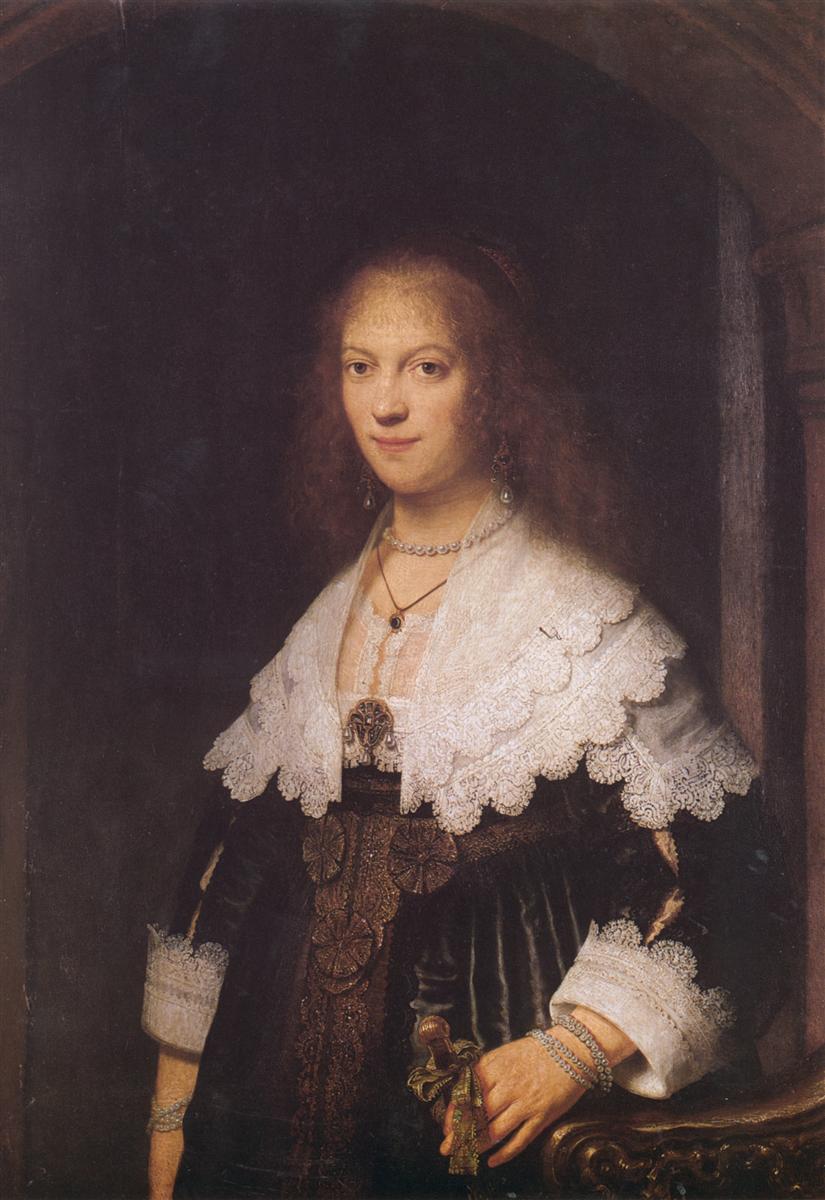
Rembrandt’s “Maria Trip” (1639) is a poised, luminous portrait of a young Amsterdam patrician rendered at nearly life size. She stands in a shallow architectural niche, the curve of a stone arch rising above her head and a balustrade catching her right hand. Within this sober frame, Rembrandt orchestrates a quiet blaze of textures—pearl and jet, gauzy lace and dense velvet, pale flesh and dark satin—so that the sitter’s presence emerges with rare clarity. The portrait is not a parade of wealth for its own sake; it is a study of how light, material, and posture can register social standing while preserving an unmistakable sense of personality. Maria appears self-possessed yet approachable, her expression calm, her gaze steady, her body gathered to the surface with a tact that makes viewers feel as if they have stepped into her antechamber at dusk.
Historical Setting and Patronage
The year 1639 finds Rembrandt fully installed in Amsterdam and working for the city’s mercantile elite. Portraits were an essential language of the Dutch Republic: in a culture that prized civic responsibility and commercial success, likenesses affirmed identity, prosperity, and reputation. Rembrandt was adept at translating those aspirations into images that felt both dignified and human. “Maria Trip” belongs to this moment of confidence. The canvas offers all that a wealthy sitter might desire—sumptuous dress, cultivated poise, a setting that signals status—yet it also conveys intimacy, the sense of a mind quietly present behind the decorum.
Composition and Framing
Rembrandt composes the portrait as a half-length figure cropped just below the waist. Maria is slightly turned to her left, her head facing us, creating a triangle of shoulder line, collar, and gaze. The architectural arch behind her is more than ornament. It frames the head like a halo of stone, pushes darkness close to the figure so that she advances visually, and introduces a gentle curve that softens the rectilinear composition. The balustrade at lower right provides a tactile ledge on which the sitter can rest her hand; it anchors the figure in space and echoes the warm stony tones of the arch.
The figure occupies the left half of the canvas, leaving a large pool of shadow at the upper right. That intentional asymmetry gives the portrait a breath of air and directs our eyes back to the face whenever they wander toward the jewelry or embroidery. The balance of forms is classic Rembrandt: stable, unforced, and quietly theatrical.
The Face and the Psychology of Presence
At the heart of the painting is a carefully observed head. Maria’s expression is composed without stiffness. Her lips rest in a line that hints at a smile; the corners of her mouth are softened by a delicate transition from rose to a paler flesh tone. Her eyes are set widely and lit by small, precise highlights that give them a living humidity. The shadows of the brow and nose are warm rather than cold, more honey than slate, so that the modeling reads as blooded flesh rather than marble.
Rembrandt avoids flattery that empties out character. There is a slight unevenness in the distribution of light across the cheeks, an honest accounting of the face’s topography; there is a living frizz at the edge of the hairline; the ear peeks through with its own cool sheen. These minute observations convert a ceremonial portrait into an encounter.
Hair, Lace, and the Rhetoric of Texture
Few painters match Rembrandt’s ability to make different materials speak in their own voices. Maria’s auburn hair is built from a halo of soft, separate strokes that catch the light in numerous tiny flares; the color flickers from warm chestnut to pale gold as it thins near the crown. The lavish lace collar is a virtuoso passage. Instead of drawing every loop, Rembrandt alternates filigreed lines, opaque touches, and reserves of bare ground to suggest layered transparency. The lace’s scalloped edge repeats rhythmically around the shoulders and arms, creating a white halo that frames the face and breaks the dark mass of the dress into legible units.
The cuffs repeat the collar’s language in a tighter register. With just a few firm strokes for seams and a net of stippled highlights, the painter evokes the crispness of linen and the fragility of lace. The delicacy never becomes fussy because it is placed against broad, quiet fields of velvet and shadow.
Costume, Ornament, and Social Meaning
Maria wears a dark—likely black or deep green—velvet gown with a richly embroidered central panel, cinched by a decorative belt whose rosettes spiral down the front like medallions. Rembrandt allows the garment’s blacks to live on a spectrum: some passages are deep and dry like suede; others bloom with a mirrored sheen where light grazes the pile. This modulation protects the large dark area from deadness and underscores the discipline of Amsterdam fashion, where sobriety of color was a virtue but quality of cloth a sign of means.
Her jewelry—pearl necklace, pendant with a warm stone, earrings that end in pear-shaped drops, and delicate bracelets—adds points of brightness. They do not steal the scene; they participate in a counterpoint with the highlights on the face and lace. The pendant’s stone anchors the vertical of the bodice; a tiny clasp at the collarbone tucks light into the throat; the earring drops echo the oval of the jaw. In a culture where portraiture functioned as social evidence, these carefully chosen objects assert inheritance, taste, and eligibility without gaudiness.
Hands and Gesture
The hands are among the painting’s most eloquent details. The left rests lightly atop the balustrade, fingers closed around the braid or pommel of a small accessory—perhaps a fan handle or decorative tassel—tied with a ribbon. The bracelets catch light at different angles, a chain of discrete notes across the wrist. The right arm, half hidden, shapes the bodice and supports the collar, keeping the composition anchored. Rembrandt understands that the hands must carry the same moral tone as the face. Here they project calm control rather than display.
Light and Chiaroscuro
A cool, directional light falls from the left, catching the forehead, the bridge of the nose, the upper lip, and the planes of the collar, and then sliding across the pearls and lace. The background drinks the light rather than reflecting it, forming a palpable dark that embraces the sitter without swallowing her. This is the language of Rembrandt’s mature chiaroscuro: not theatrical contrast for effect’s sake, but a moral technology that places a living person in relief against the world’s shadow. The zones of greatest brilliance—the collar and the cheek—are kept near one another so that the eye cycles gently between them and does not drift toward the edges.
Color and Tonal Harmony
Though the palette is restrained, it is far from monochrome. Flesh runs from creamy lights to warm ochres and subtle pinks. The lace is not stark white but a mosaic of cool and warm notes that respond to nearby colors. The dress reads as black yet carries deep greens, blues, and browns in its shadows, each chosen to modulate the way light plays on the fabric. The stone architecture contains warm ochre, pale sienna, and a thin gray glaze that cools the shadowed side of the column. These tones weave a harmony in which no color shouts; each contributes to a timbre of dignified richness.
Architecture as Moral Frame
The shallow niche and column are not generic props. They stabilize the composition and lend classical gravitas to a modern subject. The arch repeats the curve of the hairstyle and collar; the column’s vertical answers the figure’s stance; the balustrade’s curve guides the viewer’s eye back toward the hand and then to the face. Beyond design, the architecture carries a subtle symbolism: steadiness, order, and domestic solidity—the qualities expected of a patrician household and, by extension, of a woman poised to manage it.
Brushwork and Surface Intelligence
Rembrandt’s paint handling is a masterclass in measure. The face is built from thin, supple layers that allow light to travel through; small wet touches at the eyelids and lips remain distinct. The lace alternates opaque impasto with scumbled passages that create the illusion of embroidered threads catching on light. The dress, by contrast, is constructed with broader, glossier strokes laid along the warp of the fabric so that the grain of velvet can be sensed. The stone elements are painted with larger, matte passages that absorb light and give weight. This variety of surfaces—gloss, matte, impasto, glaze—makes the portrait breathe as one changes viewing distance.
Gender, Virtue, and the Dutch Ideal
Within the Dutch Republic’s visual culture, female portraits often balance ornament with restraint to communicate virtue. “Maria Trip” follows that logic but enriches it. The jewelry and lace serve as signs of patrimony and stewardship rather than indulged luxury. Her posture is erect but relaxed; her gaze meets ours directly without flirtation; her hands confirm composure. Rembrandt resists both the stiffness of emblematic ideal and the sentimentality of charm. His sitter appears as a woman of means and responsibilities, presented with the respect owed to her role in a household, a network, and a city.
Relationship to Contemporary Portraits
Compared with Rembrandt’s earlier, more flamboyant portraits from the early 1630s, “Maria Trip” shows a tightening of rhetoric. The theatrical gestures are gone; the light is cooler, the setting more architectural, the tone graver. The painting shares kinship with the artist’s companion portraits from the same year, where figures are set within niches and anchored by balustrades or columns. Yet Maria’s image stands out for the control of whites and the unique liveliness of the hair and lace, which together cast a soft aura against the surrounding dark.
The Face as Center of Gravity
Despite the enticements of lace, jewels, and stone, the face remains the portrait’s gravitational center. Rembrandt ensures this by giving it the most nuanced transitions and the most legible drawing. The contour where cheek meets hair dissolves into a haze, allowing the head to seem enveloped by light; the brow ridge and the shadows under the eyes are designed to hold a viewer’s attention. Even the pearl earring, though brilliant, slightly underplays the highlight near the eye so as not to compete. The entire orchestration depends on this hierarchy: texture may delight, but the gaze must persuade.
The Lived Moment
Though formal, the portrait contains subtle currents of time. The hair, slightly unsettled at the edge, suggests recent movement; the ribbon around the fan or tassel falls with a natural curl; the lace shows tiny crinkles where it meets the bodice, as if arranged moments ago. These touches recall that a portrait sitting was an event, not a schematic. They also keep the image from freezing into mere emblem. The viewer senses a woman standing in actual air, with fabrics responsive to gravity and skin responsive to light.
Why the Painting Endures
The lasting appeal of “Maria Trip” lies in the equilibrium it maintains. It is opulent yet restrained, public yet intimate, structured yet alive. Rembrandt treats wealth as a vocabulary for portraying personality, not as an end in itself. The gentle poise of the head, the luminous clarity of the collar, and the rich quiet of the dress create a music of contrasts—light against dark, softness against structure, simplicity against intricacy. In that music a person emerges, recognizable across the centuries.
Conclusion
“Maria Trip” is a benchmark of Rembrandt’s portraiture in the late 1630s. Architecture and costume establish social meaning; light and paint convert that meaning into presence. The lace shivers with illumination, the pearls glow softly, the velvet drinks light and returns it in subdued flashes, and the face—attentive, composed, warmly human—holds the entire composition together. The painting honors status without losing sight of the sitter’s individuality, a balance that defines Rembrandt’s greatest portraits. To stand before this canvas is to witness not only technical mastery but also a profound act of regard: a painter seeing a woman clearly and teaching us how to look with the same care.