Image source: wikiart.org
Introduction
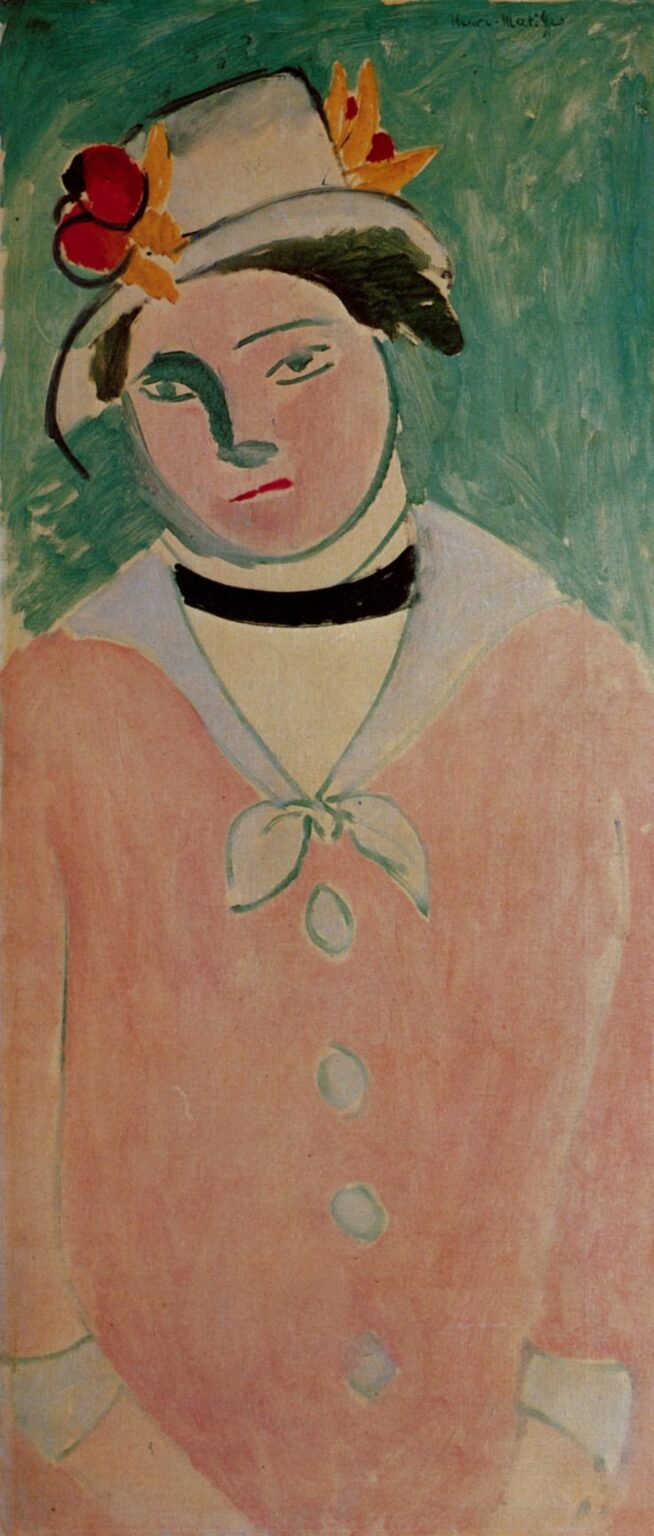
Henri Matisse’s “Marguerite with Hat” (1914) presents a tall, elegant column of color centered on the figure of the artist’s daughter. Everything about the canvas is pared down and declarative. A sea-green background hums behind a pale oval face, a white hat pricked with red blossoms and saffron leaves, and a rose-coral coat that fills the lower two thirds of the frame. A black choker rings the neck like a steady drumbeat amid light tones. Three soft buttons descend the torso, and a neat bow gathers the lapels at the sternum. The portrait is both gentle and unsentimental, more a structured harmony than an anecdote, and it shows how far Matisse could go with a few tuned hues, a handful of lines, and the courage to leave much unspoken.
Historical Context
The year 1914 is a hinge in Matisse’s career and in European life. After the blazing discoveries of Fauvism and the clarifying light of his Moroccan travels, Matisse spent these prewar months reducing his language to essentials. Contour became more decisive, planes grew larger and cleaner, and the ground of the canvas increasingly served as active light rather than blank space. Marguerite had been his model since childhood, and across the years her presence tracks his evolution: descriptive tenderness around 1906, architectural severity in 1913–1914, Mediterranean poise in the 1920s. “Marguerite with Hat” sits in the middle of that sequence, fusing familial familiarity with rigorous experiment. It is not a salon likeness; it is a test of how little is needed to make a person appear and remain.
First Impressions
Seen at a distance, the work reads like a poster: tall format, central figure, strong silhouette, immediate color logic. The face is simplified to a few planes organized by a firm nose shadow and abbreviated eyebrows. The rose-coral of the coat is not laboriously modeled; it is breathed onto the surface in thin, velvety passes. The hat’s crown nearly grazes the upper edge, which makes the sitter feel close, as if she were just across the room. Nothing distracts. The background is a single, variegated field of green, and the only interior detail is the delicate garnish on the brim—two red blossoms and flaring ocher leaves—which supplies a bright treble to the more muted chords below.
Composition and Vertical Format
The narrow upright format is not an accident. It shepherds the eye from hat to bow to buttons, establishing a measured downward rhythm. The head sits slightly above center, and the bow occupies the formal heart of the composition, tying together head and body both literally and structurally. Hands and elaborate furnishings are excluded, allowing the figure to behave like architecture. The spine of the portrait is the central axis that runs through the nose, pendant choker, bow knot, and descending buttons. This axis anchors a series of gentle diagonals—the lean of the brim, the slant of the shoulders, the oblique tilt of the gaze—that keep the design from freezing into symmetry.
Color Architecture
Matisse organizes the painting around three color families: cool sea-green for the surround, warm rose-coral for the garment, and a constellation of high-contrast accents in black, white, and red. The background green is full of nuance—bluish in places, warmer in others—so it never collapses into monotony. The coat’s coral absorbs and reflects that green, bathing the lower field in a peachy light that feels tactile rather than decorative. Black appears sparingly as contour and as the choker, a structural beam that clarifies the oval of the face and the whiteness of the collar. Red blossoms on the hat puncture the cool field with small, saturated notes, while the saffron leaves echo the warmth of the coat without competing for attention. The palette is few in number yet complete in effect, delivering temperature, volume, and mood with uncommon economy.
The Hat and Its Ornaments
Hats in Matisse are rarely mere accessories. Here the pale crown and dark, slightly lifted brim frame the face and provide the painting’s upper cornice. The small bouquet on the brim is compositional punctuation rather than naturalistic detail. Each element has a job: the red blossoms draw the eye to the head before the gaze travels down the nose line; the ocher leaves act as a hinge between warm coat and cool field; the black shadow beneath the brim sets the planes of the forehead and eye. The hat thus becomes a device that clarifies both character and structure, a crisp modern emblem in place of elaborate costume.
Contour and Drawing
The drawing is frank and economical. Matisse uses a compressed vocabulary of lines and value bands to build the face. A dark, calligraphic shadow runs along the bridge of the nose, bifurcating the pale oval and steering attention toward the eyes. Brows are short arcs; the mouth is a brief, assertive stroke; the jawline is a single, steady curve. Around the coat he draws with color rather than line, letting the soft edge of the rose-coral meet the background green in a breathing boundary. Where a hard edge is required—at the choker, along the brim—it appears with authority, securing the whole. The variety of edge quality keeps the portrait alive without adding fussy detail.
Surface and Brushwork
Close viewing reveals a surface that is open and tactile. The green ground is brushed in vertical and diagonal sweeps, leaving small ridges that catch light and create a mild shimmer—a useful foil to the matte calm of the coat. The garment itself is laid thinly enough that the weave of the canvas participates, especially in the lower register where three buttons descend like pale stones. The hat’s crown is painted in calmer, flatter strokes, making it read as a single plane that presses forward. Everywhere the handling is quick but controlled, the evidence of work kept visible as part of the portrait’s character.
Light as Reserve
One of the most modern decisions in the painting is Matisse’s reliance on the bare support as light. Large sections of the face, neck, and collar are simply the ground of the canvas left exposed or kissed with a veiling wash. Rather than building skin through layers of pigment, he lets the surface’s natural brightness stand in for illumination. Where modeling is necessary—at the cheekbone, under the brim, along the jaw—he adds gray-rose or greenish notes not to imitate color but to turn planes. This method gives the figure a clarity that never feels overworked and keeps the whole composition buoyant.
Space and Flatness
There is no deep room to wander into, and there is no measurable perspective. Space is established through overlap and value. The brim overlaps the forehead, the collar overlaps the coat, and the bow lies over the seam where lapels meet. The background functions like a wall and a curtain at once: a single chromatic atmosphere that holds the figure near the surface. Such shallow space belongs to Matisse’s decorative ideal, where the painting is as much an object in the room as it is a view into another space. The effect is both intimate and formal, a balance that suits a portrait of a known sitter rendered in a modern key.
Psychology and Poise
Marguerite’s expression is restrained and slightly enigmatic. The mouth’s small skew, the level gaze, and the set of the chin imply self-possession rather than anecdotal feeling. Because Matisse avoids narrative props and descriptive setting, the psychology emerges from posture, proportion, and color temperature: upright format for steadiness, cool surround for calm, warm garment for inward warmth. The black choker adds a note of self-command and scales the head within the tall format, an elegant sign of modern fashion that also functions as a pictorial horizon.
Relation to Other Portraits of Marguerite
Placed beside “Marguerite in a Leather Hat,” painted the same year, this work appears more airy and lyrical. The earlier canvas relies on an orange counterplane and on gray modeling in the face; the present portrait removes that architectural prop and floats the figure against a single sea-green field. It also speaks to the famous 1905 “Green Stripe” portrait of the artist’s wife: both deploy a dark, structural band down the bridge of the nose to build the face with decisive economy. Across these comparisons a constant emerges: Matisse’s loyalty to clarity over description. The sitter is not obscured by painterly rhetoric; she is revealed by design.
Fashion, Identity, and Modernity
The scarf-collar tied into a bow, the triple buttons, and the brimmed hat align Marguerite with the fashionable, forward-looking women of Paris on the eve of the First World War. But the portrait does not melt into illustration. Fashion here is a structural resource. The bow fixes the eye at the center and articulates the coat’s planes; the buttons set a measured rhythm down the vertical format; the hat frames the head. Matisse turns style into composition and, in doing so, articulates a modern identity built from clean lines and clear shapes rather than individualizing minutiae.
The Ethics of Omission
What Matisse leaves out matters as much as what he includes. There is no elaborate furniture, no dazzling pattern on the coat, no glittering jewelry beyond the choker. Even the hands, common vehicles for expressive detail, are excluded by the crop. These omissions protect the portrait from anecdote and direct attention to the balancing of fields and the tuning of color. The sitter is granted privacy; the painting demonstrates respect through restraint. In a genre historically prone to spectacle, this quiet ethic feels fresh and enduring.
Process and Revisions
Faint pentimenti and soft halos around certain contours reveal an image negotiated rather than dashed off. Along the brim, the edge thickens in places where Matisse adjusted the tilt; around the bow, small green tints leak into the rose, evidence of wet-in-wet recalibration. The face carries thin veils where earlier positions of the cheek or jaw were reconsidered. These traces keep the portrait alive as a record of decisions. Final clarity is earned, not assumed.
How to Look
The painting rewards a slow, vertical reading. Start at the hat’s blossoms, then trace the oval of the brim and see how the dark beneath it makes the forehead glow. Drop to the eyes—two brief almond slits steadied by the nose shadow—then to the choker’s dark bar and the small bow. Let the buttons guide the gaze downward until the coat’s color fades into the bare weave near the lower edge. Step back and register how the sea-green atmosphere settles the figure and how the few sharp blacks keep the composition taut. Return again to the blossoms and notice how their red repeats nowhere else, making the top edge quietly resound.
Legacy and Contemporary Relevance
“Marguerite with Hat” remains persuasive because it solves problems that painters and designers still face: how to honor a person without overwhelming them with description, how to orchestrate large fields so they feel alive, how to use color to do structural work. Its poster clarity anticipates graphic design; its use of reserve prefigures mid-century painting that treats unpainted ground as active element; its respect for the sitter, established through proportion and calm, offers a model for portraiture beyond theatrical psychology. The canvas also reminds viewers that modernism was not only about fracture and speed; it was, in Matisse’s hands, about balance and durable poise.
Conclusion
In “Marguerite with Hat,” Matisse builds a portrait from essentials: a cool sea-green surround, a warm rose-coral garment, a white hat pricked with red and ocher, a few black accents, and the live surface of the canvas allowed to shine as light. The tall format turns the figure into a column of rhythm, the bow and buttons set the cadence, and the brim frames a face rendered with the minimum of means. The result is intimate without intrusion, decorative without frivolity, modern without noise. It is a picture that invites long looking and grants the sitter a calm, enduring presence—a portrait, finally, of clarity itself.