Image source: wikiart.org
First Impressions: A Face Built From Color
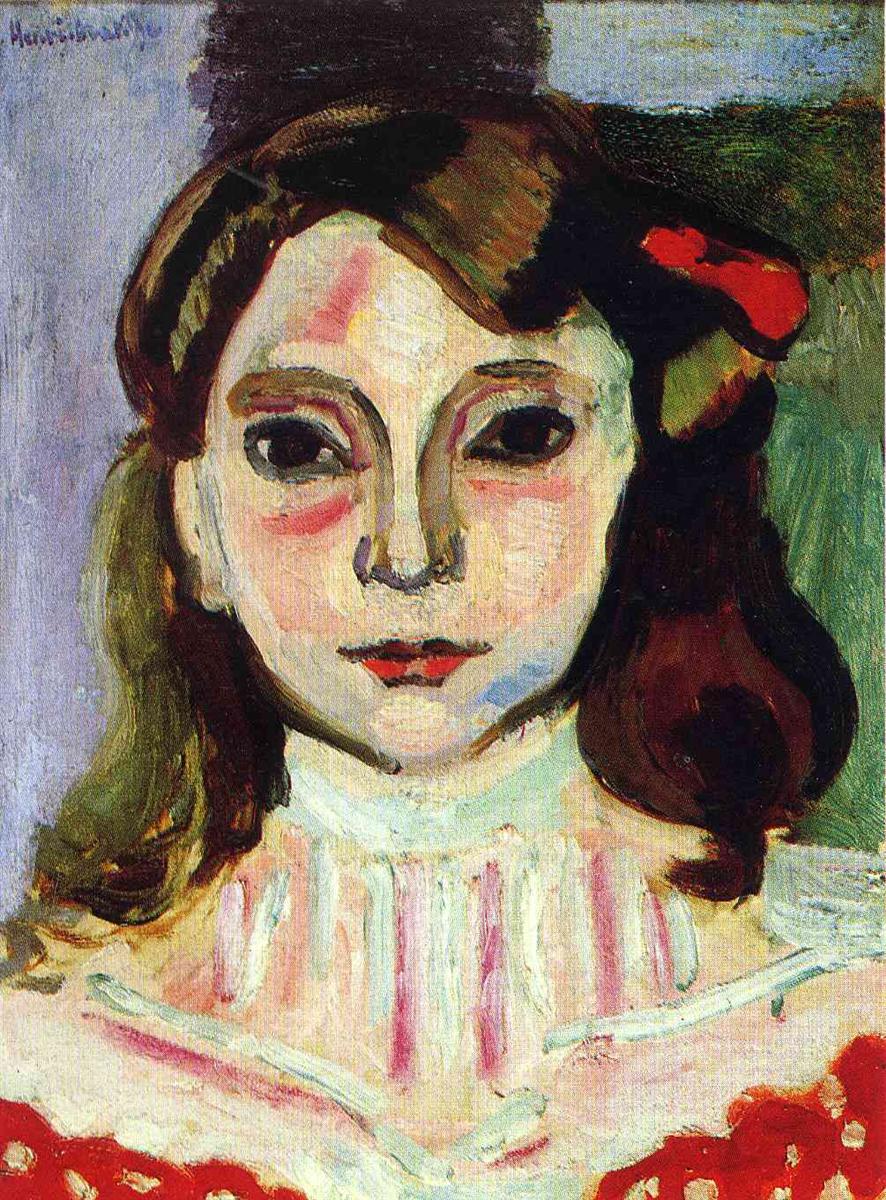
“Marguerite” (1906) greets the viewer with a frontal, unblinking gaze. The head fills the vertical canvas, cropped tightly so that the viewer arrives at the painting without preamble—no props, no narrative, only presence. The face is modeled not by brown shadow but by shifting temperatures: whites that bloom into cool violet, warm peaches set beside mint and blue, and firm, dark seams that act as elastic drawing. Hair falls in heavy, lacquered masses, interrupted by a red bow that flashes like punctuation. The blouse’s collar and bodice are reduced to buoyant passages of white, pink, and coral, making the portrait feel suspended in light rather than pinned to a studio backdrop. From the first glance, the message is clear: this is a portrait that thinks and feels entirely in color.
1906: After the Fauvist Shock, Clarity Over Spectacle
Painted the year after the incendiary Salon d’Automne of 1905, the work belongs to Matisse’s moment of consolidation. The “wild beast” palette had already announced itself in landscapes and interiors; 1906 tests whether that language can sustain the nuanced task of portraiture without collapsing into caricature. In “Marguerite,” Matisse tempers the sheer chromatic volume of 1905 and turns toward lucidity. The palette remains saturated—lipstick reds, oil-slick greens, milky violets—but it is organized with restraint. Instead of dazzling display, we find a calibrated system in which hue, temperature, and interval are sufficient to conjure anatomy, psychology, and light.
The Subject and the Tone of Intimacy
Marguerite, the artist’s daughter, appears neither as ingénue nor symbol but as a person held with affectionate clarity. Her gaze is level, her mouth composed, her expression poised yet unguarded. The intimacy of the portrayal stems from the painting’s economy: there is nothing extraneous. The formality of a frontal pose is softened by small, humanizing cues—the asymmetry of hair, a tint of blue at the jaw, the soft scallop of the collar. The portrait reads less like a “character study” than an encounter, and its authority comes not from detail but from the inevitability of its relationships.
Composition: A Stable Column Inside a Soft Frame
The composition is a vertical column centered within a narrow field, stabilized by the symmetrical placement of eyes and the equidistant curve of shoulders. Yet the picture avoids stiffness through subtle tilts. The line of hair slides diagonally across the forehead; the bow and the darker lock on the right side pull the head slightly off axis; the neckline introduces a gentle saucer shape that keeps the torso buoyant. The background is a soft continuum of lilac and green, mixing horizontal sweeps with small vertical inflections so the figure breathes. The format offers repose, but the interior asymmetries keep the image alive.
Color Architecture: Complements That Do the Drawing
Matisse constructs the head with complements rather than chiaroscuro. The ground leans lilac; the hair mass carries deep greens and burgundies; the pinks of the cheeks and lips are checked by cool notes at temples and along the jaw. Where warm meets cool, an edge appears. The bridge of the nose emerges from a single cool-streaked triangle; the eye sockets are shaped by violets pressed against pale planes; the chin turns with a tiny step from warm cream to icy blue. Because the pigments are kept clean, these temperature shifts remain legible and luminous, and the viewer experiences modeling as a series of color decisions rather than as a smudged gradient.
Flesh Tones: The Poetry of Temperatures
Look closely and the skin is a mosaic of temperatures: cream that leans toward yellow, a faint rose at the cheeks, lavender under the eyes, mint at the jaw, and a tiny pool of blue at the throat where cool air meets warm skin. These passages do not imitate capillaries or veins; they translate optical truth. Flesh in bright, even light contains all colors, and Matisse allows them to appear without apology. The effect is not theatrical makeup but breath. The face seems oxygenated, alive with shifts that behave like circulation.
Eyes, Brows, and the Mask-Like Schema
The eyes are an arresting invention: dark, almond shapes nested in larger, pale sockets, their rims reinforced by calligraphic strokes that supply both drawing and accent. The brows are long, simplified bands that float like brackets. Together they suggest a mask-like schema—broad, simplified planes, strong graphic scaffolding—yet nothing feels rigid. The relationship between the massive, dark eyes and the pale, luminous face gives the portrait its gravitational center. They are not anatomically fussy; they are structural anchors, holding the field as securely as posts hold a tent.
Hair as Design and Counterweight
Matisse treats hair as major architecture. The left mass is olive-brown with light, sap-green glints, swept into a long curve that guides the eye toward the collar. The right mass is darker, approaching burgundy and near-black, and is pierced by the scarlet bow—a complement to the green background that completes a chromatic chord with the lips. The hair’s heavy pattern counters the face’s soft planes, giving the head weight and echoing the firm, dark seams around eyes and nose.
Costume and the White-Red Chord
The blouse’s collar and bodice appear as a decorative rhythm of white and pink strokes. Rather than record lace and fabric fold by fold, Matisse recreates their lightness with swift verticals and crescent sweeps, as if the garment were a soft, luminous instrument under the chin. Near the bottom edge, red fabric returns with white dots, harmonizing with the bow and lips while bracketing the portrait in a warm cadence. These repetitions of red are not incidental; they bind top, center, and bottom into a single line of melody.
Background: Air Made of Paint
The ground’s two-part structure—lilac left, greener right—works like a soft hinge that turns the head in space. Thinly scumbled paint lets the support peek through, which reads as glare in modern light. The cooler, greener region at right pushes the right hair mass forward; the lilac at left soothes the cheek and ear, preventing their pinks from overheating. The background is not “behind” the sitter so much as the air she occupies.
Brushwork and Facture: Tactile Analogy
The portrait is a map of touches. Skin is handled in tender, medium-length strokes that merge into one another; hair receives broader, heavier applications with a sense of directional sweep; the bow is a compact knot of dense pigment; the blouse is a fast, feathery notation whose bare ground becomes part of its brightness. This variance in facture is descriptive: soft surfaces are soft paint; dense materials are dense paint. The painting never hides its making; instead, process becomes a form of character.
Drawing With Color: Lines That Are Also Hues
Where linear emphasis is needed, Matisse draws with color rather than graphite. The nose’s contour is a cool, narrow strip; the eye rims are violet and brown; the mouth is a small, unmistakable rhombus of red edged by cooler notes. These lines are not superimposed after the fact; they are woven into neighboring planes so that drawing and color are the same act. It is this integration that allows the head to retain firmness without ever hardening into outline.
Light Without Theatrics
There is no spotlight, no cast shadow; illumination feels high, even, and calm. Light is a function of placement and adjacency: a warm plane next to a cool plane; a saturated accent beside a pale field. The few true highlights are sober—small lifts above the upper lip, a cool glint at the eye, a faint sheen in the hair. The restraint protects the portrait’s serenity. The viewer feels the presence of day, not the spectacle of lighting design.
Psychology Through Structure
Matisse avoids narrative psychology and arrives, instead, at a resonance anchored in structure. The direct gaze, the measured lips, the steady vertical of the nose, and the symmetrical column of the neck create a calm, self-possessed mood. Meanwhile, the warm-cool exchanges across the face and the small asymmetries of hair and bow introduce liveliness, suggesting thought rather than stillness. The portrait’s feeling grows from its pictorial decisions, not from theatrical expression.
Comparisons: Echoes and Distinctions Within Matisse’s Portraits
Compared with the sensational “Woman with a Hat” (1905), “Marguerite” is quieter and more concentrated; bright hues remain, but they are moderated by milky lilacs and greens. With “The Green Line (Portrait of Madame Matisse)” it shares the principle of a single chromatic seam performing the work of form, though here that seam becomes a series of gentle temperature steps rather than a declarative stripe. “Margot” (1906) presents an outdoor, wind-struck poise; “Marguerite” feels indoor and reflective. Across these works, Matisse refines the same thesis: color relations—clean, intelligible, and rhythmic—can carry likeness and feeling more persuasively than meticulous shading.
Decorative Intelligence: Unity Without Pattern
No textile pattern fills the background, yet the painting is governed by a decorative logic. Repetitions of red—bow, lips, lower edge—tie the vertical together. Alternations of cool and warm across the face form a subtle stripe that aligns with the brow-to-chin axis. The blouse’s vertical strokes rhyme with the hair’s longer sweeps. Nothing becomes literal ornament, but everything participates in a shared rhythm. This is the decorative intelligence that will later support Matisse’s grand orchestrations in “Harmony in Red” and “The Red Studio.”
How to Look So the Picture Opens
Begin with one cheek and track how three adjacent temperatures—warm pink, cool lavender, and creamy white—build a curve. Move to the nose bridge and notice how the form exists as a slim column of cooler paint placed between warmer planes. Rest on one eye and register the four distinct elements: dark almond, pale socket, rose lid, and a feathered brow; then step back and feel how those components fuse into a single, breathing gaze. Drop to the collar and observe how bare ground plus a few white verticals suffice to conjure lace. With each circuit, the portrait shifts from “features” to music.
Material Presence and the Sense of Time
Because paint remains tangible, the portrait holds time. You can sense quick decisions—the stroke that defines a nostril, the lift of white that becomes a collar edge—and slower, weightier ones, such as the masses of hair. The accumulation of these decisions is visible and honest. Far from diminishing the sitter, this transparency dignifies her: the image of Marguerite is also the record of the painter working his way toward her presence.
Why the Painting Still Feels Modern
“Marguerite” remains current because it relocates truth from detail to relation. Edges appear where colors meet. Volume is the consequence of temperature steps. Atmosphere is thin scumble rather than background props. The viewer is trusted to complete forms from cues. This shift—from imitation to orchestration—has informed portraiture ever since, not only in painting but across graphic design and photography, where color blocks and subtle temperature offsets can suggest flesh, mood, and depth with surprising economy.
Place in Matisse’s Arc
The procedures stabilized here—complementary modeling, soft but decisive contour, decorative unity—feed directly into the next decades. The Nice period will adapt this clarity to interiors drenched in sea light; the monumental monochrome rooms will radicalize the idea that a color field can organize a world; the late cut-outs will literalize the union of color and contour. “Marguerite” stands as a pivotal affirmation that the most demanding subject—the human face—can be rendered with tenderness and certainty by color alone.
Conclusion: Presence Held by Relations
In the end, “Marguerite” persuades because nothing is over-explained and nothing is vague. The gaze is steady, the lips sure, the hair weighty, the blouse luminous. Warm notes meet cool notes at exactly the right intervals, and out of those intervals a person appears—poised, intelligent, and present. The portrait proves Matisse’s belief that clarity can be a form of kindness, and that a painting can offer both rest and recognition without sacrificing intensity. More than a century later, the face still meets ours with undiminished life.