Image source: wikiart.org
A Portrait Of Looking
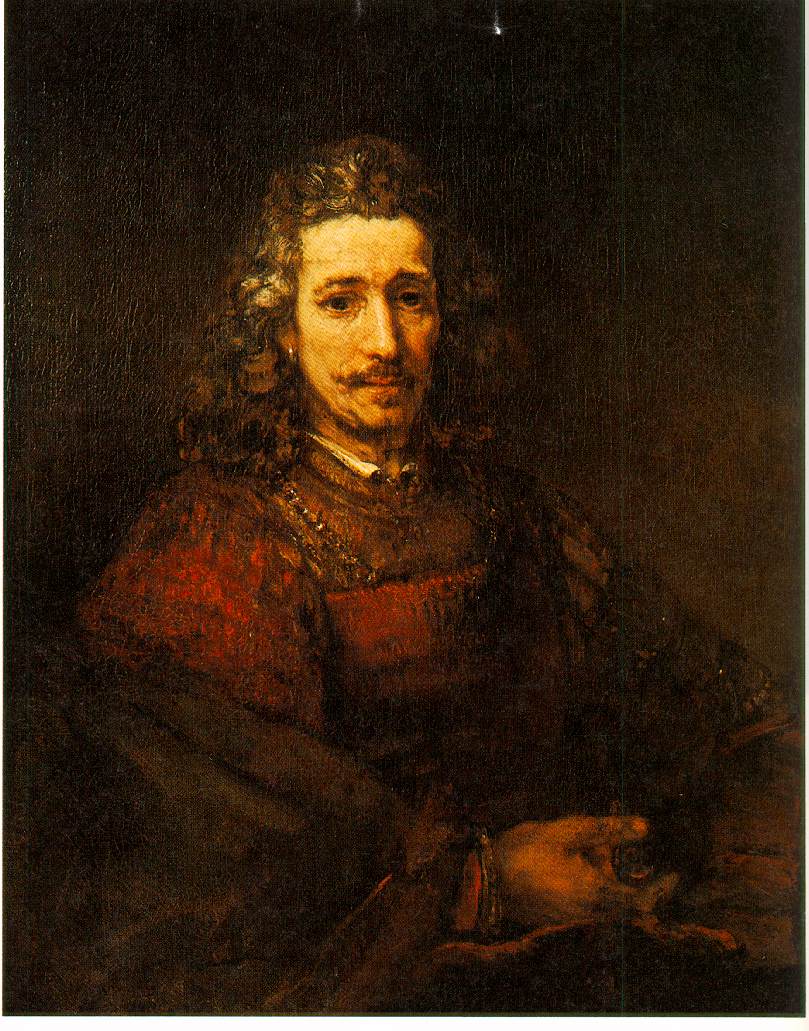
Rembrandt’s “Man with a Magnifying Glass” (1629) is a compact meditation on attention. The sitter turns toward us in three-quarter view, his face delicately illuminated while his torso sinks into a warm darkness. In his right hand he holds a small lens—barely a prop, almost a punctuation mark—whose meaning radiates through the painting. The magnifying glass is not an anecdote; it is a thesis. This is a portrait of a mind that looks closely, made by a young artist who is learning to make the world legible by the same means: patient light, chosen edges, and the courage to leave most things unsaid.
Leiden Origins And The Studio Of Close Seeing
Dating from Rembrandt’s Leiden years, the canvas reflects the culture of a university town where scholarship and trade converged. Collectors favored small pictures with high intellectual density. In that climate Rembrandt developed an idiom that could turn a modest head-and-shoulders composition into a laboratory of perception. The magnifying glass fits that ethos exactly. Leiden cutlers and instrument makers supplied lenses to scholars and craftsmen; curiosity was civic currency. The portrait participates in that milieu by celebrating scrutiny itself.
What The Magnifying Glass Means
The lens does not simply identify a profession; it signifies a posture toward the world. A magnifying glass declares a faith in things being worth a closer look, in truth lying in grain rather than glare. In Rembrandt’s hands, the object also becomes a mirror of painting. A portrait is a device for enlarging a person’s presence without distorting it; the lens is a symbol for that ambition. Its small glint gathers the surrounding darkness and focuses it into a single bright note, as if to say: attention makes light.
Composition That Guides The Eye
Rembrandt places the head in the upper third, well forward of the background, and loads the lower right with the hand and lens. The diagonal from the forehead’s highlight to the knuckles forms a quiet axis of thought-to-touch, a path the viewer follows instinctively. The left shoulder, softened into shadow, balances the weight of the right hand, while the sitter’s cloak and the red-brown garment establish a broad, stabilizing triangle. The background is minimally articulated, so that the figure’s edges breathe against a field of near-silence. Everything funnels back to the face and the small circle of glass.
Light That Behaves Like Inquiry
The light is not theatrical; it is investigative. It arrives at a low angle from the left, rakes the brow and cheek, and slides down to catch the rim of the lens before dissolving into the sitter’s cloak. The right side of the face is not abandoned to darkness but held in a soft penumbra that preserves volume while protecting privacy. This distribution of light is an ethical choice as much as an optical one. It tells us that revelation should be exact but not invasive, that the dignity of a person includes space left for interior life.
Color In A Scholarly Register
The palette rests in deep reds, warm umbers, and subdued blacks, relieved by the ivory of flesh and a handful of golden accents along the garment’s border. The red of the doublet is not courtly scarlet but a worked, rusty hue, suggestive of use rather than show. The effect is monastic without austerity: rich enough for warmth, restrained enough for thought. Against these tones the small, cool glimmer on the glass rim reads crisply, like a syllable of metal in a room of wood and cloth.
Flesh Built With Breathable Paint
Rembrandt’s early facility with flesh is on full display. The cheek’s highlight is not a single flash but a constellation of small, warm touches that allow the underlying color to breathe. Around the mouth the paint thins so that the skin’s translucency emerges rather than being painted on top. At the eyelids he places moist, minute notes that suggest both anatomy and life. Such tact makes the sitter feel present rather than posed. The face is not lacquered; it is inhabited.
The Hand As A Second Face
Hands in Rembrandt are never accessories. Here the holding hand acts as a second portrait, character expressed through grip. The fingers are relaxed yet secure, the thumb laid decisively across the handle, the knuckles catching light in small islands. It is a hand trained by habit rather than display, as comfortable around a tool as around a book. The way the lens is held—neither brandished nor hidden—suggests a temperament that trusts use over rhetoric. The hand becomes biography.
The Subtle Drama Of Edges
Edges determine how the figure belongs to the world around him. Rembrandt lets the hair’s margin feather into air, preventing cutout harshness and creating an atmosphere where light seems to circulate. At the collar and garment seams he sharpens select passages to keep the head’s turn legible. The lower body dissolves deliberately into darkness, a choice that keeps attention on the face and hand while also proposing that identity does not require full disclosure. What is withheld matters as much as what is shown.
The Psychology Of The Gaze
The sitter looks outward with a small, composed smile—more acknowledgment than charm. The eyes do not perform for us; they register our arrival like a person briefly lifted from work. There is a hint of amusement, as if the viewer has been caught inspecting the inspector. This reciprocal gaze completes the painting’s argument: looking well is a shared enterprise. We are invited into the quiet discipline the lens represents, not just to admire it.
Costume As Temperament
The clothing appears sumptuous at first glance, but Rembrandt paints it to emphasize function. The chain or trim across the breast is indicated with rough, bright flecks rather than precious detail; the sleeve’s volume reads as warmth rather than fashion. The sitter’s identity is not anchored in status symbols. He is presented as a citizen of the Republic of Attention, whose regalia consist of tools and habits rather than heraldry.
Background As A Field For Thought
The dark field behind the figure is not emptiness but cognitive space. Its texture—soft, irregular, faintly warmed—keeps the surface alive without introducing distracting architecture. Against this quiet the sitter’s illuminated forehead appears luminous with the same light that grazes the glass rim and hand. The background thus functions like the room of a mind: most of it private, one area readied for exchange.
Leiden Humanism And The Culture Of Proof
“Man with a Magnifying Glass” resonates with the period’s broader fascination with observation. Leiden’s botanists, jurists, and theologians all trusted instruments—lenses, compasses, concordances—to test claims. Rembrandt translates that culture into portraiture. Instead of an allegorical attribute or a mythic guise, the sitter’s defining emblem is a tool for verification. The portrait becomes an ethical statement: truth is sought patiently, in small increments, with devices that extend our senses rather than replace them.
A Young Painter’s Self-Declaration By Proxy
Though not a self-portrait, the painting serves as a veiled manifesto. The lens stands for Rembrandt’s own craft, which magnifies nuance and discovers character inside ordinary light. His brush mimics the instrument’s function, enlarging the significance of a glance, the slope of a cheek, the glint on a ring. Choosing such a subject early in his career is a way of aligning himself with a fraternity of close readers—of texts, of faces, of the world.
Texture, Impasto, And The Feel Of Attention
Rembrandt varies paint handling to pace the viewer’s eye. On the garment he lays heavier, irregular strokes that catch illumination like worn brocade; on the face he knits smoother layers that withdraw from visibility; on the magnifying glass he uses a tiny, precise highlight to punctuate meaning. This alternation between tactile and invisible passages replicates the process of looking carefully: we skim, we slow, we stop at a detail, we resume. The surface teaches us how to see the subject.
The Lens And The Ethics Of Power
Unlike scepters or swords, the magnifying glass announces a power that is quiet and accountable. It can reveal, but it cannot command. Rembrandt’s placement of the lens low in the composition reinforces that humility. The instrument lives near the bottom margin, ready to be put to work rather than lifted in pride. In a century of civic self-fashioning, that choice carries weight: authority grounded in scrutiny rather than spectacle.
Dialogues With Other Early Works
Put beside Rembrandt’s “Two Old Men Disputing” or “The Rich Fool,” this painting shows the young artist circling the theme of how minds handle light. The scholars in debate sort pages; the fool hoards paper wealth; the man with the lens inspects reality. All three scenes use the same toolkit—selective illumination, restrained palette, sculpted hands—to turn thought into visible drama. The continuity suggests a program: to make inward acts legible without betraying their privacy.
How The Painting Choreographs Your Look
The canvas quietly dictates an itinerary. You begin at the sitter’s left eye, ride the brow’s soft ridge to the cheek’s warm crest, drop to the mustache’s shadow, continue to the knuckles, and then spark at the lens’s bright rim before climbing back to the face. Each circuit reinforces the relationship between seeing and holding, perception and instrument. It is a choreography of attention, enacted in oil.
The Human Story Beneath The Symbol
For all its emblematic clarity, the portrait remains humane. The sitter’s slightly parted lips, the faint fatigue under the eyes, the unheroic softness in the jaw—these details keep the picture from hardening into an icon of rationality. He is a person whose tools help him, not a symbol whose tools define him. Rembrandt’s refusal to idealize preserves intimacy and makes the object—the lens—feel like a companion in work rather than a badge.
Enduring Significance
“Man with a Magnifying Glass” endures because it honors a virtue that transcends fashion: careful attention. By giving that virtue a body and a face, Rembrandt turns a small object into a way of life. The painting proposes that clarity is earned; that light is best used when it discriminates gently; that truth, in art as in inquiry, arrives through patience. In 1629 the young painter already speaks with the voice that will mark his career: unhurried, exact, sympathetic.