Image source: wikiart.org
Introduction
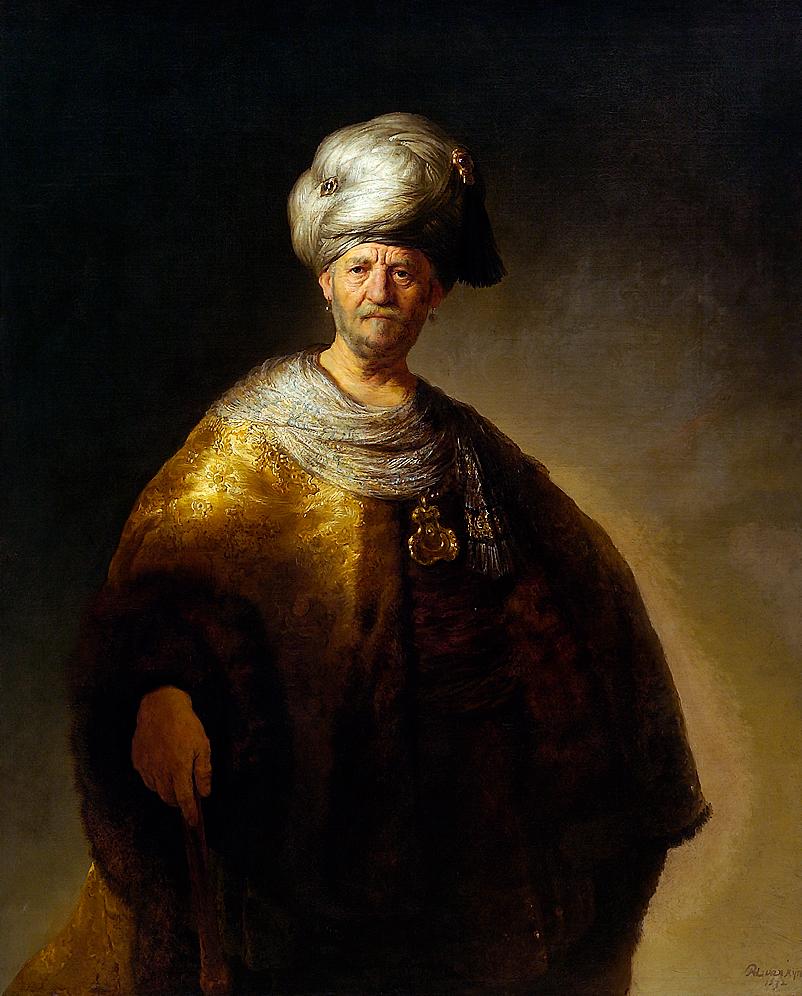
Rembrandt’s “Man in Oriental Costume (The Noble Slav / Man in a Turban)” of 1632 presents a commanding half-length figure who seems to materialize from darkness in a blaze of cloth, metal, and thought. A silver turban crowns the sitter’s head; golden brocade and fur pour over his shoulders; a tasselled pendant glitters at the breast. Yet despite the sumptuous costume, the picture’s magnet is the face: lined, alert, and human, it gathers Rembrandt’s light like a verdict. Painted in the first year of the artist’s Amsterdam career, the work exemplifies how Rembrandt could transform exotic dress into a stage for psychological presence while dazzling viewers with his mastery of texture and light.
Amsterdam, 1632: Fashioning the “Oriental” Tronie
The Dutch Republic traded across the Mediterranean and the Levant, and Amsterdam’s markets overflowed with imported textiles, jewels, and curiosities. Painters responded with tronies—character heads or half-length figures dressed in fanciful or foreign costume—not as literal portraits but as studies in expression, light, and splendor. In 1632 Rembrandt, newly settled in Amsterdam, seized on the genre to court elite patrons. This canvas belongs to that moment: part costume piece, part exercise in virtuoso paint handling, and part meditation on status, time, and identity. Its sitter may be a model or a patron role-playing as an “oriental noble,” but the truth of the likeness lies in the artist’s attention to being rather than biography.
Composition That Builds Authority
The figure occupies the canvas like a carved reliquary. A pyramidal structure rises from the broad base of the mantle to the apex of the turban, centering the face in a zone of concentrated light. The left arm, partly hidden within fur, descends to a hand that rests on a staff or folded fabric; the right flank dissolves into shadow, preserving asymmetry within the overall balance. Rembrandt leaves ample negative space above and around the head, allowing the turban to breathe and the silhouette to read with regal clarity. The alignment is frontal yet subtly turned; the body’s slight twist and the cast of the gaze prevent the picture from freezing into heraldry.
Chiaroscuro as Theater and Thought
Light enters from the upper left and pours across the turban like liquid metal, then slides down the shoulder where brocade drinks and returns it in a thousand small echoes. At the breast, a pendant concentrates the beam into pinpricks. The face receives a gentler illumination, one that registers pores, crease, and the tenderness of skin thinly stretched over bone. The shadows are not abysses but living atmospheres: within them, traces of weave and fur persist, modeled by warm reflections. This chiaroscuro performs two tasks at once. It organizes the costume into readable forms, and it makes the viewer feel intelligence moving behind the sitter’s eyes.
A Palette Orchestrated for Splendor and Sobriety
The color design is a duet between cool silvers and warm golds set against a cello-like ground of browns and near-blacks. The turban’s gray-silver carries cool notes that flirt with blue; the garment radiates honeyed ochres and tawny browns; the fur deepens toward umber and espresso; the flesh tones mediate between warmth and cool with olive half-tones at the jaw and warmer blushes at cheek and ear. Small color accents—the red glint of a gem, a greenish cast within shadows—keep the harmony from settling into monotony. Everything in the palette appears calibrated to serve the central drama: how light travels across different substances and returns as character.
The Turban as Engine of Form
The turban is a sculptural marvel. Thick ribbons of paint build ridges that catch illumination like hammered silver. Fine, parallel striations suggest stretched cloth; abrupt, loaded strokes mark folds that turn decisively. At the front a brooch punctures the silver field with a hard, jeweled glint, its geometry contrasting with the soft elasticity of linen. The wrap’s spiral conveys the logic of a hand at work: you can feel the turns that formed it, the pressure, the last tuck. Because the turban’s mass crowns the pyramid, it fixes the figure’s authority while setting off the face in a halo of cool shine.
Gold Brocade, Fur, and the Rhetoric of Texture
Rembrandt’s textures are composed, not cataloged. The gold robe is a field of micro-relief—broken, raised touches and dragged strokes—that mimic woven pattern and emphasize how brocade throws back light in countless tiny flashes. The fur border changes the tempo: broader, feathery marks gather and separate like windblown grass, catching light in a softer scatter. Between these regimes sits the pendant, a compact solar system of highlights that articulate metal’s reflective hardness. The interplay of soft, medium, and hard reflections keeps the eye moving and prevents surface luxury from becoming mere inventory. Texture becomes rhetoric—an argument for the sitter’s status and gravity.
The Face: Authority Tempered by Time
Despite the theater of costume, the face arrests the viewer with its quiet accuracy. Lines splay from the eyes; the skin at the cheeks loosens; the mouth rests in a firm, undecorated line. A faint greenish undertone at the beard area and cooler notes under the eyes suggest circulation and age. Light bridges the brow and rides down the nose, tempered by a soft shadow that pools at the philtrum and under the lower lip. The expression is not stern but steady, the look of someone who understands both performance and its limits. Rembrandt declines to flatter; he offers dignity that has weathered many winters.
Gesture, Bearing, and the Psychology of Stillness
The sitter’s left hand, emerging from fur, holds a strap or staff with relaxed authority. Its placement close to the picture’s lower edge steadies the composition and implies weight. The right shoulder eases back; the head tilts a fraction forward; the overall effect is of someone who has chosen not to move rather than someone who cannot. This voluntary stillness suggests self-command. It also deepens the picture’s time signature: the body pauses while the mind proceeds.
The Background as Breathable Stage
Instead of inserting architectural props, Rembrandt constructs an atmospheric ground that grades from warm gray to umber. A soft aureole behind the figure’s head and shoulders keeps the silhouette legible. The background tints the entire scene with northern air; it is not empty but inhabited by light. This restraint respects the sitter’s presence and avoids the picturesque clichés that often accompanied “oriental” dress in other hands. The environment is moral as well as visual: it refuses distraction and insists that we meet a person, not a costume.
Edges and the Art of Transitions
Edges tell the truth of Rembrandt’s seeing. Where the turban meets the light, the contour is crisp; where it meets shadow, it dissolves, permitting atmosphere to enter. Along the fur hem, edges bristle and soften in alternation, imitating hair’s uncertain boundary. The jawline against the mantle is firm but warmed by reflected gold, preventing the head from reading as cutout. These transitions stabilize the figure in space and make the image feel breathed, not pasted.
Brushwork, Impasto, and the Memory of Making
Close viewing reveals a surface alive with the memory of touch. Thick impastos on the turban and pendant hold actual light; the robe’s pattern is woven from gently lifted highlights; the fur’s grain is dragged wet-into-wet so strands appear to skitter across each other. The face, by contrast, is built from thin, fused strokes that bury bravura and allow skin to live. This orchestration of touch is not showmanship but empathy: hard for metal, soft for flesh, varied for cloth. The paint itself becomes a biography of materials.
Orientalism, Fantasy, and Dutch Curiosity
The picture participates in seventeenth-century Dutch fascination with the “Orient,” a geography that mixed real trade partners with imagined courts. Rembrandt’s approach is less ethnographic than theatrical. He borrows the turban, the pendant, and embroidered textiles to construct an abstract of nobility rather than a document of cultural identity. The Dutch viewer would have recognized the game—a citizen temporarily transformed by costume into a princely emblem. What distinguishes Rembrandt is that he refuses to let fantasy eclipse humanity. The costume projects otherness; the face insists on likeness.
Comparisons Within Rembrandt’s Oeuvre
This painting converses with Rembrandt’s other tronies from 1631–1633, including figures in gorgets or “oriental” robes and several self-portraits in exotic dress. Compared with works where youthful models play soldiers or scholars, “Man in Oriental Costume” carries a different gravity: the sitter is older, the textiles richer, the light more ceremonial. It also prefigures later masterpieces in which Rembrandt stages historical characters through contemporary models while insisting on psychological truth—kings, apostles, and patriarchs who wear their roles without losing their humanity.
Meaning Without Emblem
Although the pendant and turban suggest rank, the picture resists allegorical certainty. It might allude to wisdom, command, or the timelessness of rule; it might be a meditation on wealth’s materials; it might be simply an exquisite tronie offered to collectors. The most persuasive reading is the simplest: Rembrandt asks how surface magnificence and inner steadiness can occupy the same person. He answers by lighting the costume like a festival and the face like a confidant.
A Guide for Slow Looking
Begin with the turban’s brightest ridge and follow the light as it fades into the shadowed coil; notice how the coolness of the silver shifts as the cloth turns. Drop to the pendant and count—rhythmically, not literally—the glints that define its edges and relief. Travel across the robe’s brocade and feel how broken touches simulate woven gold; then sink into the fur where strokes fray and overlap. Rise to the face and let your gaze move from eye to eye, across the bridge of the nose, and down to the compressed mouth; register the asymmetric subtleties that convert anatomy into presence. Finally, step back and sense how the aureole of background light holds the entire figure like weather.
Craft, Trade, and Material Intelligence
The picture’s fascination with texture is not only painterly; it mirrors Amsterdam’s material culture. Merchants dealt in cloth-of-gold, velvets, furs, and gemstones, and collectors prized paintings that seemed to transform pigment into these commodities. Rembrandt, however, treats luxury as a way to talk about light rather than as an end in itself. Gold here is a machine for reflections; fur is a laboratory of soft edges; silver is a stage for cool highlights. The painting is a physics lesson disguised as opulence.
The Ethics of Dignity
A lesser painter might have allowed costume to overwhelm character or caricature to creep into the aged face. Rembrandt declines both temptations. He hands the sitter all the tools of spectacle and then ensures that the gaze, not the garment, holds the field. Dignity, in this picture, is the ability to wear splendor without becoming its prisoner. That ethic gives the work its lasting resonance across cultures and centuries.
Legacy and Afterlife
“Man in Oriental Costume” has long been admired as one of Rembrandt’s most sumptuous early portraits and as a benchmark of his tronie production. Its marriage of bravura surface and sober psychology influenced followers and imitators who mined the genre for market appeal. Later artists—from eighteenth-century portraitists to twentieth-century photographers—have echoed its formula of exotic dress plus direct gaze to conjure timeless authority. What endures is not fashion but the painting’s fierce concentration: a human face held inside a theater of light.
Conclusion
In “Man in Oriental Costume (The Noble Slav / Man in a Turban),” Rembrandt stages a meeting between spectacle and inwardness. The silver turban, the golden robe, the fur’s darkness, and the hard glitter of a pendant would be enough to satisfy any collector of marvels. But the painter goes further, arranging those marvels so that they kneel before a thinking face. Light here is not merely illumination; it is judgment, selecting and clarifying until costume becomes context and character becomes the work’s true subject. Created in 1632, at the dawn of Rembrandt’s Amsterdam success, this canvas still reads as a masterclass in how to render authority without losing humanity.