Image source: wikiart.org
Introduction
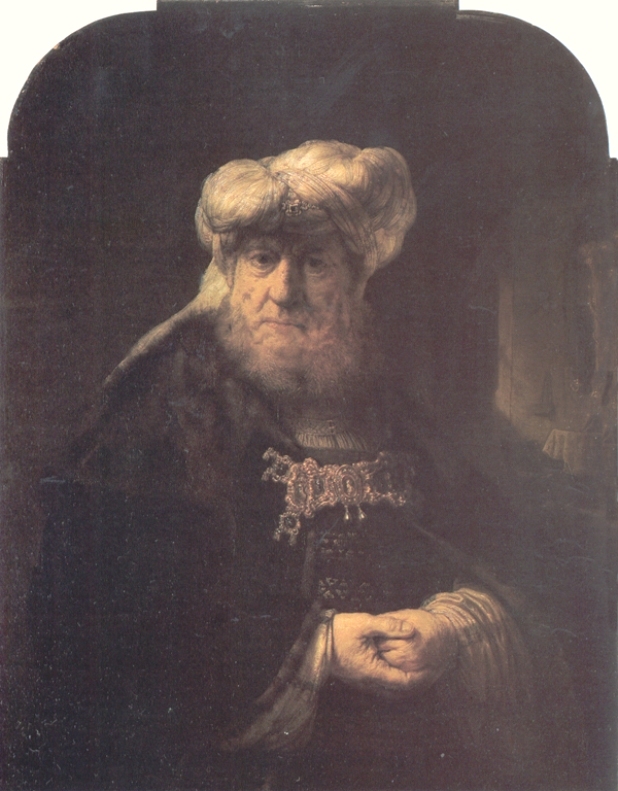
Rembrandt’s “Man in Oriental Costume” (1639) is a richly atmospheric portrait that blends theatrical splendor with psychological depth. The sitter, bathed in a concentrated glow, wears a towering white turban pinned with a jewel and a robe secured by elaborate clasps across the chest. His beard spreads like frost over a winter collar; his hands, partially gloved by layered sleeves, gather in front of him with a slow, reflective poise. Behind him, darkness absorbs the room until, at the far right, a faint pocket of space—table, candlestick, a suggestion of architecture—flickers like a memory. The painting belongs to a group of Rembrandt’s so-called “Oriental” figures, images that use exotic costume as a vehicle for grandeur, historical imagination, and meditations on authority. What could have been mere dress-up becomes, under Rembrandt’s eye, an investigation of age, presence, and dignity.
The Fashioning of an “Oriental” Persona
Seventeenth-century Amsterdam was a global entrepôt where Turkish silks, Persian carpets, and Levantine headdresses circulated through markets and studios. Painters kept closets of garments and props for depicting biblical kings, soldiers, and scholars. Rembrandt made frequent use of such “Eastern” attire—not to mimic an exact culture but to conjure a timeless aura of power and wisdom. The turban, in particular, frames the head with monumental mass, conferring a sculptural authority. In this canvas the headgear is not a mere accessory; it is the crown that turns a specific sitter into an emblematic elder. The costume opens the portrait to layered identities: merchant, Old Testament patriarch, learned ruler, or philosopher. That ambiguity is part of the painting’s charge, inviting viewers to project narratives without fixing the man to a single story.
Composition and Stagecraft
The composition is stark and focused. The oval-topped format encloses the figure like a niche, pushing him forward into our space while preventing the eye from drifting to the edges. Rembrandt places the head just left of center; the torso turns gently toward the light; the hands settle at the lower right, completing a diagonal descent from mind to gesture. The background remains largely unarticulated, a velvet darkness that erases distractions and turns illumination into event. Within that dark, a tiny enclave at far right hints at domestic space—a table, perhaps a candlestick—scarcely drawn yet essential. It establishes that the sitter occupies a world beyond the rectangle while insisting that the portrait’s universe is, above all, the man himself.
Chiaroscuro as Revelation
Rembrandt’s signature chiaroscuro here functions like a slow dawn over the face and garments. Light enters from the upper left, glancing across the turban’s ridges, seeping into the fur collar, and lingering on the cheek and forehead before sliding down to the clasped hands. This movement converts viewing into a ritual: we meet rank (the turban), then presence (the face), then action (the hands). The surrounding dark is not aggressive black but a deep, brown-violet atmosphere layered with glazes; it breathes, allowing edges to soften and flesh to glow. The delicate highlights—on the jewel at the turban, the beaded clasp, and the knuckles—are placed with surgical accuracy, never shouting, always guiding.
The Face and the Psychology of Age
Rembrandt’s elder is not caricatured. The cheeks sag gently; the eyes sit in tenderly shadowed sockets; the mouth rests in a line that is neither grim nor indulgent. What we sense is the mind’s occupancy in the body—the alertness behind softness, the scrutiny behind calm. Tiny strokes build the lattice of wrinkles without hardening them; warm and cool tones intermix to suggest circulation beneath the skin. The eyelids carry that moist glint Rembrandt so often used to signal life. The painter avoids theatrical emotion in favor of stillness: a finely tuned neutrality that lets viewers read intelligence, gravity, and kindness according to their own temperaments.
Hands as Moral Center
The hands, folded together with the right thumb slightly raised, form the composition’s second pole. They are painted with a blend of terseness and care: veins laid in with translucent browns; highlights resting along tendons; cuffs glimmering with layered whites and grays. In Rembrandt, hands are the truth-tellers of character. These do not command or plead; they abide. Their meeting suggests readiness to speak, to bless, to consider—gestures consistent with the aura of a counselor or patriarch. The hands echo the turban’s mass on a smaller scale, balancing the portrait and tying authority to humility.
Costume as Architecture
The robe’s lavish clasped front reads like masonry for the body, a façade of chased metal and embroidered loops that both decorates and supports. Rembrandt revels in the interplay of materials—fur absorbing light in deep, plushy blacks; metal catching it in needlepoints; linen cuff and under-sleeve reflecting it in quiet planes. He differentiates these surfaces not by cataloging detail but by orchestrating the paint’s behavior: dry scumbles for fur, impasted flicks for jewels, thin glazes for cloth. The costume becomes architecture, the stable house of a person whose interior we glimpse through the illuminated face.
Color and Tonal Harmony
The palette is restrained but symphonic: warm umbers and burnt siennas wrap the figure; cool pewter grays modulate the turban’s lights; tiny sparks of desaturated red glint in the clasp and lips; creamy notes in the cuffs and beard punctuate the darker chorus. This harmony prevents the bright passages from feeling isolated. The color world is “autumnal”—not merely brown, but a harvest range that suggests maturity and stored warmth. Against this tonality the face reads as a candle within a lantern: not blinding, but steady and nourishing.
The Background Niche and The Room Beyond
The small window of space at the right—table and perhaps a taper—is a brilliant narrative device. It prevents the portrait from ascending into abstraction by reminding us of ordinary time: rooms, furniture, the daily stage where authority is exercised. This distant interior, lit by a separate, fainter glow, also dramatizes the proximity of our own viewing. We are close enough to count threads, yet the man retains a world where we cannot intrude. That balance between intimacy and privacy is a hallmark of Rembrandt’s portraits.
Identity and the Ethics of Invention
Who is this man? Scholars have proposed that he may be a model dressed in studio costume or a patron seeking the glamour of historical guise. Rembrandt resists the reductive answers. His “Oriental” portraits are less ethnographic than ethical. They ask what clothing does to the perception of a person and how paint can register a soul behind embroidered fiction. Rather than parody the East, Rembrandt uses the East as Europe imagined it—ancient, royal, wise—to explore the aura of authority and the loneliness that accompanies it. The result is respectful, not exploitative: the costume is not a joke but a vehicle for reverence.
Dialogue with History Painting
The head in turban was a staple in Rembrandt’s history pictures—kings, prophets, and captains often appeared in such garb. By extracting the figure from narrative and placing him alone, the painter imports the prestige of history painting into portraiture. We meet a person who could step into a biblical scene, pronounce a judgment, or receive emissaries. That theatrical potential deepens the psychological reading: the sitter has a role to play, but he holds himself in reserve, aware that titles and turbans only partly explain a life.
Brushwork and Surface Intelligence
Under close looking, the surface reveals an orchestra of methods. The turban’s ridges are built with long, supple strokes whose direction confirms the wrapping; the jewel is a compact of small, brisk touches; the beard combines feathered strokes and semi-opaque scumbles; the skin is a mosaic of thin glazes, adjusted millimeter by millimeter to smooth transitions. Rembrandt modulates edges strategically: sharp at the cheekbone, soft at the jawline, feathery at the beard’s perimeter. The robe’s deepest shadows are not flat; they shimmer with buried color, so that even darkness breathes. This material intelligence—paint behaving like cloth, fur, flesh, light—creates an illusion that remains candid about its own making.
Light as Authority, Shadow as Mercy
The portrait’s light carries symbolic weight. It rests on the head and hands—the organs of thought and action—suggesting a benign order: wisdom first, then deed. Shadow shelters the rest—the layered robe, the breadth of the torso—so that power does not overbear. In many Rembrandt portraits, shadow acts as mercy, protecting dignity by not revealing everything. Here, mercy is extended to age as well: the face is legible but not cruelly dissected; the beard’s whorls glow rather than bristle; the skin is warmed by light rather than bleached by it.
The Viewer’s Path Through the Painting
The choreography of looking is deliberate. We enter at the turban’s luminous folds; move to the eyes, which absorb and return our gaze; descend along the bejeweled clasp and robe to the resting hands; and then drift to the miniature room beyond before circling back. That path is not only visual; it is interpretive. It leads us from emblem to person to gesture to world, suggesting how identity is built from symbols, character, actions, and context.
Comparison with Rembrandt’s Other “Oriental” Heads
Placed beside related works—such as “Man in Oriental Costume (The Noble Slav),” “Polish Rider” sketches, or the many turbaned figures in his biblical scenes—this painting stands out for its equilibrium. Others court drama through sharp highlights and sparkling jewels; this one yields to sobriety. Its gravity comes from the slow collaboration of light and flesh rather than from the lure of ornament. It feels closer to Rembrandt’s late portraits, where surface and soul seem to share a breath.
Cultural Imagination and Responsibility
Modern viewers often ask how to read European “Orientalism.” Rembrandt’s use of Eastern costume predates the imperial ideologies of later centuries and grows from biblical theatre, trade networks, and collectors’ fascination with far goods. Still, the painting invites responsible viewing. We can acknowledge that the costume is not documentary while appreciating how respectfully Rembrandt treats the persona it creates. He neither mocks nor exoticizes the sitter; he dignifies him. The “Oriental” becomes a mirror for virtues the artist admired: patience, gravity, thoughtfulness, the beauty of age.
Sound, Texture, and the Sensory World
The portrait has a felt soundscape: the muffled scrape of turban cloth, the soft rasp of beard, the faint clink of a clasp when a breath moves it, the rustle of robe over sleeve as the hands resettle. These imagined sounds arise from the precision of textures. Rembrandt, more than most, knew that sensation persuades; when a viewer senses how a fabric would feel or how a jewel would catch, the fiction of presence deepens. The picture becomes an encounter rather than a display.
The Ethics of Attention
What ultimately distinguishes the painting is the quality of attention it confers. Rembrandt gives an older face the kind of study usually reserved for youthful beauty or imperial masks. He attends to slowness and weight without impatience. In our era, when age can feel socially invisible, the portrait remains radical: it says that a life’s late season deserves the full resources of art—its light, its labor, its respect.
Legacy and Afterlife
Collectors prized Rembrandt’s turbaned heads for their combination of spectacle and inwardness. They influenced generations of artists who sought to charge portraiture with historical resonance—think of Goya’s grandees, Delacroix’s North African figures, or late nineteenth-century “Oriental” studio portraits. Yet few matched Rembrandt’s balance of grandeur and intimacy. The 1639 canvas continues to draw viewers because it addresses universal matters—authority, memory, mortality—through the most concrete means: skin under light, fabric under hand, the curve of a turban that gathers the mind within.
Conclusion
“Man in Oriental Costume” is a drama of quiet authority. Turban and robe provide the theater; light supplies the script; face and hands deliver the performance. Rembrandt transforms studio costume into a vehicle for truth, using restrained color, exhaustive texture, and a reverent chiaroscuro to present a human presence that feels both emblematic and particular. The portrait honors age without sentimentality and power without display. Across centuries, the sitter’s steady gaze meets ours and asks not for recognition of his costume but for respect for the life within it. In that exchange—intimate, simple, enduring—lies the painting’s abiding power.
