Image source: wikiart.org
Introduction
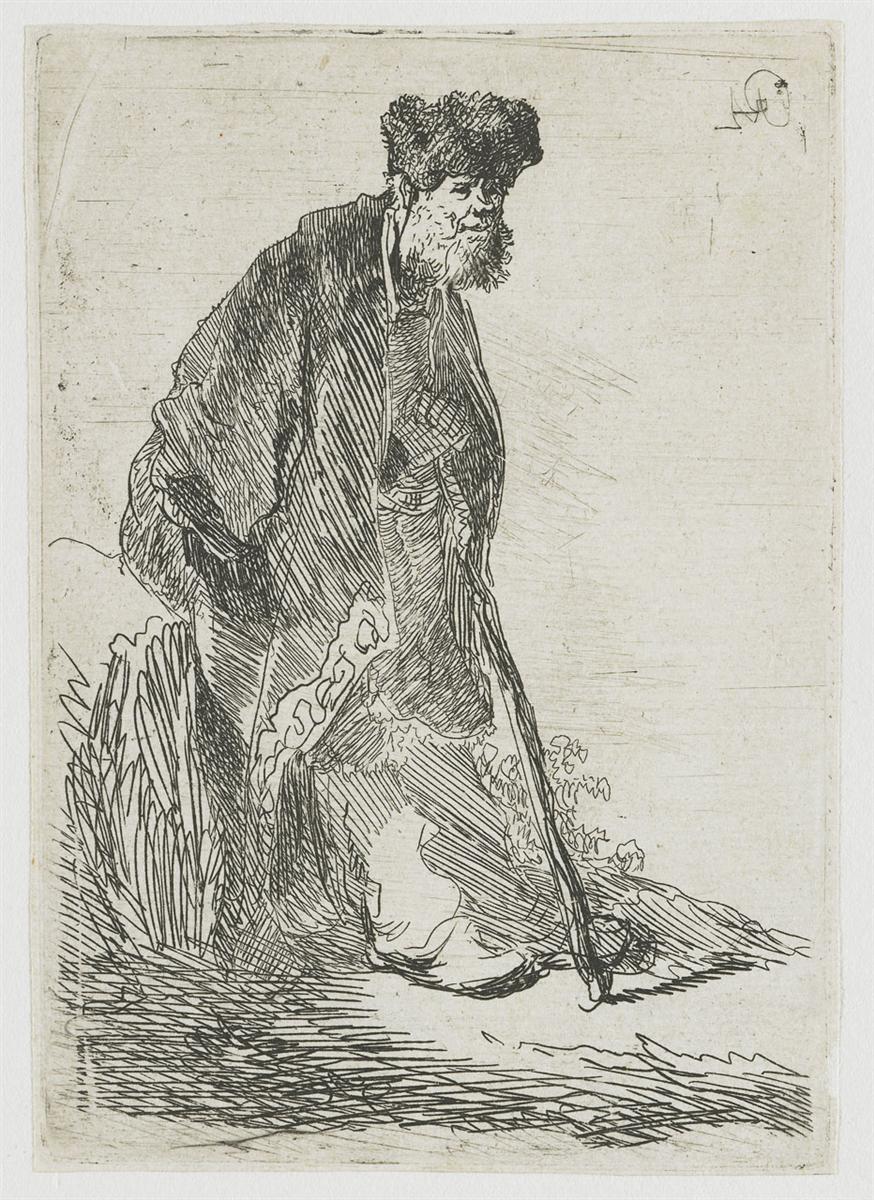
Rembrandt’s “Man in a Coat and Fur Cap Leaning against a Bank” (1630) is a compact etching that captures the instant when rest and motion meet. A bearded figure in a heavy cloak pauses on uneven ground, his weight settling into a long staff while the rim of a fur cap presses low across his brow. A tuft of reeds rises behind him; the blank field in front of him opens like weather. With a handful of lines, the young Rembrandt creates not just a likeness of a passerby but a complete drama of balance, fatigue, and resolve. The image belongs to the crucial Leiden years, when the artist was testing how little he needed to say in order to say everything.
The Leiden Moment and Why This Subject Matters
In 1630 Rembrandt had not yet moved to Amsterdam. He was in his early twenties, turning out small plates of beggars, elders, scholars, and biblical episodes that circulated among collectors who prized virtuoso drawing and scenes of ordinary life. These works—often called tronies, or heads and figures “in character”—were laboratories for style and sympathy. The present etching aligns with the string of studies of the poor he made around 1629–1630: men on crutches, a beggar with a wooden leg, a figure warming hands at a brazier, couples conversing in the street. They are not satires or moral warnings. They are studies of body-knowledge: the ways human beings adapt their posture and tools to the ground under their feet and the weather in the air. The man in a fur cap leans—not as a melodramatic gesture but as an engineer of his own balance.
Etching as the Record of Gesture
Etching preserves the velocity of the hand. A needle draws through wax; acid bites the exposed copper; ink gathers in the lines and transfers to paper. The medium can register everything from a tremor to a decisive stroke. Rembrandt exploits that responsiveness to build a vocabulary of marks that read as materials. The cloak is a cascade of long, slanted hatchings whose direction follows the pull of gravity; the fur cap is a thicket of short, roughened strokes that hold light like a pelt; the beard bristles in quick, wiry touches; the staff descends as a firm, unbroken line with a slight thickening near the base where pressure is greatest. These are not generic textures. They are acts of touch translated into drawing. We feel the weight of cloth and the prick of fur because the needle felt them first.
Composition: The Triangle of Body, Staff, and Ground
The figure occupies the left half of the rectangle, leaning diagonally into the open field. That lean, braced by the staff, creates a triangular geometry: the sloping back of the cloak forms one side; the long staff forms another; the ground sweeps in a dark arc to close the shape. The triangle stabilizes the composition and converts a pause into structure. Behind the man, a wedge of reeds acts as a buttress, preventing the mass of the cloak from toppling into negative space. The right side of the plate remains almost blank, the kind of silence that lets the figure breathe and promises space ahead. The design thus carries narrative: the man has come from density into openness and will move again when breath returns.
Light and Paper White as Weather
Because etching builds darkness and leaves light as untouched paper, Rembrandt’s whites are not empty. They are active agents—the air of the day, the margin of possibility. The blank field to the right is a windless sky into which the staff points; the white snared between the beard’s strokes is a glint of moisture and breath; the slim halo behind the shoulder pushes the silhouette forward. Even the small, lightly sketched monogram in the upper right behaves as a glimmer of brightness, a note that balances the heavy cloak below. Light does not come from a single source. It is the page itself, preserved where attention needs it.
The Psychology of Leaning
The man’s posture is not a generalized slump. The head tips forward slightly as if checking the ground ahead; the shoulder closest to us rises to grip the cloak; the far arm disappears into the folds where his hand may be stowed against cold. At the hip, the garment bulges where a pouch or bundle presses, and the knee bends just enough to indicate a leg resting before the next step. The staff’s tip anchors in a patch of angled hatching, a small plane of earth inscribed with the geometry of foothold. The whole body reads as a calculation: this much weight on wood, this much on muscle, this much surrendered to the slope. It is the kind of arithmetic the body does without words.
Fur, Cloth, and the Ethics of Texture
One of the mark’s marvels is the fur collar or lining that runs along the cloak’s edge. Rembrandt renders it with two alternating rhythms: a soft zigzag that suggests plush depth and a spiky accent that catches light along the border. The effect is luxurious without ostentation. The fur is not a sign of wealth; it is a device for warmth. Beside it, the plain cloak—described with large, drooping hatchings—sags from the shoulder in a way that tells of long use. Together, these textures argue for a quiet humanism: the person is afforded respect through the accuracy of the artist’s attention, not through elevating costume or moralizing caption.
Staff and Tool as Biography
The staff acts as both axis and biography. Its straightness and girth mark it as a chosen tool, not a stage prop. It is drawn with just enough weight to convince but without decorative flourish. Its diagonal leans slightly forward of the figure’s center of mass, implying a cautious advance. In Rembrandt’s beggar suite, such tools—staves, crutches, wooden legs, chafing dishes—carry character the way swords and halberds do in military portraits. They declare how a person meets the world. Here, the staff tells of distances walked and steps budgeted, of a relationship to terrain learned over time.
The Bank and the Suggestion of Landscape
The “bank” against which the man leans is more suggested than drawn. A few bundled strokes rise behind him as reeds or grasses, and the ground curves gently underfoot with a swath of darker hatching. This is enough. The point is not to situate him on a plotted map but to give the body resistance and the staff a place to land. The slight elevation whispers of a canal verge or ditch edge familiar to Dutch eyes. This minimal landscape does its job like good stagecraft: it supports action without demanding notice.
The Face: Specific Without Caricature
Seen in profile, the face combines a craggy nose, a shadowed eye, and a beard that spreads like frost. Rembrandt refuses caricature, keeping features understated but particular. The cheekbone catches a strip of light; the brow is drawn with a single quick curve; the lips are lost in hair. This restraint keeps us from reading the face as a cartoon of poverty and directs our attention back to posture and ground—the real subjects of the print. The figure retains dignity precisely because the artist refuses to harvest cheap drama from wrinkles.
Kinship with Rembrandt’s Beggar Series
This plate speaks to other etchings from the same period: the beggar with a wooden leg, the figure warming hands over a chafing dish, the couple conversing, the solitary man leaning on a stick. Together they map a small atlas of human adaptations. Each isolates one elementary action—walking, resting, warming, balancing—and renders it with a new syntax of marks. The present image focuses on leaning. Its vocabulary of diagonals and long hatchings clarifies how a body borrows strength from a stick and a slope. The series as a whole makes a claim about art: that ordinary acts merit extraordinary attention.
Printing Variants and the Life of Impressions
Etchings live many lives as impressions. The same copperplate can print differently depending on how it is inked and wiped. A plate tone left on the surface might fog the blank field with a gray haze, suggesting damp weather and giving the figure more enveloping atmosphere; a clean wipe leaves the field bright, sharpening silhouette and staff. Heavier inking deepens the cloak and reeds, weighting the figure; lighter inking lets the beard sparkle and the fur glow. Such variations allow the plate to register different days in the same life. The man seems to move through weathers as real people do.
Lessons for Draftsmen
For artists, the etching is a compact manual of craft. To suggest heavy cloth, align long hatchings with gravity and vary their interval. To give fur life, alternate soft zigzags with bright accents and leave tiny reserves of paper white along the edge. To plant a staff, thicken the line where pressure is greatest and seat it in a small plane of dark. To push a figure forward without drawing a background, place a wedge of vertical hatching behind the contour at one flank and leave open paper at the other. Above all, stop early. Let paper serve as light and air rather than filling every void.
Emotion Without Performance
There is no imploring gesture, no melodramatic sag. Emotion arises from the compatibility of parts: the size of the cap relative to the head, the sag of the cloak, the precise angle where staff meets ground, the open field ahead. The image does not tell us what the man feels; it tells us how he stands. That restraint paradoxically opens space for empathy. We can project our own weather onto the blank field and our own fatigue onto the leaning body. The print does not ask for pity; it offers recognition.
Humanism and the Ethics of Looking
In Dutch art of the period, the poor were often treated as comic types or moral lessons. Rembrandt’s etchings resist both. Their ethics lies in attention. He draws his subjects with the same rigor he gives to old soldiers, scholars, or himself. The accuracy of posture, the honesty of texture, the silence of background all work against condescension. To look at the man in the coat and fur cap is to watch someone negotiate the world with intelligence. That recognition—rather than a sermon—is the artist’s humanist statement.
The Sound of Line and the Time of Viewing
A good Rembrandt etching becomes audible with time. Here the reeds behind the figure rustle in upward scratches; the cloak murmurs in long, even strokes; the beard crackles; the staff sounds a steady note. These “sounds” are not fanciful. They describe how the eye moves. Rembrandt controls tempo by changing stroke length and density. We slow over the heavy cloak, quicken along the staff, and pause in the open field. The print is not just an image but a score for looking, guiding our attention through a choreography that mirrors the figure’s measured breath.
Modernity of Restraint
The sheet feels strikingly modern because it trusts essentials. No pen fills in clouds; no detail crowds the right half. Negative space becomes a protagonist. The figure is drawn with lines that never pretend to be anything else; their honesty is part of the beauty. In this way, the etching anticipates later graphic traditions that value economy and the expressive power of the unfilled page. Its modernity lies not in subject matter but in method: a few true marks are better than many false ones.
What the Image Withholds
We do not know the man’s name, occupation, destination, or exact trouble. Rembrandt withholds these on purpose. Their absence encourages a wider reading: the image becomes a portrait of human balance rather than a particular biography. It also avoids turning the figure into a specimen in a social taxonomy. The viewer meets a person caught in an action we all understand. The sheet becomes a mirror for our own pauses, our own moments of leaning into support before continuing on.
Conclusion
“Man in a Coat and Fur Cap Leaning against a Bank” is a masterclass in how minimal means can carry maximal truth. A diagonal staff, a sagging cloak, a bristling cap, a wedge of reeds, and a sweep of blank paper combine to depict a person negotiating the physics of fatigue and the ethics of endurance. The body’s lean is both design and narrative; the staff is both line and life; the bank is both ground and story. In his early twenties, Rembrandt already knew that dignity can be drawn into being by the accuracy of a few strokes and that light—when preserved as paper white—can stand for the hope of space ahead. The figure rests, the world waits, and we, having studied the choreography of his balance, feel a little steadier in our own.