Image source: wikiart.org
Introduction
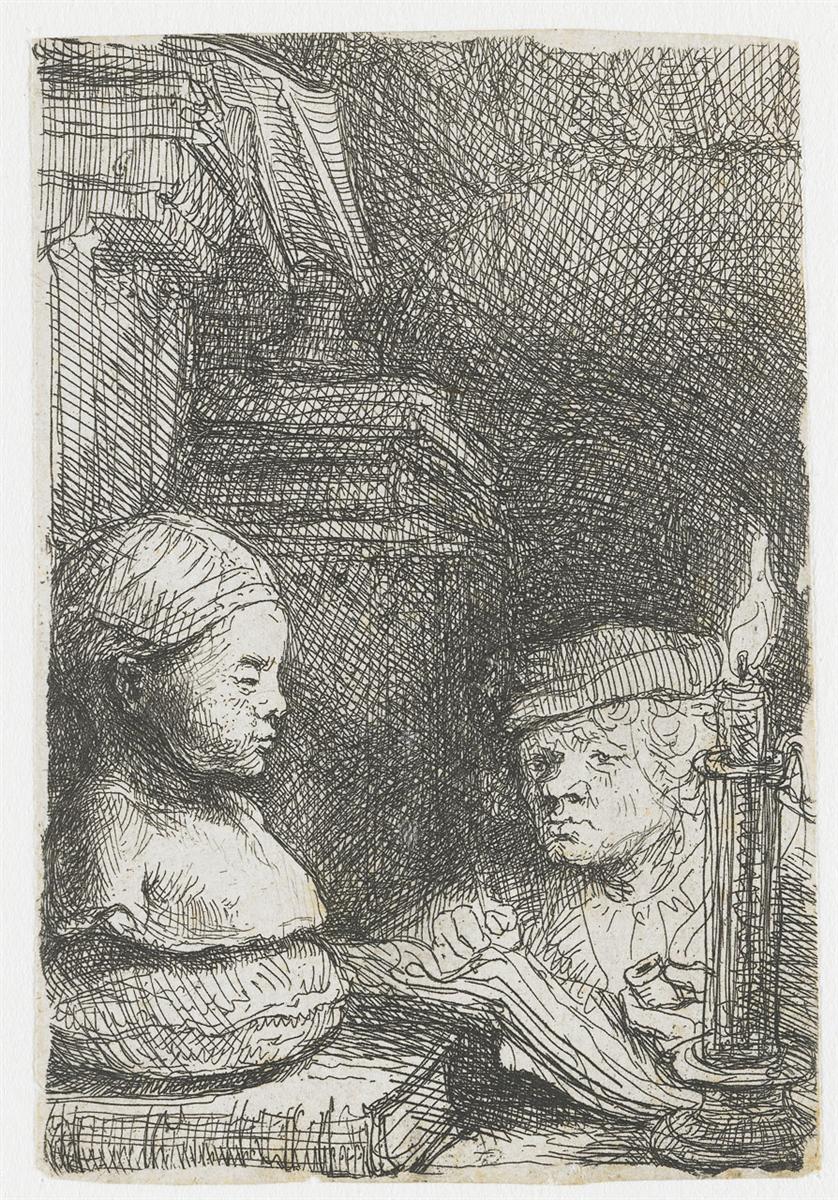
Rembrandt’s “Man Drawing from a Cast” (1641) is a compact etching that condenses the world of the artist’s studio into a few inches of copper. A young draughtsman bends toward a plaster bust set on a block; a tall candlestick lifts a flame beside him; massive architectural fragments loom in shadow behind the cast. The scene is unassuming and profound at once. Instead of heroic subjects or mythic battles, Rembrandt gives us the daily discipline of looking and translating—an artist at the most fundamental exercise of his craft, shifting the three-dimensional into a fluent shorthand of lines. That choice turns the print into a manifesto about learning, perception, and the ethics of attention.
A Studio Lesson in a Small Rectangle
The print stages a classic exercise that later academies would formalize: drawing from plaster casts under controlled light. The cast, with its unyielding surfaces and simplified values, offers a perfect laboratory for training the eye to read form and the hand to articulate it. Rembrandt shows the practice before it became institutional. The setting is intimate, a workbench covered with paper and books, a tall candle with a thumbled ring of wax poised to drip, a student in a cap whose concentration narrows the whole world to the angle of nose and brow. Objects crowd close to the picture plane; space is shallow, deepening just enough to stack pillar, base, and bust. Nothing here is decorative. Every element exists to sharpen sight: the flame for directional light, the column for a vertical against which proportions can be measured, the book or portfolio for reference and for the reassuring weight of work already done.
Compositional Geometry and the Traffic of Attention
Rembrandt organizes the small sheet with extraordinary economy. A strong diagonal runs from the left edge of the bust’s head across the student’s drawing hand to the candlestick at right, a line of energy that unites subject, draughtsman, and light source. A counter-diagonal descends from the upper left corner—where a draped cloth hints at the cast’s original mold or another model—down through the pedestal’s bevels to the lower right corner, where paper gathers in a splayed fan of pages. These interlocking diagonals create a tight triangle that locks the action into a stable, legible core. Around that core the background becomes a woven fabric of cross-hatching, a dark envelope that presses the figures forward and keeps the eye from wandering.
Chiaroscuro as Pedagogy
Light in this print is not stage spectacle but a teaching device. The candle, placed just beyond the draughtsman’s head, throws a crisp beam that makes the cast’s planes and edges read with clarity. The left cheek passes into soft shadow; the nose, brow ridge, and upper lip take highlights; the ear falls away. On the paper before the student, Rembrandt lets a wedge of brightness open so that we can imagine the line being born in illumination. Even the column base catches a narrow rim of light, enough to define its volume without distracting from the main conversation between eye and model. Chiaroscuro here demonstrates what the student learns: form is legible only when light is understood.
The Cast: Ideal Form Made Available
The bust is rendered with a blend of brevity and specificity. We feel the chalky dryness of plaster, the abridged detail of an idealized face, the seam where molds would have met. Casts allowed Dutch artists to study the “antique” without traveling; they imported proportional ideals into a workshop. Rembrandt treats the bust respectfully but not reverently. It is a tool for honing judgment, not an idol. Slightly turned, it seems to “watch” the student, a witty reversal that underscores the reciprocal nature of observation: as we look, we are also measured by what we see. The bust’s silence and steadiness are the perfect foil to the student’s animated line.
The Draughtsman’s Concentration
The student’s head leans forward, the mouth set, eyes narrowed. Rembrandt refuses caricature; this is not a comic apprentice, but a person at work. The cap softens the skull’s contour and catches a soft glow from the candle. The hand that holds the stylus is described with a few decisive strokes, enough to show the knuckle’s angle and the grip’s firmness. In his other hand he appears to hold a small flask of ink or a chalk stump—implements that transform attention into marks. The brow wrinkles not with strain but with precision, like a musician counting rhythm under breath. We are close enough to hear the scratch of nib on paper.
The Candle, the Flame, and the Time of Work
The candlestick is a protagonist. Its shaft rises through rings and collars, the flame tilted as if sensing the draught of breath from the artist. The flame’s white tongue, carved from untouched paper, becomes the brightest shape in the print; everything else is calculated around its authority. It sets the hour—night, or at least a dim interior—when distractions fall away and the eye becomes more acute. The candle also functions metaphorically. It is the visible measure of effort: as wax dwindles, skills accumulate. Paintings and prints that celebrate feasts or battles show outcomes; this little flame shows process, the slow burn intelligence requires.
The Architecture Behind the Cast
Massive, blocky forms loom behind the bust: an entablature with a folded cloth, a squatting capital, a heavy plinth. Rembrandt cross-hatches these elements densely, making them nearly merge with the dark field. Their presence is practical—studio props—and symbolic—history’s weight in a workshop. The student learns not only from a single cast but also from the grammar of classical forms that scaffold Western art. Yet Rembrandt denies them the glamor of full light. He keeps them shadowed so that tradition is context, not master. The eye is not detained; it returns to the living triangle of cast, hand, flame.
The Grammar of the Etched Line
This print is a manual in the expressive possibilities of line. For the background, Rembrandt lays down a tight lattice of crisscrossing strokes, varied in angle and pressure, to achieve an almost woven darkness. For the cast, he loosens the network into curved, responsive hatches that wrap form and pause at edges to suggest crispness. For the student’s face, he employs quick, searching marks, a mixture of hatching and contour that records thought in motion. The papers at lower right are handled with fluttering lines that mimic the lightness of sheets sliding over each other. The result is an orchestra: deep strings in the background, woodwinds in the plaster, a solo violin in the face and hand.
Plate Tone and Breathable Atmosphere
Many impressions reveal delicate plate tone—the thin film of ink that remains on the copper after wiping. In the upper field Rembrandt leaves the tone heavier so that the air feels thick, almost dusty, like a room where chalk has been ground. Near the bust and candle he wipes more cleanly, allowing those forms to emerge as if wreathed by a small clearing of light. This manipulation of tone gives the scene a breathing rhythm: dense-over-thin, obscurity-into-clarity. It also makes the paper itself part of the lighting plan, an active participant rather than a passive support.
A Treatise on Looking
“Man Drawing from a Cast” is not only an image of study; it enacts study. The viewer’s eye is forced to make the same moves the student makes: diagnose the big forms first, translate planes into values, locate edges by contrast rather than outline, and recognize that the liveliness of a line depends on the freshness of attention behind it. The print encourages slow viewing, rewarding anyone who lingers with small revelations—the nick on the plaster edge, the bent corner of a page, the slight melt in the candle. By training the viewer’s perception, Rembrandt gives us a felt experience of practice itself.
The Ethics of Practice and the Myth of Inspiration
Many artworks dramatize sudden inspiration. Rembrandt offers the opposite myth: skill as the residue of patient habits. The student does not look ecstatic; he looks steady. The cast does not bestow genius; it offers a problem. The candle does not blaze with revelation; it keeps time. This ethic is consistent with Rembrandt’s larger oeuvre, where saints and heroes are made human and where interior experience emerges from attentiveness rather than spectacle. The print dignifies the unnoticed work that underwrites visible achievement.
Dialogue with Contemporary Pedagogy
In later academies, cast drawing would become the first stage of formal training, followed by life drawing and composition. Rembrandt, who ran a busy studio filled with apprentices and collaborators, clearly practiced a version of this sequence, but with the freedom and improvisation that characterize his teaching. The sheet reads like a glimpse inside that world: the master showing a student how to seat a model, how to place light, how to test contour against shadow. It is not a classroom diagram; it is a living demonstration. Even the slightly awkward angle of the bust—head tilted a fraction too far forward—feels like the sort of imperfection that studios use to sharpen judgment.
Silence, Sound, and the Intimacy of Scale
The print’s smallness is part of its poetry. It asks the viewer to lean in, to enter the quiet radius of the candle where one can imagine the soft crackle of wick and the faint rasp of the pen. By refusing monumentality Rembrandt creates intimacy; the encounter feels private, even companionable. We sense that this view of the studio is not a public performance but a shared moment of craft, the kind of memory an artist carries like a talisman.
The Bust’s Expression and the Question of Models
Critics have proposed various identities for the cast—antique, Netherlandish, a student-made practice piece. Rembrandt insists on its anonymity. The face is generic, closed-eyed, its mouth set with slight firmness. That generic quality is important. Because the bust lacks individual drama, the drama shifts to the act of drawing itself. The student does not chase personality; he is learning the universal grammar of form. In this way the bust’s blankness becomes generous: it opens space for the hand to practice without the burdens of likeness.
The Role of Books and the Authority of Paper
At lower right, beneath the student’s hand, a stack of papers or a bound portfolio splays open, the top sheet curling into the air. Another book or ledger lies under the bust’s base. Paper here is both tool and symbol. It is the site where observation turns into memory, the medium that registers growth. Rembrandt gives it a tangible presence—edges, thickness, the slight shadow of a gutter—so that we feel the labor that fills it. The sheets are not pristine; they are already lived in. The studio is not a place of blank beginnings but of continued revisions.
Humor and Humanity
Though the print is serious, it is not solemn. There is gentle humor in the way the ranks of objects—cast, student, candle—huddle together as if they were a conspiratorial trio. The column’s massiveness contrasted with the student’s soft cap hints that tradition is weighty but not crushing. Even the candle, with its slightly exaggerated height, looks like a tall, patient tutor. The warmth comes from Rembrandt’s sympathy with learners; he depicts effort without condescension.
A Self-Portrait by Proxy
Many viewers have read the student as a proxy for Rembrandt himself—if not literally, then spiritually. The print belongs to a cluster of images in which he explores the act of making: the artist etching at a window, the painter in his studio, the master instructing pupils. Here the identification is quiet. The intensity of looking, the dignity of tools, the soft authority of light—these are values the artist claimed for his own work. The sheet is thus both a genre scene and a credo.
Contemporary Relevance
For modern audiences, “Man Drawing from a Cast” resonates with anyone who practices slowly acquired skills—programmers debugging at night, musicians running scales, writers revising sentences. The candle’s circle of attention is easily transposed to a screen, a score, a page. The print teaches that the most exalted achievements grow from humble repetitions performed with care. Its lesson is not nostalgic; it is evergreen.
Conclusion
“Man Drawing from a Cast” is one of Rembrandt’s clearest meditations on art as disciplined seeing. Within a small studio corner he organizes a complete philosophy: the model as problem, the hand as interpreter, the candle as measure, and darkness as the field from which form emerges. The cross-hatched atmosphere breathes; the plaster bust keeps still; the student leans forward as the world concentrates into light, edge, and plane. What might have been a utilitarian scene becomes, through Rembrandt’s empathy and craft, a quiet epic of learning. The print honors not the thunderclap of genius but the steady flame of practice—the kind of flame that, once lit, keeps illuminating every drawing that follows.