Image source: wikiart.org
Introducing Francisco de Zurbaran’s “Madonna with Child”
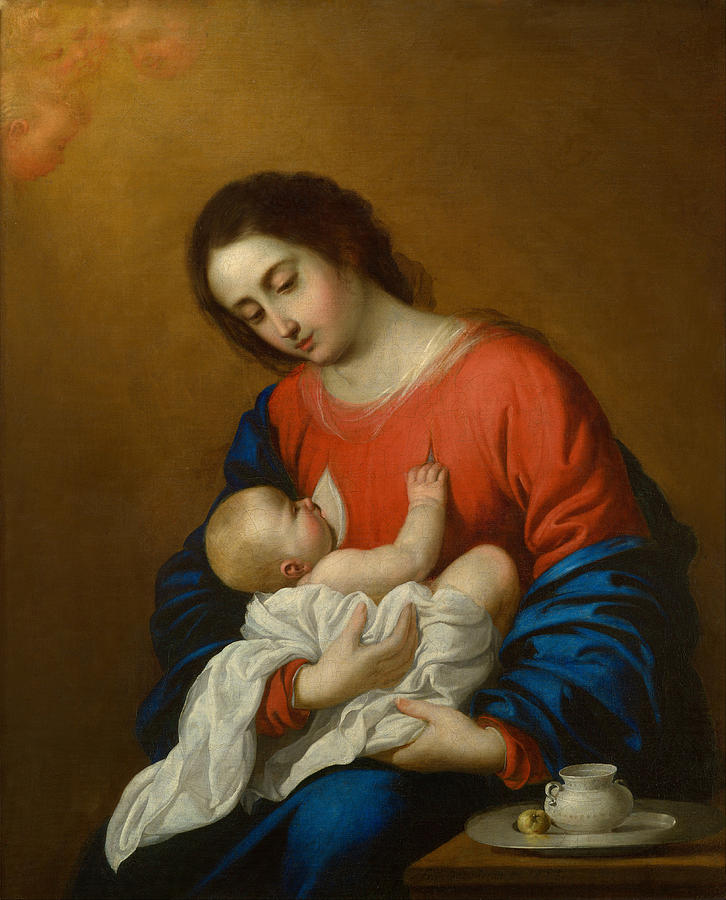
Francisco de Zurbaran’s “Madonna with Child,” painted around 1658, is one of the most tender and intimate Marian images in Spanish Baroque art. Far from a distant Queen of Heaven enthroned among clouds, Zurbaran’s Virgin appears as a young mother seated in a quiet interior, gently nursing her baby. The Christ Child sleeps or rests trustingly in her arms, wrapped in soft white cloths, while Mary bends her head toward him with a look of deep affection and contemplation.
The composition is simple and concentrated. A warm, golden brown background eliminates distractions and allows the figures to stand out with sculptural clarity. Mary wears the familiar colors of red and blue, the red tunic signifying love and suffering, the blue mantle suggesting her heavenly vocation. A modest still life of a cup, saucer and fruit rests on a small table at the lower right. High in the upper left corner, faint cherub heads emerge from a veil of light, barely visible yet unmistakably present.
With just these few elements, Zurbaran creates a powerful meditation on motherhood, incarnation and the everyday humanity of Christ. The painting invites the viewer to draw close, not as to a distant liturgical icon, but as to a quiet scene of domestic tenderness transformed by divine meaning.
The Human Tenderness of the Virgin and Child
One of the first things that strikes the viewer is the physical closeness between mother and child. Mary cradles the infant Jesus in her lap, supporting his weight with both arms. The Child leans against her body, one hand resting against her breast, his tiny fingers pressing the fabric where it opens. This small gesture, natural and unselfconscious, makes clear that he nurses from her, sharing the most basic bond between mother and baby.
Mary’s head is gently inclined, her cheek almost touching the baby’s forehead. Her expression is calm and slightly melancholic. She does not gaze directly at her son, nor at the viewer, but seems lost in silent contemplation. This mixture of affection and thoughtful distance hints that she is pondering the mystery of who this child truly is and what his future will be.
Zurbaran’s handling of anatomy emphasizes the physical reality of the scene. The baby’s plump limbs, smooth skin and relaxed posture convey the vulnerability of an infant totally dependent on maternal care. At the same time, the careful modeling of Mary’s hands, the softness of her face and the shadows under her eyes suggest the quiet fatigue and responsibility that accompany motherhood. The painting communicates that the Virgin’s holiness does not erase the effort and tenderness required to care for a child.
Composition and the Quiet Geometry of Devotion
The composition of “Madonna with Child” is stable and harmonious. Mary’s figure forms a gentle triangular shape, with the apex at her bowed head and the base at the wide hem of her blue mantle. The Child, nestled diagonally across her lap, creates a secondary triangle that echoes and softens the main one. This repetition of triangular forms gives the painting balance and calm.
The figures are slightly off center, shifted toward the right, which leaves space on the left for the golden glow in which the cherub heads appear. This area of light acts as a subtle visual counterweight to the still life on the lower right. The viewer’s eye moves in a gentle circle: from Mary’s face, down along the child’s body, across the white cloth, to the objects on the table, then back up through the blue mantle and into the upper left where the angels hover.
There is very little depth in the background. The warm brown field behind the figures recedes only slightly, suggesting a wall rather than an expansive landscape. This lack of spatial complexity pushes the Virgin and Child toward the front of the picture plane, making the encounter with them feel immediate and personal. The viewer is almost seated at the same level, perhaps across a small table in a domestic room.
Color Harmony and Symbolic Meanings
Zurbaran’s color choices are both traditional and expressive. Mary’s red tunic and blue mantle follow long established conventions in Christian art. Red evokes charity, sacrifice and the burning love of God. Blue conveys serenity, faithfulness and heavenly wisdom. In this painting, the red is warm and saturated, drawing attention to Mary’s upper body and the area where the Child rests. The blue, deep and velvety, wraps around her like a protective cloak, echoing the shelter she provides for Christ and for believers who seek her intercession.
The Child’s white cloths stand out against these stronger hues. White symbolizes purity, innocence and the divine light that the Child brings into the world. The folds of the cloth are painted with delicate modulations of tone, suggesting both softness and volume. The white also creates a visual bridge between the baby and the small still life on the table, where a white cup sits on a saucer beside pieces of fruit.
The background’s golden brown tone bathes the scene in a gentle warmth. It harmonizes with the red and blue without competing for attention. This color suggests a quiet, candlelit interior, perhaps analogous to many Spanish homes of Zurbaran’s time, and it adds a sense of timeless intimacy to the portrayal.
Light, Softness and the Late Baroque Mood
Unlike some of Zurbaran’s earlier works that feature stark tenebrism and dramatic contrasts, “Madonna with Child” uses a gentler, more diffused light. Illumination seems to come from a high, soft source that bathes Mary’s face and the Child’s body in a delicate glow. Shadows are present but not harsh. They help model the forms without plunging them into deep darkness.
This soft lighting aligns with the painting’s emotional tone. It suggests an atmosphere of quiet evening, perhaps when daily tasks are finished and mother and child can rest together. The luminous quality of Mary’s skin and the baby’s flesh gives the figures a tangible presence, yet the overall softness prevents the scene from feeling overly material. The effect is both natural and subtly idealized.
The small cluster of cherub heads in the upper left appears in a lighter, almost vaporous glow that hints at a supernatural dimension. Their forms are less sharply defined than the main figures. They seem to hover at the threshold between visibility and invisibility, reminding viewers that this intimate domestic moment has cosmic significance. Heaven itself watches and reveres this quiet act of nursing.
The Still Life: Cup, Saucer and Fruit
One of the most intriguing details in the painting is the small still life on the table at the lower right. A white cup with a lid sits on a matching saucer, next to a modest piece of fruit, perhaps a pear or fig. This still life is typical of Zurbaran, who often included carefully painted objects in his religious works.
On a practical level, the cup might suggest nourishment such as milk or broth, reinforcing the theme of feeding and care. The fruit could allude to the natural world and the everyday meals that sustain human life. On a symbolic level, the cup and fruit may evoke Eucharistic associations. The cup can be read as a vessel prefiguring the chalice of the Mass, while the fruit might hint at the new fruit of redemption that Christ will bring.
By placing these simple objects in the painting, Zurbaran links the domestic sphere of mother and child with the liturgical life of the Church. The same Christ who nurses at Mary’s breast will one day offer his body and blood as spiritual food. The still life quietly anticipates this transformation of ordinary sustenance into sacramental grace.
Theological Meaning of the Nursing Madonna
Images of the Virgin nursing the Christ Child, often called “Maria lactans,” have a long history in Christian art. They emphasize the reality of the Incarnation: the Son of God truly became human, sharing the vulnerability of infancy and depending on his mother’s body for nourishment. Such images also underline Mary’s role as nurturing mother of believers, who spiritually receive from her the grace that her Son brings.
In Zurbaran’s “Madonna with Child,” these themes are presented in a particularly accessible way. The Christ Child is not posed as a distant symbol of divine majesty, but as a small, sleepy baby entirely at home in his mother’s arms. Mary’s act of nursing, while discreetly indicated rather than explicitly shown, affirms that God chose to enter history through the ordinary processes of birth and care.
For seventeenth century Spanish viewers, this image would have encouraged trust in the maternal tenderness of Mary and in the closeness of Christ to human experience. It also would have been a powerful reminder that spiritual life, like physical life, requires continual nourishment. Just as the infant depends on his mother’s milk, so believers depend on the grace that flows from Christ through the sacraments and through the Church.
Zurbaran’s Mature Style and Emotional Restraint
Painted late in Zurbaran’s career, “Madonna with Child” reveals a softer and more lyrical side of the artist. Earlier he was known for austere images of monks and martyrs, strong contrasts of light and shadow, and bold, sculptural forms. In this canvas, he retains his mastery of form and drapery but tempers it with a newfound delicacy.
The folds of Mary’s mantle are still solid and weighty, yet they flow more gently than in some of his earlier works. Her face is rounded and youthful, with subtle modeling rather than sharp sculptural lines. The baby’s body is tenderly described, with close observation of how an infant truly lies and relaxes in a mother’s arms.
Despite this increased softness, Zurbaran avoids sentimental excess. The figures are not excessively sweet or idealized. Mary’s eyes have a trace of weariness, and the scene remains calm rather than theatrically emotional. This restraint makes the painting feel more authentic and contemplative. It invites quiet prayer and reflection rather than dramatic outward reactions.
Intimacy, Silence and the Viewer’s Participation
One of the reasons this painting remains so moving is its sense of silence. No one speaks. There is no narrative action, no dramatic gesture. The only movement is the gentle rise and fall of the baby’s breathing and perhaps the soft rustle of cloth.
This silence creates space for the viewer. Standing before the painting, one almost feels as if intruding upon a very private moment, yet Mary’s calm expression makes that presence welcome rather than intrusive. The viewer is invited to share in the stillness, to contemplate the mystery of divine love becoming small and vulnerable.
The modest scale of the figures relative to the canvas, and the focus on their upper bodies rather than a grand setting, intensify this intimacy. The painting is well suited for a chapel or private oratory where an individual could pray in front of it. In such a setting, the viewer might imagine placing personal hopes and fears into the open hands of Mary as she cradles the Child.
Legacy and Contemporary Resonance
Today, Zurbaran’s “Madonna with Child” continues to speak to modern audiences. In a world that often separates spirituality from daily life, this painting insists that holiness is found in simple acts of care and love. The tenderness of a mother feeding her baby is revealed as a place where divine mystery unfolds.
The image also offers a counterpoint to depictions of power and success. Here there is no display of strength, wealth or status. The core of the scene is vulnerability: a baby who cannot survive without his mother and a mother whose body is given over in service to her child. For Christian viewers, this vulnerability mirrors the self giving love at the heart of the Gospel. For viewers of any belief, it can evoke a deep appreciation for the quiet heroism present in ordinary family life.
For those drawn to Marian devotion, the painting presents Mary as gentle companion, not distant queen. Her gaze, slightly downward, suggests that she listens to those who approach her with their own concerns. The small still life on the table hints that nothing is too small to be included in the realm of grace. Even cups and pieces of fruit can participate in a sacred story.
Conclusion
Francisco de Zurbaran’s “Madonna with Child” is a masterpiece of quiet intimacy and theological depth. Through a simple composition, harmonious color, gentle light and carefully observed human gestures, he presents the Virgin Mary and the Christ Child in a way that feels at once domestic and transcendent.
The nursing infant, the thoughtful mother, the subtle cherubs and the humble still life together create a visual meditation on the Incarnation, on maternal love and on the nourishment of body and soul. The painting exemplifies Zurbaran’s mature style, where technical mastery serves a serene and contemplative spirituality.
More than three centuries after its creation, this canvas continues to invite viewers to pause, to breathe and to ponder the mystery of divine love revealed in the most ordinary yet profound of human relationships, that of mother and child.