Image source: wikiart.org
Introduction to Madonna with a Napkin
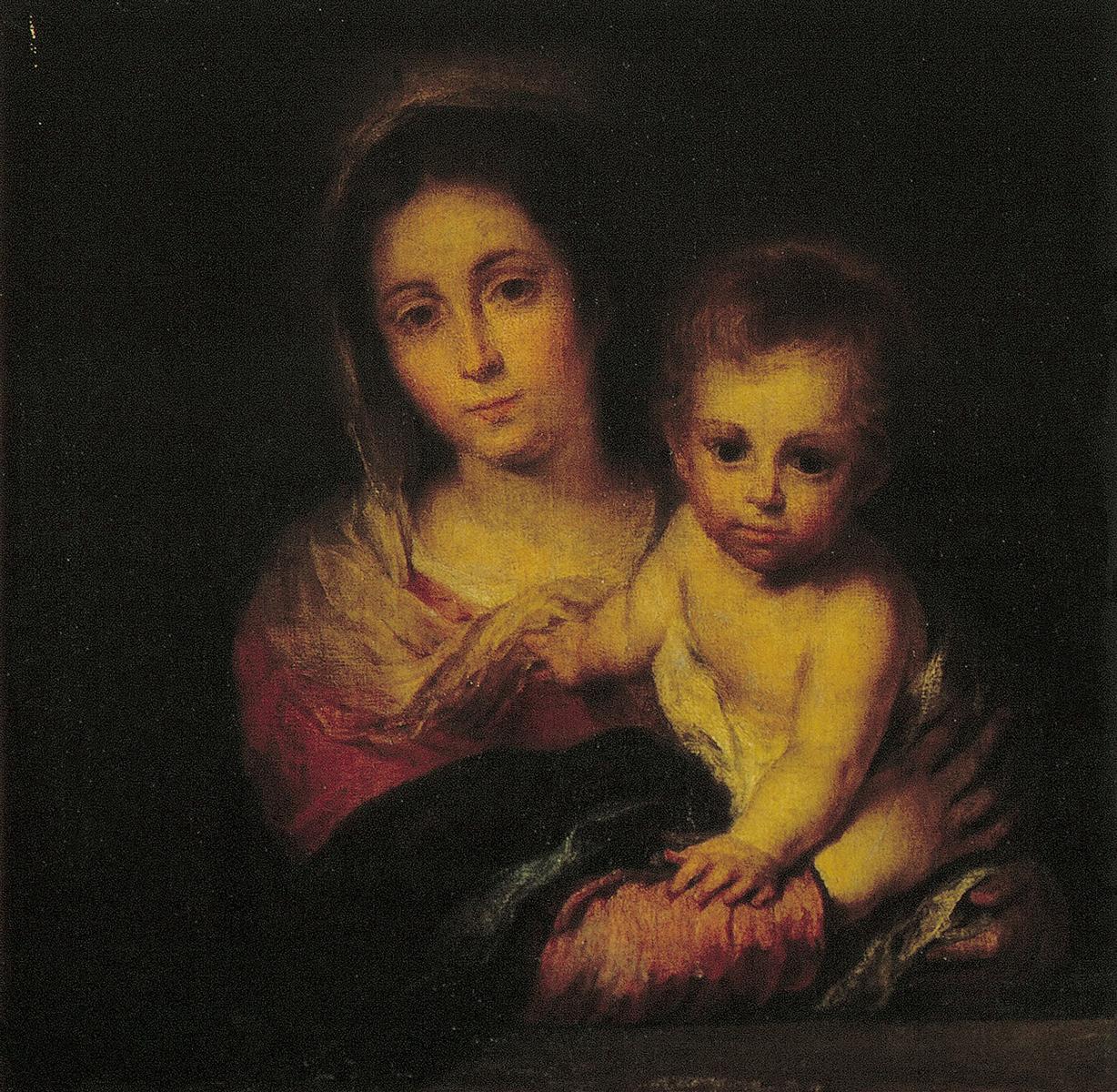
“Madonna with a Napkin,” painted by Bartolomé Esteban Murillo around 1666, is a small, intimate image that distills his vision of the Virgin and Child into a quiet, almost whispered scene. Instead of a grand throne, elaborate architecture, or a crowded heavenly court, Murillo presents Mary and Jesus half length, emerging from a deep, velvety darkness. Their faces, softly lit and tenderly modeled, lean gently toward the viewer as if they have stepped out of contemplation to meet our gaze.
The work takes its name from a legend that a Capuchin lay brother, unable to afford a proper canvas, asked Murillo for a devotional image on a simple napkin. While the fabric itself is no longer present, the story captures the spirit of the picture. This Madonna seems made for private prayer rather than public display. It is a painting that suggests the closeness of Mary and Jesus to the humblest believer, and it shows Murillo at his most concentrated and poetic.
Historical and Devotional Context
Murillo painted for churches, confraternities, and religious orders in Seville at the height of the Spanish Baroque. The Capuchins, known for their poverty and simplicity, valued images that could nurture heartfelt devotion rather than impress with luxury. “Madonna with a Napkin” belongs to this world of quiet chapels and personal prayer.
By the mid seventeenth century, Marian devotion in Spain was intense and widespread. Paintings of the Virgin were not merely decorative. They were understood as aids to contemplation, windows through which the faithful might encounter the loving presence of the Mother of God. Murillo responded to this demand with a series of Madonnas that combined theological depth with a warm, human charm.
This work stands out because of its intimacy. There is no narrative context such as the Nativity or the Adoration of the Magi. Instead, it is a purely devotional image that focuses on the relationship between Mary and her son. Murillo’s ability to make that relationship feel both holy and recognizably human accounts for the lasting appeal of the painting.
Composition and First Impression
At first glance, the eye is drawn to two softly illuminated faces set against a dark background. Mary is on the left, slightly higher, her head tipped gently toward the Child. Jesus sits in her arms on the right, his body turned toward us, one little hand resting on the ledge at the bottom of the composition as if touching the viewer’s world.
The composition is triangular, with Mary’s head at the top and the Child’s body forming the lower two points. This triangular structure gives the small painting stability and quiet balance. Murillo crops the figures closely so that almost no space surrounds them. The dark field behind them functions like a curtain of shadow, isolating them from any specific time or place. They seem to hover between heaven and earth, yet very near to the observer.
The napkin itself appears subtly as the light cloth around Mary’s shoulders and beneath the Child. It is not a grand brocade but a simple, practical fabric that blends into the scene. This simplicity reinforces the sense that we are seeing an everyday moment transformed by grace rather than a royal portrait.
The Virgin’s Expression and Presence
Mary’s face is the emotional anchor of the painting. Murillo portrays her as a young woman with delicate features, slightly tired eyes, and a calm, resigned expression. She does not smile, yet there is warmth and gentleness in her gaze. Her look seems directed not quite at the viewer but just past us, as if contemplating the future of the Child she holds.
Her head is covered with a faintly visible veil, and a soft halo glows around it, so subtle that it blends with the surrounding darkness. This subdued halo conveys sanctity without breaking the naturalism of her appearance. She could be a Sevillian mother, yet she is also the Mother of God.
Murillo uses very fine gradations of light to model her features. The gentle illumination on her forehead, nose, and cheeks contrasts with the darker tones around her eyes, giving them a slightly melancholic depth. This balance of sweetness and sorrow hints at her knowledge of Christ’s destiny, a common theme in depictions of the Virgin.
Her hands are partly hidden by the Child, but we see one arm curving protectively around him and the other supporting his weight. The pose suggests tenderness more than grandeur. Mary is not enthroned as a queen; she cradles her son as any loving mother would, and this accessibility is a hallmark of Murillo’s style.
The Christ Child and His Gesture
The Child is seated in Mary’s lap, leaning slightly forward. Murillo shows him with large, serious eyes that seem to meet the viewer directly. While his body is rendered with the plump softness of a real infant, his gaze possesses a striking maturity. This combination of baby like physicality and adult seriousness is typical of Baroque depictions of the Christ Child, emphasizing both his humanity and his divine wisdom.
He is wrapped only loosely in a light cloth, leaving most of his torso and legs bare. The warm, golden flesh tones contrast with the surrounding darkness and draw attention to his small yet central presence. One arm rests over his mother’s arm, while the other reaches out toward the front edge of the painting. His fingers touch the ledge as if establishing a bridge between the sacred space of the image and the world of the viewer.
This gesture can be read symbolically. By extending his hand outward, the Child seems to offer himself to the faithful, suggesting the future offering of his life. At the same time, the touch of the ledge grounds him in a physical reality that makes him relatable and close.
Light, Color, and Chiaroscuro
“Madonna with a Napkin” is a masterclass in controlled chiaroscuro. Almost the entire background is a velvety darkness, containing only the faintest suggestions of space. Against this dark field, the faces and hands of Mary and Jesus glow with a warm, golden light.
Murillo’s palette is restrained. Soft reds, browns, and creams dominate the clothing, while the flesh is rendered in peach and honey tones. There are no sharp contrasts or bright highlights. Instead, the light seems to emerge gradually from within the figures. This effect creates an atmosphere of quiet contemplation rather than dramatic theater.
The red garment of Mary, visible at her chest and sleeve, hints at love and sacrifice. Over it lies a pale scarf or napkin that catches the light in delicate folds, softening the red and linking visually to the Child’s cloth. The darkness around them is not threatening. It functions as a gentle enveloping shadow that makes the illuminated faces seem all the more precious, like candles glowing in a dim chapel.
The Symbolism of the Napkin
The title “Madonna with a Napkin” invites reflection on the humble cloth that appears around Mary’s shoulders and beneath the Child. According to the traditional story, the image was painted on an actual napkin for a Capuchin friar. Even if this anecdote is partly legendary, the symbolism remains rich.
The napkin evokes the everyday world of domestic work and service. It suggests that holiness is not reserved for grand occasions but can inhabit ordinary gestures like caring for a child. For viewers in a seventeenth century convent or church, this would have been a moving reminder that God’s grace is present in humble tasks.
On a deeper level, the cloth that supports the Child hints at the linens that will later wrap his body in the tomb. Murillo often plants such quiet foreshadowings in his religious scenes. Here, the soft folds of the napkin serve both as a maternal support and as a distant echo of the burial shroud, linking birth and sacrifice in a single subtle symbol.
Emotional Tone and Devotional Function
The emotional tone of “Madonna with a Napkin” is remarkably gentle. There is no overt drama, yet the painting carries a deep undercurrent of feeling. Mary’s calm, almost wistful gaze and the Child’s serious eyes create a mood of affectionate contemplation.
For seventeenth century viewers, this mood would have made the image an ideal focus for prayer. One could kneel before it and feel personally addressed by their quiet presence. The close cropping and frontal pose of the figures help create this sense of direct encounter. The painting does not place Mary and Jesus far away on a throne; they seem to be sitting just across from the viewer, close enough to touch.
Murillo’s characteristic tenderness reinforces the devotional function. He was celebrated for his ability to portray children with warmth and grace, and he uses this gift here to make the Christ Child feel real and approachable. At the same time, the careful rendering of halos and the enveloping darkness signal that we are in the presence of something holy.
Murillo’s Mature Style in a Small Format
“Madonna with a Napkin” shows many features of Murillo’s mature style distilled into a small scale work. The soft, sfumato transitions of light and shade, the warm color harmonies, and the affectionate realism all appear here in concentrated form.
Unlike some of his larger canvases, which include multiple figures and complex settings, this painting relies on restraint. Murillo eliminates all elements that do not directly contribute to the emotional encounter between viewer and figures. The result is almost modern in its simplicity.
The brushwork is delicate and fluid, especially around the faces and hands. Edges are often blurred, merging softly into the dark background. This approach enhances the sense that Mary and Jesus are emerging from mystery into visible form. Their presence feels both real and slightly dreamlike, as if glimpsed in a moment of prayer.
Comparison with Other Madonnas by Murillo
Murillo painted many images of the Virgin and Child, from more formal enthroned Madonnas to playful domestic scenes. Compared with works such as “Virgin and Child with the Infant St. John” or “Madonna and Child” with full figures and elaborate draperies, “Madonna with a Napkin” is notably stripped down.
Here there are no additional saints or symbols, no architectural frameworks, and no expansive landscapes. This simplicity allows the psychological relationship between Mary and Jesus to come to the fore. The painting feels closer to a personal icon than to a public altarpiece.
Yet, despite this reduction, it clearly belongs to Murillo’s world. The gentle oval faces, the luminous flesh, and the quiet warmth of color all echo his larger works. In a sense, the painting offers a concentrated essence of what made Murillo so beloved: the capacity to present theological mysteries in a human, emotionally accessible way.
Lasting Significance and Contemporary Appeal
Today, “Madonna with a Napkin” continues to resonate with viewers who may not share the exact devotional practices of seventeenth century Spain. Its power lies in its portrayal of tenderness and vulnerability. The painting speaks of maternal love, trust, and the solemn awareness of future suffering, themes that cross boundaries of time and culture.
The close-up intimacy of the composition can feel surprisingly modern. Many contemporary viewers are drawn to artworks that offer a sense of personal connection rather than distant spectacle. Murillo provides exactly that. Mary and Jesus do not tower above us; they meet us at eye level, inviting a quiet exchange of gazes.
For those interested in the history of Baroque art, the painting offers a clear example of how Spanish artists combined Caravaggesque chiaroscuro with a softer, more emotional sensibility. For those seeking a contemplative image, it continues to function much as it did for the Capuchin friar who first treasured it: as a gentle companion in prayer and reflection.
Conclusion
“Madonna with a Napkin” by Bartolomé Esteban Murillo is a small painting with a large spiritual presence. Through a simple composition, restrained color, and delicate light, Murillo creates a moving portrait of the Virgin and Child that feels both deeply human and quietly divine.
The dark background and soft illumination focus attention entirely on their faces and hands, while the humble napkin that gives the painting its title suggests the sanctity of everyday care and service. Mary’s serene, slightly melancholy expression and the Child’s direct gaze invite viewers into a contemplative relationship rather than a spectacle.
In this work, Murillo demonstrates how an artist can express complex theological ideas through the most modest of means. The painting remains a testament to his ability to touch hearts across centuries, offering an image of maternal love and divine tenderness that continues to inspire admiration and devotion.