Image source: wikiart.org
Introduction to Madonna of the Apple
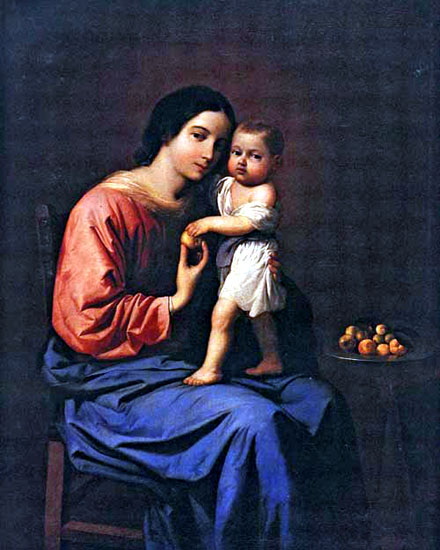
Francisco de Zurbaran’s “Madonna of the Apple,” painted around 1664, presents one of the most intimate and tender visions of the Virgin and Child in Spanish Baroque art. Instead of a grand throne or celestial setting, Zurbaran places Mary on a simple wooden chair, dressed in red and blue, with the Christ Child standing on her lap. He is supported by her arm while he reaches out, holding an apple that she has just placed in his hand. To the right, a small table carries a plate of fruit, softly lit against a dark background.
The painting fuses domestic simplicity with deep theological meaning. It feels at once like a quiet family moment and a visual meditation on salvation history. Through careful composition, color and symbolism, Zurbaran transforms this modest scene into a powerful reflection on Mary’s role as mother of Christ and on Christ as the new Adam who restores humanity.
Composition and the Intimate Setting
The composition of “Madonna of the Apple” is compact and focused. The figures are placed slightly to the left, framed by the dark, neutral background. Mary sits in profile but turns her head gently toward the viewer, while the Child stands frontally, his gaze directed outward. This arrangement creates a triangular structure: Mary’s seated body forms the base, her bent arm and the Child’s upright figure form the rising sides, and their closely aligned heads form the apex.
The dark background has almost no detail. There is no architectural setting, landscape or crowd of angels. This simplicity directs all attention to the relationship between mother and child. It also gives the painting a timeless quality. The scene could be taking place in any humble interior, anywhere and at any moment. The only secondary object is the small round table with a plate of apples, which anchors the right side of the composition and balances the mass of blue cloth on the left.
Zurbaran has clearly designed the arrangement to foster intimacy. The figures occupy the foreground, close to the picture plane. Viewers feel as if they are standing just a few steps away, invited into this quiet domestic space. The low eye level reinforces that sense of closeness, making Mary and Jesus appear approachable rather than distant icons.
The Human and Tender Face of Mary
Mary in this painting is not an idealized queen but a young woman of gentle beauty. Her features are soft and realistic: a straight nose, full lips, and large dark eyes. Zurbaran paints her with a calm expression that combines modesty and quiet pride. Her head inclines slightly toward the Child, emphasizing the emotional bond between them. At the same time, she looks outward with a serene gaze, as if she is aware of the destiny that lies ahead for her son and for the world.
Her hair is dark and smooth, partially covered by a veil that falls behind her shoulders. There are no jewels or elaborate ornaments. The simplicity of her appearance reflects the humility and poverty traditionally associated with the Holy Family. Though Zurbaran gives her the classical beauty expected of the Madonna, he keeps her grounded in the everyday world of his viewers.
Mary’s hands are especially expressive. One hand gently supports the Child, resting on his hip and back. The other hand holds his arm as she guides the apple into his grasp. These gestures communicate maternal care and also suggest that Mary introduces her son to his mission. She is the one who offers the fruit that symbolizes the story of sin and redemption, yet she does so with tenderness, knowing that his acceptance will bring both suffering and salvation.
The Christ Child and His Direct Gaze
The Christ Child stands barefoot on Mary’s lap, supported by her robe and her arm. He wears a simple white garment, loosely tied at the shoulders and waist. The fabric slips slightly, exposing one chubby shoulder and emphasizing his vulnerability as a real infant. At the same time, his stance is surprisingly stable for a child of his age. One foot rests firmly on Mary’s blue robe, the other is planted near the edge of her knee, as if he is about to step toward the viewer.
His face is round and serious, with large dark eyes that look directly out of the painting. This direct gaze is remarkable. While Mary’s eyes are gentle and introspective, the Child’s look is almost solemn. It establishes a powerful connection with the viewer, reminding us that this is not only a sweet infant but also the incarnate Word who sees and knows each person.
In his small hands he holds the apple that gives the painting its title. One hand wraps around it while the other steadies it from below. The gesture is both childlike and symbolic. He seems curious about the fruit, yet in art historical context it stands for something far greater than simple hunger. By accepting the apple, the Child accepts his role as the new Adam who will undo the damage of the first.
Symbolism of the Apple and the Plate of Fruit
The apple is the key symbol in this painting. In Christian tradition it refers to the fruit of the Tree of Knowledge in the Garden of Eden, which Adam and Eve ate in disobedience. That act of disobedience represents the origin of human sin. In “Madonna of the Apple,” however, the fruit appears not in the hands of Eve but in the hands of Christ.
By placing the apple in the grasp of the Christ Child, Zurbaran alludes to the idea of Christ as the new Adam. Where the first Adam reached for the fruit in rebellion, the new Adam receives it in obedience. He will bear the consequences of sin on behalf of humanity and transform the symbol of disobedience into a sign of redemption. Mary, who hands him the fruit, appears as the new Eve who cooperates with God rather than defies him.
The plate on the small table holds several more apples. Their rounded shapes and warm colors echo the fruit in the Child’s hand. They may suggest the multitude of sins and the universal reach of original sin, while the chosen apple in Jesus’s grasp points to the particular act of salvation accomplished through his life and death. At a more ordinary level, the plate of fruit also anchors the scene in everyday family life. In a humble home such fruit could be a rare treat, reminding viewers that the Holy Family shared the modest pleasures of their contemporaries.
Color Harmony and Emotional Tone
Zurbaran’s use of color in “Madonna of the Apple” is both traditional and inventive. Mary wears the familiar combination of red and blue. Her tunic is a warm, muted red, while her mantle and skirt are a deep, saturated blue. These colors have long been associated with the Virgin: red for love and suffering, blue for fidelity and heavenly grace. The painter modulates these hues with subtle shifts of light and shadow, creating a sense of volume and weight in the fabric.
The Christ Child’s garment is white, symbolizing purity and divinity. Against the darker tones of Mary’s clothing, the white stands out brilliantly, drawing the eye to the center of the composition. The apple adds a touch of golden yellow, echoing the warm flesh tones of the figures and the fruit on the table. Overall, the palette consists of restrained yet rich colors. The dark background and low key lighting intensify the vibrancy of the red, blue and white, lending the scene a quiet radiance.
Emotionally, this color harmony supports a mood of peaceful contemplation. The rich blue of Mary’s robe spreads broadly across the lower half of the painting, like a sheltering sea. The red of her tunic glows near the Child, suggesting warmth and maternal love. The white of his garment and the apple’s golden tones become centers of luminous focus, hinting at the divine light present within this domestic scene.
Light, Shadow and the Baroque Atmosphere
Light in “Madonna of the Apple” comes from an unseen source at the left, illuminating the figures while leaving much of the background in darkness. This technique, inspired by Caravaggist tenebrism, is typical of Zurbaran’s work. Yet in this painting the contrasts are softer than in some of his more dramatic depictions of saints and martyrs. The shadows are deep but not harsh. They envelop the figures gently, creating a sense of intimacy rather than fear.
The light falls most strongly on the faces and hands of Mary and Jesus, as well as on the apple and parts of Mary’s blue robe. This selective illumination guides the viewer’s attention to the emotional centers of the composition. The Child’s head and chest are especially radiant, which underscores his identity as the light of the world within the humble setting.
The dark background has a dual effect. Practically, it provides contrast that makes the figures stand out. Symbolically, it can be read as the world overshadowed by sin and ignorance, into which Christ is born as light. The warm, focused illumination on the holy pair thus becomes an image of grace breaking into darkness, a theme central to Baroque religious painting.
Domestic Realism and Spiritual Meaning
One of the most striking qualities of “Madonna of the Apple” is its combination of domestic realism with profound spiritual meaning. The figures are completely believable as a young mother and her toddler son. Mary’s seated posture, the Child’s bare feet and slightly awkward stance, the simple wooden chair and the small table with fruit all belong to everyday life.
This realism makes the painting accessible to viewers who see in Mary a reflection of their own family experiences. At the same time, the symbolic elements transform the scene into more than a family portrait. The sacred story of salvation is woven seamlessly into the ordinary gestures of feeding and caring for a child.
Zurbaran’s ability to hold these two levels together is part of what gives the painting its lasting power. There is no forced separation between holy and ordinary. God’s presence is revealed precisely in the tenderness of a mother who guides her child’s hand to a piece of fruit. In this sense, “Madonna of the Apple” embodies the theological idea of incarnation in visual form.
Zurbaran’s Mature Style in the Late Work
Painted near the end of Zurbaran’s career, “Madonna of the Apple” reflects a mature style that had grown softer and more lyrical than his earlier, more austere works. In the 1630s and 1640s he was known for severe images of monks and martyrs, often isolated against dark interiors. By the 1660s, influenced in part by artists such as Murillo and by changing tastes, his figures became gentler and his color more varied.
In this painting, the forms are still solid and the lighting still focused, but there is a warmth and delicacy that speak of an artist who has spent decades contemplating sacred subjects. The drapery is handled with broad, confident brushstrokes. The faces have a quiet refinement that avoids excessive sweetness yet conveys deep affection.
The painting also demonstrates Zurbaran’s skill in composing two figures in close relationship. The way Mary’s body turns to support the Child, the placement of his feet on her robe, and the interlocking of their hands around the apple all show a sophisticated understanding of human interaction. Nothing appears accidental. Every gesture contributes to the overall theme of maternal guidance and divine mission.
Devotional Function and Viewer Engagement
For its original viewers, “Madonna of the Apple” would have served as a devotional image for prayer and reflection. The composition invites contemplation of several mysteries at once: the incarnation of God in a human child, the loving cooperation of Mary, and the transformation of sin into salvation symbolized by the apple. Believers standing before the painting could meditate on these themes while being emotionally drawn into the tender bond between mother and son.
The direct gaze of the Christ Child plays a key role in this devotional function. It creates a sense of personal encounter, as if he is looking at each viewer individually. This encounter is softened by Mary’s gentle presence. She appears almost to lean toward the viewer, bringing the Child closer and presenting him for contemplation.
The painting also encourages quite practical reflection. Many viewers would have been parents themselves, struggling to raise children in faith. In Mary they could see a model of patient guidance, and in the Child a reminder that every child is a gift of God whose life has a unique meaning.
Legacy and Contemporary Appeal
Today, “Madonna of the Apple” continues to speak to audiences beyond its original Spanish Baroque context. Its combination of realism and symbolism gives it broad appeal. Art historians appreciate the skillful composition, rich color and nuanced lighting. Devotional viewers find in it a powerful image of Mary’s maternal love and Christ’s gentle yet determined acceptance of his mission.
The painting also resonates with contemporary discussions of family, motherhood and spiritual nurture. It presents motherhood not as sentimental perfection but as attentive presence and guiding care. Mary’s posture and expression suggest that true authority is exercised through tenderness rather than domination. Christ, even as a child, stands with quiet dignity, reminding viewers that every person, no matter how small, bears a unique vocation.
In a world where religious art is sometimes seen as distant from everyday life, Zurbaran’s “Madonna of the Apple” offers a refreshing vision of holiness rooted in ordinary gestures. It suggests that salvation history unfolds not only in grand events but also in the humble act of a mother placing an apple into her child’s hand.
Conclusion
Francisco de Zurbaran’s “Madonna of the Apple,” painted around 1664, is a masterpiece of intimate devotion and theological depth. Through a simple domestic scene of Mary seated with the Christ Child on her lap, the artist weaves together the story of the fall and redemption, the roles of Mary and Christ as new Eve and new Adam, and the interplay of everyday life with divine mystery.
The apple at the center of the composition serves as a powerful symbol, transformed from the fruit of disobedience into an emblem of salvation held firmly in the Child’s grasp. The warm colors, subtle lighting and quiet realism draw viewers into a space where they can contemplate both the tenderness of a mother’s love and the grandeur of God’s plan.
Even centuries after its creation, “Madonna of the Apple” remains a moving visual meditation on how divine grace enters human history through the most ordinary of relationships. In the gentle exchange between Mary and her son, Zurbaran invites every viewer to encounter the mystery of a God who becomes small, approachable and lovingly present in the heart of family life.