Image source: wikiart.org
Introduction
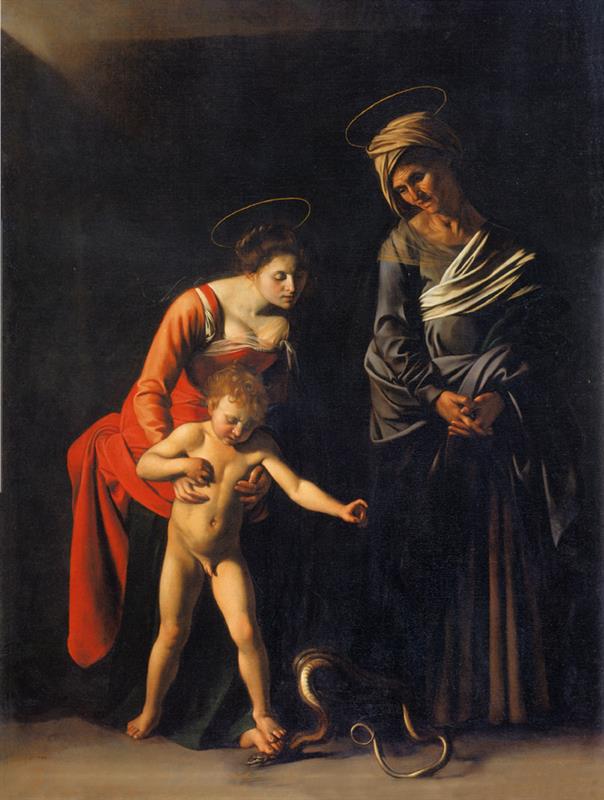
Caravaggio’s “Madonna and Child with St. Anne” (1606), also called the “Madonna dei Palafrenieri,” is a study in how light can turn doctrine into drama. In a darkness so dense it feels architectural, three figures gather near the picture plane: a youthful Virgin Mary, the Christ Child she steadies, and the elderly St. Anne. At their feet writhes a serpent, its body caught mid-coil. Mary guides the Child’s tiny foot to press upon the snake’s skull, and with that single action Caravaggio translates centuries of theology into the pressure of tendon and skin. The painting’s beauty, controversy, and immediacy spring from the same source: its unsparing realism and the way it lets revelation occur in ordinary flesh.
A Commission Meant for the Basilica—and a Swift Rejection
The canvas was commissioned for the altar of the Confraternity of the Palafrenieri, papal grooms whose patroness was St. Anne. Installed briefly in St. Peter’s, it was removed within days. The reasons were many and have the air of rumor and official prudence: the Virgin’s plunging neckline, her monumental physicality, the frank nudity of the Child, the hard, peasant realism of St. Anne’s face, and the serpent depicted as a literal animal rather than an elegant symbol. Caravaggio’s decision to bring the sacred so close to the viewer—bare feet at the edge of the floor, tendons taut, haloes mere whispers—overruled decorum. Yet what unsettled contemporaries gives the painting its modern force: it insists that salvation is enacted by bodies in real light.
The Theology in a Gesture
Mary’s right hand encircles the Child’s waist; her left hand guides his ankle. The boy leans forward, intent on the serpent at his feet, while his mother’s forward step gives both the leverage needed to crush. This is Genesis reimagined through touch—the long-expected victory over the tempter dramatized as a mother teaching a child how to place his foot. In traditional iconography the “new Eve” cooperates with her Son; Caravaggio compresses that doctrine into posture and pressure. The result is not allegory but action. You feel the weight of the Child, the steadiness of the mother, the resistance of the snake. Theology happens at floor level.
St. Anne’s Presence and What It Means
At the right, St. Anne stands in half shadow, her hands folded, her weathered face turned toward the scene with quiet satisfaction. She is patroness of the commissioning confraternity, but her role is more than ceremonial. As Mary’s mother, she embodies lineage and instruction; as a figure from the older covenant, she looks on while the new covenant takes decisive form. Her placement—slightly behind, dimly lit, clothed in somber slate—suggests a transmission: faith and flesh move from generation to generation until the moment when the serpent is crushed. The wrinkles and the work-worn hands are not disrespectful; they are Caravaggio’s respect for the history that made this instant possible.
A Triangular Composition That Breathes
The figures trace a stabilizing triangle: St. Anne at the right apex, Mary at the left, and the Child near the base, all planted on the ground where the snake writhes. Within this structure, dynamic diagonals keep the picture alive. Mary’s scarlet torso leans forward; the Child’s arm stretches toward the serpent; St. Anne’s shawl slips in a descending sweep that calms the movement. The triangular frame asserts order; the diagonals convey urgency. Nothing feels accidental. Even the slight bend of Mary’s supporting knee is part of the composition’s grammar, a pivot that ties the upper world of faces to the lower world of feet and reptile.
Chiaroscuro: Light as Doctrine
Caravaggio’s tenebrism here is disciplined and argumentative. Light enters from high left, igniting Mary’s face, shoulder, and the pale architecture of the Child’s body before slipping toward St. Anne’s modest halo and the glint on the serpent’s scales. The background is almost absolute darkness; it is not emptiness but a deliberate silence that lets the beam argue its case. In that light we read the hierarchy: the Child and his mother are unmistakably central, while St. Anne participates as witness and guardian. The serpent’s head, partly lit, invites the eye to the very place where victory is being enacted.
Color and the Emotional Weather
Caravaggio restricts the palette to a few charged hues: Mary’s brilliant red gown with a white chemise at the neckline; the Child’s warm flesh; St. Anne’s ashy blues and browns; the serpent’s oily green-black; the encompassing darkness. Red becomes zeal and maternity; blue-gray speaks of age and stability; flesh radiates life; black protects mystery. The picture feels like late afternoon in a shuttered room, a climate of intimate ceremony rather than public pageant. The restraint of color gives the action moral clarity.
The Feet That Preach
Caravaggio’s feet carry meaning. Mary steps forward barefoot, a sign of humility, poverty, and readiness. Her sole presses the ground with the familiarity of someone who knows the world’s weight. The Child’s foot is small, searching, obedient to the guidance of his mother’s hand; it is also the instrument of the prophecy that the seed of the woman would crush the serpent’s head. By staging the drama at ankle height, the painter shifts the center of gravity downward and asks viewers to look where they would rarely look for salvation—in the humble zone of balance and locomotion.
The Serpent as a Real Animal
The snake is not decorative. It coils and rears, a tangible creature with the splotched sheen of something dragged from a dark corner. Its physicality intensifies the victory. Caravaggio refuses stylization so that the allegory remains anchored in a believable world. The serpent’s position—mouth open, body tense—gives the Child’s action urgency and risk. This is not ritual choreography; it is a real threat being mastered by a real boy under a mother’s steadying hands.
Halos as Breath, Not Gold
All three figures wear haloes so thin they almost vanish into the dark. Caravaggio keeps sanctity modest—a luminous hint rather than an assertion. The radiance seems to emanate from within rather than descend from above. This choice pulls holiness into the human: the grace that wins over evil has taken residence in bodies that sweat, age, and learn.
The Controversy Embedded in Realism
The painting’s short public life at St. Peter’s owes much to how vigorously it collapses the sacred into the ordinary. Mary’s neckline unsettled tastes formed by colder classicism; her body reads as alive, not ideal. The Child is completely nude, a traditional choice rendered here with disarming frankness. St. Anne looks too much like someone’s grandmother. But that discomfort is the point. The Incarnation, Caravaggio implies, is not a polite metaphor; it is a commitment to human texture. If redemption happens, it happens in this kind of skin.
The Virgin’s Body as Architecture
Mary’s torso is monumental, her skirt a red column that anchors the left side of the painting. The fabric’s weight, the way it pools and folds, lends her a stable mass against which the Child can push. Her head tilts toward him in concentration; her eyes track his foot and the serpent’s sudden movements. She is at once teacher, temple, and terrain—an embodied shelter from which the Son undertakes his first victory. Caravaggio’s handling of cloth makes theology tactile.
St. Anne’s Expression and the Ethics of Age
Unlike Mary’s focused intensity, St. Anne’s face carries a complicated softness: relief, humility, and a trace of weariness that has finally found its purpose. She is not a passive extra. The way she holds her hands—clasped low, almost hidden—recalls the devotional pose of countless worshipers. Her presence argues that grace honors history; the old are not sidelined when the new arrives. The Church, Caravaggio suggests, includes those who have made room, kept customs, and sustained faith quietly.
A Painting of Near-Contact
Caravaggio places the figures very close to the picture plane. The Child is inches from our world; the serpent could cross the border with one more coil. This proximity invites participation rather than observation. Viewers are not peering into a remote tableau; they are standing at the same floor level as the crisis being resolved. The effect is sacramental: the painting does not merely show victory; it lets that victory touch the space we occupy.
Technique: Flesh, Fabric, and the Persuasion of Paint
The painter models flesh with a thin, luminous film that lets warmth breathe under cooler highlights. The Child’s skin gleams with life; Mary’s forearms show subtle definitions of tendon and vein; St. Anne’s hands are darker, their skin coarser. Fabrics are handled differently: Mary’s scarlet behaves like heavy wool that drinks light; St. Anne’s slate-gray shawl is matte and stiff; the Child has only a small swath of drapery that barely covers him, emphasizing vulnerability. The serpent’s body is glazed to a sinister shine. Highlights are rationed with precision—the ridge of a calf, the knuckle of a hand, the rim of a coil—so the eye moves exactly where the narrative requires.
Space Reduced to Morality
There is almost no setting: no room, no furniture, no landscape. Caravaggio eliminates scenery to keep the subject free of anecdote. The dark becomes moral space—an emptiness in which the act of crushing evil is the only event that matters. This decision aligns the painting with the artist’s late style, in which tenebrism serves as a discipline rather than a flourish.
Reading the Iconography Without Labels
With the minimal toolkit of serpent, mother, child, and elder, the picture conveys a complex chain of meanings: the defeat of sin, the collaboration of Mary and Christ in salvation history, the confirmation of doctrine around the Immaculate Conception, the continuity of generations, the humility that grounds victory. None of this is written; all of it is embodied. The viewer learns the narrative by watching how bodies interact, which is precisely Caravaggio’s gift—turning ideas into gestures that feel inevitable.
The Painting’s Journey After Removal
After its removal from St. Peter’s, the canvas was taken to the confraternity’s own church and soon purchased for a princely collection. That trajectory mirrors its content: work done on the floor of a church finds a home in a setting where it can be contemplated at closer range. The scandal fades; the authority remains. Today the painting reads less as a provocation than as a lucid catechism in paint.
How to Look
Start at the Child’s foot and the serpent’s head; feel the tension in the ankle and the firm counter-pressure of Mary’s hand. Travel up along the Child’s arm to his intent face, then to Mary’s downward gaze, and out along the bold red fold of her gown. Cross to St. Anne’s bowed head and hands; notice how her shawl’s white fold echoes the Child’s pale skin, linking generations. Finally, let your eyes return to the dark that surrounds them; it exists to protect the brightness of this one act.
Why the Painting Matters Now
“Madonna and Child with St. Anne” proposes that evil is not defeated by abstraction but by cooperation—by a mother teaching a child, by an elder standing guard, by bodies placed together in purpose. In a world saturated with spectacle, Caravaggio’s realism restores gravity. Redemption looks like pressure, focus, and love willing to kneel. The painting invites viewers to take their place at ground level and add their weight to the heel pressing down.
Conclusion
This is one of Caravaggio’s most concentrated statements about the Incarnation. He gives us a serpent, a foot, and two women—youth and age—coordinated by light. The result is devotional, muscular, and unforgettable. In the hush of tenebrism, in the heat of Mary’s red, in the creased tenderness of St. Anne’s face, and in the Child’s eager step, the old promise becomes a present-tense truth. The story of salvation is not far away; it is happening where your eye meets the floor.