Image source: wikiart.org
Introduction to “Madonna and Child” by Bartolomé Esteban Murillo
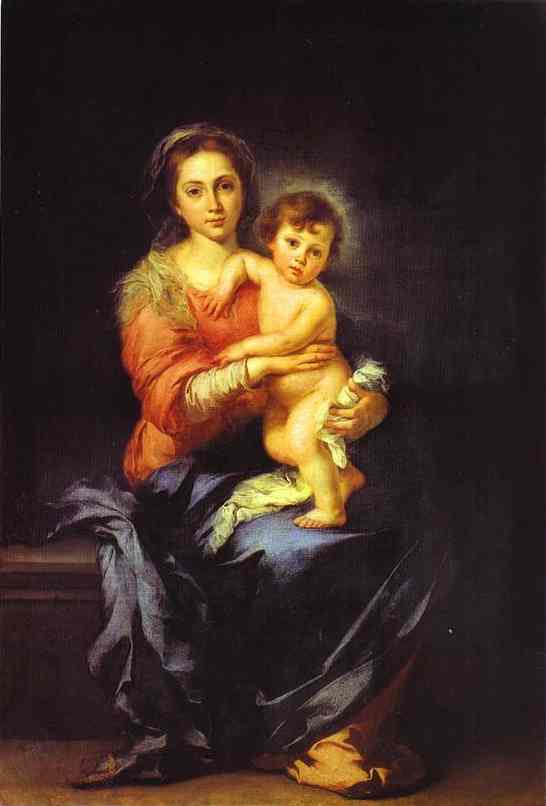
“Madonna and Child,” painted around 1650 by Bartolomé Esteban Murillo, is a quiet and luminous meditation on motherhood and divine love. The canvas presents the Virgin Mary seated against a deep, unarticulated background, with the Christ Child perched on her lap. Mary wears a warm red dress and a blue mantle, the traditional colors associated with her in Christian art. The child is unclothed except for a small cloth that Mary holds in one hand, his small body turned toward the viewer while his arm rests over his mother’s shoulder.
At first glance the painting seems simple. There are no elaborate architectural settings, no angels, and no narrative details. Yet this simplicity is precisely what gives the work its power. Murillo has distilled the theme of Madonna and Child to its essential elements, focusing on the human bond between mother and son while allowing hints of divinity to shine through in the soft light and gentle expressions. In this image Murillo unites the devotional heart of Spanish Baroque painting with an almost modern sense of psychological intimacy.
Composition and the Intimate Focus on Two Figures
Murillo structures the composition around a strong vertical axis. Mary sits in the center, her body forming a stable column of color from the base of the canvas to just above its midpoint. The Christ Child balances on her knee, his body angled slightly outward. The two figures create a compact, almost sculptural group that stands out sharply against the dark background.
The artist crops the setting so tightly that we see only a hint of a stone ledge or bench beneath Mary. Everything else is swallowed by deep shadow. This compositional choice removes distractions and situates the mother and child in a timeless space. There is no clear indication of time of day or specific location. Instead, the viewer encounters the figures as if they were illuminated in a small pool of light within an infinite darkness.
Mary’s mantle flows downward in soft folds of blue that merge at the base with the reddish tones of her dress and the earthy colors of her footwear. The drapery fills much of the lower portion of the canvas, creating a sense of grounded weight that stabilizes the more fragile body of the child. The diagonal lines suggested by the folds of fabric lead the eye upward toward the central meeting point of their faces and hands.
The child sits in a natural but carefully arranged pose. One leg dangles down, the toes just brushing the folds of his mother’s clothing, while the other leg bends at the knee. His left arm rests around Mary’s neck, while his right hand holds a piece of cloth that trails across her lap. This arrangement of limbs creates an intricate pattern of curves and diagonals that gives the composition life and movement without disturbing its overall calm.
Mary’s Expression and the Humanity of the Virgin
Murillo is renowned for his tender depictions of the Virgin, and in this painting he presents Mary as both idealized and deeply human. Her face is oval, with soft, regular features and a smooth complexion. Yet she does not look distant or formally posed. Her slightly parted lips and large, observant eyes give the impression that she is fully present in the moment, attentive to the child she holds and perhaps to something beyond the viewer’s sight.
Mary’s gaze is directed outward, meeting the viewer rather than her son. This creates a subtle triangle of attention. The viewer looks at Mary, Mary looks back at the viewer, and the child, whose gaze also moves outward, seems to share this contact. The result is a sense of inclusion. The beholder feels drawn into a silent exchange with both mother and child.
There is also a quiet seriousness in Mary’s expression. She does not smile broadly, yet neither is she sorrowful. Her look combines affection, contemplation, and a hint of foreknowledge, as if she already senses the future suffering of her son. Murillo often introduced this gentle gravity into his images of the Madonna, reminding viewers that the sweetness of the Nativity is inseparable from the path that will lead to the Passion.
Mary’s hands reinforce this mixture of tenderness and responsibility. One arm supports the child securely around his waist, while the other hand grips the cloth that is wrapped loosely around him. The firmness of her grip suggests both physical and spiritual protection. She is not merely holding a baby but caring for a savior whose destiny she cherishes and fears.
The Christ Child and the Balance of Vulnerability and Divinity
The Christ Child in this painting is depicted with the healthy roundness of a real toddler. Murillo paints his flesh with delicate transitions of pink and gold, using soft highlights to suggest the warmth and softness of infant skin. The slight redness in the cheeks and the curl of the hair contribute to a sense of lively individuality.
At the same time, there is more here than an ordinary child. Murillo surrounds the boy’s head with a faint halo of heightened light, not a sharply drawn circle but a subtle glow that lifts him from the realm of everyday portraiture. His gaze is alert and somewhat solemn for his age. Instead of looking at his mother, he faces forward, engaging the viewer directly. This frontal regard hints at divine self awareness, an early sign of the Christ who will later address crowds and disciples.
The child’s pose is striking. His arm around Mary’s neck reads as a natural gesture of affection and security, yet it also has a symbolic aspect. It suggests an intimate union between the divine and human natures, a physical metaphor for the theological belief that Christ is both fully God and fully human, joined inseparably in one person.
The small piece of cloth he holds functions practically as a modest covering, but its whiteness and the way it trails across Mary’s lap also evoke the swaddling cloths of Bethlehem and, by extension, the burial shroud of the tomb. Murillo often employed such visual echoes to connect infancy with the Passion in a gentle but persistent way.
Color, Light, and the Spiritual Atmosphere
Color plays a central role in creating the painting’s spiritual atmosphere. Mary’s garments display the familiar pairing of red and blue. The red dress suggests love, sacrifice, and earthly life, while the blue mantle evokes heaven, purity, and the spiritual realm. Murillo renders these colors with a rich yet soft saturation that avoids harsh contrasts. The blue, in particular, shifts from deeper tones in the shaded folds to luminous highlights where the fabric catches the light.
The flesh tones of both figures are warm and golden, standing out against the deep brown and black of the background. This contrast endows Mary and the child with a gentle radiance. It is as if they are lit from within, an effect that underscores their spiritual significance.
The source of light is not explicitly indicated, but it seems to fall from the upper left, illuminating Mary’s face and the child’s body while leaving the far right side in soft shadow. This directional lighting subtly models the forms, giving them three dimensional presence. At the same time, the surrounding darkness functions as a symbolic field. It can be read as the world before the Incarnation, or as the sin and suffering from which Christ’s presence brings light.
Murillo’s handling of light differs from the dramatic tenebrism of artists like Caravaggio. Where Caravaggio might orchestrate sharp beams and stark shadows, Murillo prefers a more diffused, enveloping illumination. In “Madonna and Child” this results in a calm, contemplative mood that invites prolonged looking and prayer.
The Relationship Between Mother and Child
Although both Mary and Jesus engage the viewer with their gazes, the relationship between them remains central. Their bodies are intertwined in a natural and affectionate way. Mary’s arms encircle the child, his leg curves around her waist, and their forms overlap to create a unified silhouette.
This physical closeness speaks of maternal love, but Murillo also uses it to express theological ideas. In Christian tradition Mary is seen as the first disciple, the one who receives Christ not only in her womb but also in her heart. Her embrace can therefore be understood as symbolizing the Church’s reception of Christ and its mission to present him to the world.
The child’s slightly outward leaning posture suggests that he is about to move forward, perhaps to bless or to reach toward the viewer. Mary supports this movement while remaining anchored. She is both shelter and launching point, the one who nurtures the savior and the one who offers him to humanity.
The tenderness of touch is evident in small details. The fingers of Mary’s left hand press gently into the soft flesh of the child’s thigh. His own hand rests on her shoulder with relaxed familiarity. These touches give the painting a sense of living warmth, grounding its theological meaning in the reality of bodily affection.
Murillo’s Personal Style and the Spanish Baroque Context
“Madonna and Child” exemplifies Murillo’s mature style within the Spanish Baroque tradition. Seville in the mid seventeenth century was a center of religious art, with painters such as Zurbarán and Herrera the Elder producing intense, often austere images for churches and monasteries. Murillo inherited this environment, but he brought to it a distinctive warmth and softness that set him apart.
Where Zurbarán often emphasizes sharp contours and dramatic contrasts, Murillo softens edges and bathes his figures in diffused light. His brushwork becomes looser in the draperies and background, yet remains precise in the rendering of faces and hands. This combination creates a sense of spiritual gentleness that resonated deeply with contemporary viewers and continues to appeal today.
The Counter Reformation context also shaped Murillo’s approach. Religious art was expected to instruct the faithful, encourage devotion, and align with doctrinal clarity. In “Madonna and Child” Murillo fulfills these expectations without sacrificing psychological nuance. The painting clearly identifies Mary and Jesus through traditional attributes, yet it also presents them as approachable, human figures. This accessibility made such images powerful tools for prayer and contemplation in churches, convents, and private homes.
Emotional Resonance and Devotional Impact
The emotional resonance of “Madonna and Child” lies in its successful fusion of universality and individuality. On one level, the painting portrays a specific mother and child in a specific historical and religious context. On another, it speaks to the universal experience of parental love and the vulnerability of infancy.
For believers, the work offers a focus for meditation on the mystery of the Incarnation. Seeing the divine child cuddled in his mother’s arms invites reflection on the humility of God who becomes small and dependent. Mary’s attentive gaze models the receptive attitude of the believer, while the child’s steady look suggests an invitation to trust and intimacy.
For viewers of any background, the painting can evoke memories and emotions related to family care, protection, and tenderness. The quietness of the scene, combined with the soft glow of the colors, creates a sense of calm that contrasts with the noise and speed of contemporary life. Spending time with this image can feel like entering a small sanctuary of visual peace.
Conclusion
Bartolomé Esteban Murillo’s “Madonna and Child” from around 1650 is a masterpiece of intimate devotion and artistic subtlety. Through a carefully balanced composition, refined use of color and light, and an acute sensitivity to human expression, Murillo presents the Virgin Mary and the Christ Child as both holy figures and real, affectionate persons.
The dark background concentrates attention on the luminous pair, while the flowing drapery and intertwining limbs create a sense of unity and tenderness. Mary’s calm yet serious gaze and the child’s direct look toward the viewer draw us into a contemplative relationship with them. Symbolic details, such as the red and blue garments and the small cloth in the child’s hand, link the scene to broader themes of love, sacrifice, and redemption.
Within the broader history of Spanish Baroque art, this painting stands as a prime example of how religious imagery can be both doctrinally rich and emotionally accessible. For centuries it has invited viewers to ponder the mystery of divine love made visible in the bond between mother and child. Even today, “Madonna and Child” continues to shine as a quiet, glowing testimony to the enduring power of tenderness and faith.