Image source: wikiart.org
Introduction
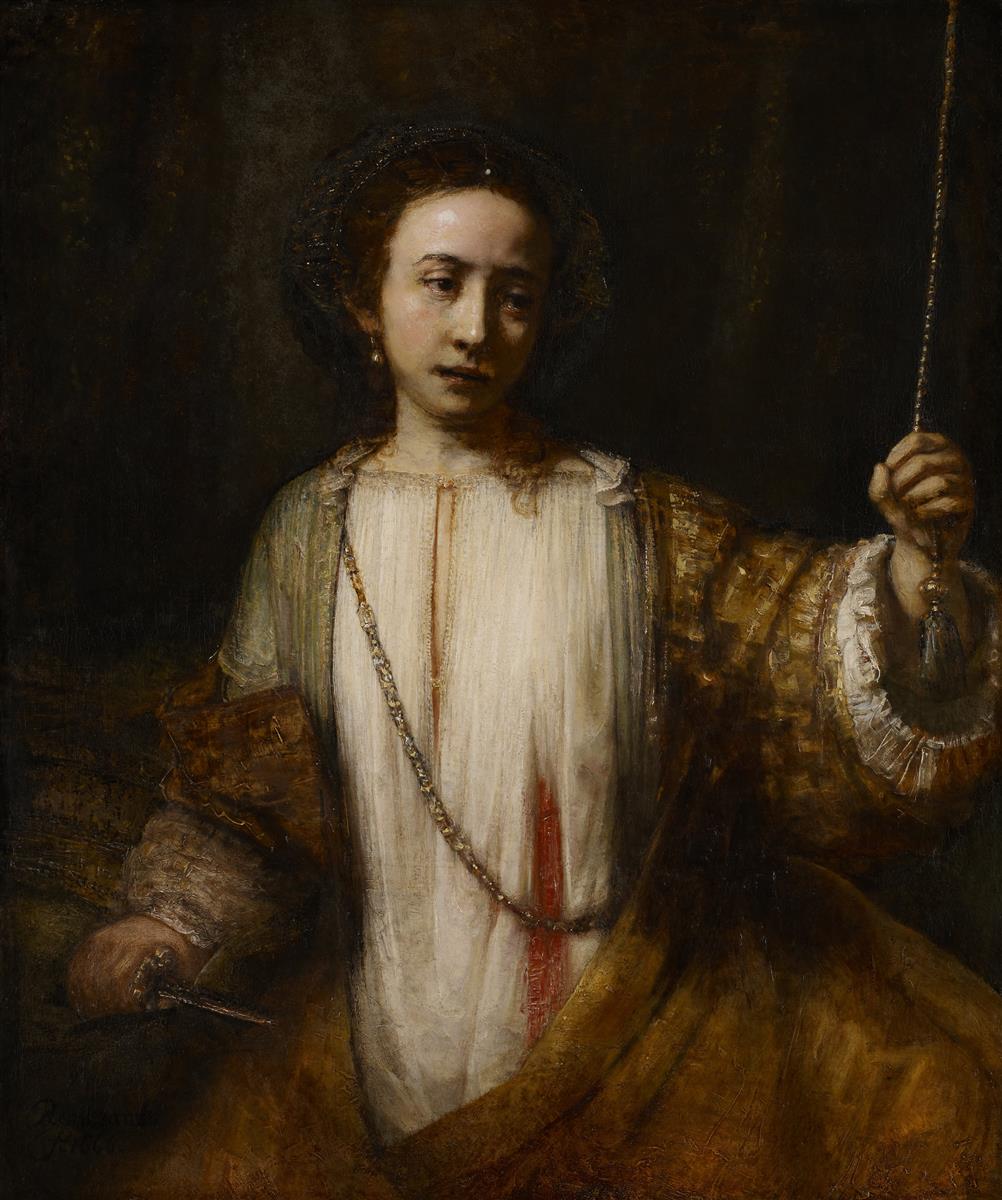
Rembrandt’s 1666 “Lucretia” is among the most piercing tragedies in European painting, a late work that distills an ancient Roman legend into a single, devastating moment. On a dark stage the heroine stands almost life-size and close to us, her pale chemise illuminated against a surrounding brown-gold dusk. A thin chain drops along the front of her dress, already stained by a vertical flare of crimson. In her right hand she holds the cord used to summon witnesses; in her left, just visible at the lower edge, lies the dagger whose wound has begun to bloom. The face is unadorned, the eyes heavy with knowledge, the mouth parted in a breath that seems still to hang in the air. Rembrandt refuses theatrical frenzy; he allows dignity, shame, and unbearable resolve to coexist in quiet equilibrium. The result is a painting that feels both timeless and shockingly immediate.
The Legend And Its Moral Gravity
Lucretia was the chaste wife of the Roman aristocrat Collatinus. Raped by Sextus Tarquinius, son of the tyrant king, she summoned her husband and father, told them the truth, and, to preserve her honor and incite public justice, took her own life. Her act catalyzed the expulsion of the Tarquins and the founding of the Roman Republic. Artists had long used Lucretia to contemplate the ethics of honor, sexual violence, and political change. Rembrandt approaches the subject not as an emblem carved in marble but as a person at the edge of an irreversible decision. He sets aside the expected crowd, the oath-swearing men, and the classical decor; he shows only Lucretia, the cord, the dagger, and the wet, vertical mark of the wound. The grandeur is moral, not architectural.
Composition And The Architecture Of The Scene
The figure is organized into a tall triangle whose apex is the head and whose base widens across the skirt and sleeve. This pyramidal structure grants stability to a moment of physical weakness. Lucretia’s right arm rises to hold the bell-pull; the diagonal of the cord anchors the upper right of the canvas, while the opposite diagonal formed by the left sleeve and dagger completes the compositional X that holds the figure in place. The vertical seam of light down the chemise—interrupted by the red stain—operates as the painting’s spine. The head tilts gently, breaking symmetry and letting pathos flow through the lines of neck and shoulder. The tight framing denies the viewer any escape; we stand within the space of her choice.
Light As Judge And Witness
Rembrandt’s light, entering from the left, acts like both witness and judge. It grazes the forehead and cheeks, slips briefly across the chain, and floods the white garment with a pitying radiance. Everything else withdraws into a mild obscurity—the golden sleeve with its thick brocade, the loosely suggested background, the shadowed fingers around the dagger. Because the illumination is selective, the red stain becomes the painting’s brightest color and its moral center. This is not melodramatic spotlighting; it is a hesitant, humane light that exposes what must be seen and protects what should remain private. The darkness is tender, not sinister, and it allows Lucretia to be both figure and interior space at once.
Palette And The Poetics Of Restraint
The color range is narrow and exquisitely tuned. Earth browns and umbers dominate, warmed by soft golds in the sleeve and warm grays in the background. Against this restrained field the flesh tones feel lived rather than idealized: warm blushes on the cheek and neck, cooler notes around the eyes and lips, subtle rosiness in the hand that holds the cord. The chemise is a miracle of whites—lead white pulled across warmer underlayers so that the cloth seems to breathe. The single flare of red possesses extraordinary power because it is alone; it is pigment and blood at once, both surface and story.
Brushwork And The Intelligence Of Matter
Late Rembrandt lets paint carry feeling. The sleeve is built from thick, granular strokes that rise from the surface like woven metal; one can almost hear the friction of fabric. By contrast, the face is a harmony of semi-opaque veils and small impastos placed at the inner corners of the eyes and the moist edge of the lower lip. The chemise receives long, soft sweeps, then is crossed by a few confident touches that define folds and clasped gathers. The chain is embedded in dashes of thicker paint that catch actual light; the red stain is thin, sinking into the ground like liquid. This alternation between density and transparency gives the painting the sensation of a living body touched by time and decision.
Gesture, Tools, And The Grammar Of Decision
The painting’s drama resides in the quiet choreography of hands and objects. The right hand grasps the bell-pull, enacting her appeal to witnesses; the left encloses the dagger, completing the final act of self-judgment. The bell-cord runs taut, sending a tiny tassel upward toward darkness; the dagger points downward toward the hem. The body is the axis between these two directions—public appeal and private resolve. Rembrandt does not show the moment of stabbing, nor does he show collapse. He gives the steadier, more terrible instant in which a person knows exactly what she has done and what it will mean.
Face, Psychology, And The Refusal Of Heroic Pose
Lucretia’s expression resists classical nobility. She is not an allegory of Virtue with uplifted gaze; she is a woman who has measured the price of speaking truth and paid it. The eyes sag with fatigue and stunned recognition, the brow is smooth rather than theatrically furrowed, the mouth opens slightly as if breath and speech were at war. Rembrandt’s genius is to hold the face at the threshold between action and aftermath. We read not simply grief or shame but a complex mixture of exhaustion, resolve, and fragile calm. The painting thus refuses voyeurism; it insists on solidarity.
Costume, Ornament, And The Humanization Of Antiquity
Rembrandt dresses Lucretia in seventeenth-century finery rather than archaeological costume. The loose net cap with glimmering edges, the laced sleeve, the pearl earring, and the jeweled chain all belong to the world of Dutch portraiture. This decision grounds the legend in the artist’s present and avoids the coldness of costume history. The luxurious sleeve with its thick impasto suggests rank; the chemise’s whiteness suggests innocence; the chain—now slashed by red—suggests the social bond that violence has broken. Each element carries meaning without turning into emblem.
The 1666 Canvas In Dialogue With Rembrandt’s 1664 Lucretia
Rembrandt painted Lucretia twice in the mid-1660s. The 1664 version captures the moment before the act, with the dagger raised. The 1666 painting shows the immediate after, when the bell has been pulled, the wound dealt, and time slows into recognition. Together they form a diptych of will and consequence. The later canvas is quieter, darker, more inward. It trades theatrical suspense for moral presence, placing the viewer not in the excitement of impending action but in the solemnity of plighted honor fulfilled.
Space, Distance, And The Viewer’s Role
The plain background stands close behind Lucretia’s shoulders; there is no deep perspective to put distance between her and us. We are pressed into her moral vicinity. The scale of the figure reinforces this proximity; she is nearly life-size, and the rope rises beyond the upper edge, as if the scene continues in our space. The viewer therefore becomes the witness she summoned. The painting does not simply depict an event; it implicates us in it.
Technique, Layers, And The Time In The Surface
The canvas reveals the layered procedures of Rembrandt’s final decade. A warm ground establishes the general tonality, over which the artist lays blocks of middle value to sketch the figure. He then uses thin, oily glazes to deepen background and sleeves, scumbles to soften contour, and impastos to ignite highlights at cheek, chain, and cuff. Revisions are visible: adjustments at the outline of the sleeve, slight changes in the position of the dagger hand. These pentimenti allow us to feel the picture’s making as a sequence of decisions, mirroring Lucretia’s own sequence of choices.
The Ethics Of Representation And The Violence Offstage
Representations of Lucretia often hover perilously close to erotic spectacle. Rembrandt avoids this trap entirely. The chemise reveals no seduction; its whiteness is not titillation but testimony. The red stain is not aesthetic flourish; it is the minimum needed to register a wound. Even the jewelry is subdued, made with paste-like paint rather than glittering illusionism. Violence remains offstage, acknowledged rather than shown. The painting thus maintains a compassionate gaze that honors its subject’s autonomy.
Theology, Humanism, And The Republic Of Conscience
Although classical, Lucretia’s story always carried quasi-religious overtones of sacrifice and purification. In Rembrandt’s hands it becomes an image of conscience rather than cult. The darkness does not thrill; it shelters. The light does not glorify death; it recognizes the price of justice in an unjust world. The painting thereby aligns with the artist’s broader late humanism—a commitment to depicting people at decisive thresholds with tenderness and truth.
Viewing Notes For Encountering The Painting
Seen in person, the canvas invites changes of distance. From across the room the white garment and the angled cord strike first, and the red reads like a single brush of fate. At conversational range the face opens into minute half-tones and a wetness at the lower lid that suggests a tear. Close inspection reveals bristle tracks on the sleeve, microscopic ridges at the chain’s highlights, and places where thin red sank into the weave. Step back again and the parts fuse into presence; one feels the hush in the room, the small clink of a bell receding into silence.
Legacy And Continuing Relevance
“Lucretia” has remained a touchstone for artists and viewers seeking a way to picture trauma without exploitation. It demonstrates how restraint can intensify feeling, how a limited palette can carry enormous moral weight, and how gesture can tell a story more profoundly than spectacle. In a world still wrestling with violence against women and the public price of private wrongs, the painting speaks with undiminished urgency. Its compassion is unsentimental, its gravity earned in every inch of paint.
Conclusion
Rembrandt’s 1666 “Lucretia” transforms a classical legend into an intimate, contemporary tragedy. The design is simple, the palette austere, and the brushwork alternately sumptuous and spare. Yet within that simplicity a world moves: honor violated and defended, truth spoken and paid for, a life gathered into one final, lucid breath. The painting’s greatness lies in its refusal to flatter either death or heroism. It grants Lucretia the dignity of a person who chooses with full knowledge and stands, for a moment, in the light of her own conscience. Few images carry such quiet power, or achieve so much with so little noise.