Image source: wikiart.org
Introduction
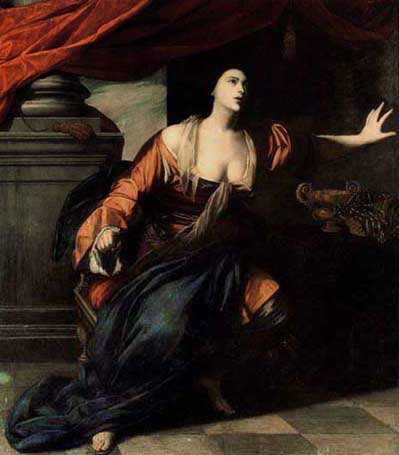
Artemisia Gentileschi’s “Lucretia” (1642) is a chamber tragedy conducted with the restraint of a whispered confession and the force of a public oath. The Roman noblewoman, violated by Sextus Tarquinius, sits in a charged interior as drapery presses down like the weight of history. Her body turns on a hinge of decision: one arm extends into the dark, palm lifted as if halting the world, while the other contracts toward the breast, where a dagger—barely seen in reproductions, yet felt in the tautness of her grip—waits to ratify a vow. Gentileschi chooses not the lurid instant of the blade’s entry nor the tableau of collapse, but the breath before action when conscience, shame, and civic consequence converge inside one mortal frame. The result is a portrait of Roman virtue understood at human scale and a late self-assured statement by a painter who had long specialized in the anatomy of resolve.
The Story And Its Roman Stakes
The legend of Lucretia, preserved by Livy and Ovid, underwrites the birth of the Roman Republic. After being raped by the prince, Lucretia summons husband and kinsmen, recounts the crime, and—declaring that no unchaste woman shall live by Lucretia’s example—takes her own life. The act ignites Brutus’s revolt and the end of Tarquin rule. Painters across centuries mined the subject’s explosive mixture of private trauma and public transformation. Artemisia’s biography—marked by her own assault and the notorious trial in Rome—gives her a particular moral intelligence here, but she does not convert Lucretia into autobiography. Instead she builds a lucid theater where a single figure carries a republic’s turning, and in which the viewer’s task is to read the body’s grammar of intention without voyeurism.
Composition And The Architecture Of Resolve
The composition balances a sweeping diagonal with a static armature. On the left, a monumental plinth—square, weighty, civic—anchors the scene, rising into the red canopy that droops like a court curtain. Lucretia’s body, placed three-quarters to the viewer, arcs from that stone toward the right, where an ornate chest and a sliver of darkness receive the outstretched hand. The gesture opens a negative space that reads as silence itself: a pause wide enough to contain testimony, appeal, and refusal. The down-swept drapery and the checkerboard floor drive the eye back toward the figure, while the seat’s arms press inward, amplifying the sense that decision is being formed under pressure. Nothing circles aimlessly; every line contributes to a geometry of will.
Light, Shadow, And The Theater Of Conscience
Gentileschi’s light behaves like an interrogator’s lamp and a benediction at once. It descends from above left, whitening the column, cutting a bright blade across Lucretia’s exposed chest and throat, and then sliding into the midnight folds of her gown. The face is modeled with meticulous half-tones that keep the neck’s tendons legible, the eyes lifted, the mouth suspended between oath and cry. Shadow pools where doubt might cling—beneath the extended arm, inside the niche of the seat, within the brocade-draped coffer—and in those pools the painter refuses narrative distraction. We are not asked to peer into domestic details; we are forced to regard a conscience illuminated. The tenebrism is moral, not merely optical: light declares what is at stake, darkness protects what is not essential to the act.
Color And Emotional Temperature
The palette is a dialogue between hot and cool: embers under black. The red canopy is dulled to wine, heavy with civic gravitas; the gown’s dominant notes are smoked violet and graphite, colors that drink light rather than spill it. A warm ochre creeps along the lining and sleeve, echoing flesh and binding costume to body. The marble plinth holds a greenish gray, cooling the left side of the canvas into civic stone; the checked pavement alternates cool and warm squares like the counting of time before a deed. The chromatic temperature enacts the psychology: heated intention contained by deliberation, passion disciplined into law.
Gesture, Gaze, And The Grammar Of Decision
Lucretia’s face is turned upward, not in ecstasy but in appeal—to witnesses just summoned, to gods that preside over Roman vows, to the abstraction of honor that will outlive her. The right hand thrusts outward with the flat of the palm exposed; it rejects, interrupts, refuses contamination. The left hand, gathered toward the breast, draws the robe aside to expose the site where the dagger will enter; the fingers prepare, not caress. Shoulders torque around the spine’s axis, a rotation that translates interior resolve into visible energy. Artemisia’s command of bodily rhetoric means we read the sequence: the mind has decided, the hand signals, the blade will follow.
The Dagger, The Chest, And Objects As Witness
Artemisia’s restraint with props dignifies the scene. The dagger is not brandished; it nestles in cloth and shadow, its presence transmitted through the knuckle’s white ridge and the robe’s tension where metal presses silk. The coffer at right, a repository for jewels or linen, gleams with small highlights but contributes chiefly as a foil: luxury that cannot protect, wealth that cannot ransom honor. The column at left is a civic witness; the drapery above it functions as the state’s mute canopy. These objects form a ring of spectators that never compete with the protagonist. They establish the categories—private, public, sacred—but the drama remains an act between a woman and her vow.
Space, Scale, And The Viewer’s Place
The setting is shallow, drawing the figure within arm’s length of the picture plane. We occupy the zone where witnesses might stand; the raised hand halts us at precisely that ethical distance. We are not permitted to advance into a clinical inspection of flesh or blood. Nor are we dispersed into a broad historical panorama. The painter concentrates space so that responsibility condenses. Our vantage aligns with the moment Livy records: the relatives summoned to hear, to swear vengeance, to watch the self-sacrifice, and to carry the consequence into the city. The painting binds us to that role.
Fabrics, Flesh, And The Credibility Of Surfaces
Gentileschi builds flesh with warm glazes tightened by cool half-tones along clavicle and sternum; light tips the upper lip and the rim of the nostril, keeping the face alert even in dread. The gown’s deep fabric is described with directional strokes that trace weight and fold; the red lining snaps into brightness where it flips over the forearm, creating a band of heat to match the surge of resolve. The canopy is brushed in heavier sweeps, a cloud of cloth that participates in the gravity but never descends into the anecdotal. Such material intelligence persuades the senses that the air is thick, the stones cool, the robe heavy—the very conditions in which a hard decision must be carried through.
Comparison With Earlier Lucretias
Renaissance Lucretias—Botticelli’s chaste allegories, Lucas Cranach’s elegant archers at the heart—often deploy the figure as emblem or erotic paradox. Many Baroque treatments, from Guido Reni to Elisabetta Sirani, stage the stabbing as a delicate ballet of white arm and glittering steel. Caravaggio’s circle introduces brutal immediacy but can drift toward theatrical shock. Gentileschi cuts a new channel: she inscribes the event within stoic dramaturgy. No spectacle of blood, no coy erotic counterpoint; instead, a civic vow unfolding inside a human being. The engraving of the floor, the mass of the column, the tamped flame of the canopy are her chorus, stern and controlled. In Artemisia’s version one sees less a martyr’s display than a senator’s act made by someone excluded from the senate.
Gender, Agency, And Artemisia’s Ethics
Artemisia’s legacy is often summarized as the empowerment of women; this canvas clarifies what that means in Roman terms. Lucretia’s agency is absolute and tragic: she determines the meaning of her own body when institutions have failed to protect it. The outstretched hand protects the gaze; the bared chest claims the wound as self-authored. There is no hint of performative shame nor of prurient invitation. The viewer is held to attention by integrity, not titillation. This ethic distinguishes Artemisia’s treatment from many male contemporaries: the body is not an aestheticized pretext but the instrument of a political and moral act.
Sound, Breath, And The Senses Beyond Sight
Though silent, the picture hums with implied acoustics: the muffled fall of the canopy’s folds, the small metallic note as a dagger’s hilt shifts against ring and bracelet, the intake of breath before speech, the rasp of silk as the arm moves. The light itself seems to make a low sound as it strikes marble and recedes into the dark. The very checkered floor, with its alternating fields, paces the heartbeat. Artemisia’s ability to suggest these sensations without descriptive clutter deepens the viewer’s presence inside the room where a private sentence becomes public law.
Iconography Of Virtue And The Republic
Classical audiences read Lucretia as pudicitia incarnate; early modern patrons used her as a mirror for princely virtue or a warning to tyrants. Gentileschi keeps the iconography lean but pointed. The pillar recalls civic architecture; the red canopy suggests the ceremonial bed transformed into a tribunal; the chest of domestic valuables stands for a household reordered by principle. The rightward extension into darkness evokes the future—unseen yet determined—when Brutus will parade the corpse through Rome and the people will cast out kings. Artemisia therefore makes an image of personal sovereignty that generates political sovereignty, a chain of consequence traced without a single emblematic inscription.
Technique And Painterly Judgment
By the 1640s Gentileschi’s hand was both economical and exact. She sets highlights with unsparing accuracy—on knuckle, on sleeve edge, along the clavicle’s ridge—so that form turns decisively. Shadows are glazed thinly to retain breath; the background stays porous rather than asphalt-black. Edges soften where air intervenes (under the chin’s curve), and go hard where will concentrates (the heel of the palm, the knife’s suggestion). The brush speaks in sentences rather than adjectives; it organizes rather than ornaments. This technical command allows the subject to carry its full ethical weight without the painter forcing the drama.
Patronage, Function, And Where It Would Hang
A Lucretia like this would have suited a studiolo, a reception chamber, or a civic patron’s private gallery—rooms where Roman virtue could be contemplated as policy. For a ruler, it whispered the necessity of justice; for a magistrate or scholar, it modeled the capacity to convert personal injury into civic change; for the artist herself, it demonstrated mastery over a famous theme while asserting an ethic of looking that dignifies the subject. The painting functions as a moral instrument: it tunes the viewer to decision.
Time, Threshold, And Aftermath
Baroque narrative excels at the suspended moment. Artemisia suspends more than action; she suspends history. Everything necessary to the republic’s birth is present but unaccomplished: the blade not yet driven, the witnesses not yet entered, the city not yet awakened. The painting holds the hinge and asks us to feel its weight. Because the act is still future, the picture refuses closure; it invites the viewer to complete, in imagination, the oath and its cost. That open-endedness lends the canvas a permanent urgency. Each viewing is a fresh summons to speak and to act.
Legacy And Contemporary Resonance
Modern audiences see in Gentileschi’s “Lucretia” a disciplined rebuttal to the exploitation that has often accompanied the subject. It is an image of sovereignty rather than sensationalism, of a woman taking command of meaning at the edge of life. The restraint—no gore, no distracting ornament—has helped the painting age with authority. It addresses debates about consent, honor, and the politics of shame without anachronism because Artemisia builds the argument out of universal devices: light that distinguishes, gestures that speak, objects that witness. The canvas feels uncannily modern not because it preaches but because it grants Lucretia the gravity of a citizen.
Conclusion
“Lucretia” is Artemisia Gentileschi’s late meditation on how a single decision alters a state. Within a compressed interior she orchestrates column, canopy, chest, and floor around a body speaking the language of vows. Light isolates conscience; color cools and warms with the temperature of resolve; gestures cut the space into zones of refusal and self-command. Without spectacle the painting compels awe. We watch a woman seize the authorship of her story and, in doing so, give birth to a republic. The hand raised toward us is both warning and benediction: look rightly, witness truly, act accordingly.