Image source: wikiart.org
A Portrait of Rest, Thought, and Daily Ritual
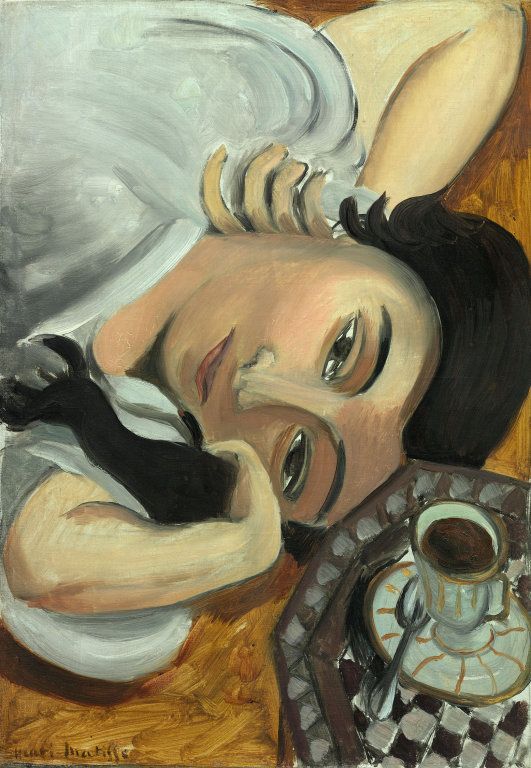
Henri Matisse’s “Lorette with Cup of Coffee” (1917) captures a private interlude and turns it into a modern icon of calm. The model—Matisse’s frequent sitter Lorette—reclines on a wooden floor or low divan, her cheek resting on the crook of an arm, her dark hair pooling into the composition like a ribbon of ink. Beside her, on a small tray patterned with a check of cool and warm tones, sits a demitasse and saucer. Nothing in the painting is staged for spectacle. Instead, Matisse builds intimacy from proximity, gentleness from a limited palette, and presence from the authority of line. The image reads instantly across a room and then unfolds slowly, revealing how the painter locates feeling in structure, rhythm, and the material pleasure of paint.
An Immediate, Disarming First Impression
At first glance the painting feels tender and unguarded. Lorette is neither posing nor performing; she is simply present, her head tilted, eyes open, body relaxed. The coffee, still dark and unspoiled by milk, signals a pause—a small daily ceremony that frames the sitter’s solitude. The mood is neither dreamy nor dramatic. It’s the honest quiet of a morning or late afternoon when light is steady and time loosens its grip. Matisse refuses props beyond what is needed. No patterned draperies or elaborate furnishings intrude, and the result is a portrait that is both personal and universal: anyone who has rested with a warm cup nearby recognizes the feeling.
A Bold Composition Turned on Its Side
One of the picture’s most striking decisions is compositional. Matisse rotates the subject so that the head fills the left half of the canvas on a diagonal, the arm arcs across the lower register, and the cup occupies the lower-right corner. This rotation creates a supple Z-shaped movement that carries the eye from forehead to nose, down the wrist, across the tray, and back up to the sitter’s gaze. It is a modern answer to the reclining figure: instead of spreading the body across a long horizontal, he concentrates the head and hand in a tall frame, letting the coffee act as counterweight. The sense of closeness comes partly from this turn; the viewer is pulled into the same plane as the face and cup, as if kneeling beside the sitter.
Nearness as a Strategy of Intimacy
Matisse positions us just inches from Lorette. The cropping is tight, placing her cheek almost against the picture plane. This nearness eliminates unhelpful distance and prevents the portrait from turning theatrical. It also allows the painter to use large, readable shapes—sleeve, cheek, brow, cup, saucer—without resorting to fussy detail. You can count the painting’s essential forms on one hand, and that economy gives the scene its ease. We sense breath, not performance; company, not display.
The Authority of Line and the Quiet of Edges
The drawing is carried by a flexible black that behaves like architecture. Eyebrows, upper lids, the bridge and wing of the nose, the lip’s rim, and the core shadows around the wrist and knuckles are all stated with strokes that thicken and thin, recording the pressure of the brush. These lines are never decorative; they stabilize the design. Elsewhere Matisse lets edges go soft—the outer contour of the cheek, the fold of the sleeve—so that air enters the picture. The alternation between firm line and dissolving edge generates a rhythm the eye enjoys: attention sharpens, then rests, then sharpens again.
A Palette That Feels Like a Room You Know
Color is deliberately restrained. Cool whites and silvers describe the blouse and saucer; peach and rose ochres build skin; deep, elastic blacks define hair and contour; honeyed browns and ambers warm the wood surface; a dull maroon-violet and dusty gray checker animate the tray. Because the palette is narrow, relationships do the expressive work. Warm skin against cool cloth makes the face glow. Black hair against pale cheek clarifies the head’s turn. The dark coffee mirrors the hair’s value and binds the cup to the portrait, not just to the tray. Nothing shouts; each hue finds its register and keeps to it, creating the serene climate Matisse prized.
Light as a Broad, Democratic Envelope
The light in “Lorette with Cup of Coffee” has no single theatrical source. Instead it acts like an even atmosphere that clarifies planes and keeps color truthful. Highlights register where form turns—on the bridge of the nose, along the upper lip, over knuckles, on the cup’s rim—yet they are never hard. Shadows are gentle and often cool rather than brown, allowing flesh to remain fresh. This even, respectful light is why the portrait feels breathable. It’s a painter’s light rather than a photographer’s: meant to serve color and structure, not to create drama for its own sake.
The Pleasure of Brushwork You Can Feel
Matisse leaves the record of his hand visible. The blouse is laid with supple, crescent strokes that track the garment’s folds and act like a second set of contours. Skin is modeled with broader, flatter passes that change direction as planes turn, ensuring volume without fuss. Hair is brushed in weighty, lacquer-like swathes that sit on top of the underpainting, giving the mass density and sheen. The wooden ground uses longer, slightly sinuous strokes whose direction suggests the grain. On the tray, the checker is stated with small, committing squares, each stroke adjusted to the tray’s oval and perspective. The painting is not polished to hide its making; it celebrates touch.
The Cup as Counterpoint and Anchor
That small demitasse does an outsized amount of structural work. Its rim and saucer offer circular forms to counter the diagonals of arm and face. Its dark contents echo the value of the hair, tying the lower corner to the center of the portrait. The oval base anchors the lower-right edge so the composition doesn’t float. And as image, it is a pocket of ritual: a token of pause and solitude that gives the painting its title and its emotional temperature. In a picture with so few actors, the cup is the necessary second presence—a quiet companion to the thoughtful face.
Geometry and Rhythm Hidden in Everyday Forms
Under the scene’s ease lies crisp geometry. The arced forearm and the curve of the cheek set two long, parallel sweeps. The bend of the wrist mirrors the saucer’s oval. The tray’s diagonal edge answers the incline of the head. Even the eyebrow’s dark arch is echoed by the handle’s shadow on the saucer. Matisse never advertises these correspondences; he embeds them so that the eye, even without noticing, benefits from their harmony. This is the painter’s craft at its most humane: order made effortless.
Psychological Nearness Without Theatrics
The expression is not a thesis; it’s a mood. Lorette’s gaze is soft, slightly inward, open to us without asking for judgment. The forward tilt of the head implies listening. The proximity of hand to mouth suggests thoughtfulness, not anxiety. Because Matisse refuses exaggerated signals—no furrowed brow, no smile—the viewer’s own feeling can enter the scene. Psychological depth arrives through tempo and relation: the long diagonal that slows the eye, the safe weight of the hand under the cheek, the reassuring, stable oval of the cup.
A Portrait in the Heart of the Lorette Series
Between late 1916 and 1917 Matisse made dozens of images with this model—seated, standing, reclining; in blouses, robes, turbans; against flats of green, red, or patterned fields. “Lorette with Cup of Coffee” sits near the center of that exploration and shows what the series was testing: how little is needed to conjure a person with conviction. Compared with more elaborate interiors Matisse would soon pursue in Nice, this canvas is pared down. Yet the kernel of his later odalisques is already here: a figure at ease, a domestic ritual, decorative pattern (the tray) held in check by strong contour.
The Wartime Discipline of 1917
The year matters. In 1917 Matisse had turned from the blazing Fauvist hues of a decade earlier toward a steadier, more structural language: black returns as a constructive color; chroma is rationed; compositions are built from a few large planes. That discipline is everywhere in this picture. The black of hair and line unifies the design; the whites of blouse and saucer carry light; the earth tones keep warmth grounded. The result is quiet authority rather than spectacle—a portrait that steadies rather than taunts the viewer.
Dialogues With Tradition, Spoken in a Modern Accent
A resting figure with a cup is as old as painting itself, but Matisse’s grammar is modern. He declines the story-laden interiors and virtuoso reflections of nineteenth-century realism. Where an academic painter would model the cup with meticulous highlights and multiple light sources, Matisse uses a few decisive shapes and lets the eye complete the rest. Where a salon portrait might dress the sitter in status and narrative, he trades those for nearness and clarity. The past remains present as a set of problems—how to make volume with color, how to seat a figure in space—but the solutions belong to the twentieth century.
The Eye’s Route Through the Picture
Matisse designs a loop that never tires. Most eyes start at the sitter’s nearest pupil, cross the bridge of the nose to the far eye, slide to the small bloom of color in the lips, and then travel down the forearm’s arc to the tray. The checker’s rhythm slows the gaze just enough to register the cup’s weight before the route returns up along the sleeve’s pale ridge and lands, once again, in the eyes. Every turn is marked by a clean value contrast—dark hair against pale cheek, white cup against maroon squares, warm wood against cool blouse—so the circuit remains fresh. The painting teaches looking as a kind of gentle walking.
Material Facts That Keep the Image Honest
The surface includes small pentimenti—subtle adjustments along the edge of the cheek or the outer sleeve where Matisse shifted a line to better fit the whole. The tray’s pattern shows minor irregularities that humanize the geometry. In the coffee’s dark, you can read a thicker application that resists light differently than the blouse’s thin scumbles. These facts matter because they keep the scene from becoming a poster. Presence depends on particularity, and particularity is what the hand leaves behind when it has made up its mind.
The Cup of Coffee as Modern Still Life
Many Matisse portraits include a compact still life that almost functions as a second portrait: a pot, a bouquet, a fruit. Here the demitasse is that second subject. It articulates scale (the hand could grasp it), establishes culture (the café ritual of the modern city), and offers the painting a small theater of ellipse, cylinder, and oval that contrasts beautifully with the softer anatomy of face and arm. If the portrait whispers a story, it’s about attention: to the person before us and to the little cup that makes a moment of the ordinary.
Sensing Time: Morning, Afternoon, And the Pace of Looking
The painting’s temperature invites you to assign a time of day—many feel morning in the cool blouse and fresh skin, others see late afternoon in the deep coffee and amber wood. Matisse does not decide; he leaves the hour open. What he does fix is pace. Everything in the canvas slows: the long diagonal of the body, the steady checker of the tray, the equal, democratic light. The viewer’s nervous system meets that pace and settles. In this way the painting fulfills the goal Matisse often named: an art of balance and serenity that offers true rest without dullness.
Why “Lorette with Cup of Coffee” Endures
The canvas endures because it gets difficult things right with very little. It turns nearness into intimacy without sentimentality. It lets pattern decorate without taking over. It models volume with color rather than tricks of shadow. It gives ritual—the humble coffee—the dignity of form. From across a room you recognize the scene immediately; at arm’s length you feel the painter’s decisions in every edge and stroke. The work is both personal and exemplary, a compact lesson in how modern painting makes presence from a handful of relations put exactly in place.
A Closing Reflection on Rest and Attention
To sit with this picture is to practice the very act it depicts: pausing, breathing, attending. The head rests on the hand, the coffee waits, the light keeps its promise. Matisse’s great gift is to make that ordinary interval feel complete. Nothing is missing; nothing clamors. The viewer leaves not with a story but with a tempo—a way of seeing that can be carried back into the day, as restorative as a small cup set just so on a tray.