Image source: wikiart.org
A Red Ground for Rest and Line
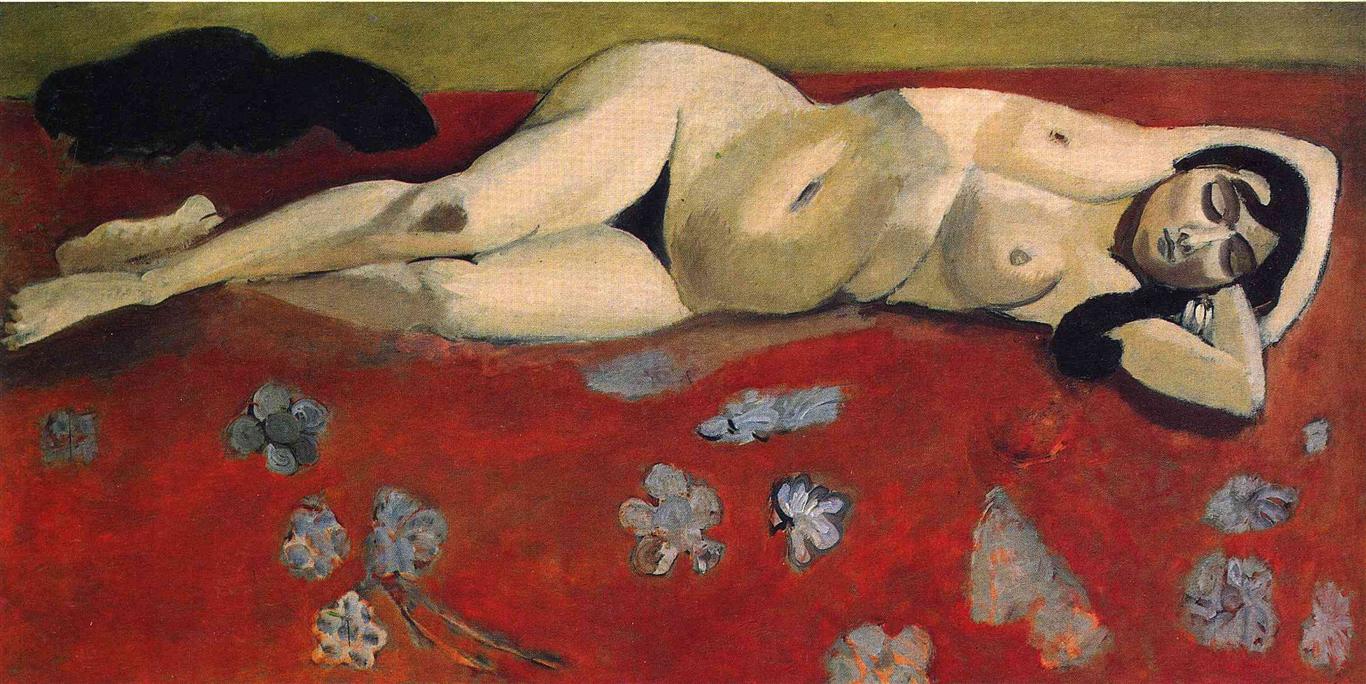
Henri Matisse’s “Lorette Reclining” (1917) presents a sleeping nude stretched from edge to edge across a saturated red field strewn with pale floral forms. The body lies almost parallel to the canvas’s long horizontal, head at the right, feet at the left, one arm folded to cradle the cheek. A narrow band of olive-green caps the composition, while small passages of dense black accent hair and shadow. The first impression is of calm amplitude: a figure perfectly at home in a sea of color, weightless and serene, rendered with Matisse’s characteristic union of decisive contour and breathing paint. Rather than staging anecdote, the painting proposes a few relations—flesh to red, contour to pattern, horizontality to gentle diagonals—and lets them carry both form and feeling.
The Composition’s Frieze-Like Logic
The format is panoramic, and Matisse uses it to transform the reclining figure into a continuous frieze. The body unfurls as a single, legible ribbon: ankles crossed at the left; knees slightly bent; abdomen and hip forming the composition’s high swell; torso tapering into shoulder, arm, and the self-pillow of a bent wrist. The head, nestled near the right edge, closes the line with a dark, rounded mass of hair that answers the small black shadow behind the feet. This left–right echo locks the figure into the field. Because the pose runs nearly the entire width, the surrounding space becomes less a room than a color-plain, so that the nude reads as both person and sign—an arabesque inscribed on a textile earth.
The Red Field as Architecture
Matisse’s red is not merely background; it is the painting’s architect. Its saturation anchors the canvas, its breadth supplies the atmosphere, and its temperature calibrates every other color. Across the field, the painter scumbles cooler and warmer reds, drags the brush so underlayers breathe through, and allows patches of gray-pink to bloom like abrasions or faded areas in fabric. These nuances are not fussy; they are enough to give the ground a living, tactile presence. Sprinkled over this expanse are pale, flower-like devices—bluish, silvery, mauve—that hold the eye in place and keep the field from sliding into uniformity. Pattern here behaves as a rhythm rather than a narrative, like islands in a sea that confirm the scale of the figure.
Color Relationships That Define Mood
The palette is disciplined and eloquent: the red ground; the olive band; warm, creamy flesh with cool gray shadows; and strategic pockets of black. Because the colors are few, their relationships carry meaning. Flesh appears luminous because the red remains strong and surrounding shadows stay cool. The narrow green at the top tempers the heat below, functioning like a horizon that admits air. Black, sparingly placed in hair and at two or three pressure points along the body, organizes value and prevents the picture from feeling weightless. The economy is typical of Matisse in 1917: reduced chroma compared with Fauvism’s blaze, but a heightened sense of how each hue does structural work.
Contour as a Quiet Authority
The figure is built with Matisse’s supple contour—sometimes a steady, dark line; sometimes a soft edge produced by a shift of temperature rather than a drawn stroke. Along the legs and hip the contour is firmer, asserting the body’s rise against the red; at the breast and cheek it loosens, allowing light to feather the boundary. These choices are not ornamental. They determine how the figure sits on the ground, when it floats and when it anchors, where the eye lingers and where it glides. The line’s pressure changes become a music in themselves, telling the viewer how to move through the pose without the need for strict anatomical description.
Modeling That Respects Flatness
Matisse refuses theatrical chiaroscuro. Volumes are turned with modest value steps and cool-warm shifts rather than with deep shadows. Knee and hip are rounded by transitions so gentle that the paint seems to breathe. Gray-green notes in the shadowed thigh and beneath the arm echo the olive band, knitting figure to field. Because modeling is so restrained, the body retains a planar clarity that cooperates with the decorative ground. The nude is not an illusionistic statue lying on a carpet; it is a painted body sharing the same ordered climate as the red field beneath it.
Pattern Versus Plain in Productive Tension
The floral devices scattered across the red provide ornament, but they are carefully placed to serve composition. Clusters near the figure’s midsection and along the lower edge counterbalance the visual weight of head and hip. Their pallor keeps them recessive, while their cooler temperature keeps the red vivid. Most importantly, the blossoms never intrude upon the figure; they stop short of the contour, acknowledging the body’s primacy. This negotiation between patterned ground and simplified figure anticipates the complex interiors of Matisse’s Nice years, where patterned textiles, screens, and ironwork would frame and amplify the human form without dissolving it.
Shallow Space and the Comfort of Compression
There is almost no perspectival depth in the usual sense. The red carpet is a plane; the olive band implies a wall or distant strip of floor; the figure lies between them like a relief. The shallow space enhances the image’s calm. It prevents the gaze from wandering into corners; it concentrates attention on relations that feel inevitable. This compression also allows Matisse to treat body and ground as partners in one decorative order, an idea central to his project from the Fauve period onward: painting as a flat surface organized to create a particular kind of pleasure and clarity.
The Psychology of Sleep Without Sentimentality
Although the body is fully nude, the tone is not eroticized in the descriptive sense. The eyes are closed; the face is composed; the arms form comfortable brackets for head and torso. The pose suggests trust and repose rather than display. Matisse’s vision of the reclining nude is less about voyeurism than about the ideal of rest he often spoke about—an art of balance and serenity. The painting offers companionship in quietude: a human shape at ease in a world ordered by color and line.
Lorette as Muse and Transition
The model known as Lorette appears throughout Matisse’s work from late 1916 through 1917, varying between clothed portraits and several nudes. In “Lorette Reclining,” she becomes a hinge figure between the pared-down, structural portraits of the war years and the luxuriant odalisques of the early 1920s. The restrained palette and the frank drawing belong to the former; the emphasis on textile ground, the languid pose, and the enlarged field of color foreshadow the latter. The picture thus reads as a rehearsal: a rehearsal for the long horizontal odalisque formats, for the red rooms and patterned carpets, and for the modern reimagining of the reclining female figure that Matisse would develop in Nice.
Dialogues With Tradition, Spoken in a Modern Accent
The reclining nude carries a lineage from Titian and Giorgione to Ingres and Manet. Matisse’s version keeps the essential—horizontality, the long, continuous silhouette, the format that asks the eye to travel—while stripping away anecdote. There is no velvet couch, no elaborate drapery, no attendant. By exchanging those props for a plane of color and a few floating motifs, he retains the genre’s composure while renewing its terms. The historical conversation is present, but the painting speaks with Matisse’s own accent: a commitment to essentials, to the equality of figure and ground, and to the authority of color.
The Body as Landscape
One of the painting’s loveliest effects is the way the nude reads like a landscape within the field. Hip becomes hill, abdomen a gentle plateau, shin a pale river course crossing red terrain. Viewed this way, the floral devices become both blossoms and clouds, the red a desert or an orchard floor, the olive band a narrow horizon. This double reading is not a trick; it is a consequence of the image’s flatness and its reliance on large shapes. The body becomes an abstract path for the eye, and the landscape of the carpet becomes a sensual ground—the two readings folded into one.
Edge, Interval, and Breathing Room
Matisse is attentive to distances: the gap between toes and left edge, the small cushion of red beneath the right elbow, the breathing space above the head before the olive band. These intervals matter. They keep the figure from crowding the borders, and they let the composition’s music play in time. Where he wants tension, he narrows the gap; where he wants ease, he widens it. The rhythm of patterned blossoms cooperates, occasionally clustering near a pressure point (the hip, the knee) to stabilize the long sweep of the pose.
The Eye’s Journey Across the Picture
The painting proposes a satisfying route for the gaze. Most viewers begin at the head—dark hair against pale cheek—then follow the curve of neck and shoulder to the breast, across the abdomen’s soft rise, and along the legs to the crossed feet at the left edge. From there, the flowers and scumbled reds guide the eye back through the middle ground toward the head. The olive band offers a resting line before the circuit repeats. Each lap reveals new particulars: a cool gray under-plane at the elbow; the slight dark pressure mark at the knee; a feathery bloom of paint in a flower; the way the contour thickens where weight meets ground.
Material Facts That Ground the Dream
Up close, the surface records deliberate work. The red is laid in both thinly and thick, leaving ridges that catch real light; the flesh shows warm and cool passes that knit into gentle transitions; black has been brushed in with enough body to sit on top of the ground, asserting structure. Small pentimenti—adjustments at a knee or along the torso’s contour—remain faintly visible, reminding us that the figure was sought and found, not traced. These facts keep the painting from becoming a poster. They hold it in the world of things made.
Light as a Shared Envelope
Illumination feels ambient, not directional. There are no harsh cast shadows, only modest coolings along the body’s under-sides and soft accents on cresting planes. Highlights appear as broader pale areas rather than as pinpricks, respecting the matte character of both skin and carpet. This shared light is one of the reasons the figure belongs so intimately to the ground. Everything sits in one atmosphere, and that atmosphere is color.
Why the Painting Endures
“Lorette Reclining” endures because it embodies a rare balance: frank sensuality without fuss, modern flatness without chill, decoration without distraction. From across a room it reads instantly—a pale, sleeping body afloat on a sea of red. Up close it reveals a wealth of painterly decisions, each modest, all necessary. It is not a spectacle but a place of rest, made of the simplest possible terms: a horizon of olive, a field of red, a body drawn with care. In a year of discipline and transition for Matisse, the painting offers the serenity he prized—an art that steadies the viewer by means of clarity.
A Closing Reflection on Rest and Order
Matisse often said he wanted his art to be like a good armchair for a tired worker. “Lorette Reclining” makes that ambition visible. It invites the eye to lie down with its subject, to stretch along the length of the composition and breathe. The flower forms drift, the red warms, the contour quiets. Nothing asks for more than attention; nothing asks for less. The painting shows how a human body, simplified and cared for by color and line, can make a world where looking itself becomes a form of repose.