Image source: wikiart.org
A Face Made of Planes and Presence
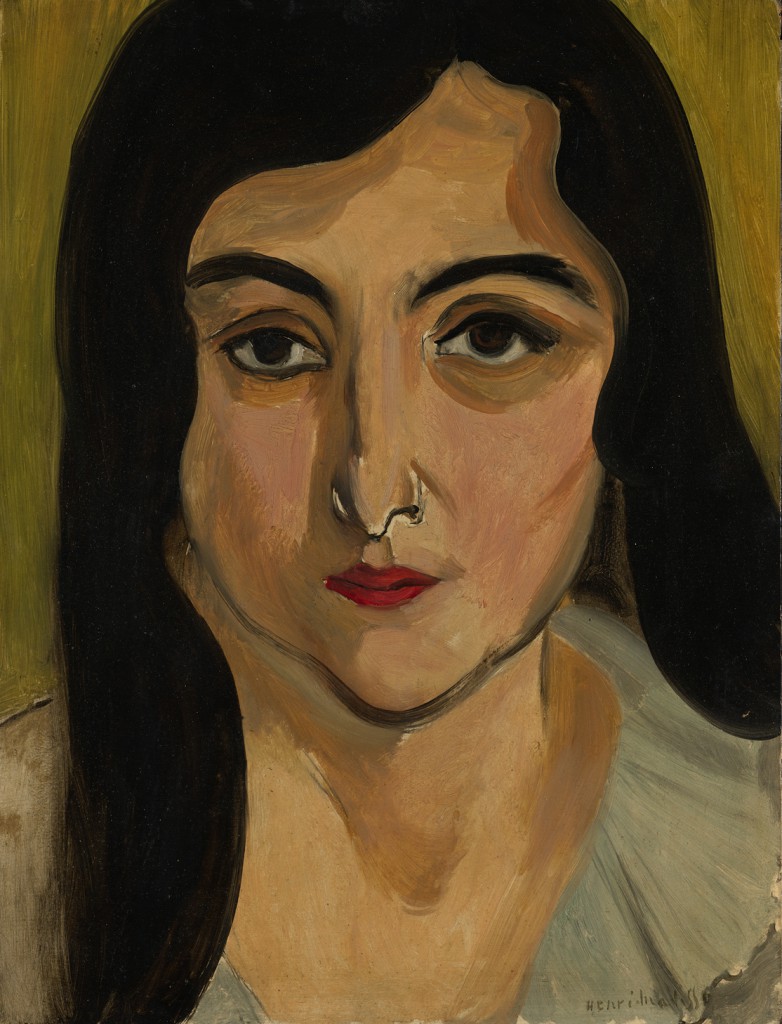
Henri Matisse’s “Lorette” (1917) confronts the viewer with a head that fills almost the entire canvas. The composition is startlingly close: no chair, no patterned fabric, no window to suggest a setting—only a face, hair, and a thin halo of background. Matisse’s model, known simply as Lorette, was a central muse for the artist in 1916–1917, appearing in dozens of paintings that probe the boundaries between likeness and design. In this version he distills her presence to the essentials. Broad planes of warm flesh meet a curtain of black hair; eyebrows are dark, decisive arcs; the nose is a narrow wedge; the mouth a compact flare of red. The portrait reads across a room in a single beat, yet on close inspection it reveals a finely tuned system of edges, temperatures, and value shifts that make the face breathe.
A Composition That Chooses Intimacy Over Stagecraft
The painting’s first decision is its cropping. Matisse brings the head and shoulders so close to the picture plane that the sitter becomes an environment in herself. The skull nearly touches the top edge; the hair at left slides off the canvas; the shoulders arrive only as pale, angled triangles of blouse. The background—an olive, airless field—exists simply to keep the silhouette legible. This compositional compression has consequences. It removes anecdote and forces the portrait to carry meaning through structure: the balance of masses, the tilt of features, the pace of contours. The viewer does not look at a person “in” a room; the viewer meets a person, period.
Color as Climate and Character
Matisse restricts the palette to a few notes and lets their relationships carry the psychology. The skin is a range of ochres and beiges tinged with rose; the hair is a dense, nearly absolute black; the background is a muted olive; the blouse is a cool gray; the lips are a strong, saturated red. Because the colors are few, each has a role. Black anchors and frames; olive pushes the head forward without sparkle; gray cools the lower register and makes the skin glow by comparison; red becomes a single, strategic accent that collects attention at the mouth. The face is warm without blush, calm without pallor. Matisse’s color reads as temperament: clarity, focus, and self-possession.
Drawing With the Brush
Contour in this painting is not an afterthought; it is the armature of likeness. Matisse draws with a loaded brush, setting the borders of eyebrows, eyelids, nostrils, hairline, lips, and chin in strokes that thicken and thin as they move. These lines are not fussed. They do not chase every ripple of anatomy. Instead, they fix the large relations on which recognition depends. The right brow lifts slightly higher than the left; the upper lip’s bow is stated in one confident sweep; the chin is cupped by a dusky line that gives the head weight. Within those contours, Matisse lets paint travel softly, so volumes rise and fall without a network of small hatchings. The face becomes a field of decisions—few, clear, and irrevocable.
Planes, Not Details
Matisse builds the face with planes, not with pores and lashes. The forehead is a broad table of light that steps down at the temple; the eye sockets are warm hollows topped by the black of brow and lid; the bridge of the nose is a narrow, cool plane that catches a glint; the cheeks swell in gently warming tones; the jaw turns away with a single shift into shadow. This planar construction allows the portrait to hold together at any distance. From afar the head reads as a coherent architecture; up close, the transitions remain smooth and convincing, never breaking into illustrative smallness. The method aligns Matisse with Cézanne’s lesson about “modulations” of color and value, yet it remains distinctly his in its concision and calm.
Red Lips as the Picture’s Pulse
The mouth is the most saturated element in the portrait. Matisse uses a tight, bright red that sits cleanly on the flesh tones and is held by a dark, minimal rim. The color carries expressive weight without resorting to modeling. It suggests warmth and alertness, a readiness to speak, and it anchors the vertical axis of the face. Because no other hue approaches its intensity, the red also calibrates the entire palette, making the olives cooler, the blacks deeper, and the skin more luminous. The mouth becomes both a psychological and structural center.
Hair as Architecture
Lorette’s hair is handled as a single monumental form. At left it falls like a black curtain; at right it curves inward, almost framing the cheek with a negative S-curve. The hair’s density simplifies the composition into two interlocking regions—warm flesh and dark mass—so that the smallest inflections at the boundary (a soft bay at the temple, a tighter curve near the jaw) have powerful effects. The hair’s near-absolute black also stabilizes the value scale. It gives the portrait its gravest tone, against which every lighter color can be measured.
Light Without Theater
The light in “Lorette” is broad, diffuse, and undramatic—more an atmosphere than a spotlight. There are no hard cast shadows on the wall, no deep creases under the nose or chin, no glitter across the eyes. Instead, the skin turns with gradual changes in value and temperature. Highlights are simply paler notes; shadows are modest coolings. This light grants dignity. It doesn’t probe; it reveals. It allows the color to remain faithful and the surfaces to keep their softness. The approach matches the painting’s larger ethic: clarity over display, essentials over bravura.
The Background as Quiet Force
The olive ground looks simple, but it is a carefully tuned field. Its warmth relates to the flesh yet remains muted; its cool undertone quietly binds the gray blouse. The brushwork is visible—long, slightly diagonal sweeps that keep the color lively while staying recessive. The olive field also eliminates depth cues, so the head sits nearly flush with the picture plane. That compression, combined with the frontal gaze, produces a sense of presence stronger than any perspectival stage could provide.
The Psychology of Frontal Gaze
Frontal portraits can easily harden into masks. Matisse avoids that trap through tiny asymmetries and the tenderness of his transitions. One eyelid sits a little heavier than the other; the pupils are not perfectly centered; the nostrils differ by a hair; the mouth corners rest unequally. These variations keep the human in the icon. The gaze feels returned, not staged. Lorette appears thoughtful but not inscrutable, inward but not closed. Matisse trusts the viewer to assemble a psychological reading from these measured signs rather than from exaggerated expression.
A Portrait in the Midst of a Series
Lorette was Matisse’s primary model in the winter of 1916–1917, and he painted her repeatedly—seated and standing, in patterned blouses and plain, with elaborate hair and with simple wraps. This head-only version pushes the series toward abstraction. Costume, props, and setting drop away; surface design yields to the architecture of a face. Seeing it in the context of the series clarifies Matisse’s goals: not reportage of a person’s activities or social role, but exploration of how much feeling and recognition painting can deliver with minimal means. “Lorette” is the distilled answer.
Between Fauvism and the Nice Period
Historically, 1917 is a hinge. Matisse’s Fauvist blaze of primaries had cooled into more tempered harmonies. Black returned to his palette as a structural color, not just a contour. In a few years he would settle in Nice and create interiors filled with patterned fabrics, iron balconies, and languorous figures bathed in Mediterranean light. “Lorette” stands between these eras. It borrows Fauvism’s conviction about color’s independence while adopting a new calm in composition and tone; it anticipates the Nice portraits’ serenity while retaining the experimental strictness of the wartime studio.
Influences Held, Not Worn
Commentators often note how Matisse and other modernists looked closely at non-Western sculpture—especially masks—for lessons in simplification and frontal power. “Lorette” acknowledges that lesson without literalizing it. The firm brows, the emphatic nose bridge, the hieratic pose recall sculptural economy, yet the paint’s softness and the skin’s modulated warmth keep the image humane. The portrait speaks both to a global visual history and to Matisse’s own drive toward an art of essentials.
The Eye’s Route Through the Picture
Matisse devises a compact and satisfying itinerary for the viewer. Most eyes begin at the red mouth, climb the narrow highlight of the nose to the right eye, cross to the left eye along the brow ridge, and then slide out along the hairline to the shoulder’s pale triangle. From there the gaze travels under the chin, notes the cupping shadow, and rises again to the lips. The loop is tightened by strong value contrasts placed precisely at its turns—red against warm beige at the mouth, black against light at the lid, black against olive at the hair. The portrait holds attention by rhythm rather than by narrative incident.
Material Presence: The Pleasure of Paint
Even in a picture of such restraint, the surface retains sensuous interest. The skin’s planes are laid in with visible strokes that change direction as they turn; the background sweeps reveal bristle marks and small gaps where undercolor breathes through; the hair’s black is not a flat fill but a living field where occasional warm undertones thicken the mass. These traces keep the image from feeling diagrammatic. They insist that the portrait is not just a design but a record of decisions—made in time, by hand, on a particular day.
Presence Without Anecdote
What, finally, gives “Lorette” its lasting charge is the way it balances abstraction and individuality. Strip away costume and setting, and many portraits collapse into generic heads. Matisse avoids that fate by putting pressure on the surviving elements—plane, edge, color temperature—until they carry personality. The slightly higher right brow, the firm yet small mouth, the dignified directness of the gaze: these become distinguishing traits at the level of design. The painting honors the person by respecting form.
Why This Portrait Endures
The canvas endures because it proves a demanding proposition: that a face can be rebuilt from a handful of truthful relations and still feel complex. It reads immediately across a room—a pale mask set in black hair, olive ground, red mouth—and yet rewards close, patient looking with subtle modulations and tender inflections. It belongs to its historical moment—measured, pared down, seeking stability—while also speaking outside it as a model of how to make presence out of paint. “Lorette” shows that when color, contour, and plane are set right, a portrait needs very little else.
A Closing Reflection
Stand in front of this painting and you sense the calm confidence of its making. No part is over-explained; nothing flirts for attention; everything essential is present. The sitter’s gaze meets yours plainly. The red mouth, the black hair, the quiet olive air: together they create a small zone of concentration in which looking feels like listening. In an age of noise, Matisse’s 1917 head of Lorette remains an education in clarity.