Image source: wikiart.org
Introduction
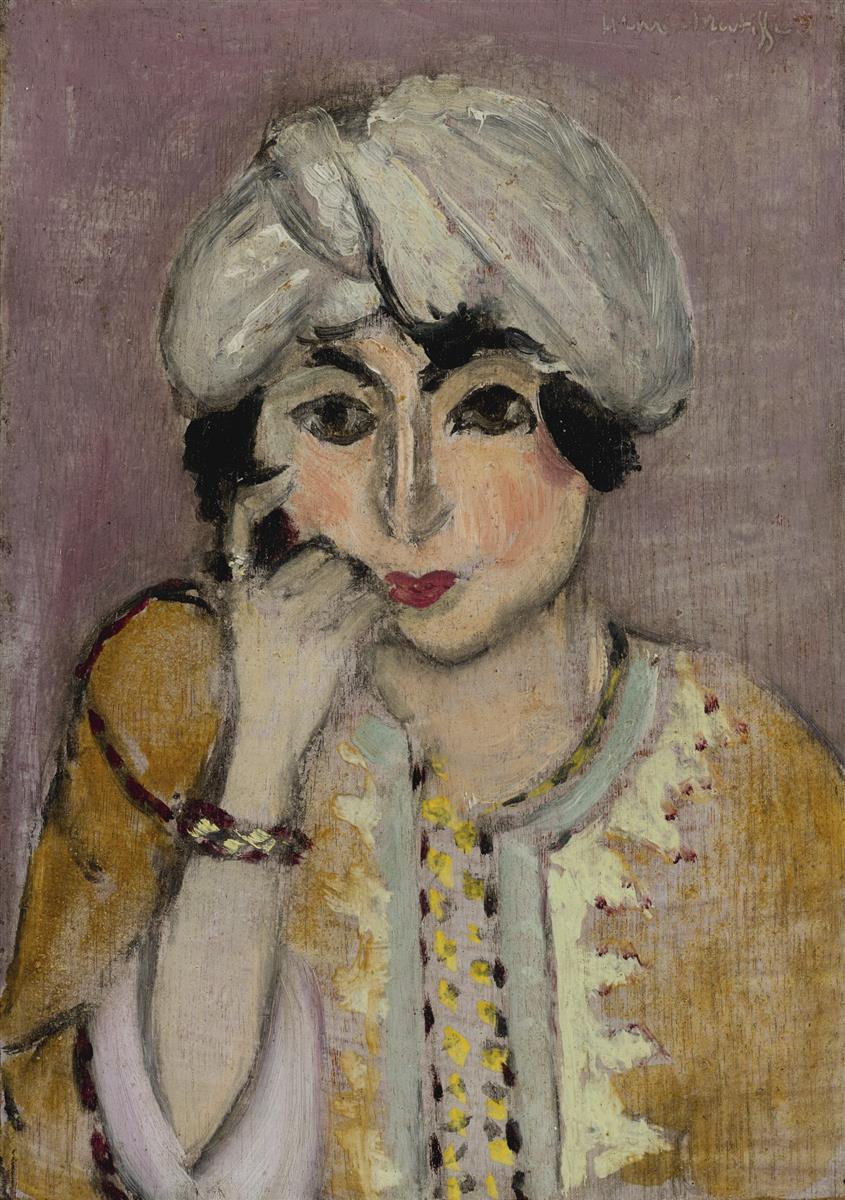
Henri Matisse’s “Lorette” (1916) presents a compact, intimate portrait that finds poetry in economy. A young woman gazes out with soft, level eyes, her cheek pressed into a resting hand. A white turban gathers dark hair into a halo; a mustard-gold jacket trimmed with light embroidery frames the face; a mauve field of paint holds everything in a quiet hush. The brush is frank, the modeling restrained, and the surface alive with the slight ridges and scrapes that record the painting’s making. What might, in other hands, become merely charming turns here into a precise study of presence, built from calibrated color, decisive contour, and the rhythmic punctuation of small ornaments. “Lorette” distills Matisse’s wartime search for clarity into a single, disarmingly direct image.
Historical Context
The year 1916 sits inside Matisse’s crucial wartime sequence (1914–1917), when he tightened his palette, simplified forms, and treated the picture plane as an autonomous field rather than a window to illusion. A few years earlier, Moroccan journeys had reawakened his interest in textiles, head coverings, and the ritual of sitting for a portrait. In 1916 he painted a sustained group of works of a model known as Lorette, exploring her features and wardrobe across a wide range of formats: busts, three-quarter views, turbaned profiles, and small canvases like this one. Each experiment tested how little information could sustain likeness while preserving the decorative unity of the surface. “Lorette” belongs to this group but feels singular for its intimacy and for the way the sitter’s quiet awareness meets the painter’s discipline.
Subject and Poise
The image is built around a gesture that feels both casual and inevitable: Lorette’s head leans into the crook of her hand, fingers resting along the cheek and chin. The pose compresses the space between viewer and sitter, creating a confidential atmosphere. Her eyes, dark and almond shaped, meet us frontally but without attack. The mouth is a sober rose, the line of the lips carefully placed to avoid sentimentality. The turban wraps the crown in broad, pale folds that function as an expanded halo, while the jacket’s trim concentrates small notes of color close to the face. The pose, so economical, allows Matisse to concentrate expression in the triangle between eyes and mouth and in the diagonal of the resting forearm that leads us there.
Composition and Framing
Matisse composes the canvas like a small stage. A mauve ground fills the rectangle with a uniform but subtly modulated field. The head sits slightly above center, pushing the eyes to the upper third and giving the portrait a quiet monumentality despite its modest size. The hand enters from the left and arcs inward, setting up a graceful diagonal that meets the vertical of the nose and the round of the turban. The jacket’s nearer shoulder intrudes in a warm curve, counterbalancing the cool plane of the cheek. The right edge remains comparatively open, allowing the figure to breathe. These few, deliberate placements keep the surface readable at a glance while rewarding close looking with harmonized intervals.
Color Architecture
The palette is concentrated and expressive. Mauve and lilac create a cool stage; creamy whites and pale grays lay out the folds of the turban and the planes of skin; black defines hair, eyelashes, and a few structural borders; mustard-gold and olive-ochre warm the jacket; lifted sparks of garnet and lemon appear in small beads and embroidered flecks; the lips carry a softened crimson. None of these hues fights for dominance. Instead they act as tuned notes in a chamber ensemble. The mauve ground cools the whites so they don’t glare; the jacket’s ochres pull warmth back toward the face; the small reds echo between mouth, bracelet, and trim, knitting the portrait together. Color here is not description; it is climate.
Light and Value
Light is spread rather than beamed. Matisse avoids dramatic chiaroscuro in favor of a calm, breathable illumination that lets the surface register as paint. The turban’s ridges are stated by slight jumps in value and temperature, not by carved shadow. The cheek blush is a warm veil laid gently over a pale ground. The jacket’s highlights are sketched with creamy strokes that stop before turning into reflected sheen. This restraint keeps the painting present tense—light as an atmosphere rather than a narrative effect—and lets small value shifts carry surprising emotional charge.
Brushwork and Texture
The brush moves deliberately and leaves its trace. The mauve field is animated by vertical and diagonal combings that break the monotony and invite the eye to register the painter’s hand. In the turban, thicker impasto rolls over the canvas weave, holding ridged highlights that make the fabric feel tactile without tedious description. The jacket’s surface mixes opaque strokes with scraped-back passages so that undercolor peeks through; this keeps the garment alive and suggests wear without anecdote. Around the eyes and mouth, Matisse switches to a more precise touch: small, loaded strokes lay out lashes and the curve of the lip, concentrating detail where the portrait’s focus belongs.
Line and Structure
Contour is presented as a living edge rather than a rigid outline. The turban’s silhouette wavers slightly, allowing air to vibrate between figure and ground. The line between cheek and hair is partly drawn and partly carried by a contrast of temperature and value. The jacket’s border along the nearer shoulder is indicated by a scalloped run of impasto, more carved than sketched. Within the face, a handful of lines are weighted carefully: the arch of the brows, the slender bridge of the nose, the quick notch that evokes a nostril. These few strokes establish structure and anchor the face without over-explaining.
Costume, Ornament, and the Decorative Ideal
Lorette’s costume is integral to the portrait’s decorative logic. The turban and jacket refer obliquely to North African dress, not as ethnographic display but as a repertoire of forms Matisse loved for their capacity to carry color and pattern close to the face. The jacket trim’s tiny repeats create a rhythmic band that frames and focuses the image; the bracelet’s braided notes echo the lip color and provide a pivot on the wrist. Matisse had long argued that a painting should possess the balanced unity of a textile. In “Lorette,” that ideal arrives not as crowded pattern but as the coordination of a few ornamental beats with broad, lucid planes.
Psychology Without Anecdote
The portrait is conspicuously free of explanatory props. No studio window, no table, no narrative object intrudes; the sitter’s personality emerges from posture, glance, and the tempo of paint. Lorette appears thoughtful but not melancholic, self-possessed rather than aloof. The resting hand suggests a pause in conversation more than dramatic languor. Because the setting is reduced, the viewer projects fewer stories and instead attends to the logic of the face: the way the brows meet, the patient weight of the eyelids, the adjusted line at the mouth which, though small, carries remarkable expressive power.
Relation to the Lorette Series
Matisse’s fascination with this sitter produced multiple portraits in quick succession, each rehearsing a different approach: spare drawings in ink and charcoal, bolder canvases with higher chroma, and intimate panels like this one that value restraint. Against the more elaborately patterned versions—where the robe or headscarf becomes a field of motifs—this “Lorette” insists on the priority of the face. It reads almost like a painter’s notebook page resolved into a finished picture: reduced, exact, and tender. Studying the series shows how Matisse could vary accent and rhythm while keeping identity constant; this iteration feels like the whispered register of that range.
Connections to Earlier Experiments
A few years before, Matisse had pressed portraiture into austere geometry, as in the bifurcated, masklike faces of 1915. “Lorette” retains the discipline those works taught—economy of mark, emphasis on large planes—but softens the severity. Where “White and Pink Head” demonstrates a structural manifesto, “Lorette” demonstrates empathy shaped by the same grammar. The eyes are still simplified, the nose a single plane, the mouth a precise sign, yet none of these choices pushes the sitter into abstraction. The painting reconciles modern clarity with human warmth.
Space and Scale
Scale matters to the portrait’s effect. The canvas’s modest size encourages the viewer to stand close, almost inside the sitter’s personal space. The shallow depth compresses figure and ground into a single field, so that the turban and jacket feel contiguous with the mauve air behind them. The result is not claustrophobic; it is intimate. Matisse trusted that a small canvas could sustain gravity if the relations of color and line were tuned. “Lorette” proves the point: it sits on a wall with quiet authority disproportionate to its dimensions.
Evidence of Process
Pentimenti and revisions animate the surface. The turban’s lower edge shows a faint earlier contour, shifted slightly upward to tighten the halo around the face. The inner edge of the cheek near the hand carries a soft halo where a previous stroke was pulled back. The mauve ground varies in thickness; here and there a scuff or scratch on the panel rides under the paint. None of these traces feel careless. They act as a record of choices, making the achieved simplicity feel earned rather than schematic.
The Role of the Hand
The hand in a portrait can drift toward distraction. Here it is a structural and psychological hinge. Its diagonal pulls the eye from the jacket’s warm shoulder into the face, and its pale value repeats the turban’s light, forming a triangle of white notes that steadies the composition. The gesture also signals inwardness without theatricality, a body at rest in thought. Matisse reduces fingers to a few soft articulations, resisting the descriptive temptation that would draw attention away from the eyes and mouth.
Light, Flesh, and the Turban’s Halo
One of the portrait’s quiet pleasures is the way light migrates across flesh into cloth. The cheek’s warm veil advances toward the viewer and then cools as it approaches the turban, where the paint thickens and lifts the light physically off the surface. The turban’s folds then carry that light outward toward the edges, where it dissolves into the mauve ground. This choreography gives the small rectangle a sense of breathing space and makes the white fabric feel both material and symbolic—a halo of attention around the sitter’s thought.
Tradition and Modernity
“Lorette” converses with historical portraiture without mimicry. The frontal gaze and modest headscarf recall Northern Renaissance panels; the compressed space and decorative emphasis on textile echo Persian and Ottoman miniatures that Matisse admired; the loose handling and respect for the picture plane align with early twentieth-century modernism. The painting borrows their virtues—frontal dignity, ornamental framing, surface candor—and fuses them into a language unmistakably Matisse’s.
How to Look
Begin by letting the portrait register as a whole: mauve atmosphere, white turban, warm jacket, dark eyes. Then dwell at the corner where the cheek meets the hand and notice how a few cool strokes make bone and pressure legible. Follow the jacket’s trim as it leads the eye up, past the bracelet, toward the mouth. Hover over the turban’s ridges and watch how broken whites become cloth. Step back until the picture becomes a harmony of four or five colors; step forward to feel the drag of the brush. The painting yields its richest pleasure in this oscillation between clarity at a distance and tactile evidence up close.
Legacy and Significance
As a work from a pivotal set of portraits, “Lorette” reveals Matisse’s vision of what modern portraiture could be: not anecdote, not theatrical likeness, but a durable arrangement of relations that holds a person’s presence. Designers can learn from its restrained palette and tight orchestration of accents; painters can read it as a manual in economy—how a single curve can carry a cheek, how two strokes can pronounce an eye. Viewers discover that intimacy need not rely on detail; it can arise from the trust placed in a handful of tuned elements.
Conclusion
“Lorette” demonstrates how Matisse could convert limited means into expansive feeling. With a compressed range of colors, with lines that do only what is necessary, and with brushwork that leaves room for air, he creates an image that feels both private and public, both quiet and resonant. The portrait’s calm is not emptiness; it is balance. Over a century later, the canvas still reads as fresh because it asks so little and gives so much: a conversation held in whispers, a face shaped by light and thought, and a surface that remembers every touch.