Image source: wikiart.org
Introduction
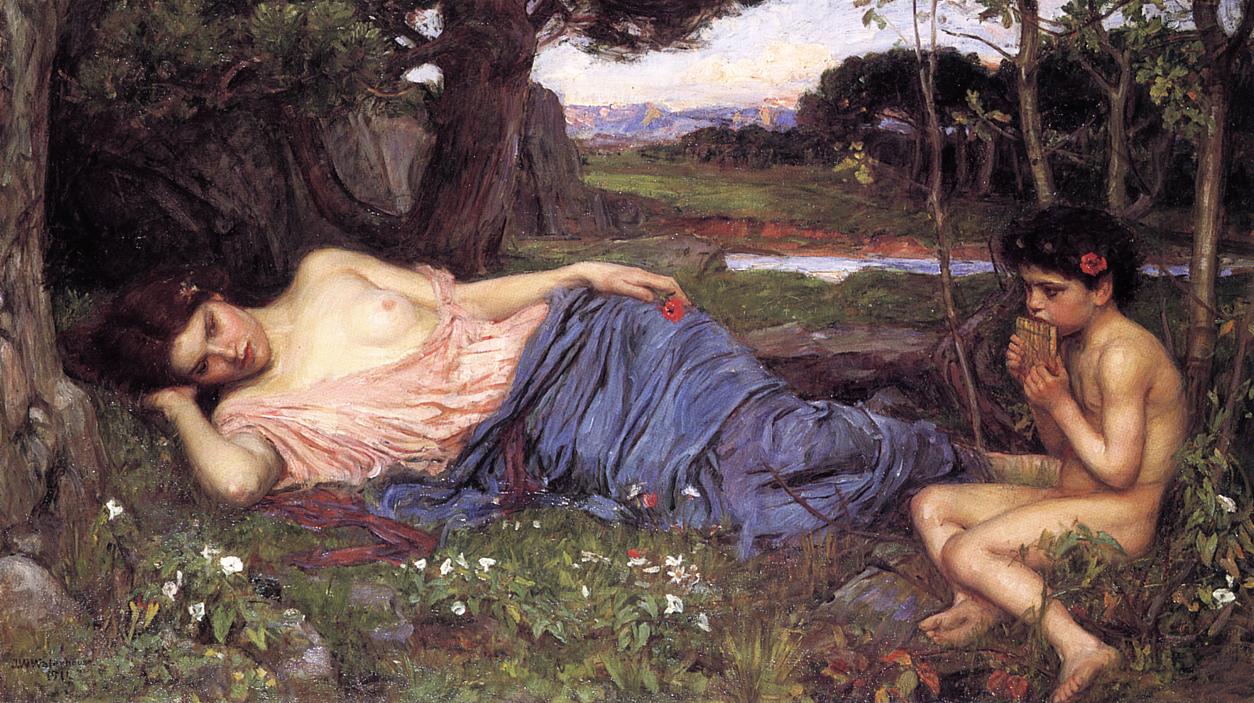
John William Waterhouse’s Listen to My Sweet Pipings (1911) is a late work that distills many of his enduring interests into a single, quietly theatrical scene. A reclining nymph rests in the shade at the edge of a clearing while a youthful faun, half hidden by branches, plays the panpipes. The encounter is intimate without being overt, suspended between invitation and reverie. Nothing “happens” in a narrative sense, yet the painting feels charged because Waterhouse frames it as an exchange of attention. Sound is the subject as much as sight, and the title makes that clear, asking the viewer to imagine music threading through the stillness.
The picture belongs to Waterhouse’s long conversation with classical myth. Rather than treating antiquity as distant history, he uses it as a stage for recognizably human states: boredom, curiosity, desire, absorption, and the shifting power dynamics of looking and being looked at. In this canvas, the mythological veneer serves a modern psychological aim. The nymph’s heavy-lidded calm and the faun’s concentrated effort create a drama of mood, not action. Waterhouse invites us to linger in that mood and to notice how painting can suggest the senses it cannot literally reproduce.
The Mythic Setup and Its Emotional Stakes
The nymph and the faun carry immediate symbolic weight. In Greco-Roman tradition, nymphs embody the life of a place, the spirit of water, woods, or meadows, while fauns and satyrs represent the untamed, musical, and impulsive energies of nature. Waterhouse does not insist on strict iconography, but he draws on the associations that viewers bring to these figures. The faun’s panpipes are a clear sign of rustic music and pastoral pursuit. The nymph’s repose suggests the languor of midday in an Arcadian landscape, a world where time slows and sensation takes precedence over duty.
What makes the scene compelling is how restrained it is. The faun is not painted as a forceful intruder, and the nymph is not painted as a simple object of conquest. Instead, Waterhouse stages a mutual awareness. The faun plays, watching her response. The nymph listens, poised between sleep and attention, her posture relaxed yet not completely unguarded. The title reads like a spoken line, which adds a note of persuasion. The painting therefore becomes a study of influence: can music soften resistance, awaken curiosity, or deepen a dream? Waterhouse keeps the answer open, and that ambiguity is part of the work’s modernity.
Composition and the Slow Pull of Attention
The composition is built around a diagonal that runs along the nymph’s body, from her head at the left to her legs extending toward the right. This long, reclining form establishes calm dominance in the picture. It is the largest shape, the brightest area of flesh, and the primary carrier of light. Against it, the faun is placed at the far right edge, smaller, darker, and partially screened by foliage. This imbalance matters. The nymph appears to occupy the landscape with ease, while the faun seems to approach from its margins, almost as if nature itself is leaning in to speak.
Waterhouse uses the tree trunk and overhanging branches as a framing device. The left side is anchored by dense shadow and bark texture, which creates a sheltered nook for the nymph. The right side opens outward, with thinner trees and a glimpse of distance. This contrast between enclosure and openness supports the theme of invitation. The nymph rests in a private pocket of shade, and the faun’s music travels across that boundary. The viewer’s eye follows the blue drapery, then tracks toward the faun’s hands and instrument, completing a visual circuit that mimics listening: attention moves out from the resting figure, then returns.
Light, Color, and the Temperature of the Scene
The palette is characteristic of Waterhouse’s late style, earthy, muted, and softly luminous. Greens and browns dominate the foreground, but they are not bright spring greens. They are deep, slightly greyed tones that suggest late summer or early autumn, a season where warmth remains but the air begins to cool. The nymph’s skin is painted with gentle transitions, warm highlights and cooler shadows, so that the body reads as living presence rather than marble. The fabric, especially the blue cloth, becomes a crucial color counterweight. It introduces coolness and depth, like a pool of shadowed water laid across the grass.
Light appears filtered, as if coming through leaves rather than striking directly from above. That filtering is important because it keeps the scene from becoming harsh or stark. The nymph’s face and upper body catch enough light to draw focus, but the shadows remain thick under the trees, giving the painting its hush. In the distance, the landscape opens to a pale horizon and low mountains, which introduces airy, atmospheric color and implies a wider world beyond the intimate foreground. This distant brightness does not compete with the figures. Instead, it supports them, like a soft stage backdrop that makes the nearer tones feel richer.
Texture, Brushwork, and the Sensation of the Pastoral
Waterhouse balances softness and specificity. Flesh and fabric are smoothed into convincing planes, but the surrounding nature is worked with broader, more varied strokes. Grass, leaves, and bark are described through texture rather than meticulous detail. This choice matters because it encourages the viewer to feel the environment as a sensory field. You sense the coolness of shade, the roughness of the tree trunk, the dampness of earth near the water, even though these are only paint.
The drapery is especially expressive. Its folds gather and release like waves, guiding the eye while also suggesting weight and touch. The blue cloth looks heavy enough to insulate, to keep the nymph warm as she rests. In contrast, the lighter pink fabric feels thin, almost like a veil, a delicate note against the darker ground. These material differences create a subtle narrative: the nymph is both at ease and carefully arranged, present in her body yet wrapped in a world of textures that echo the music’s imagined movement.
The Figures as Characters, Not Symbols
Although the subject is mythological, Waterhouse paints the figures with a psychological realism that resists simple allegory. The nymph’s expression is not fixed into a single emotion. It reads as drowsy, possibly receptive, possibly indifferent. Her gaze does not confront the viewer, and it does not clearly meet the faun’s eyes either. This ambiguity makes her interiority feel private. She is not performing for an audience. She is having a moment.
The faun is similarly restrained. He is focused on the act of playing, holding the pipes close, his posture slightly curled inward. Waterhouse emphasizes concentration rather than swagger. The faun’s closeness to the edge of the canvas also makes him feel tentative, as if he is unsure how fully he is allowed into the nymph’s sheltered space. This dynamic keeps the painting from becoming a straightforward chase scene. It becomes an encounter shaped by attention and response, by the uncertain outcome of music as persuasion.
Music as an Invisible Subject
Painting cannot produce sound, yet Waterhouse makes sound feel central. The panpipes are held in a way that draws attention to breath and rhythm. The faun’s hands create a small triangle of focus, and the nymph’s body becomes the receptive surface, like a landscape the music moves across. The title adds another layer. It turns the painting into a voiced moment, as if the faun is speaking or singing to her, framing his music as a direct address.
This is where Waterhouse’s narrative skill shows. Rather than depicting a clear myth episode with identifiable plot points, he chooses a fragment of experience. The viewer is invited to imagine what the music sounds like, and then to imagine how it feels to be listened to or to be the listener. The scene therefore becomes about the power of art itself. Music, like painting, can enchant without force. It can create a shared space, a temporary world where persuasion is gentle and time stretches.
The Pastoral Landscape as Psychological Space
The setting is not just a background. It functions as a mental atmosphere. The shaded foreground suggests privacy, a place where ordinary rules do not apply. The open distance suggests escape, a horizon of possibility. Between them lies a narrow ribbon of water, a reflective element that often symbolizes transition or dreaming. Waterhouse places this water behind the figures, not in front, so it reads less as an obstacle and more as a quiet echo of the scene’s emotional current.
The trees play a similar role. Their branches create a canopy that feels protective, almost like a room made of leaves. The nymph’s head rests near the tree trunk, linking her to the solidity of the earth. The faun is closer to thin saplings, suggesting movement and youthful energy. These cues are subtle, but they reinforce the idea that the figures embody different aspects of nature and of temperament. The landscape becomes the meeting ground between stillness and impulse.
Waterhouse and the Late Pre-Raphaelite Mood
By 1911, the high Victorian phase of the Pre-Raphaelite Brotherhood was long past, yet Waterhouse continued to adapt its ideals. The precision of natural detail, the love of literary and mythic themes, and the emphasis on beauty remain present, but they are softened by a later sensibility. In this work, the colors are less jewel-like than earlier Pre-Raphaelite painting, and the handling is more atmospheric. The result is a moodier, more introspective pastoral.
This late quality matters because it changes how myth functions. Myth is not presented as moral exemplum or grand historical pageant. It becomes a language for desire and dream, for the ambiguity of attraction and the quiet complexity of response. Waterhouse often returns to women in moments of suspended action, and here he does it again, but with an especially gentle tone. The painting does not accuse or preach. It watches.
Desire, Consent, and the Ethics of the Gaze
It is impossible to approach this painting without noticing that it stages looking. The faun looks toward the nymph while playing. The viewer looks at both. Waterhouse structures the scene so that the viewer’s gaze aligns first with the nymph, then is redirected to the faun. That redirection is significant because it complicates the usual dynamic of the reclining figure as a purely passive subject. The faun’s presence reminds us that the nymph is not alone, and that her privacy is already in question within the scene’s own logic.
At the same time, Waterhouse avoids depicting coercion or struggle. The nymph’s posture is relaxed, and the faun’s approach is mediated by music rather than physical action. The picture therefore sits in a tense middle ground, where attraction and vulnerability coexist. The painting’s power comes from that tension. It asks the viewer to consider how attention works, how persuasion can be soft, and how the boundary between invitation and intrusion can be emotionally complex even in a seemingly idyllic pastoral.
Symbolic Details and Their Quiet Resonance
Small details deepen the scene’s meaning. The red flower tucked near the faun’s hair and the scattered blossoms in the foreground provide accents of color that read as signs of vitality and temptation. They punctuate the green and brown palette like little sparks. The distant hills and pale sky introduce a sense of calm continuity, suggesting that this moment is part of a larger, timeless rhythm.
The fabrics also carry symbolic charge. The blue cloth suggests coolness, perhaps calm restraint, while the pink cloth feels like warmth and softness. Their overlap mirrors the painting’s emotional overlap, the meeting of repose and invitation. Even the placement of the nymph’s hand, relaxed yet not entirely slack, implies a threshold state, neither fully asleep nor fully engaged. Waterhouse is skilled at these in-between gestures, the kind that make a scene feel psychologically true.
Why This Painting Endures
Listen to My Sweet Pipings endures because it is both specific and open-ended. It presents a clear scenario, a musician trying to charm a listener, yet it refuses to lock the moment into a single interpretation. Is the nymph enchanted, amused, indifferent, or simply drifting into sleep? Is the faun confident, hopeful, or uncertain? The painting holds these possibilities at once. That multiplicity keeps the viewer returning, hearing different imagined music each time.
It also endures because it showcases Waterhouse’s ability to merge figure and environment into a unified mood. The landscape is not decorative. It is emotional architecture. The shadows, the filtered light, the cool drapery, the distant air, all of it supports the sensation of a hush broken by delicate sound. In the end, the painting becomes a meditation on art’s gentle force. Music persuades without touching. Painting makes us listen with our eyes. Waterhouse orchestrates both, and leaves us suspended in the same quiet spell as his resting nymph.