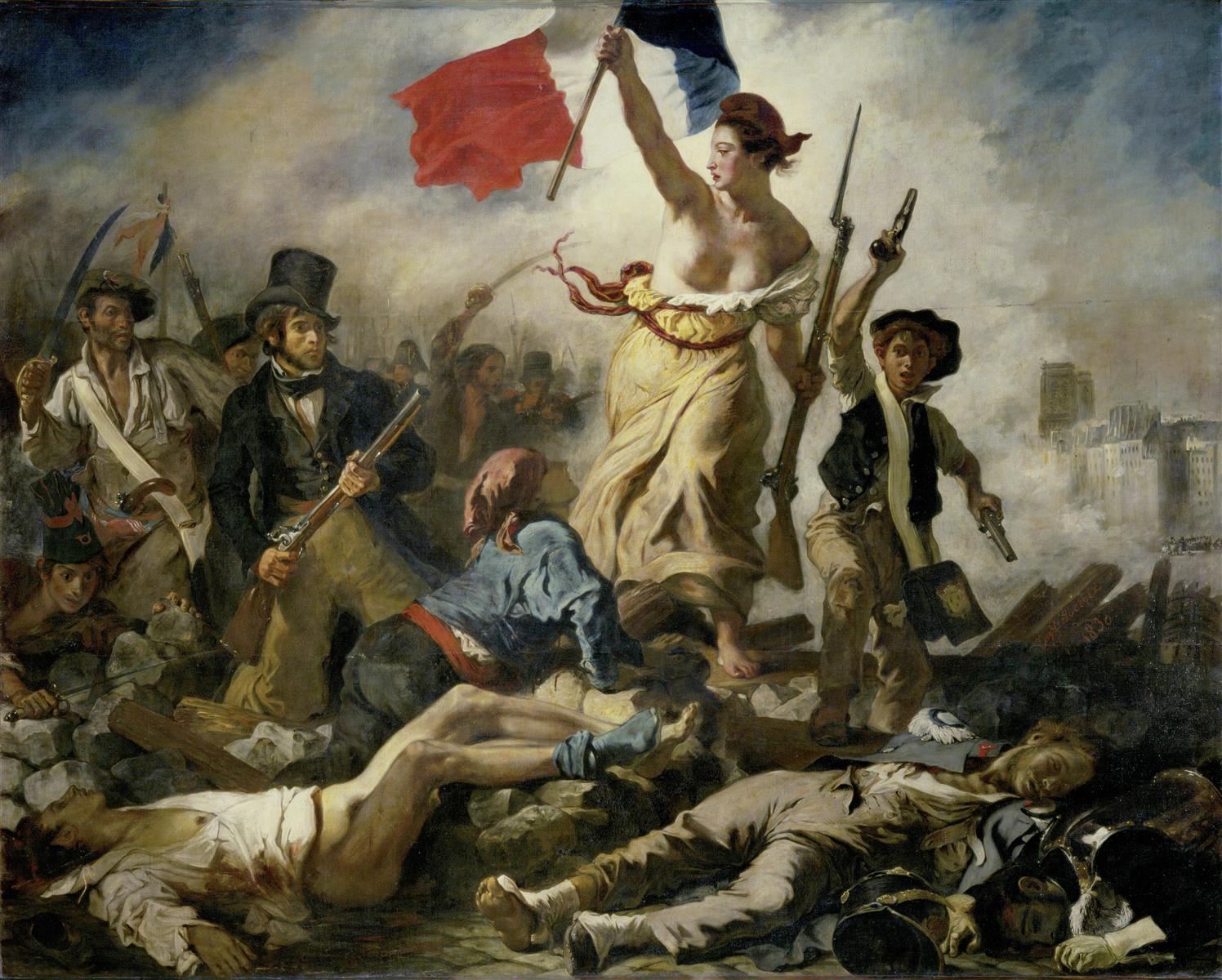
Image source: wikiart.org
Introduction
Eugene Delacroix’s Liberty Leading the People is one of the most recognizable political paintings in Western art. Created in 1830, the work stands at the intersection of history, myth, revolution, and visual theater. It is a painting that captures a specific political moment in France, yet it also rises above its immediate context to become a timeless image of rebellion and collective struggle. Few works have done so much at once. It records the energy of a popular uprising, transforms political unrest into a heroic spectacle, and turns an abstract ideal into a living, marching presence.
At first glance, the painting appears to show a chaotic street battle. Smoke fills the air, bodies lie underfoot, and armed figures surge forward over a barricade of the dead and dying. But the scene is far more than a literal report of events. Delacroix did not simply paint a documentary image of the July Revolution. He created a symbolic vision of liberty in action. The famous female figure at the center is not an ordinary participant in a Paris street fight. She is Liberty herself, embodied as a vigorous woman who leads a mixed crowd of citizens into history.
This fusion of reality and allegory is one of the painting’s greatest achievements. Delacroix understood that political art becomes powerful not only when it records facts, but when it gives shape to feelings, hopes, and ideals that people cannot easily express in ordinary language. In Liberty Leading the People, the viewer encounters revolution as emotion, as movement, and as myth. The painting is not calm or neutral. It is passionate, unstable, noisy, and charged with urgency. It asks the viewer not merely to observe, but to feel the momentum of events.
The painting remains compelling because it speaks to several audiences at once. It is a historical image about France in 1830. It is a Romantic masterpiece full of color, motion, and dramatic intensity. It is also a universal symbol of resistance against oppression. Even viewers who know little about French history can sense its power. The image communicates through gesture, light, contrast, and emotional force. Delacroix created not just a scene, but an icon.
Historical Context of the July Revolution
To understand the full meaning of Liberty Leading the People, it is essential to place it within the political turmoil of early nineteenth century France. The painting was made in response to the July Revolution of 1830, a three day uprising in Paris that led to the fall of King Charles X. His increasingly authoritarian policies, including restrictions on the press and limitations on political representation, provoked intense public anger. The result was a sudden eruption of resistance in the streets.
France in the decades after the French Revolution and the Napoleonic era was marked by instability, contested authority, and unresolved questions about liberty, citizenship, and the nature of power. The Bourbon Restoration had attempted to bring back monarchical order, but the revolutionary legacy could not simply be erased. Ideas of national sovereignty and political freedom remained deeply alive. When Charles X overreached, the city exploded. Barricades rose, citizens armed themselves, and Paris once again became the stage for revolution.
Delacroix was not a frontline fighter in the uprising, but he was deeply moved by it. He reportedly wrote that if he had not fought for his country, he would at least paint for it. That statement reveals much about his artistic ambition. He understood painting as an active response to political life, not a retreat from it. Yet his goal was not merely patriotic illustration. He wanted to capture the emotional truth of the event, the way it felt to live through a moment when history seemed to burst open.
This context matters because the painting is rooted in a real crisis but deliberately shaped into a broader vision. The revolution was political, but Delacroix transforms it into a struggle over the meaning of freedom itself. The painting therefore reflects not just the events of July 1830, but the continuing French obsession with revolution as a force of renewal, danger, sacrifice, and collective identity.
Composition and the Drama of Forward Motion
One of the most striking features of Liberty Leading the People is its composition. Delacroix organizes the scene in a pyramidal structure, with Liberty at the summit and the surrounding revolutionaries rising around her. This gives the painting both stability and dynamism. The central triangle anchors the eye, but every figure seems caught in movement. The effect is one of powerful forward thrust.
Liberty’s body serves as the compositional center. She steps over rubble and corpses, turning slightly while driving ahead. Her raised arm lifts the tricolor flag high into the smoky sky, creating a vertical axis that dominates the scene. In her other hand she carries a musket, making clear that this is not a passive ideal but an armed force. The figures around her echo and intensify her motion. The man in the top hat leans forward with determination. The worker at left charges with weapon in hand. The boy at right brandishes pistols and appears almost to leap into battle.
Delacroix uses layering to create depth while preserving the sense of crowd pressure. The foreground is filled with bodies, both dead and alive, making the viewer confront the cost of upheaval. The middle ground surges with action. The background dissolves into smoke, architecture, and the distant towers of Paris. This creates a sense that the entire city is engulfed in struggle. Space is not calm or clearly measured. It is compressed, volatile, and unstable.
The composition also guides the viewer emotionally. The dead at the bottom remind us that liberty is purchased through sacrifice. The living figures in the center embody courage and urgency. The flag at the top becomes the visual culmination of the whole image. The eye rises from death to action to ideal. This upward movement gives the painting a narrative and symbolic arc. It is a journey from suffering toward aspiration, from the ground soaked with violence to the banner of national hope.
Liberty as Woman, Symbol, and Force
The central female figure is the soul of the painting. She is one of the most memorable personifications in art because Delacroix balances abstraction and physical presence with extraordinary skill. She is not a delicate goddess floating above events. She is muscular, earthy, and immediate. Her bare feet touch the ground. Her clothing is disordered. Her face is resolute rather than conventionally beautiful. She belongs to the world of action, not dreamlike perfection.
At the same time, she is unmistakably allegorical. She represents Liberty, the ideal of freedom made visible. Her Phrygian cap evokes revolutionary symbolism and recalls earlier associations with emancipation and republican virtue. The tricolor flag she carries ties her directly to modern France. She is therefore both timeless and contemporary, classical and political, mythic and national.
The exposure of her breast has often attracted attention, but it should not be reduced to mere sensuality. In the language of allegorical art, partial nudity linked her to classical traditions of personification. Yet Delacroix does not present her with the polished distance of academic idealization. Her body feels vigorous and alive, part goddess and part woman of the people. This ambiguity is central to the painting’s power. She cannot be contained within a single category. She is mother, warrior, citizen, symbol, and force of history.
Her expression is also important. She does not seem ecstatic or dreamy. She appears focused, commanding, and alert. She does not simply inspire the crowd from afar. She leads it physically. This makes liberty feel active rather than abstract. Delacroix suggests that freedom is not a static condition granted from above. It is something seized, embodied, and advanced through collective struggle.
The Crowd as a Vision of the Nation
Another reason the painting has endured is the way it brings together figures from different social backgrounds. Delacroix presents the revolution not as the action of one class alone, but as a moment of shared national uprising. The crowd includes types that viewers would have recognized as belonging to different parts of society. There is the bourgeois figure in the top hat, often interpreted as a member of the educated middle class. There is the worker or laborer armed with a saber. There is the young boy wielding pistols, a figure of youthful defiance and reckless courage. Together they form a symbolic cross section of the people.
This mixture matters because the July Revolution was widely understood as a popular movement that brought together diverse groups under a common cause. Delacroix dramatizes that unity without pretending that revolution erases difference. Each figure retains a distinct identity, costume, and posture. Yet all move in the same direction. The painting thus visualizes a national community forged in action.
The inclusion of the boy is especially memorable. He has an almost theatrical intensity, and many viewers have seen in him a prototype for later literary revolutionaries such as Gavroche in Victor Hugo’s Les Miserables. He represents youthful bravery, but also the vulnerability and danger of political upheaval. Children should not be in battle, and yet in revolutionary moments the whole social order is overturned. The presence of a child with weapons heightens the emotional stakes of the image.
The dead bodies in the foreground also participate in this national vision. They are not decorative details. They remind the viewer that the people are both victors and victims. Revolution produces heroes, but it also creates loss. Delacroix refuses to show liberty as clean or painless. The nation emerging in the painting walks over sacrifice. This gives the work its moral complexity. It celebrates freedom, but never allows that celebration to become innocent.
Color, Light, and Atmosphere
Delacroix was one of the great colorists of nineteenth century painting, and Liberty Leading the People demonstrates his mastery of color as an emotional and structural tool. The palette is rich but controlled. Earth tones, smoky grays, flesh tones, deep blacks, and bursts of red, white, and blue dominate the canvas. These colors do not simply describe objects. They organize the painting’s emotional temperature.
The French flag provides the most vivid chromatic accent. Its colors are repeated elsewhere throughout the composition, subtly unifying the scene. The blue of clothing, the red of caps and blood, the white highlights on fabric and skin all echo the tricolor. This repetition turns the entire painting into a kind of visual extension of the national banner. France is not confined to the flag alone. It spreads across the canvas in fragments of color.
Light in the painting is dramatic rather than naturalistic. Delacroix illuminates the central figures so that they emerge from the smoke with extraordinary force. Liberty appears almost backlit by history itself, glowing against the haze. Yet the light is uneven, broken, and unstable. It flickers across bodies, weapons, and cloth. This makes the scene feel immediate and turbulent. The smoke does not merely fill space. It transforms the atmosphere into something almost elemental, as if revolution has altered the air itself.
The contrast between dark foreground and luminous center strengthens the painting’s symbolic trajectory. Death lies in shadow below, while action and ideal rise into a brighter zone above. Delacroix uses painterly energy to reinforce this movement. Brushwork in the painting feels alive, especially in passages of smoke, fabric, and flesh. Nothing is inert. Everything vibrates with motion and tension.
Violence, Death, and the Cost of Freedom
Although the painting is often celebrated as a triumphant symbol of liberty, it is equally a meditation on violence. The viewer cannot reach the central allegory without first confronting the bodies at the bottom of the canvas. These corpses are stark reminders of what political transformation demands. Their limbs spill across the foreground, forcing the eye to reckon with physical mortality before rising toward the heroic figures above.
This is one of the painting’s deepest strengths. Delacroix does not sentimentalize revolution into pure glory. He understands that freedom and destruction are bound together in moments of upheaval. The dead include both fighters and representatives of the fallen regime. Their presence suggests that history advances through conflict, and that ideals become real only through suffering and loss.
Yet Delacroix also transforms violence into a form of tragic grandeur. He does not present death with cold detachment. Instead, the fallen bodies become part of the painting’s emotional rhythm. They are mournful, but also structurally necessary. Liberty steps over them, not because they are insignificant, but because revolution itself proceeds through the memory of the dead. Their sacrifice becomes the ground on which the future is built.
This tension between horror and heroism is central to Romantic art. Delacroix believed in the expressive power of extremes. He did not seek the polished serenity of neoclassical balance. He wanted art that could convey agitation, danger, and emotional intensity. In Liberty Leading the People, violence is not hidden behind decorum. It is woven into the very fabric of the image.
Delacroix, Romanticism, and Artistic Style
Delacroix is often described as the leading painter of French Romanticism, and this painting helps explain why. Romanticism valued emotion, imagination, individuality, movement, and the sublime force of history. It often pushed against the clarity and restraint associated with neoclassicism. In Liberty Leading the People, Delacroix embraces complexity, energy, and dramatic feeling.
The figures are not arranged with cool sculptural stillness. They twist, strain, reach, and surge. The color is expressive rather than merely descriptive. The surface of the painting carries visible life through its brushwork and tonal variation. Even the subject itself reflects Romantic interests. Revolution is not treated as an administrative event or constitutional adjustment. It is staged as a moment of passion and destiny.
At the same time, Delacroix was too intelligent an artist to abandon structure completely. The painting is carefully organized, drawing on older traditions of history painting while transforming them. Liberty resembles classical allegory, but her realism and urgency belong to modern life. The group arrangement recalls heroic art, yet the mud, smoke, and corpses disrupt ideal order. The result is a painting that bridges old and new, tradition and innovation.
This helps explain the work’s continuing importance in art history. It is not only a political image, but a statement about what modern painting can do. Delacroix shows that art can respond to current events without becoming mere journalism. It can elevate, interpret, and intensify reality. That ambition would influence later generations of artists, from political painters to modernists interested in color, energy, and subjective force.
Reception, Legacy, and Cultural Power
When Liberty Leading the People first appeared, it was already recognized as powerful, but its political implications made it complicated. Revolutionary imagery is never neutral, especially in a nation repeatedly shaped by regime change. The painting could be admired for its artistic brilliance while also causing anxiety because it glorified popular uprising. That tension is part of its history.
Over time, however, the painting’s status grew immensely. It came to represent not just the July Revolution, but the broader French tradition of liberty, citizenship, and resistance. The female figure of Liberty became one of the defining images of the nation, alongside other symbols such as Marianne. The painting moved beyond its original political moment and entered public memory as a visual shorthand for collective freedom.
Its influence reaches far beyond museums. It has been reproduced in textbooks, posters, political graphics, popular culture, and public discourse. That wide circulation speaks to the image’s clarity and force. Even when viewers do not know the full history of 1830, they understand the essential message. A people rise. A banner advances. Freedom is embodied as a commanding human presence. The visual language is immediate and unforgettable.
Yet the painting’s power also lies in its ambiguity. It does not offer a neat political solution. It celebrates revolution, but it also shows bloodshed. It unites social classes, but each figure remains distinct. It presents Liberty as an ideal, yet she is inseparable from struggle and danger. Because of these tensions, the work remains alive. It can be invoked by many movements and interpreted in many ways, but it never loses its edge.
Why the Painting Still Matters
Liberty Leading the People still matters because it captures a truth about political ideals that remains relevant. Liberty is easy to praise in the abstract. It is harder to imagine what it looks like when people fight for it in real conditions of fear, chaos, and sacrifice. Delacroix gives us that image. He shows freedom not as a legal phrase or philosophical concept, but as a force moving through bodies, streets, and history.
The painting also continues to matter because it understands the emotional nature of public life. Revolutions are made not only of ideas, but of symbols, stories, and images that people can rally around. Delacroix created one of the greatest such images ever made. His Liberty does not belong only to France in 1830. She belongs to every moment in which a population tries to transform suffering into action and action into hope.
This is why the painting never feels entirely historical. It is of its time, but not trapped in it. Viewers continue to find in it a language for courage, unrest, and aspiration. Its smoke never fully clears. Its figures never fully come to rest. The image remains suspended in permanent advance, as if history were always beginning again.
Conclusion
Eugene Delacroix’s Liberty Leading the People endures because it unites the concrete and the symbolic with extraordinary force. It is a painting of a real revolution, yet it is also a timeless vision of freedom in motion. Through its commanding central figure, its varied crowd, its powerful use of color, and its refusal to hide the violence of political struggle, it transforms historical upheaval into unforgettable art.
Delacroix did not paint liberty as a distant ideal floating above the world. He painted it as something embodied, urgent, and costly. His Liberty walks barefoot over the dead, surrounded by citizens of different backgrounds, driven forward by conviction and necessity. That image remains powerful because it speaks to the deepest contradictions of political life. Freedom inspires hope, but it also demands sacrifice. It unites people, but emerges from conflict. It is beautiful, yet never clean.
That complexity is exactly why the painting has never faded into mere historical illustration. It continues to challenge, move, and inspire because it understands that the struggle for liberty is both noble and tragic. In Liberty Leading the People, Delacroix gave the modern world one of its greatest visual myths, and he did so without losing sight of the bodies, smoke, and danger from which that myth was born.