Image source: wikiart.org
Introducing Liberation of St. Peter by Bartolome Esteban Murillo
“Liberation of St. Peter,” painted in 1667 by Bartolome Esteban Murillo, is one of the artist’s most dramatic religious works. It retells the episode from the Acts of the Apostles in which Peter is miraculously freed from prison by an angel. Murillo, famed for his tender Madonnas and genre scenes of street children in Seville, brings the same humanity to this miraculous night vision. In this canvas he fuses Baroque drama with a deeply personal sense of spiritual consolation, turning a biblical miracle into an intimate encounter filled with light, touch and emotion.
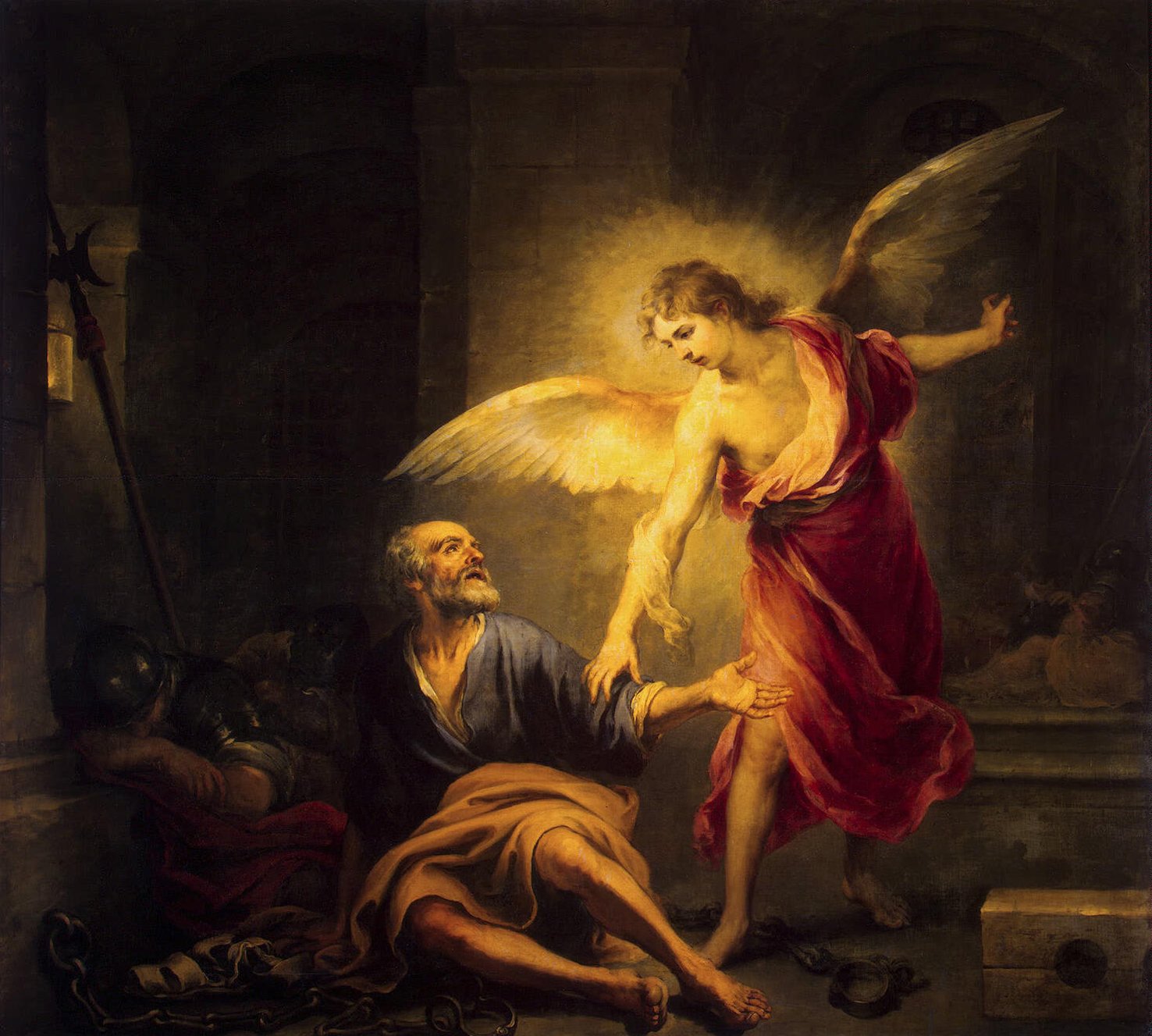
The painting shows the moment when the angel reaches out to the apostle, inviting him to rise and follow. Chains lie in the foreground, guards sleep in the shadows, and the interior of the prison is plunged into darkness. Against this gloom the angel blazes like a living flame, wrapped in a red cloak and encircled by a halo of golden light. The composition focuses on the exchange of glances and gestures between Peter and his celestial rescuer, as if the entire miracle hangs on Peter’s decision to trust and stand up.
Historical and Religious Context
Murillo painted in seventeenth century Seville, a city marked by intense Catholic devotion, monastic commissions and a strong culture of charitable works. The story of Peter’s liberation from prison had particular resonance in Counter Reformation Spain. It illustrates divine protection of the Church, the power of prayer and the victory of faith over oppression. For a public that regularly attended processions, penitential rituals and sermons about martyrdom, this subject was both reassuring and inspiring.
The scene also reflects Baroque fascination with moments of sudden change. Peter moves from captivity to freedom in a single instant. The miraculous intervention is not shown as a distant spectacle but as something that breaks directly into human space. Murillo adopts this narrative to encourage a contemplative response. Viewers are invited to see themselves in the kneeling apostle, newly awakened to grace, and to imagine that divine help might enter their own darkness just as unexpectedly.
Composition and the Choreography of Figures
The composition of “Liberation of St. Peter” is carefully constructed to guide the viewer’s eye from shadow to light, from fear to hope. The scene is set in a prison interior, its architecture only loosely defined. Murillo uses diagonals to energize the painting. The diagonal formed by Peter’s body, leaning back on one knee, runs up through his outstretched arm and into the angel’s luminous torso and wings. This line draws the gaze toward the glowing center where human and angelic forms meet.
On the left side, two soldier guards are slumped in sleep, their armor and weapons scattered. They occupy a low, dark zone of the canvas, pushed into the background. Their heavy postures and closed eyes contrast sharply with the alert, upright angel. Murillo places the guards at the edge of the light’s reach, suggesting both physical and spiritual sleep. The miracle takes place almost inches away, yet they remain unaware.
Peter occupies a middle ground. He is not entirely in light, not entirely in shadow. His face is turned upward toward the angel, and the golden glow strokes the side of his head and beard, revealing his age, worry lines and astonishment. His left leg is bent beneath him, his right leg extended, showing that he is in the midst of rising. The pose communicates hesitation, awe and movement at once, as if the viewer witnesses the first moment of obedience after long suffering.
The angel stands firmly, slightly off center, dominating the right side of the painting. With one hand he grasps Peter’s wrist, with the other he gestures outward, indicating the path to freedom. This anchoring stance provides the painting with stability. The meeting point of their hands becomes the true center, both visual and spiritual. Murillo uses this physical contact to express the mystery of grace. Liberation comes through a touch, concrete and tender.
The Drama of Light and Shadow
Light is the central actor in this work. Murillo uses chiaroscuro to heighten the contrast between supernatural revelation and earthly gloom. The prison walls and floor sink into deep browns and blacks. The chain at Peter’s feet and the metal of the soldiers’ armor catch only small glints of light, enough to indicate their texture and weight but not enough to distract from the central relationship.
From the upper right of the angel’s body radiates an intense golden halo, almost like a sun behind him. This light spills over his wings and clothes, then falls down onto Peter. Murillo softens the transitions, letting the glow dissolve into the surrounding darkness. The effect is atmospheric rather than harsh. The divine illumination feels warm and enveloping, not blinding.
The angel’s wings themselves are a study in luminosity. They are painted in creamy whites with subtle hints of yellow and pink, catching and reflecting the surrounding glow. Their feathers dissolve into the darkness at the tips, giving them an ethereal quality. They appear both solid and radiant, suggesting the angel is truly present yet not bound by ordinary physical laws.
Peter’s face is modeled with softer light, allowing the viewer to read every nuance of his expression. Shadows pool in his eye sockets and under his cheekbones, hinting at nights of anxiety and prayer. At the same time, the light that touches his face indicates that he is already partly transformed by the divine presence. Murillo uses this interplay of light and shadow to suggest the interior journey from doubt to trust.
Color and Emotional Atmosphere
Murillo’s palette in “Liberation of St. Peter” is rich yet restrained. The prison architecture, floor and background are rendered in deep browns, blacks and grayish greens. Against this somber backdrop, the angel’s clothing bursts out in saturated red and warm gold. The large red cloak flows diagonally across the composition, echoing the movement of the wings and unifying the celestial figure.
Red in Christian art often symbolizes both love and sacrifice. Here it evokes the passionate intensity of divine intervention and perhaps also hints at the blood of martyrdom that Peter may yet face. The golden halo and warm flesh tones of the angel convey comfort and assurance. The angel is not only a warrior of God but also a bearer of compassion.
Peter’s clothing is far plainer, rendered in muted blue and brown. His torso is exposed, wrapped only loosely in a cloth that resembles a prisoner’s garment. The humble colors emphasize his vulnerability. His body appears slightly emaciated, the muscles clearly defined, suggesting long imprisonment and hardship. Murillo’s choice of subdued tones for Peter aligns him with the earthly world, while the angel’s vivid palette marks him as a visitor from another realm.
The subdued, earthy colors of the sleeping guards reinforce this contrast. Their dark armor and red fragments of cloth lie in the dull half light. They belong to the world of brute force, not to the world of grace.
Overall, the color scheme creates a mood of intimate solemnity. This is not an explosion of spectacle but a quiet, luminous turning point. The warmth of the angel’s light and the softness of the flesh tones invite empathy rather than awe alone.
Symbolism and Theological Meaning
Beyond its narrative clarity, “Liberation of St. Peter” contains layers of symbolism. The chains on the floor in the foreground are obvious signs of captivity, yet once broken and cast aside they become symbols of sin and spiritual bondage overcome by divine action. Their placement near the viewer’s vantage point invites reflection on personal chains, whether of guilt, fear or despair.
The sleeping guards signify the blindness of worldly authorities to God’s work. No amount of force or surveillance can prevent the fulfillment of divine will. Their slumber also mirrors the spiritual drowsiness from which believers are called to awaken. The painting thus becomes a meditation on vigilance and watchfulness in the life of faith.
The angel’s gesture outward, as though pointing to an unseen exit, can be read as a call to mission. Peter is not freed simply to enjoy life outside prison walls, he is liberated so that he can continue preaching and shepherding the emerging Church. Murillo suggests this future mission by painting Peter’s face with renewed energy and attention, as if he already senses that new responsibility.
The interior of the prison itself may symbolize the human soul in a state of darkness. Murillo’s delicate transition from black shadows to golden glow recalls the spiritual movement from ignorance to enlightenment. The painting therefore speaks not only about a historical apostle but about the interior liberation that every believer seeks.
Human Emotion and Psychological Depth
One of Murillo’s greatest strengths is his ability to convey genuine feeling. While the subject is miraculous, the emotions are deeply human. Peter’s expression combines fear, astonishment and gratitude. His slightly open mouth and wide eyes show that he is still processing what is happening. His gesture of placing one hand on his chest suggests both humility and trust, as though he is acknowledging his unworthiness and yet accepting the grace offered.
The angel, in contrast, exudes calm certainty. His face is serene, his gaze focused on Peter with a mixture of urgency and gentleness. The way he bends toward the apostle, leaning into the light, communicates care and protection. This difference in emotional tone between the two figures emphasizes their roles. Peter brings human vulnerability, the angel brings divine confidence.
Even the sleeping soldiers are characterized with insight. Their heavy, slumped bodies indicate exhaustion and perhaps indifference. Murillo does not demonize them, instead he portrays them as ordinary men who simply do not see the miracle unfolding beside them. The viewer might even feel a touch of pity for their spiritual blindness.
The painting thus becomes an exploration of different spiritual states: Peter in awakening faith, the angel in perfect obedience, the guards in oblivious sleep. Murillo weaves these states together to create a rich psychological drama.
Murillo’s Painterly Technique
From a technical perspective, “Liberation of St. Peter” showcases Murillo’s mature style. His brushwork is soft and blended, especially in flesh tones and draperies. This softness contributes to the painting’s dreamy, nocturnal atmosphere. Unlike some of his contemporaries who favored sharp outlines and stiff folds, Murillo lets his forms breathe and merge gently with the surrounding space.
The angel’s red cloak is painted with flowing, almost liquid brushstrokes that catch the light in broad highlights and sink into velvety shadows. The effect is both luxurious and dynamic. Peter’s coarse garment and bare skin, by contrast, are treated with more textured marks, indicating rough fabric and tired flesh. Murillo delights in such contrasts of material, using paint to evoke differences between heavenly and earthly textures.
The background architecture is loosely indicated, just enough to establish depth and confinement. Murillo avoids overloading the composition with detail. His restraint keeps the viewer’s attention on the central exchange between angel and apostle.
The handling of light, especially the subtle gradients of brightness around the angel, reveals Murillo’s mastery of glazing techniques. Thin layers of transparent paint over darker underlayers create a glowing effect that feels internal rather than superficial. The light seems to emanate from within the figure, perfectly suited to a depiction of supernatural radiance.
Place within Murillo’s Oeuvre
“Liberation of St. Peter” holds an important place in Murillo’s body of work. While he is widely known for tender Madonnas and scenes of children, this painting demonstrates his ability to handle large scale narrative drama. It likely formed part of a religious commission, perhaps for a monastery or church devoted to St. Peter.
The painting also reflects Murillo’s interest in nocturnal and visionary scenes, an interest shared by other Spanish Baroque artists. Compared to the more austere realism of Zurbarán or the intense tenebrism of Ribera, Murillo’s approach is softer and more accessible. His figures often feel like ordinary people touched by grace rather than remote saints. In “Liberation of St. Peter,” this humanizing tendency is particularly evident. Peter could be an elderly Sevillian laborer, the angel a radiant young man from the same city, yet they are also timeless biblical characters.
This blend of local realism and sacred narrative helped make Murillo extremely popular in his own time and long afterward. The painting offers insight into how seventeenth century Spanish viewers understood their faith, not as a distant legend but as a living reality that could enter everyday life.
Why Liberation of St. Peter Still Resonates Today
For contemporary viewers, “Liberation of St. Peter” continues to speak powerfully. Many people know what it means to feel trapped by circumstances, anxiety or guilt. Murillo’s scene of unexpected rescue offers a visual metaphor for hope that breaks into despair. The gentle yet firm way the angel grasps Peter’s arm suggests that help sometimes arrives when a person is too weary to move alone.
The painting also raises questions about perception. The guards sleep through the miracle, while Peter turns toward the light. Murillo seems to ask what it takes to recognize grace when it appears. Is it openness, humility, a willingness to be surprised. The quiet interiority of Peter’s expression encourages viewers to look inward at their own readiness to respond.
Finally, the painting exemplifies the enduring power of Baroque art to engage the senses and the emotions in the service of spiritual reflection. The glow of the angel, the richness of the red cloak, the soft modeling of the human body, all draw the viewer into a world where visible beauty hints at invisible mercy.
Conclusion
“Liberation of St. Peter” by Bartolome Esteban Murillo is more than a dramatic biblical illustration. It is a carefully crafted meditation on freedom, grace and awakening. Through its dynamic composition, masterful use of light, expressive color and psychological depth, the painting invites viewers to share Peter’s experience of being lifted from darkness into light.
Murillo places human vulnerability and divine compassion side by side. The kneeling apostle, worn and chained, meets the radiant angel who bends toward him with outstretched hand. Around them the world slumbers, unaware that a miracle is unfolding. In this meeting of hands, in this exchange of glances, the entire theology of liberation is encapsulated. The painting remains a moving testament to the belief that no prison, whether physical or spiritual, is beyond the reach of divine mercy.