Image source: wikiart.org
Introduction
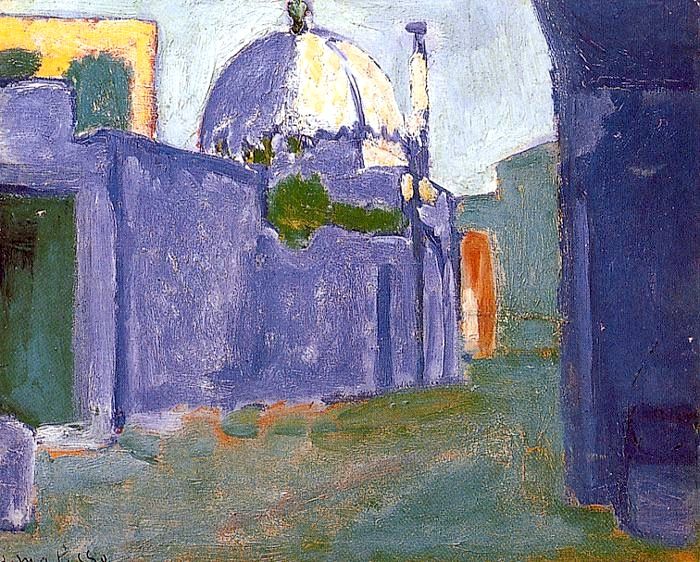
Henri Matisse’s “Le Marabout” (1912) distills a Moroccan street and its shrine into a few radiant planes of color. A white dome rises beyond thick violet-blue walls; a bright orange aperture glows like a coal in shadow; patches of sap green suggest vegetation clinging to masonry; and a band of sky, bleached by sun, lifts everything toward silence. With almost no descriptive detail and only the lightest scaffolding of drawing, Matisse captures the architecture, temperature, and spiritual hush of a marabout—the North African domed shrine associated with the tomb of a holy person. The painting belongs to the artist’s pivotal North African sojourn of 1912–13, when he transformed observational travel into a new language of flattened forms, high-keyed color, and contemplative balance. In this small canvas, the air shimmers, walls breathe, and color itself becomes a bearer of meaning.
The Subject and Its Cultural Resonance
A marabout is not simply a building; it is a site of pilgrimage, prayer, and local memory. Matisse avoids ethnographic illustration, leaving out figures, inscriptions, and ornament. Instead, he treats the shrine’s presence as a volume of light contained by walls. The domed roof—rendered in pearly whites broken by lavender shadow—signals sanctity without rhetoric. The surrounding lanes, flattened to tapes of blue-grays and dusty greens, stress the shrine’s isolation and the meditative stillness that often envelops such places. The one intense warm note—a small orange portal set into the far wall—reads like a flame at the edge of a vision, hinting at human passage without breaking the quiet. In this way, the painting communicates reverence not through storytelling but through the discipline of restraint.
A Composition Built from Planes
The scene is orchestrated as a shallow set of interlocking planes. At left, a long wall runs diagonally into the picture, its top edge rising toward the dome. That diagonal leads the eye directly to the shrine, which anchors the horizon line; the dome’s curve confirms the building’s volume, but the silhouette remains crisp and monumental. On the right, a dark vertical mass—perhaps a nearby wall or shadowed arch—acts like a coulisse, the theatrical side-curtain that frames a stage. Between these flanks, a wedge of ground opens and narrows, pulling the viewer inward without conventional perspective lines. Matisse does not build depth with measured orthogonals; he suggests it with overlapping slabs of color, each a note in a chromatic chord.
Color as Architecture
“Le Marabout” is an essay in how a limited palette can organize an entire world. The dominant color family is a range of blues and violet-grays, laid down in broad, slightly scumbled strokes that let underlayers breathe through. These cool tones do the structural work typically assigned to drawing: they construct the walls, carve the edges of the dome, and fold shadow into corner recesses. Against this cool architecture, Matisse sets three accents that carry narrative and mood. The first is white, reserved for the dome and bits of sunstruck wall; it is not a blank but a luminous paint film that seems to emit light. The second is green, concentrated in a band of vegetation that fences the base of the dome and in faint passages on the street; it cools the heat of light and hints at life. The third is orange, a square of warmth that glows like an ember inside a doorway; placed sparingly, it enhances the blues around it and punctuates the composition like a quiet exclamation.
Light Constructed by Adjacency
Rather than model light with cast shadows, Matisse constructs illumination by placing values and temperatures in charged proximity. The dome appears bright because its whites sit beside the deep violets of the walls; the sense of glare arises from the contrast, not from any painted sun. The orange portal feels incandescent because it is tucked inside a pool of blue shade; color becomes “lighted” through its neighbor. This method—illumination by adjacency—gives the painting a clarity that reads instantly from across a room and grows richer up close, where scumbles and thin veils reveal how the artist tuned the surface to breathe.
Drawing with the Brush
Contour in “Le Marabout” is sparse and decisive. A few strong edges—wall tops, dome rim, corner breaks—are laid with the edge of the brush, while most boundaries are registered as meetings of color. You feel the slow drag of a bristle across rough canvas, the pause where paint thins and the ground shows through, the small returns where Matisse corrected a silhouette by placing one color against another. These signs of process honor the truth of the moment: the scene is not an architect’s plan but a painter’s perception, synthesized outdoors in shifting light.
The Silence of an Unpeopled Street
Matisse often excludes figures when he wants the environment to speak. Here the absence of people is not emptiness; it is a way of allowing space to carry human presence indirectly. You infer footsteps in the worn angle of the street, voices in the warm glow of the far passage, devotion in the way the dome’s white turns almost opalescent. The silence is attentive, like the hush inside a chapel when worshipers have just left. By withdrawing anecdote, Matisse gives the viewer a direct encounter with the room-temperature of the place—its air, light, and proportion.
Morocco and the Recalibration of Vision
“Le Marabout” belongs to the cluster of Moroccan works that catalyzed one of Matisse’s most fertile phases. In Tangier and its environs, he found a radiance unlike the tempered light of northern France: colors hardening at noon, shadows turning to planes, forms simplified by sun. Rather than imitate Orientalist spectacle, he answered the light with a new economy. The flat-screen clarity of “Le Marabout,” with its few well-tuned notes, prefigures the larger interiors and studio pictures that would follow, where single climate colors—red, pink, blue—unify complex arrangements. Morocco helped Matisse to trust color as structure and to let omission do the work of detail.
Space Without Anxiety
Perspective in the academic sense drops away. The street does not tunnel; the shrine does not sit inside measured orthogonals. Instead, space is designed for emotional clarity. The left wall’s diagonal offers forward motion, the dark right mass supplies weight and shelter, the dome rises as a calm center, and the orange opening at back suggests destination. The eye knows how to move because the composition gives it an itinerary, not because geometry insists upon it. This approach yields an unusual serenity: depth is felt, not computed.
The Poetics of Surface
Look closely and the painting reveals a dialogue between thin and thick paint. Large fields of blue are laid with semi-transparent layers, their scumbles catching on the weave to create a dusty bloom. The whites on the dome are more opaque, but even they are broken, allowing a note of lavender to cool the glare. The small orange passage is denser, its edges softened into neighboring blues so it seems to glow from within. These tactile differences give each zone a specific temperature and material feel—chalky wall, sun-baked limewash, humid vegetation, air. The picture’s poetry resides in these modulated surfaces.
The Dome as Spiritual Geometry
The round of the dome is the painting’s only true curve, and that rarity gives it symbolic charge. Everything else is abutment and angle: walls meet, streets turn, doorways open as rectangles. The dome rises from that geometry like a blessing—soft, continuous, light-drinking. Matisse makes it read with minimal means, a few arcs of white laid over violet mass, the top slightly clipped by the painting’s edge so that it feels larger than the field. Because the curve belongs structurally to the architecture and metaphorically to the sacred, it quietly unites form and meaning.
The Role of the Orange Portal
It is difficult to overstate the importance of the small orange aperture. In pictorial terms, it is a complementary spark that animates the sea of blues. In spatial terms, it is a back-gateway, a lure that pulls the gaze through the courtyard. In psychological terms, it is the picture’s human pulse: a sign that the place is used, that passage and ritual occur here. Matisse’s discipline in reserving warm chroma almost exclusively for this opening concentrates its effect. The painting becomes a meditation with a single candle.
Edges, Reserves, and Breath
Matisse often leaves tiny reserves—slivers of underpaint or bare canvas—at key boundaries. Around the top of the wall or the rim of the dome, such reserves act like breaths of air, preventing heavy colors from choking one another and keeping the silhouette lively. In “Le Marabout,” the reserves also carry light: that nearly unpainted filament between sky and wall can be read as glare off plaster, a momentary blink produced by high noon. These decisions are minute on the scale of the canvas and decisive on the scale of experience.
Memory, Place, and the Ethics of Looking
Travel pictures risk exoticism; “Le Marabout” avoids it by refusing spectacle. The shrine is not a curiosity but a presence; the street is not a market of signs but a calm passage. Matisse records a particular place with humility—no copied tile patterns, no catalog of garments, no theatricalized prayer. He attends to essentials that anyone who has stood in such a lane would recognize: the cool shade of close walls, the startling brilliance when a surface catches sun, the peculiar way white domes hold the sky’s color. The painting honors memory by staying close to sensation.
A Prefiguration of Later Simplicities
The economy shown here anticipates Matisse’s later achievements, from the majestic spareness of “The Moroccans” to the improvisational purity of the cut-outs. In all of these, he trusts large shapes, few colors, and firm intervals. “Le Marabout” is an early proof of concept: with four or five tonal families and a handful of forms, a whole world can be summoned. It is not a sketch in the preliminary sense; it is a complete utterance whose completeness depends on subtraction.
The Viewer’s Itinerary
The painting proposes a clear path for the eye. You enter at the lower right where the dark vertical mass creates a threshold; you step into the lit court to the left, your gaze guided by the diagonal wall; you arrive at the dome, rest on its cool highlight, and then slip toward the orange opening beyond. On the way back you notice the green vegetation cuffing the base of the dome, the faint yellow of distant masonry at upper left, and the soft scrape of the brush across plastered planes. This itinerary is unhurried. The painting’s greatest gift is time restored to looking.
Why It Still Feels Fresh
The clarity, restraint, and chromatic candor of “Le Marabout” speak directly to contemporary sensibilities. Designers recognize the power of a dominant cool field snapped alive by a single warm accent. Photographers feel the lesson of exposing for highlights and letting shadow fall to broad planes. Painters learn how thin and thick paint can alternate to create breath across a surface. Viewers, regardless of training, sense the sincerity of a picture that says only what it must. The painting’s freshness comes from its honesty.
Conclusion
“Le Marabout” is small in size and large in consequence. It captures a shrine’s quiet authority without narrative, builds a convincing space without anxious perspective, and turns a limited palette into a complete climate. The dome, the walls, the orange passage, the green traces of life, and the bleaching sky are not separate items but members of a single chord. Matisse composes that chord so that looking becomes contemplation. In the end, the painting is about sanctuary—of place, of color, of attention. It is a room of light one can enter again and again and leave with the feeling that something essential has been kept.