Image source: wikiart.org
Introduction
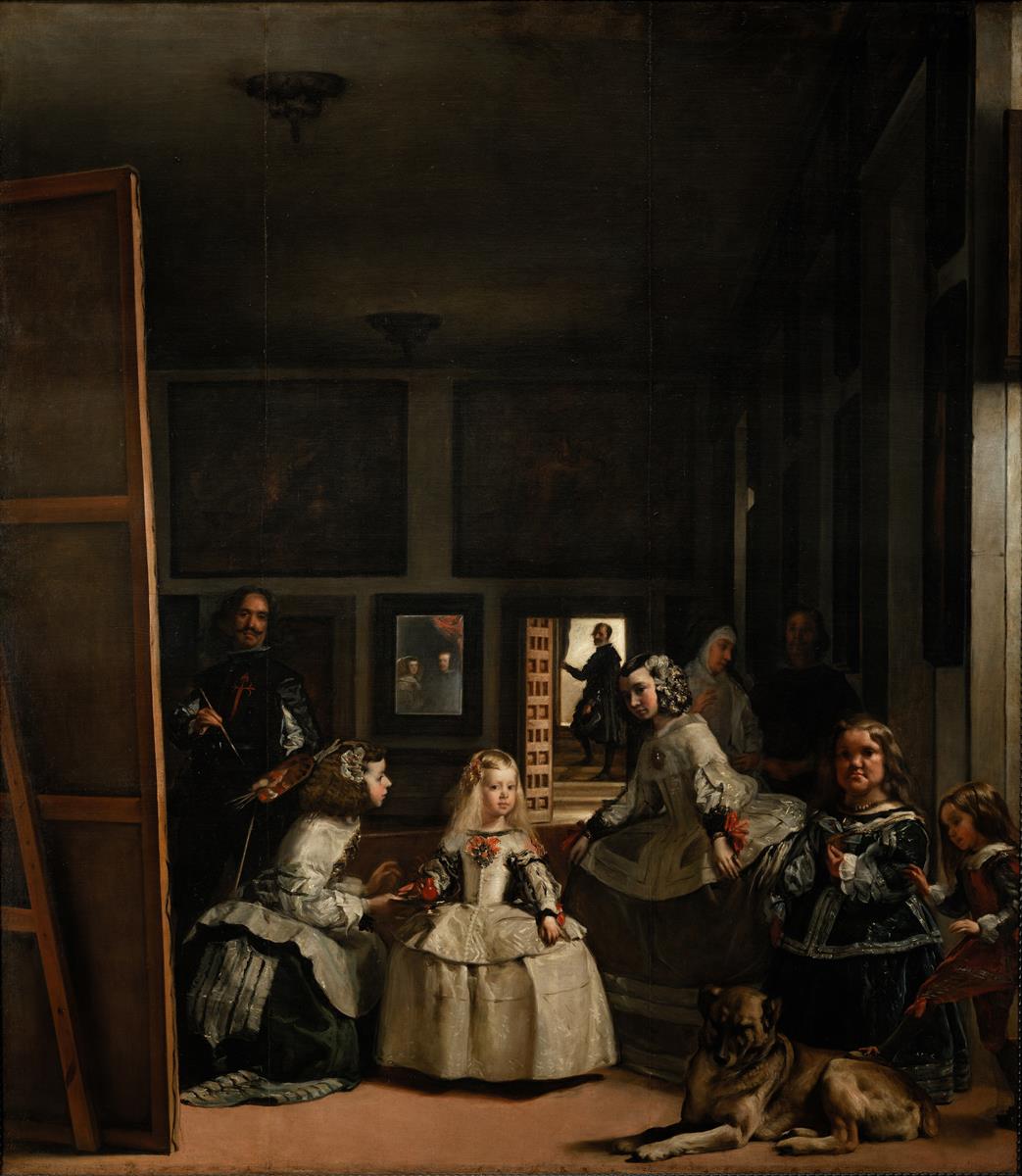
Diego Velázquez’s “Las Meninas” (1656) is the rare painting that behaves like a living room: people enter and exit, light travels, glances ricochet, and the viewer becomes part of the action the instant they look. Set in the artist’s studio in the Alcázar of Madrid, the scene appears casual—servants, a court dwarf, a dog, a nun, an official, and the Infanta Margarita at the center—yet the image is built with an astonishing architecture of sightlines, reflections, and frames within frames. Velázquez paints himself at the easel and, through a small mirror at the back of the room, reflects the king and queen. The result is not only a court picture but a meditation on looking, status, authorship, and time, all staged with the most persuasive naturalism of the Spanish Baroque.
A Court Studio Turned Theater
The setting is Velázquez’s own workplace, a long room hung with large canvases. On the left, the back of a monumental painting leans toward us like a proscenium. In the center foreground, the Infanta Margarita, the child of Philip IV and Mariana of Austria, stands in a bright reservoir of light, flanked by her meninas, the ladies-in-waiting who fuss over her water vessel and gown. Behind them, the painter faces a vast canvas and pauses, brush in hand, returning our look. A dwarf and a young boy occupy the right edge; a faithful dog lies at their feet. Further back, a chaperone and bodyguard hover, and in the deep background, a court official named José Nieto opens a door that floods the room with distant daylight. At the very back, a tiny mirror catches and holds the heads of the king and queen, who are otherwise invisible. The studio becomes a stage on which every rank of court life, from sovereigns to servants, appears at once.
Composition and the Architecture of Gazes
The composition is a web of directed sight. The Infanta looks slightly forward and right; the meninas bend their bodies toward her while stealing glances outward; the dwarf confronts us boldly; Velázquez himself meets our eyes; the figure in the doorway looks back into the room; the reflection of the monarchs faces forward as if posing. The painting coordinates these trajectories with a geometry of rectangles and diagonals. The back of the easel creates a massive vertical plane at left. The frames on the wall repeat that verticality in diminishing scale, drawing the eye into depth. The open doorway establishes a powerful axial pull, a bright aperture around which the room’s darker tones hinge. These clear architectural cues keep the complex social choreography legible.
The Mirror and the Status of the Viewer
No element is more debated than the rear mirror reflecting the king and queen. Many readings are possible, yet all agree on one fact: the mirror changes the viewer’s status. If the monarchs are being painted by Velázquez, they must stand where we stand, just outside the frame. That means our vantage is a royal one. The painting makes us witnesses from the most privileged position in the room, and the cluster of figures in the foreground behaves accordingly. The meninas attend to the Infanta while remaining alert to whoever occupies that space. The picture then becomes a document of courtly etiquette and a thought experiment about representation: the painter paints a painting of the sovereigns by looking at them; he also paints himself painting; and he paints the act of looking that knits everyone together.
Light, Air, and the Tact of Reality
Velázquez constructs the sensation of natural light with breathtaking tact. A large, soft illumination drops from high right, bathing the Infanta’s dress, catching the meninas’ sleeves, and dispersing into the room’s breathable darkness. A second, colder light pours through the open doorway, striking José Nieto and the stair. The mirror’s glow adds a third, ghostly source. These different temperatures keep the space alive without calling attention to artifice. Fabrics gleam because pigment has been dragged and feathered to mimic silk’s broken reflections; the dog’s hide looks warm because glazes are set over earth tones; faces breathe because transitions are wet and slow rather than hard and linear. The entire scene feels ventilated. Even the ceiling, seemingly empty, is a great, dark plane of air that deepens the room and makes every highlight count.
The Central Role of the Infanta Margarita
Although the painting spirals around many centers, the Infanta Margarita remains the gravitational core. Her dress forms a bright, architectural oval from which the rest of the scene seems to expand. She is at once child and emblem, learning the choreography of rule even as she accepts a drink. Velázquez renders her face with tender planes and minimal red, avoiding sugary charm in favor of poised presence. That mixture of innocence and ceremony determines the work’s tone: it is a court picture without stiffness, a family picture without informality.

Velázquez as Author and Courtier
Including himself on the left, brush poised, Velázquez performs a delicate negotiation. He appears not as a humble artisan tucked in a corner, but as a commanding participant occupying the same band of space as the central figures. He wears the keys of the palace and later would bear on his chest the red cross of the Order of Santiago—an emblem of noble status added contemporaneously or shortly after. By painting himself so prominently, he asserts the dignity of artistic labor in a court that prized lineage. Yet he also pauses, a respectful servant of the sovereigns who stand where we stand. The self-portrait is thus both ambition and deference, a visual statement that painting belongs among the liberal arts and that the painter belongs among the chief agents of the realm.
The Dog, the Dwarfs, and Courtly Reality
Velázquez’s court portraits often include dwarfs and jesters, not as oddities but as fully realized personalities. Here, Maribarbola stands upright and direct, her gaze level with ours, while Nicolasito Pertusato nudges the mastiff with his foot in a small act of mischief. These figures ground the composition in lived behavior and broaden the social spectrum present in the room. The sleeping dog, painted with a few loaded strokes across the snout and shoulder, provides an anchor of wit and weight. Nothing in the painting is idealized out of existence; power is shown alongside play, etiquette alongside boredom, and the presence of those who historically lived on the fringes of courtly visibility is acknowledged with unforced respect.
Frames, Pictures, and Paintings within the Painting
On the back wall hang large pictures in shadow, while two smaller framed works flank the mirror. Velázquez loves rectangles nested in rectangles because they metaphorically echo his main act: a painting about painting. Every frame recedes into darkness at a slightly different rate, tuning the perspective and anchoring the scale. The giant, unseen canvas at left is the boldest of these devices. We feel its mass, sense the weight of painterly work, and infer the monarchs’ likeness rising on its hidden surface. The room becomes a workshop and a gallery at once, a place where images are both made and judged.
Perspective, Depth, and the Doorway’s Magnetism
The mathematics of the room are meticulously judged but never ostentatious. The floor tiles and the receding sequence of framed pictures describe orthogonals that converge behind the Infanta, holding her firmly in place. The open door is the picture’s great spatial magnet. José Nieto stands on a stair, half turned, the highlight on his sash pointing us outward. That bright rectangle grips the eye and releases it repeatedly, creating a pulse of in-and-out movement that keeps the static scene dynamically alive. The door’s light also implies time: the session will end, people will leave, the day will continue. The painting’s narrative never freezes into tableau; it breathes.
Brushwork and the Art of Necessary Paint
Closest marks reveal the means that make the miracle. The meninas’ sleeves are filigree at distance but broad, confident passages up close. Pearls are a single touch of thick light; lace is broken white threaded with shadow; hair is dragged in soft, splayed strokes that catch just enough highlight to turn into ringlets. The faces are not carefully outlined ovals but mosaics of planes assembled wet-on-wet so that the skin seems to think under its light. Velázquez works with sufficiency rather than enumeration. He says only what is needed and trusts the viewer’s eye to complete the rest, producing a realism that feels observed rather than manufactured.
Who Stands Where We Stand
Because the mirror shows the king and queen, the viewer occupies their station. Several figures respond to that presence. Velázquez looks out to study the sitters he is painting; the meninas and the Infanta acknowledge that the sovereigns are near; the dwarf’s frank gaze and the boy’s teasing of the dog play to our side of the room; the nun glances toward us while speaking across the aisle. The painting thereby becomes a social contract enacted between the court and the viewer. To look is to momentarily share royal space, a dizzying inversion that reveals how images calibrate power.
Time, Event, and the Suspended Second
“Las Meninas” is not a posed parade. It is a suspended second in which many minor events occur at once: a drink is offered, a dog is nudged, a door opens, a conversation murmurs, a painter pauses, a reflection holds. The canvas thus invents a new kind of narrative painting, one that forgoes a single climactic action in favor of the atmosphere of an afternoon. That invention explains the work’s inexhaustibility. Each viewing finds a different hinge—today the door, tomorrow the mirror, next week the painter’s paused hand—and the scene rearranges itself around the selected moment.
Politics, Power, and the Ethics of Looking
The painting negotiates delicate politics with unusual grace. It honors hierarchy—the Infanta central, the sovereigns implied, the servants alert—while inserting the painter among the elite and inviting the viewer into highest privilege. It records the real people of the palace without caricature and endorses the dignity of labor by putting the tools of the studio in proud view. Above all, it suggests that power is sustained by attention: the world of the picture coheres because all its actors are engaged in seeing and being seen. The ethics of looking—the respect, patience, and exactness required—becomes the painting’s deepest subject.
The Work’s Afterlife and Its Modernity
“Las Meninas” has fascinated artists and thinkers for centuries precisely because it feels contemporary. It anticipates photographic candidness without losing painterly presence; it breaks the fourth wall long before theater coined the term; it folds the viewer into the image, prefiguring modern art’s self-awareness. From Goya to Picasso and beyond, painters return to it not to copy but to converse with its audacity. Its modernity lies in restraint: a quiet room, ordinary gestures, and a perfect storm of relations among eyes, mirrors, canvases, and doors.
Why the Painting Still Feels New
The work feels new because it trusts the fundamentals—light, space, human attention—more than decorative tricks. It offers openness rather than answer, clarity rather than explanation. The painter’s presence insists that making is part of meaning; the mirror insists that viewing is part of the story; the door insists that time continues beyond the frame. Every return to “Las Meninas” is a new visit to the studio, complete with the thrill of arriving while something is happening.
Conclusion
“Las Meninas” is Velázquez’s most audacious and generous invention. It is a court portrait that transforms into a study of vision, a self-portrait that ennobles the act of painting, a genre scene that measures the subtle gravity of etiquette, and an architectural marvel of light and depth. In a single, unified breath of air, the image includes sovereigns, servants, child, dog, painter, and viewer. The room becomes a mirror of the world, and the mirror reveals that the world depends on how we look. Centuries later, the studio door stands open, the figures hold their places, and the painter meets our gaze as if he had been expecting us all along.