Image source: wikiart.org
Introduction
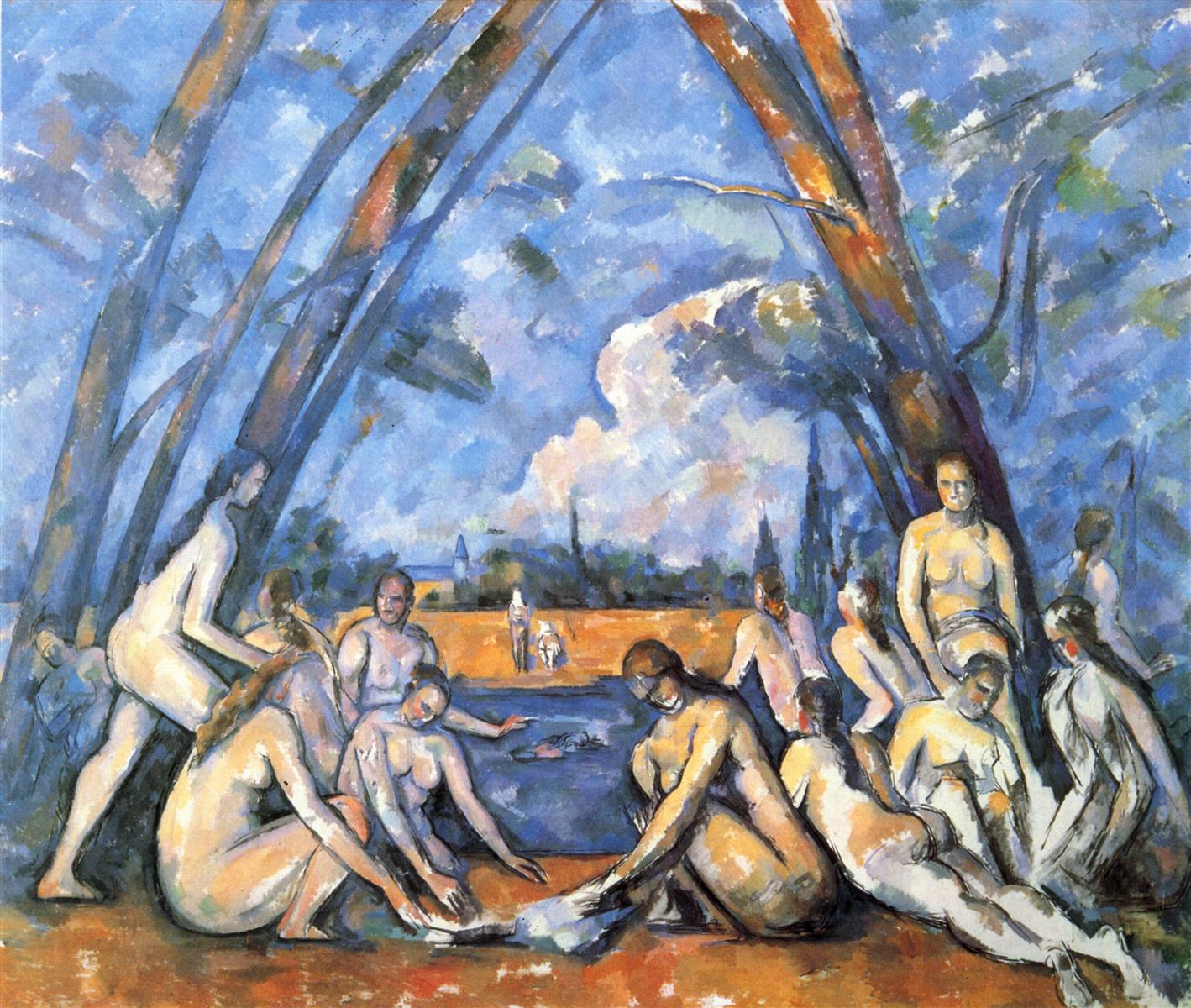
Paul Cezanne’s Large Bathers from 1906 stands as one of the defining paintings of modern art. At first glance, it presents a gathering of nude figures in a landscape, a subject with deep roots in European painting. Yet the longer one looks, the clearer it becomes that Cezanne is doing something very different from the academic tradition he inherited. This is not a polished mythological scene designed to flatter the eye with smooth anatomy and theatrical storytelling. It is a radical rethinking of how bodies, trees, space, and color can be organized on a canvas.
The painting belongs to the final phase of Cezanne’s career, when he was pushing painting toward a new structural logic. Rather than describing forms with precise outlines and naturalistic shading, he builds the image through interlocking planes of color and rhythmic shapes. The figures are present, but they are also part of a larger architecture. The trees arch over the bathers like a vaulted frame. The landscape opens in the middle distance. The sky, ground, and bodies seem to merge into a single visual system. Everything feels both observed and invented at once.
That tension is what gives Large Bathers its lasting power. It is rooted in a familiar subject, but it transforms that subject into something monumental, abstract, and deeply modern. This painting does not simply show a scene of people bathing. It explores how vision itself can be organized, simplified, and remade. In that sense, it marks both the end of one tradition and the beginning of another.
The place of Large Bathers in Paul Cezanne’s career
By the time Cezanne painted Large Bathers, he had spent decades developing his distinctive method. He had moved beyond the influence of Impressionism, even though he remained close to some of its concerns, especially the study of light and direct visual experience. Unlike many Impressionists, however, Cezanne was less interested in passing effects and more interested in permanence, structure, and order. He wanted to give painting a sense of solidity without returning to the strict formulas of academic art.
The bathers theme occupied him repeatedly over many years. He produced numerous images of bathers, both male and female, in different arrangements and scales. These works allowed him to tackle several problems at once. He could explore the human body, the landscape setting, and the challenge of composing many figures into a balanced whole. He could also work at some distance from direct observation, relying on memory, sketches, and invention rather than the immediate presence of a model.
In Large Bathers, these long investigations come to a climax. The painting feels like a summary of Cezanne’s ambitions. It gathers together his concern with geometric order, his love of nature, his refusal of conventional finish, and his increasingly bold simplification of form. Because it was made near the end of his life, the work is often seen as a final statement, a painting in which he brought his most persistent artistic questions to their most powerful expression.
A modern reinvention of an old subject
The subject of bathers was an old one long before Cezanne. Renaissance, Baroque, and Neoclassical painters had all turned to nude figures in outdoor settings, often connecting them to mythology, pastoral ideals, or scenes from classical literature. Such works usually depended on narrative or allegory to justify the display of the nude body. Even when the story was vague, the figures often carried an air of heroic grace or ideal beauty.
Cezanne strips much of that away. In Large Bathers, there is no obvious mythological episode and no clear narrative to guide the viewer. The bathers are not presented as specific individuals, nor are they idealized in the polished sense expected by academic tradition. Their forms are simplified, elongated, and sometimes awkward. Their gestures do not build toward dramatic action. Instead, they exist in a quiet but charged arrangement, almost like notes in a musical composition.
This shift matters because it changes the function of the nude. The bodies are no longer there to perform a story or embody a moral lesson. They are part of an investigation into form and composition. The ancient subject becomes a vehicle for modern experimentation. In that way, Cezanne respects tradition while also transforming it. He keeps the grandeur of the theme, but he rebuilds its meaning through paint, structure, and rhythm.
Composition and the architecture of the scene
One of the most striking features of Large Bathers is its compositional stability. The figures are gathered beneath a canopy of trees whose trunks lean inward from both sides, creating a broad triangular or pyramidal arrangement. This kind of shape had long been used in Western painting to produce harmony and monumentality, but Cezanne uses it with unusual boldness. The triangular structure does not just organize the scene. It becomes the scene’s underlying architecture.
The bodies are arranged around the lower portion of the canvas in a ring-like formation, creating a sense of enclosure. Some figures sit, some bend, some turn away, and others stand, but their poses are less important than the overall rhythm they create. They guide the eye across the picture surface and back toward the center, where the distant space opens up. This central opening is crucial. It prevents the composition from becoming too dense and gives the scene an inward pull.
The trees act almost like pillars in a natural cathedral. Their angled trunks frame the bathers and lift the viewer’s gaze upward into the sky. At the same time, the open sky and distant horizon create a contrast with the enclosed foreground group. The result is a remarkable balance between intimacy and monumentality. The viewer sees a secluded gathering, but also a vast and almost timeless landscape order.
Cezanne’s composition feels carefully constructed, yet it does not look mechanical. The asymmetries keep it alive. The figures are not mirrored perfectly from one side to the other. The trunks lean at slightly different angles. The spaces between bodies vary. These irregularities prevent the image from becoming static. Order and freedom exist together.
The relationship between figures and landscape
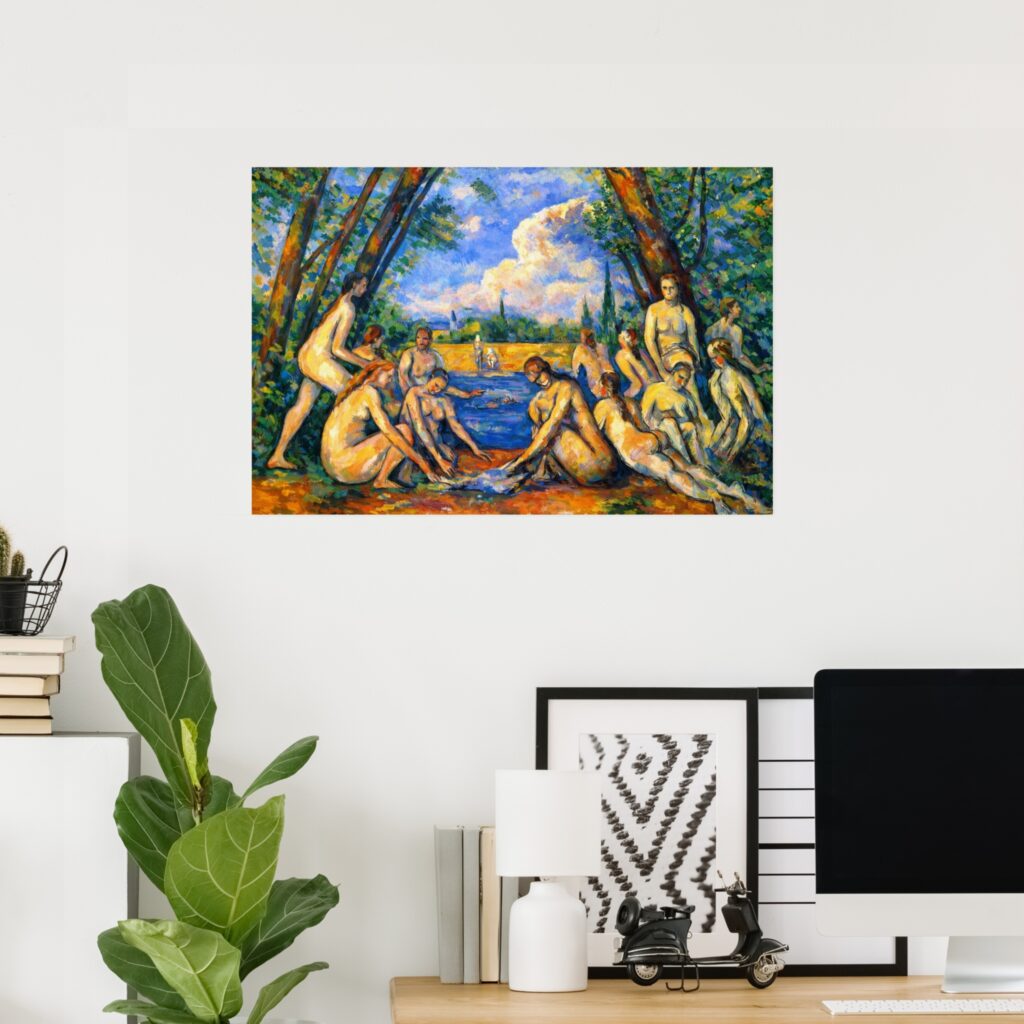
In many earlier paintings, figures occupy a landscape as though they had been placed into it after the fact. In Large Bathers, the figures and landscape are inseparable. The bodies echo the curves of the trees and the contours of the ground. Their pale flesh tones stand out against the cooler blues and greens, yet they also absorb those colors in places, making them seem woven into the environment.
This fusion is one of the painting’s most original achievements. The bathers do not dominate nature, and nature does not merely surround them. Instead, both are part of the same visual fabric. The painting suggests a world in which human presence is continuous with the natural order. This does not mean the bodies disappear into the setting, but rather that they participate in the same rhythms of mass, line, and color.
Cezanne had long been interested in how landscape could be structured through relationships of shape and tone. Here, he extends that thinking to the human body. Limbs, torsos, and heads are treated as forms that can be balanced against branches, sky passages, and patches of earth. The painting becomes less a scene with separate elements and more a unified system of relations.
This sense of unity gives Large Bathers a peculiar serenity. Even where the brushwork is energetic and the forms seem unstable, the whole remains calm. The figures appear absorbed in a collective stillness. The landscape is not a backdrop for action but a field of belonging.
Color and the emotional atmosphere of the painting
The color of Large Bathers is one of its greatest expressive strengths. Blues dominate much of the upper half of the picture, from the sky to the shadows and cool passages within the trees. These blues create a fresh, airy, and slightly dreamlike atmosphere. Against them, the warm ochres, creams, and peach tones of the bodies and ground create contrast without destroying the painting’s harmony.
Cezanne does not use color in a merely descriptive way. He is not trying to copy the exact local color of skin, bark, or sky. Instead, he uses color to establish relationships across the canvas. A cool blue in the shadows of a body may connect that figure to the surrounding air. A warm touch in the tree trunks may echo the flesh tones of the bathers. These repeated chromatic links help unify the image.
The emotional effect is subtle. This is not a dramatic or sentimental painting. Its mood comes from balance, restraint, and quiet intensity. The cool tones suggest distance, reflection, and calm. The warmer areas prevent the scene from feeling cold. Together, they create an atmosphere that feels suspended between physical presence and poetic abstraction.
There is also something unfinished and searching in the color. Some forms seem to dissolve into adjacent tones. Edges are often soft or broken. That quality makes the image feel alive, as though it is still becoming. Rather than presenting a closed and perfected world, Cezanne gives us a world held in active visual tension.
The treatment of the human body
The human figures in Large Bathers are central to the painting, yet they do not function in the traditional way. Cezanne is not trying to produce anatomically ideal nudes in the classical sense. Some of the bodies appear elongated, simplified, or slightly distorted. Their faces are minimal. Their individuality is reduced. What matters is not portrait character but structural presence.
This treatment can initially seem strange, especially when compared with the smooth refinement of academic nudes. But that strangeness is essential to the painting’s modernity. Cezanne is not rejecting the body. He is rethinking how it can exist in a painting. The bodies are built from masses and directional strokes rather than from polished contours and fine modeling. They feel substantial, yet not conventionally realistic.
The poses also contribute to this effect. Several figures bend or turn in ways that emphasize silhouette and rhythm more than natural movement. They are arranged as compositional elements, but they do not become lifeless. Instead, they seem to inhabit a different kind of reality, one shaped by pictorial necessity. The viewer senses real bodies, yet those bodies have been translated into a new visual language.
This is part of what makes the painting so influential. Cezanne shows later artists that the body can be treated as a form among forms without losing expressive force. The nude becomes not only a subject but also a problem of construction.
Space, depth, and the challenge to traditional perspective
Another remarkable aspect of Large Bathers is the way Cezanne handles space. Traditional Western painting often used linear perspective to create a convincing illusion of depth. Cezanne does not fully abandon depth, but he refuses to let perspective dominate the image. Space in this painting feels compressed, layered, and unstable in a deliberate way.
The foreground figures are large and close, but they do not always sit neatly within a fully measurable environment. The middle ground opens toward water and distant landscape, yet the transitions between planes are not smooth. The viewer senses both recession and flatness at the same time. The scene extends backward, but the surface of the canvas remains strongly present.
This ambiguity is one of the painting’s most modern qualities. Cezanne wants the viewer to feel the solidity of the picture plane while still experiencing depth. He does not want illusion to erase the fact that this is a painting made of pigment on a flat surface. By keeping those two conditions in tension, he creates a richer and more demanding visual experience.
The effect is especially clear in the relation between the bathers and the surrounding space. Some figures seem firmly anchored, while others appear to hover slightly or merge with nearby forms. This does not signal incompetence. It reflects Cezanne’s refusal to submit everything to a single fixed viewpoint. Vision, for him, is more complex and shifting than academic perspective allows.
Why the painting feels both unfinished and complete
Many viewers notice that Large Bathers can seem unfinished in places. Brushstrokes remain visible. Some passages are loosely defined. Edges blur. Faces lack detail. Yet despite this, the painting feels complete as a work of art. This paradox is central to Cezanne’s achievement.
He redefined what completion could mean. In academic painting, finish often meant polish, precision, and smooth resolution. Cezanne sought something else. He wanted the painting to hold together structurally and emotionally, even if individual parts retained a sense of openness. The visible brushwork is not a flaw. It is evidence of the painting’s construction and of the artist’s effort to grasp form through repeated adjustments.
This open quality makes the work more active for the viewer. Instead of passively receiving a closed illusion, we participate in the act of seeing. We sense the relation between strokes, masses, and intervals. The painting invites us to experience vision as a process rather than a finished certainty.
That is why Large Bathers feels so alive. It preserves the energy of making while achieving a deep overall unity. The whole is stable, but the parts remain vibrant and searching.
The influence of Large Bathers on modern art
The importance of Large Bathers extends far beyond Cezanne’s own career. This painting became a crucial reference point for many artists in the early twentieth century. Its simplification of form, its compression of space, and its emphasis on underlying structure helped open the path toward Cubism and other modern movements.
Artists such as Pablo Picasso and Georges Braque drew lessons from Cezanne’s refusal to accept conventional naturalism. They saw in his paintings a new way of organizing the visible world. Instead of treating objects and bodies as things to be copied, they could be analyzed, broken down, and reconstructed. Large Bathers offered a powerful example of how a traditional subject could be transformed into an exploration of pictorial logic.
The painting also mattered because it preserved emotional and monumental force while moving toward abstraction. It showed that modern painting did not have to choose between seriousness and experimentation. A work could be formally radical and still carry grandeur. That balance would prove decisive for many later artists.
Even today, Large Bathers feels fresh because it still poses essential questions. How can a painting create order without becoming rigid? How can it remain connected to nature while acknowledging its own artificiality? How can the human body be made new within a long artistic tradition? Cezanne does not answer these questions once and for all, but he gives them unforgettable form.
The lasting meaning of Large Bathers
What makes Large Bathers endure is not just its historical importance but its visual and emotional depth. The painting offers a vision of collective human presence without anecdote, spectacle, or sentimentality. The figures are together, yet their gathering remains mysterious. The landscape is welcoming, yet also architectonic and strange. The whole image feels suspended between memory, observation, and invention.
That ambiguity is part of its beauty. The painting can be seen as a meditation on harmony between humanity and nature. It can also be seen as a disciplined experiment in form. It can suggest timelessness, or it can be understood as a decisive break with the past. None of these readings cancels the others. The richness of the work lies in its ability to sustain them all.
In the end, Large Bathers is one of those rare paintings that seems to gather an entire artistic era into itself while pointing beyond that era. It absorbs the legacy of classical composition, pastoral subjects, and the nude tradition, then remakes them through a radically modern vision. The result is both serene and unsettling, monumental and fragile, deeply rooted in painting’s history and astonishingly forward-looking.
For that reason, Paul Cezanne’s Large Bathers remains one of the great achievements of early modern art. It is a painting that rewards repeated viewing because it never settles into a single meaning. Its forms continue to shift, its color continues to breathe, and its structure continues to reveal new harmonies. More than a scene of bathers, it is a profound statement about how painting can think, feel, and endure.