Image source: wikiart.org
Introduction
Claude Monet’s Lane in Normandy from 1868 is a painting that invites the viewer into a quiet, enclosed world of earth, trees, fading light, and rural stillness. At first glance, it may seem less immediately dazzling than some of Monet’s more famous works filled with open skies, bright water, or flower gardens. Yet this painting reveals something deeply important about his art. It shows his ability to find beauty in modest places and to transform an ordinary country road into a rich visual experience shaped by atmosphere, movement, and light.
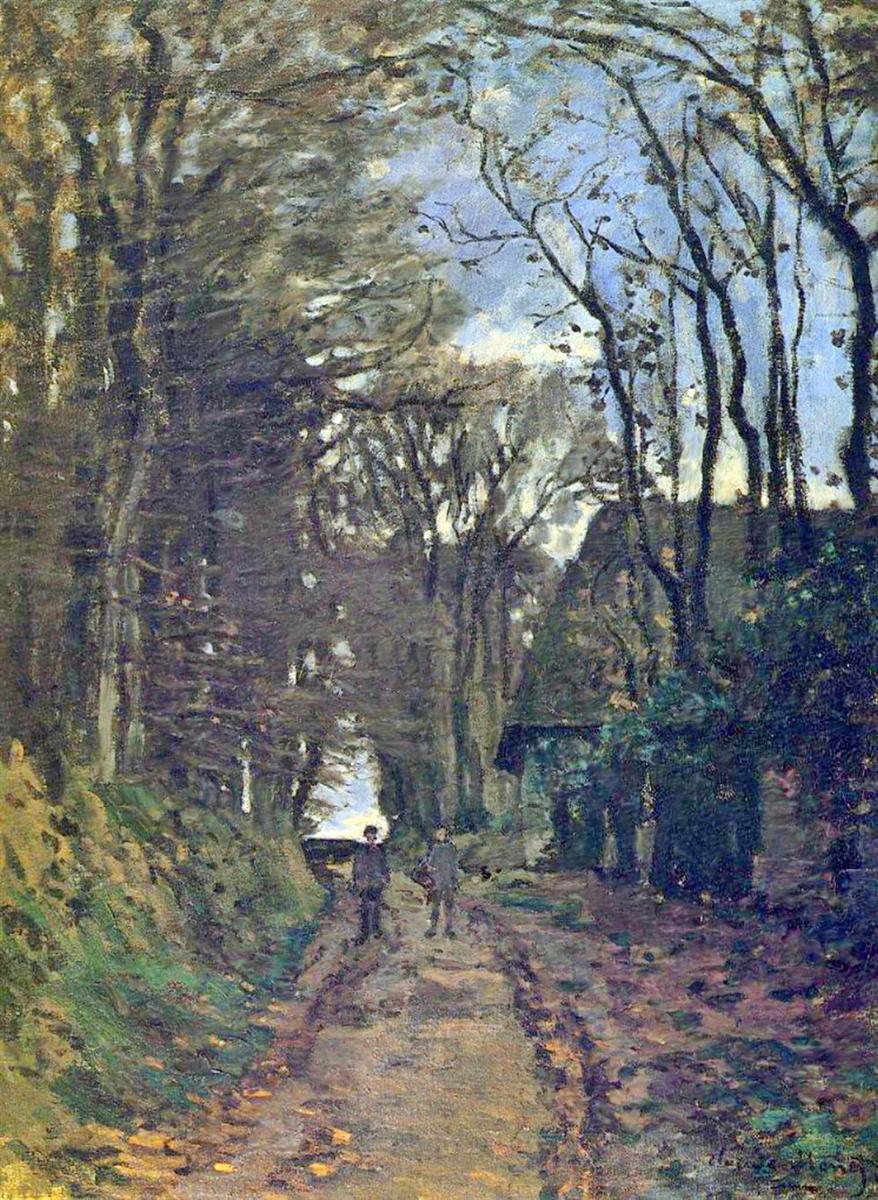
The scene is simple. A narrow lane cuts through a wooded area, drawing the eye gently into the distance. Tall trees rise on both sides, their branches creating a loose canopy overhead. A small house appears on the right side, half concealed by shadow and foliage. Two small figures walk along the path, giving the scene a human scale without disturbing its silence. The road itself seems damp, worn, and uneven, suggesting a real place touched by weather and daily use. Nothing dramatic happens here, and that is part of the painting’s power. Monet turns the ordinary into something memorable.
This work belongs to an important period in Monet’s development. In the late 1860s, he was still a young artist, but already moving toward the fresh, immediate style that would later define Impressionism. Lane in Normandy carries traces of realism and landscape tradition, yet it also shows the artist thinking in terms of sensation, fleeting atmosphere, and the visual vibration of a moment seen outdoors. Instead of carefully describing every leaf, branch, and stone, Monet gives us an impression of the place as it feels to stand within it. The result is both grounded and elusive.
What makes this painting especially compelling is its balance between structure and softness. The composition is carefully organized, but the brushwork keeps the image alive and unstable. The road provides direction, the trees provide vertical rhythm, and the sky offers a pale opening amid the darker mass of the landscape. At the same time, forms dissolve into quick touches and layered color. The lane is not only a physical route through the countryside. It becomes a path into Monet’s growing vision of nature as something constantly shifting before the eye.
Composition and Spatial Design
The composition of Lane in Normandy is one of its strongest features. Monet organizes the scene around the central road, which begins near the lower edge of the painting and recedes inward toward the middle distance. This path acts as a visual guide, inviting the viewer into the landscape. It also creates a sense of narrative, even though the painting does not tell a specific story. A lane always implies passage, movement, and destination. We do not know where it leads, but the eye naturally follows it.
The road is framed by banks, trees, and undergrowth, which narrow the viewer’s focus and produce a tunnel-like effect. This feeling of enclosure is central to the painting’s mood. Unlike a broad panoramic landscape where the eye can roam freely in all directions, this composition gently controls our experience. The trees on either side rise vertically and create a strong architectural presence. They act almost like pillars in a natural cathedral, turning the lane into a corridor of shadow and filtered light.
The house on the right side adds another layer to the composition. It is partially hidden, which makes it feel integrated into the land rather than sharply separate from it. Monet does not present it as a prominent architectural subject. Instead, it emerges from the surrounding darkness almost quietly, reinforcing the sense that human life in this painting is modest and secondary to the wider life of the landscape. The small figures on the road function similarly. They are not the main focus, but their presence adds scale and gentle activity.
One of the most effective compositional contrasts is the relation between the dense dark masses of the trees and the pale opening of sky in the upper and central portions of the image. The eye moves between shadow and light, between enclosure and release. The sky does not dominate the picture, but it plays a crucial role. It gives breathing space to the composition and prevents the wooded scene from becoming too heavy. Monet understands that a narrow lane can still feel expansive if light is allowed to enter at the right points.
The painting also depends on asymmetry. The left side is marked by a steep bank and thick, somewhat tangled growth, while the right side contains the house and a darker wooded mass. These sides are not mirror images of one another, and that irregularity makes the painting feel more natural. The lane itself is not perfectly straight or idealized. It bends gently and carries the marks of real terrain. This refusal of rigid balance helps give the scene its authenticity.
Color, Light, and Atmospheric Mood
The palette of Lane in Normandy is restrained, but it is far from dull. Monet uses muted greens, browns, grays, blue-violets, and pale creams to create a world that feels cool, damp, and softly illuminated. The color choices are perfectly suited to a shaded rural lane, where light filters through branches rather than flooding the ground directly. Instead of bright sunshine, the painting offers a more subtle kind of radiance, one that lives in transitions and half tones.
The sky is especially important in establishing the mood. Its pale blue and whitish tones appear through the branches and beyond the trees, creating luminous openings within the darker structure of the composition. This light does not erase the shadows. Rather, it coexists with them. Monet is interested in how dim areas and illuminated areas interact, and how atmosphere softens the boundary between them. The result is a scene that feels moist and breathable, almost as if the air itself is visible.
The road reflects and absorbs light in a particularly beautiful way. It is not painted as a flat strip of local color. Instead, it contains subtle shifts of beige, gray, mauve, and earthy pink. These variations suggest uneven ground, dampness, and the changing effects of light on mud or packed soil. The road becomes a living surface, responding to the weather and the environment around it. Monet treats it not simply as a path but as a field of sensation.
The darker passages of the painting are equally complex. The wooded areas are built from layered hues rather than simple black or brown. Deep blue-green, smoky violet, and earthy olive all contribute to the shadows. This gives the darker zones a richness and internal movement that prevent them from becoming dead or empty. Monet had already begun to understand that shadows are full of color, a realization that would become central to Impressionist painting.
There is also a mood of seasonal transition in the picture. The trees are not thick with lush summer foliage, and the ground seems scattered and worn. The scene may suggest late autumn or a cool, early season moment when the landscape is subdued rather than flourishing. Whether or not we assign it to a precise season, the painting clearly avoids the bright exuberance of midsummer. Its beauty lies in quietness, in slight melancholy, and in the tenderness of fading natural light.
This emotional atmosphere is one of the reasons the painting lingers in the mind. Monet does not dramatize the scene, but he fills it with feeling. The colors and light suggest a place that is both ordinary and slightly mysterious, familiar yet remote. The lane seems to hold memory. It feels walked upon, lived beside, and touched by passing days.
Brushwork and the Language of Observation
One of the most revealing aspects of Lane in Normandy is Monet’s brushwork. Even in this early period, he is clearly moving away from the highly polished finish valued in more academic painting. The surface of the picture is active, varied, and visibly worked. Brushstrokes remain present as marks, which means the painting never fully hides the process of its making. This is essential to its vitality.
The trees, for example, are not defined by meticulously outlined leaves and branches. Instead, they are built from loose touches, streaks, and layered applications of paint. Some branches are slender and dark, drawn almost calligraphically against the pale sky. Others dissolve into broader, softer masses. This combination of linear definition and painterly looseness gives the trees a natural instability, as though they are moving slightly in wind or light.
The foliage on the left side of the painting has a dense, almost turbulent texture. Monet uses broken marks and overlapping strokes to create the impression of clustered growth without spelling out each element. This method allows the eye to participate in completing the image. We do not read every detail individually. We register the sensation of vegetation. That is a crucial step toward the Impressionist approach, where seeing becomes a process of optical assembly rather than strict description.
The road is handled with similar freedom. Its surface is constructed from strokes that shift direction and density, suggesting ruts, patches, and irregularities. Monet avoids a smooth, idealized finish because a real lane is not smooth. The tactile quality of the paint mirrors the tactile quality of the earth itself. In this way, technique and subject are closely linked.
The house is also notable for the way it hovers between solidity and suggestion. It is recognizable, yet not overly precise. Monet provides just enough structure for us to identify walls and roof, but he does not isolate the building from its surroundings with rigid contours. It belongs to the same visual atmosphere as the trees and ground. This integration is typical of Monet’s sensitivity to the unity of the scene.
What matters most is that the brushwork captures perception in motion. The painting does not look frozen or mechanically recorded. It feels like the result of attentive looking under changing natural conditions. Monet is less interested in permanent outlines than in the impression a place makes at a particular moment. That emphasis on immediacy would become a defining element of his mature art.
Nature and the Rural World
Lane in Normandy is rooted in rural experience. It presents the countryside not as a grand spectacle but as a lived environment shaped by paths, houses, weather, and trees. This is not an untouched wilderness, nor is it a formal garden or an aristocratic estate. It is a working landscape, modest and human in scale. That quality gives the painting much of its emotional honesty.
The lane itself suggests everyday use. It is the kind of road that villagers, workers, and children might take on foot. The two small figures reinforce that sense of daily life. They are not individualized portraits. They appear as ordinary people moving through an ordinary place. Their small size emphasizes the dominance of the surrounding landscape, but it also humanizes the scene. This is a world inhabited rather than staged.
The house on the right further anchors the painting in rural reality. It is not picturesque in an exaggerated sense. Monet does not use it as a decorative cottage placed for charm alone. Instead, it sits quietly within the trees, partly obscured and seemingly weathered by time. It feels like part of the lane’s natural history. The human presence here is embedded in the environment, not imposed upon it.
This relationship between people and nature is central to many nineteenth century landscape paintings, but Monet gives it a special freshness. He does not moralize the countryside or turn it into a sentimental symbol of rustic virtue. Instead, he paints it as a place of real visual richness, where light, color, and texture transform common features into art. The lane matters not because it is famous or ideal, but because it is seen with intensity.
Normandy was especially important for this kind of painting. Its changing skies, coastal air, wet climate, and varied rural terrain offered artists endless opportunities to study atmosphere. For Monet, the region was not just a backdrop. It was a place where he could refine his understanding of outdoor light and direct observation. In Lane in Normandy, that exploration takes the form of a sheltered inland view rather than an open seascape, but the spirit of close looking remains the same.
The painting also suggests that nature is never static. Even in a quiet scene, everything seems in flux. Light filters, branches sway, shadows gather, and the road recedes into an uncertain distance. The landscape is calm, but not still in a rigid sense. It is alive with subtle changes. Monet’s sensitivity to this living quality of the environment is one of the reasons his landscapes continue to feel immediate.
Monet in 1868
To understand the significance of Lane in Normandy, it helps to place it within Monet’s career in 1868. At this moment, he was still developing the visual language that would later make him one of the central figures of Impressionism. He had already absorbed lessons from landscape painting, from working outdoors, and from the example of artists who valued direct contact with nature. Yet he was not simply repeating existing models. He was pushing toward something more fluid, more atmospheric, and more responsive to fleeting visual experience.
In 1868, Monet had not yet reached the full brilliance of his later serial studies of haystacks, poplars, water lilies, or Rouen Cathedral. But this earlier period is fascinating precisely because it shows him in formation. Paintings like Lane in Normandy reveal the experimentation behind the later achievements. The essential concerns are already there: the instability of light, the breakdown of fixed contours, the expressive use of color within shadow, and the desire to paint the sensation of being present in a place.
At the same time, the work still retains a certain density and gravity that distinguish it from some later Impressionist canvases. The dark wooded areas are substantial, and the composition has a stronger structural framework than many of Monet’s more openly luminous later scenes. This gives the painting a unique position in his development. It combines youthful freshness with lingering solidity.
The year itself was a difficult and transitional time in Monet’s life, marked by personal and financial pressures. While the painting does not illustrate those circumstances directly, it is tempting to see in its quiet inwardness a certain seriousness of mood. The lane is not festive or expansive. It feels reflective, almost private. Whether or not that emotional tone relates to biography, it certainly deepens the painting’s character.
This period also matters because it reminds us that Monet was never only a painter of dazzling sunlight. He was equally attentive to subdued weather, shaded paths, and muted tonal harmonies. Lane in Normandy broadens our understanding of him. It shows that his art was not limited to brilliance in the obvious sense. He could also find beauty in cool shadow, softened edges, and humble terrain.
The Emotional Effect of the Scene
The emotional power of Lane in Normandy lies in its restraint. Nothing in the image demands attention through spectacle. Instead, the painting draws the viewer inward slowly. It works through atmosphere, intimacy, and quiet visual rhythm. This is the kind of landscape that becomes more affecting the longer one looks at it.
Part of that feeling comes from the contrast between shelter and openness. The lane is enclosed by trees, banks, and shadow, which creates a sense of privacy and protection. Yet there are openings of light ahead and above, suggesting a world beyond the immediate corridor. This tension gives the scene emotional depth. It feels both contained and expansive, both near and distant.
There is also a gentle sense of transience in the painting. The figures are passing through. The light is changing. The leaves are sparse and uncertain. The road seems worn by time. Even the brushwork contributes to this impression, since forms appear to shimmer or dissolve rather than remain absolutely fixed. The painting seems aware that every moment in nature is temporary.
This awareness does not make the work sad in a dramatic way, but it does give it a reflective tone. The scene may evoke memory, solitude, or the pleasure of walking in a quiet rural place near evening or under cool weather. Many viewers will recognize the emotional truth of such a moment. Monet captures not just what the lane looks like, but what it feels like to be there.
The small human figures are important in this respect. Because they are so understated, they can almost serve as stand ins for the viewer. We imagine ourselves entering the road, moving toward the brighter distance, passing the shadowed house, hearing the faint sounds of the countryside. The painting opens a space for contemplation rather than closure.
Why the Painting Still Matters
Lane in Normandy remains compelling because it demonstrates how much can be achieved through sensitivity to ordinary things. Monet does not need a grand historical subject or an extraordinary location to create significance. He finds depth in a muddy road, a few walkers, a hidden house, and the interplay of trees and sky. That ability to elevate the everyday without distorting it is one of the lasting strengths of his art.
The painting also matters because it reveals the foundations of modern landscape painting. Here we see an artist loosening traditional finish, trusting visible brushwork, and prioritizing immediate perception over precise detail. These choices helped reshape the course of art. They encouraged viewers to understand painting not as a polished illusion alone, but as a record of seeing and feeling.
At the same time, the work remains accessible. Its subject is easy to recognize, and its mood is deeply human. One does not need specialized knowledge to respond to the enclosed path, the pale sky through branches, or the quiet companionship of the two figures. The painting speaks through atmosphere first, and through theory only afterward.
It also offers a valuable corrective to simplified ideas about Monet. He is often remembered primarily for bright gardens and shimmering water, but this painting shows a different side of his vision, more subdued, more earthy, and perhaps more introspective. It proves that his sensitivity extended across a wide emotional and visual range.
In the end, Lane in Normandy is memorable because it transforms a passing rural view into a lasting experience. It shows Monet discovering how to paint not just objects in space, but the very conditions of perception: filtered light, moving air, damp ground, and the shifting relationship between human presence and the natural world. That achievement gives the painting both historical importance and enduring beauty.
Conclusion
Claude Monet’s Lane in Normandy is a remarkable early landscape that combines careful composition, atmospheric subtlety, and increasingly free brushwork. Through a narrow road, a stand of trees, a modest house, and two small figures, Monet creates a scene that feels immediate, lived in, and emotionally resonant. The painting does not depend on grandeur. Its strength lies in its quiet authority and its ability to make an ordinary place seem visually inexhaustible.
The work captures a significant moment in Monet’s artistic growth. It retains enough structure to feel grounded, yet it already points toward the freer and more perceptual style that would transform modern painting. Light is filtered rather than blazing, color is muted yet complex, and form is suggested through touch rather than rigid outline. These qualities make the painting an important example of Monet’s early search for a new language of landscape.
Most of all, Lane in Normandy reminds us that Monet’s genius was not limited to famous motifs or dazzling surfaces. He could also find poetry in shade, silence, and modest rural paths. In this painting, the Normandy countryside becomes a place of reflection, movement, and sensory richness. The lane leads inward, not only into the picture, but into a deeper appreciation of how Monet saw the world.