Image source: wikiart.org
Introduction to Peter Paul Rubens’s “Landscape with Tower”
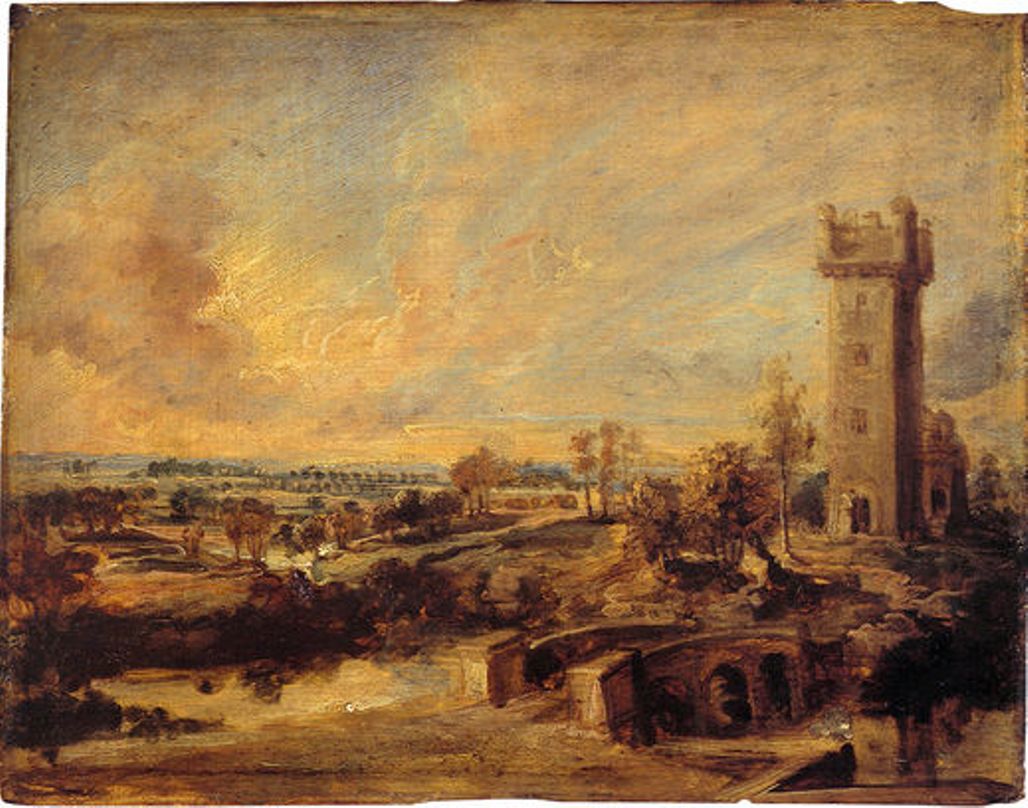
“Landscape with Tower,” painted by Peter Paul Rubens around 1638, belongs to the radiant group of late landscapes that the artist created while living at his country estate near Antwerp. In contrast to his grand altarpieces and mythological dramas, this painting is quiet and contemplative. A solitary tower rises on the right, bathed in warm light, while a broad expanse of countryside unfolds to the left beneath a sweeping, golden sky.
At first glance, the work seems deceptively simple: no bustling peasants, no mythic heroes, no violent storms. Yet the more you look, the richer it becomes. The tower anchors the composition like a sentinel of stone, while winding paths, bridges, and distant tree lines guide the eye into the depth of the picture. The painting feels like a memory of a real place transformed by emotion and atmosphere rather than a topographical record. It is Rubens’s meditation on land, time, and the tranquillity he sought in his final years.
The Late Rubens and His Turn Toward Landscape
In the last decade of his life Rubens increasingly turned to landscape painting, a genre that had long been cultivated in the Low Countries but which he elevated to new heights. Having triumphed as a court painter and diplomat, he retreated to his estate at Steen, where he devoted himself to painting the countryside he loved. Works like “Landscape with Tower” reflect this shift in focus from courtly spectacle to personal refuge.
These late landscapes are not mere studies of nature. They blend observation with poetic invention, creating spaces that feel both real and idealized. They also reveal Rubens’s fascination with changing light and weather, as well as his delight in the textures of earth, foliage, and architecture. In “Landscape with Tower,” he compresses these interests into a small but intensely expressive panel, most likely an oil sketch painted quickly from nature and later refined in the studio.
Composition: The Tower and the Open Plain
The most striking feature of the composition is its asymmetry. The right third of the painting is dominated by a tall, fortress-like tower that rises vertically from the earth. Its crenellated top, narrow windows, and attached structures suggest a watchtower or a small castle keep. It stands at the edge of a slope, near what appears to be a small fortified bridge or ruined wall in the foreground.
To the left, the land opens outward in undulating fields and clusters of trees that recede toward the distant horizon. The sky occupies nearly two-thirds of the canvas, particularly on the left, where clouds billow and light diffuses across the scene. This imbalance between the solid vertical tower and the wide horizontal expanse of land and sky creates a dynamic tension: the eye moves continually between the grounded mass of stone and the boundless space around it.
The tower functions as a visual anchor. Without it, the landscape might feel diffuse and unmoored. With it, the scene gains a sense of narrative and human presence, even though no figures are clearly visible. The structure hints at roads, inhabitants, histories of defense and observation. It suggests that the land is not wild but shaped, watched, and protected.
Light and Color: A Golden Atmosphere
One of the most captivating aspects of “Landscape with Tower” is its enveloping golden light. The sky is suffused with warm ochres, pale oranges, and soft yellows that gradually shift into cooler greys and blues toward the upper right. These tones spill onto the landscape below, tinting trees, fields, and masonry with a honeyed glow.
This light evokes a specific time of day—likely late afternoon or early evening—when the sun hangs low and casts long shadows. The tower, in particular, is bathed in warm brightness on its sunlit side, while its shaded face melts into the surrounding sky. This interplay of illumination and shadow models the structure in three dimensions and integrates it harmoniously into the atmosphere.
Rubens uses a restrained palette, but within it he achieves remarkable variation. The greens of the trees are subdued and infused with gold, suggesting the mellow tones of late summer or early autumn. The earth tones in the foreground range from deep burnt umber to reddish-brown, adding richness and depth. Against these hues, the pale band of distant horizon appears cool and almost silvery, enhancing the sense of distance.
The Sky as Emotional Stage
In this painting, the sky is not just a backdrop; it is the emotional heart of the scene. The clouds are painted with sweeping, energetic strokes, some translucent, others thickly opaque. They form rolling masses that catch the light differently across the canvas: luminous and dissolving on the left, more solid and shadowed on the right.
This sky conveys a mood of calm yet active weather—a day when the atmosphere is alive with shifting light but free of threatening storms. The golden color imparts a sense of peace, nostalgia, and gratitude, as if Rubens were capturing the closing of a beautiful day. The slight diagonal movement of clouds from bottom left to upper right gently echoes the upward thrust of the tower, binding the two main elements into a coherent whole.
For Rubens, such skies often carried symbolic overtones. They can be read as manifestations of divine benevolence, bathing the countryside in grace. In “Landscape with Tower,” the luminous heavens seem to bless the land below, including the human-made fortification. The tower is not a symbol of oppression but a participant in the harmonious order of nature and light.
Landscape Detail: Paths, Bridges, and Trees
Although the painting’s small scale and loose technique mean that details are not sharply defined, Rubens includes enough information to make the landscape feel richly inhabited. In the foreground left, dark masses suggest clumps of shrubbery and perhaps a stream or wet ground, catching reflections of the sky. A stone structure—possibly a small bridge or arched gateway—spans this lower area, leading the eye toward the tower.
Further back, groups of trees rise in varied shapes and densities. Some are slender trunks with airy foliage; others form dense, rounded clumps. Their placement creates a rhythmic pattern across the middle ground, like chords in a musical composition. The alternation of trees and open fields gives the landscape breathing space and emphasises the gentle rise and fall of the terrain.
In the far distance, a band of evenly spaced trees marks what might be an avenue or property boundary. Beyond that, the land stretches to the horizon, dotted with tiny hints of buildings or fields. This layering of foreground, middle ground, and background is central to Rubens’s landscape style, inviting the viewer’s gaze to travel deep into the scene and imagine the world beyond what is explicitly depicted.
Brushwork and the Character of the Oil Sketch
“Landscape with Tower” bears all the hallmarks of Rubens’s oil sketch technique. The paint is applied with vigorous, open brushstrokes; in places, the texture of the ground and previous layers shows through. Edges are often soft and suggestive rather than hard and precise.
This looseness gives the painting a sense of immediacy, as if we are seeing Rubens think in paint. The tower is not rendered with architectural precision but with confident improvisation: a few decisive strokes define its crenellations, windows, and shadows. The trees are formed from quick dabs and sweeps of the brush that suggest foliage without cataloging every leaf.
Despite this apparent spontaneity, the composition is carefully balanced. Rubens knows exactly where to concentrate detail (around the tower and foreground structures) and where to let forms dissolve into atmosphere (toward the horizon and upper sky). The sketch-like nature of the painting enhances its emotional resonance; it feels like a fleeting impression of a day, a mood, perhaps a memory, rather than a static diagram.
The Tower as Symbol: Watchfulness, Memory, and Power
The tower in this landscape invites symbolic interpretation. Architecturally, it recalls the kind of fortified towers associated with medieval castles or walled estates. Such structures were built for defense and for surveillance; from their heights, one could watch the surrounding countryside for miles.
In the context of Rubens’s life, the tower may echo features of his own estate or similar properties in the Flemish countryside. It could be understood as a symbol of landed stability and noble status—values that Rubens, now a wealthy landowner, cherished. At the same time, its position on the edge of the composition, looking out over the fields, suggests a more contemplative role: the tower as a place of observation and reflection.
On a metaphorical level, the tower can signify memory or the continuity of human presence in the landscape. While plants grow and seasons change, the tower endures, bearing silent witness. The warm light that envelops it implies that it is not at odds with nature but integrated into it, shaped by the same sun that molds the clouds and trees.
Some viewers might also see in the tower an emblem of the human spirit standing upright within the vastness of creation. Against the immense sky and broad plain, this vertical structure announces human aspiration and resilience without excessive bravado. It is strong but not domineering, solitary yet at home in its environment.
Comparison with Other Rubens Landscapes
When viewed alongside other late landscapes such as “A View of Het Steen in the Early Morning” or “Tournament in front of Castle Steen,” “Landscape with Tower” appears more restrained and experimental. The larger works often feature bustling human activity—hunts, tournaments, peasant gatherings—whereas here the architecture and land are the primary subjects.
Yet there are clear continuities. The glowing light, the careful articulation of depth, and the integration of architecture into rolling countryside all reflect Rubens’s mature approach. In some respects, “Landscape with Tower” can be seen as a distilled version of those more complex paintings, stripping away narrative to focus on atmosphere and spatial relationships.
The painting also reflects a broader shift in European art toward landscapes as independent subjects worthy of contemplation. While earlier generations often used landscapes as backdrops for biblical or mythological scenes, Rubens, like some of his contemporaries, recognized that the land itself could carry emotional and spiritual meaning.
Mood and Interpretation: Quiet Grandeur
The overall mood of “Landscape with Tower” is one of quiet grandeur. There is no dramatic storm, no blazing sunset, no rushing figures. Instead, the painting presents a calm, expansive view infused with warmth and gentle movement. The world feels stable yet alive, bathed in the kind of golden light that often accompanies reflective moments at the end of the day.
This serenity may reflect Rubens’s own search for peace after a life of public responsibilities. The tower embodies security and watchfulness, but the landscape around it suggests contentment rather than anxiety. It is as if the painter is saying: here, in this harmony of built structure and open land, of human history and natural cycles, is the kind of world worth protecting and contemplating.
Viewers today can respond to this mood even without knowing the painting’s historical context. The work invites us to pause, breathe, and let our eyes wander over the fields and through the clouds. The absence of human figures opens space for our own presence; we become the implied observer who might be standing near the tower or walking along one of the paths.
Legacy and Contemporary Appreciation
While “Landscape with Tower” is less famous than some of Rubens’s monumental canvases, it holds a special place in the story of landscape painting. Its loose, expressive handling anticipates later developments in European art, from the atmospheric sketches of Constable to the light-soaked visions of the Impressionists. These later artists, too, valued the direct, subjective response to nature that this painting embodies.
For admirers of Rubens, the work offers an intimate glimpse into his private world. It feels less like a commission and more like a personal exercise, an artist painting for himself, testing how far he can convey space and light with minimal means. In that sense, “Landscape with Tower” is a key document of Rubens’s artistic freedom in his final years.
Today, the painting continues to appeal to viewers who appreciate the subtle power of landscape. It may be small and relatively modest in subject, but its harmonious composition, glowing color, and suggestive brushwork reveal the hand of a master still exploring and delighting in the world around him.