Image source: wikiart.org
Introduction
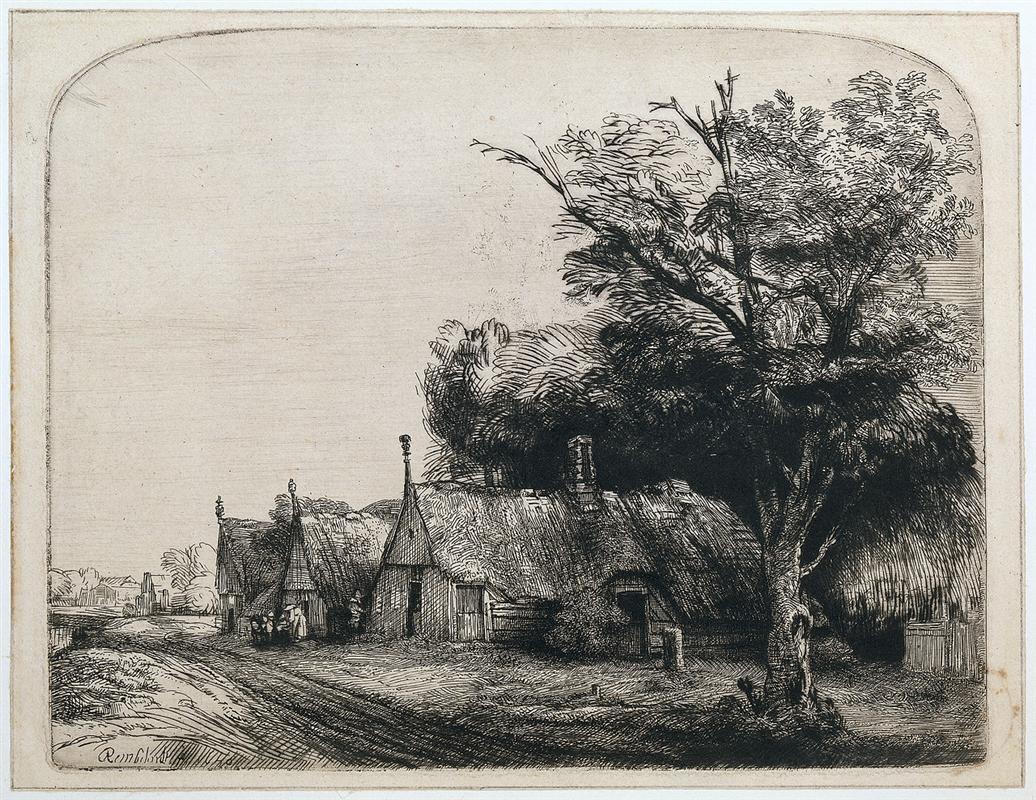
Rembrandt’s “Landscape with Three Huts” (1650) is a compact etching that turns a modest roadside cluster of cottages into a complete, breathing world. The sheet, small enough to hold in two hands, opens spaciously: a rutted track approaches from the left, curving past three thatched huts that huddle under a canopy of trees; a tall foreground tree anchors the right edge, its branches raking the pale sky; and in the deep background a faint settlement pricks the horizon. The sky is largely reserve—the clean paper itself—so air becomes the work’s first subject, followed by shelter, path, and shade. Nothing is posed for grandeur. Everything is arranged according to use. With a few hundred strokes of the needle, Rembrandt composes a hymn to ordinary architecture and the social life that gathers where road, roof, and windbreak meet.
The Triptych of Huts and the Grammar of Shelter
The three huts read like verses of a single poem. Closest to the road sits a small gabled structure, its roof sharply pitched and braced by long poles that project above the ridge; beyond it, a broader, lower building extends in a thick pelt of thatch punctuated by a stubby chimney; and behind both, half veiled by foliage, a third roofline repeats the theme at a different scale. Rembrandt’s grammar of shelter is precise. He draws thatch with clustered, downward strokes that fray into burr, letting shadows accumulate beneath eaves and in the mouths of doorways. Planks are marked with longer, steadier cuts, their verticals catching enough light to suggest the grain of wet wood. Each hut looks grown rather than built—added to, patched, and settled by weather. The sequence of roofs—steep, long, and distant—becomes a visual cadence that steadies the eye as it walks the track.
The Foreground Tree as Proscenium and Counterweight
At the right edge a tall tree functions like a stage proscenium. Its trunk, etched in muscular, knuckled lines, pulls a heavy mass of foliage into the upper corner, offsetting the open sky at left. This asymmetry is deliberate. By weighting the right side, Rembrandt gives the huts a place to lean and creates a pocket of deep shadow that cools the scene. The tree’s crown is a lattice of loops, commas, and small hatches that tangle into convincing leaf-mass. Between trunk and foliage the artist leaves slivers of paper, bright apertures that glitter like sun caught in leaves. The tree therefore does three jobs at once: structural counterweight, atmospheric shade, and a register of wind—those slanted hatchings in the canopy suggest air moving through.
The Road as Narrative
The road gathers the composition into a narrative of approach. It swings in from the left border, a pair of ruts rendered in soft, broken strokes, darkening as they pass under the thatch and the tree, then dispersing into shadow. This corridor of earth is not a decorative S-curve; it is a record of habit. Wheels have learned the dry edges after rain, hooves have traced shallows, and feet have cut shortcuts. Rembrandt thickens the strokes where traffic is heaviest and thins them where the track feathers into grass, a cartographer of use rather than ornament. The viewer’s eye travels the road as a walker would—first in brightness, then in shade, then into the tight space among doors and talk.
People as Punctuation and Scale
Beneath the first hut a small group gathers at the threshold. Rembrandt reduces them to a few deft marks—an incline of head, a darker wedge for a garment, a vertical that catches light as a staff or pole. Yet they carry the sheet’s human temperature. Their presence provides scale for the buildings and confirms the social function of the place: the road brings news, the hut gives shade, and the threshold hosts exchange. In other hands such figures might become picturesque staffage. In Rembrandt they are neighbors. They do not pose; they linger, speak, or wait.
Chiaroscuro as Weather and Mood
The tonal design is a study in meteorological chiaroscuro. Deepest darks pool beneath the tree at right and in the eaves’ interiors. Mid-tones describe the roofs and the flanks of the huts, while the left sky is a broad reserve of pale paper. The effect is a fair day in late spring or summer, with sun high enough to keep shadows short and cool. This weather is also a mood. The road’s entry in light and its passage into shade enact a small drama of relief, the everyday pleasure of stepping from glare into the thick, resinous air under leaves and thatch.
The Sky’s Reserve and the Ethics of Emptiness
Rembrandt leaves most of the sky untouched, save for faint horizontal strokes and the rounded scraped corners that softly vault the sheet. The uninked paper is not vacancy; it is light itself. This reserve keeps the image modern—open, uncluttered, and confident—and grants the huts and tree the dignity of breathing room. Emptiness here has ethics: it refuses spectacle, trusts suggestion, and allows viewers to furnish the scene with their own weather and memory.
Line, Burr, and Material Intelligence
The print’s tactile power comes from Rembrandt’s varied line. In the tree trunk he cuts hard, leaving grooves that print rich and dark; along thatch he flicks short strokes that raise burr, which prints as velvety shadow; in the road he skims the copper lightly so ink thins, creating the feel of dry, scuffed earth. The wooden doors receive firm verticals; the distant hedges break into scalloped loops; a small fence at far right is a run of brisk, upright accents. Every material has its mark-type, and the viewer perceives not only sight but contact: the tug of straw, the rasp of bark, the grit of ruts.
The Huts as Social Architecture
These are not anonymous sheds. Their gestures—poles that brace high gables, a small chimney shouldering out of thatch, a bench or trough near the door—register choices made by people who know their ground. The first hut opens to the road, serving as both workshop and gossip-porch; the long central building reads as combined dwelling and barn; the third roof behind them suggests storage or loft. The arrangement optimizes shade and windbreak, leaves a pocket for animals or carts, and holds the road in a gentle clasp that encourages stopping. Rembrandt’s respect for such pragmatic design is part of his broader affection for the Dutch rural intelligence that makes beauty out of function.
The Middle Distance and Civic Horizon
Beyond the huts, the road continues toward a faint village and small vertical forms—perhaps a church tower, perhaps a mill. Rembrandt renders these with the lightest touch, so they hover more as memory than as detail. Their function is to connect the hamlet to a larger network of places and times: bells that count the day, markets that organize the week, neighbors whose stories travel the road. The composition thus moves from intimacy (foreground tree and threshold) to community (huts) to civitas (distant tower), all within a few inches of copper.
Season, Time of Day, and Sound
The foliage’s mass and the thatch’s dryness suggest late spring or summer. Shadows are firm but not long, implying mid-morning or mid-afternoon. If the image had an audio track, it would be the muffled thud of cart wheels on packed earth, the rustle of leaves, a low conversation under the first hut’s eaves, and perhaps a dog shifting position in the shade. Rembrandt’s value pattern—bright entry, dark bower, and pale distance—creates this acoustic by distributing density like sound baffles across the plate.
The Curved Corners and the Sense of a Held View
The plate’s corners are softly rounded by burnishing, a device Rembrandt often used to cradle the view. The curved top corners especially give the sensation of looking through a lens or a gently arched window. This “held view” matches the picture’s subject: a pause by the roadside, a glance that lingers before moving on. The format collaborates with content to produce a mood of brief, affectionate attention.
Human Presence Without Heroics
No single figure dominates the foreground. The hero of the print is the place itself—the way timber, straw, earth, and leaf collaborate to make habitation. Rembrandt’s humanism here is architectural and ecological: he praises the arrangements that let people live with weather and work with one another. The little group under the first gable stands in for the rest of us, receiving the road’s news and giving the road a reason to return.
The Dialogue Between Shade and Labor
Shade in this print is not only weather; it is labor’s ally. The interval under the eaves is where repairs happen, tools are sharpened, and stories are traded while shoulders cool. Rembrandt thickens these shadows with burr until they feel almost upholstered. By contrast, the road in sunlight reads as the field’s public space—a place for exchange and passage. The drawing therefore becomes an ode to the choreography of work: out in light, back into shade, again and again.
Printmaking as Weather Control
Rembrandt’s presswork lets each impression carry a slightly different hour. A haze of plate tone left across the sky will make the day feel humid or late; a cleaner wipe brightens the road and lifts the tree’s canopy. Extra tone pooled in the lower right deepens the foreground shade and draws the viewer inward; lifting tone along the huts’ roofs makes the thatch seem newer and the air drier. The same etched drawing can thus read as multiple weathers—an honest reflection of the Netherlands’ changeable climate.
Kinship with Rembrandt’s Long-Format Landscapes
This plate belongs to the sequence of long, low landscapes Rembrandt produced around 1650, including scenes with obelisks, ruined towers, boats and canals, and flocks along dike roads. All share a confidence in emptiness, an affection for working structures, and one anchoring motif—here the triad of huts under a large tree. Where some of those prints pivot on a single monument or boat, “Landscape with Three Huts” pivots on social architecture: the threshold as stage.
Lessons for Looking and Drawing
The sheet teaches economy and emphasis. For viewers, it demonstrates how a small set of marks can evoke climate, texture, and community when placed with care. For artists, it models how to differentiate materials by line quality, how to use large reserves of paper without fear, and how to set a composition by counterweighting a dense mass (tree and thatch) with openness (road and sky). Above all, it shows how to let paths guide narrative rather than merely decorate space.
Contemporary Resonance
The image feels surprisingly modern. Its uncluttered sky, frank textures, and focus on vernacular buildings resonate with contemporary photography and design that value honest materials and functional beauty. In a time that often makes spectacle the measure of worth, Rembrandt’s etching argues for another scale: the dignity of places that work. The three huts are not quaint; they are credible. The road does not lead to a fantasy; it connects neighbors.
Conclusion
“Landscape with Three Huts” is a quiet masterpiece of attention. A road enters, three roofs receive it, a great tree gives shade, and a pale sky lets everything breathe. People gather at a threshold, and the viewer joins them for a moment, feeling the intelligence that binds shelter to path and work to weather. No grand narrative unfolds, yet the print holds a nation’s ethic: resourceful building, social exchange, and space left generous enough for air and time. Rembrandt, with a needle and a few ounces of ink, makes the ordinary world both truthful and tender—and therefore inexhaustibly worth looking at.