Image source: wikiart.org
A Storm, a Wound, and a Way Through
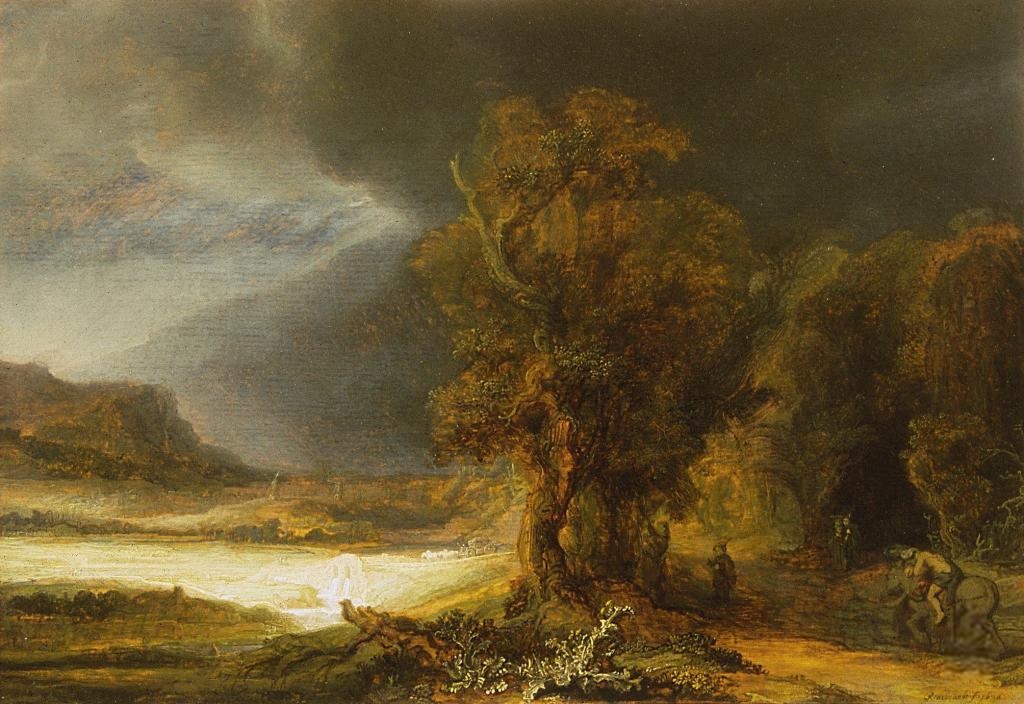
Rembrandt’s “Landscape with the Good Samaritan” transforms a biblical parable into a brooding world of weather, woods, and human scale. Instead of placing the famous rescue at center stage, the artist subordinates it to a vast, living terrain. The right foreground holds the figures—one traveler hoisting the wounded man onto a horse while a third guides the reins—yet the eye is repeatedly drawn outward: to the tunnel-like path that disappears into trees, to the river that flashes like molten metal across the middle distance, and to the sky, a cathedral of cloud rolling in from the left. The parable becomes a way of reading a landscape, and the landscape becomes a theater for mercy.
The Parable Moved Off-Center
Many painters dramatize the Good Samaritan as a close-up, centering the bandaged victim, the rescuer, and the reluctant innkeeper. Rembrandt does something more audacious: he makes the act of compassion a small, truthful incident inside a large world that is, nonetheless, altered by it. This shift of emphasis is the key to the painting’s emotional intelligence. By refusing to isolate the figures, he suggests that acts of care are woven into ordinary routes and weathers. The Samaritan’s deed is both singular and exemplary, as modest in scale as it is immense in meaning.
Compositional Geography: A Triptych of Space
The canvas reads like a horizontal triptych. At left, an open valley catches light, a lowland of fields and water segmented by hedgerows and lanes; at center, a towering oak anchors the picture, its trunk twisted and knotted, its crown dark against the sky; at right, a dim forest edge opens onto a path where the Samaritan and his companions emerge from shadow. This structure makes the eye travel—light to tree to figures—so that the narrative is discovered rather than declared. The oak is the hinge: rooted in earth, arching toward sky, it connects the open country of the left with the human drama at the right.
A Sky That Thinks and Moves
The weather matters. The sky’s left half is a cool expanse of pearl and slate, layered with long, horizontal striations that suggest wind combing cloud. A diagonal front presses in from above, darkening the upper right quadrant until the canopy of the woods seems to merge with storm-cloud. The light striking the valley is not stable sunshine; it’s a fugitive clearing, a mercy of weather. Rembrandt’s chiaroscuro is meteorological as well as moral: danger gathers overhead while guidance opens in the distance. The heavens feel like a mind changing—brooding, then loosening.
The River as Moral Axis
Across the painting’s middle runs a river or broad watercourse, catching the broken sun so fiercely it reads as a band of fire. It separates wild from cultivated terrain; it doubles as a path for the eye; and it reflects the sky’s unstable peace. In the parable, the road from Jerusalem to Jericho is a place of ambush and exposure. Rembrandt rephrases that idea: the water becomes a moving margin between threat and safety, between the dark wood that shelters brigands and the open land where a city might be reached. The good deed occurs on this side of the water, but the light points to routes that will carry it forward.
The Oak: Witness, Refuge, and Timekeeper
No element is painted with more authority than the central oak. Its trunk bears scars; roots thicken like ropes; small sprays of leaves catch incidental highlights; a dead limb juts forward, bleached and skeletal. The tree is not an emblem pasted into the scene; it is a protagonist. It has watched many passersby—travelers who hurry and travelers who stop—and it will outlast the people beneath it. Yet Rembrandt gives it a secondary role: the tree frames the Samaritan’s party without overwhelming them, exactly as a good witness should.
The Path as Sentence
The right-hand road curves inward like a grammatical clause, beginning in shadow, bending around the oak’s base, and then veering toward the lit valley. This line is the painting’s syntax. It carries the subject (the Samaritan and the wounded man), sets a subordinate phrase (the dark wood), and ends in a predicate of light (the fields and water). We feel the sentence continue beyond the canvas: the road exits the image toward help, lodging, and aftercare. The path is not only a pictorial convenience; it is a moral promise.
Figures That Refuse Theatricality
Rembrandt miniaturizes the actors. At far right, the Samaritan bends under the weight of the wounded man, hoisting the body onto the horse’s back; another traveler steadies the reins. Their scale is astonishingly small relative to the canvas, but they are modeled with sympathy: gestures are readable, clothing carries believable weight, the horse’s head dips in patient acceptance of its burden. Because they are not monumental, they feel close to us. The rescue becomes credible precisely because it is uninflated.
Chiaroscuro as Ethical Weather
Light labors through the image like a tide: ricocheting off water, gilding grasses, finding the torn edges of bark, then sinking into thickets. The human group occupies the painting’s half-tones—neither the darkest shadow nor the brightest flare—which is fitting; compassion usually lives in the middle register of attention, not in spotlight or oblivion. Rembrandt makes the chiaroscuro descriptive and prescriptive: we understand the terrain and, at the same time, learn where to look.
Brushwork That Breathes
The surface is alive with varying speeds of paint. In the sky, long, blended swathes are softened to carry atmospheric depth. In the oak’s bark, dragged and scumbled strokes build a leathery crust. Foliage is flicked with small, syncopated touches that cluster into crown and hedge. Ground in the near foreground is knife-scraped and then reharmonized with thin glazes, creating the sensation of damp soil and scattered branches. The figures are handled with quicker, tighter marks so they don’t dissolve into the gloom. This orchestra of techniques makes the canvas breathe like weather.
Color: Earth Tones With Electric Edges
The palette leans to umbers, olives, and ochres, but Rembrandt electrifies these earth tones with surprising edges of brightness—zinc-white strikes along the river, cool gray-greens inside the forest’s mouth, honey glints in grasses and deadwood. Nothing is garish. The chroma is earned by value contrast rather than pigment saturation. As the eye spends time among the browns, the smallest increment of light reads as miracle, which is exactly what the parable dramatizes: an ordinary afternoon made luminous by care.
The Inn That Isn’t There
In his “Charitable Samaritan,” Rembrandt paints the handover at the inn. Here, that architecture is absent. The omission is meaningful. This is the moment before institutions engage, when responsibility rests entirely on passersby. The world of roofs and thresholds is present only by implication in the distant buildings that dot the valley. The painting therefore pushes ethical pressure onto the viewer: while help is still far away, what will you do on the road?
The Echo of “The Stone Bridge”
“Landscape with the Good Samaritan” speaks to Rembrandt’s other 1630s landscapes, notably “The Stone Bridge.” Both feature ominous skies, a central tree, a glowing band of water, and tiny figures whose labors are dwarfed by terrain. Yet the inclusion of the Samaritan makes this canvas uniquely purposeful. The earlier work is a meditation on transience and shelter; this one adds a thesis about neighborliness. The shared vocabulary of forms achieves different meanings through the presence of compassion.
The Animal as Moral Temperature
Rembrandt’s animals often stabilize human emotion. The horse here is a luminous gray-brown, head lowered, foreleg lifted in a careful step. It radiates patience. That stillness counters the drama of lifting the wounded body and keeps the scene from melodrama. The creature becomes a kind of metronome for mercy: steady, uncomplaining, ready to bear. Without the horse’s temperament, the painting’s feeling would harden into heroics; with it, the image settles into truth.
Deadwood and Regrowth
In the immediate foreground lies a tangle of dead branches, pale and bone-like. They rhyme with the oak’s bleached limb and with the victim’s supine form. But they also cradle specks of new green, saplings catching at life along the path. Rembrandt doesn’t press the symbolism; he simply lets the eye notice that death and renewal share the same patch of earth. The Samaritan acts inside that ecology, neither pretending danger has vanished nor surrendering to it.
How the Eye Travels
Look slowly and the painting choreographs your gaze. You may start with the bright river, then slide to the oak and its bark, then drop into the path where the figures appear, then move with them toward the clearing on the left. Or you might enter through the heavy clouds, descend along their dark curve to the tree’s crown, and then find the human group where the darkness thins. Each route tells the same story: out of shadow, a path; on the path, a burden; beyond the burden, a country opening into light.
Soundscape: A Quiet After Threat
Though silent, the painting suggests an acoustic world: wind pushing treetops; a crow somewhere in the wood; hooves knocking against roots; the low speech of men concentrating on a lift. In the valley, water mutes the far world into a soft rush. The dominant sound is quiet, the measured hush that follows crisis but precedes safety. Rembrandt avoids spectacle; he trusts the music of care.
A Theology Without Emblems
There are no haloes, no inscriptions, no literalized morals. The theology is in the weather, the road, the scale, and the gesture. Grace appears as a break in cloud, as a wanderer choosing to stop, as the fact that a path exits the forest and doesn’t dead end in darkness. In Rembrandt’s hands, belief lives in the world’s structure rather than on top of it.
Dutch Eyes on a Biblical Road
The terrain is not strictly Palestinian; it is northern in its breadth of sky, its moisture, its mossed trunks. Rembrandt folds the parable into a landscape his neighbors could recognize. This localization is not a historical mistake; it is a decision to claim the story for every traveler on every road. By painting a Dutch-feeling countryside, he lets the parable speak in present tense: this is our weather, our path, our obligation.
The Ethics of Scale
The canvas teaches by scale. Human drama is small, and therefore precious. The world is large, and therefore indifferent unless we make it otherwise. The figures are not diminished by their smallness; they are dignified by the attention paid to them amidst so much else. The viewer learns to look for grace in the margins, because that is where it usually occurs.
The Minute That Changes the Day
Rembrandt often selects the breath before or just after a decisive action. Here we witness the lift, the difficult minute when weight redistributes across shoulders, saddle, and rein. It is not the sentimental bandaging or the triumphant arrival at the inn; it is the work in between. Because he fixes on that practical interval, the painting honors the labor of compassion, not just its intention.
How to Look, Slowly
Begin at the right: read the Samaritan’s crouch, the wounded man’s limp arm, the angle of the horse’s neck. Follow the path leftward until it kisses the base of the oak; climb the trunk with your eyes, counting the healed wounds in the bark; let your gaze branch into the crown and then spill into the sky’s gray-green. Cross the bright river. Pause in the distant, pale fields. Return along the riverbank to the foreground tangle of deadwood and its seeded greens. Now repeat the circuit more slowly. Each loop will loosen another knot of meaning: effort, weather, witness, way.
Why the Painting Still Feels Contemporary
We live amid large systems—landscapes of economy and climate—that can make individual action feel trivial. Rembrandt’s canvas acknowledges the vastness and refuses despair. It proposes that decency argued in the corner of a big world still matters and, in fact, is the only way that world becomes hospitable. The picture’s relevance lies in its modesty: a wound is lifted; a road is taken; the light, for now, holds.
Closing Reflection
“Landscape with the Good Samaritan” is a masterclass in how narrative can inhabit scenery without theatrics. The parable remains visible, but it does not dominate. Instead, weather, path, tree, and river collaborate to make mercy plausible. The painting asks nothing extravagant of us—no heroics, no glow of self—only a willingness to stop on the dark edge of a wood and help someone back onto a road that leads toward light. In that sense the landscape is a map of conscience, and the tiny figures are its compass.