Image source: wikiart.org
First Impressions: A Grove That Moves
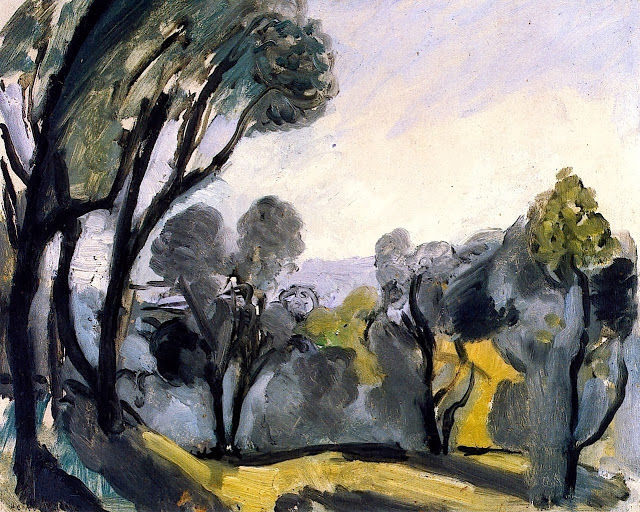
“Landscape with Olive Trees” from 1918 opens like a breath of Mediterranean air. Broad bands of light and shadow slope across the foreground, a cluster of olives rises in a tangle of dark trunks and gray-blue crowns, and beyond them a faint lilac ridge hints at distant hills. The sky is pale, almost milky, with pockets of warm light. Everything seems to sway: trees lean, canopies pulse like clouds, and paint strokes run like wind across grass. The result is a landscape that is less a place than a living climate—calm, rhythmic, and charged with quiet motion.
1918 and the New Key of the Nice Period
The year matters. In 1918 Matisse arrived on the Côte d’Azur and shifted from the carved severity of his mid-1910s canvases to a steadier, atmospheric language. The Nice period that followed is marked by tuned color, shallow but convincing space, visible process, and black used as a positive, structural hue. “Landscape with Olive Trees” is an outdoor demonstration of this new key. It trades Fauvist spectacle for measured temperature and simplifies forms until they read at a glance while remaining sensuous up close.
Composition: Arcs, Bands, and an Open Center
The design rests on three strong moves. First, two dark trees at left and right act like bookends, their trunks bending inward to frame the view. Second, diagonal bands of light and shade sweep across the foreground, establishing the terrain’s tilt and setting a slow visual rhythm. Third, the center is kept open—not empty, but breathing—so the eye can pass between trunks into the sense of distance. Matisse uses the olives’ rounded crowns like punctuation, stacking them against the pale sky to mark time. The horizon is high enough that we feel enclosed in the grove, yet it remains porous; space circulates.
Olive Trees as Calligraphy
Matisse never paints leaves one by one. He reduces olives to expressive calligraphy: serpentlike trunks that thicken and thin with the pressure of the brush, and clustered, scalloped crowns whose gray-blue notes catch and release light. These crowns interlock like a chain of clouds, while the dark limbs knit the scene together. By suppressing botanical detail, he frees the eye to register movement and relation—the way trees answer one another across space, the way shadow pools under their weight, the way light flickers at the edges of foliage.
The Path of Light
Instead of a literal footpath, Matisse offers a path of light. The foreground slopes are divided into warm and cool bands, guiding the gaze in a lazy S toward the middle distance. These bands do double duty: they model the ground without fussy shading and they meter the viewer’s passage through the picture. Their curves rhyme with the arcing trunks above, so earth and trees share a single, slow pulse.
Palette: Tempered Greens, Gray-Blues, and Buttered Yellows
The color chord is modest and masterful. Greens range from sap and emerald to olive and bottle, each tuned by the company it keeps. The olives themselves are mostly gray-blue and slate, the metallic hues of sunstruck leaves that reflect more sky than chlorophyll. Patches of yellow—particularly at right where light pools behind a tree—supply a buttery warmth that makes the cools sing. The sky is a thin veil of ivory and violet, brushed lightly so streaks of undercolor catch the eye like high clouds. Because saturation is moderated, temperature does the expressive work: cool crowns against warm earth, warm light against cool shadows, black trunks sliding between both.
Black as a Positive Color
Matisse’s darks are pigments, not voids. The trunks and the deepest pockets of foliage are stated in near-black that leans brown or blue depending on adjacency. This black does three things at once: it anchors the airy palette, it intensifies neighboring colors, and it records gesture. Where black brushes against the sky, the seam is crisp and cool; where it bites into yellow, it warms; where it traces across green, it clarifies form without resorting to outline. The painting’s bass line is played in black.
Light as Climate Rather Than Effect
There is no theatrical spotlight, no stagey cast shadows that fix a single hour. Light is a climate—present everywhere, understood as temperature. Planes turn not through hard core-shadows but by slipping from warm to cool. The right side glows honey-yellow as if the ground caught sun between trunks; the left recesses into olive-green shade; crowns cool as they tilt toward sky. This approach makes the picture feel continuous with experience: not a moment snatched, but a day breathed.
Brushwork and the Visible Pace of Making
The surface keeps the time of its making. The sky is laid in with long, lightly loaded passes; thin paint lets the tooth of the support sparkle in places. The crowns are built from overlapping comma-strokes, laid wet-into-wet so edges breathe. Trunks are pulled in single, elastic gestures that widen at the base and taper as they climb. Foreground bands show broader sweeps, the brush riding the ground’s slope. Matisse avoids cosmetic blending; he lets zones speak in their own tempos, and the coexistence of those tempos—slow sky, pulsing crowns, swinging trunks, gliding earth—creates the sensation of air moving through the grove.
Edges, Joins, and the Craft of Meeting
Edges are tailored like seams in a well-cut coat. Where a canopy meets the sky, the boundary alternates between firm and feathered; the eye reads this as leaves dissolving into light. Where trunk meets earth, the join is firmer, planting the tree. Where yellow light presses behind a dark form, Matisse softens the line so brightness appears to spill. Small halos—by-products of wet paint pulled across wet—are allowed to remain because they read as atmosphere. These varied joins keep simplified forms from looking pasted on and seat every mass in shared air.
Space Kept Close to the Plane
Depth is felt, not forced. Overlap does most of the work—foreground trunks before middle grove before distant ridge—while value change carries the rest. The far hills are lilac and gray, the gentlest cool; the midground trees are darker and clearer; the near trunks are heaviest. By avoiding linear perspective tricks or deep cast shadows, Matisse keeps space near the surface so the painting also functions as a designed arrangement of shapes and colors. That closeness is crucial to the Nice period’s calm.
Rhythm Across the Picture
The painting’s music unfolds in three registers. The highest is the scallop rhythm of the crowns, a dotted line along the sky. The middle is the sway of trunks, long legato arcs that tilt the grove. The lowest is the ground’s broad bands, a slow ostinato that steadies everything above. The eye moves through these registers as through parts in a trio—crown to trunk to earth and back—never snagging on irrelevant detail.
The Olive as Modern Motif
Olive trees carry layers of meaning—antique endurance, Mediterranean daily life, the marriage of cultivation and wildness. Matisse respects these associations but translates them into modern terms. Rather than catalog species traits, he emphasizes the olive’s structural paradox: a rugged, twisting body carrying a delicate, reflective crown. That paradox becomes a visual theme—dark versus pale, weight versus shimmer, permanence versus movement—played across the canvas until it feels inevitable.
A Guided Circuit for Close Looking
Begin at the golden slope at lower right where sunlight pools on the ground. Let your eye follow the warm band leftward until it dissolves in green. Climb the right-hand trunk; feel how the dark thickens where branches fork and thins as they whip out toward sky. Jump to the nearest crown and trace the scallops as they step across the top edge toward the left. Drop into the midgrove where grays cool and deepen; watch how small gaps of sky prickle between masses. Cross the scene to the left pair of trunks, then slide down into the deep green pocket at their base. Step out again onto the warm slope and repeat. Each loop, the grove’s rhythm becomes clearer.
Dialogues with Tradition and Near Contemporaries
Cézanne haunts the painting in its constructive planes, particularly in the way crowns are built from adjacent facets rather than blended shadows. Japanese print sensibility flickers in the bold silhouettes and flat color bands that still describe space. The decorative intelligence of the Nabis—especially Bonnard’s sense of patterned light—hovers in the warm foreground. Yet the voice is unmistakably Matisse: black as architecture, temperature as modeling, and serenity as the primary ambition.
Relation to Sister Works of 1918
Set this canvas beside “Landscape around Nice,” “Large Landscape with Trees,” or “Landscape with Cypresses and Olive Trees” and its place becomes clear. Compared with the broad atmospheric planes of “Large Landscape with Trees,” here the drawing is more emphatic, the trunks more calligraphic. Compared with the denser “Landscape around Nice,” this painting is more open, its center a breathing corridor of light. With the cypress composition it shares the bass notes of black and the bright punctuation of yellow, but olives’ reflective crowns shift the palette toward gray-blue, yielding a cooler, marine climate. Seen together, these works chart Matisse’s outdoor grammar in Nice: forms simplified to their sway, color tuned to day, depth close to the surface.
Emotional Register: Privacy and Ease
The scene is companionable rather than dramatic. There are no figures, yet the ground feels walked, the shade inhabitable. The grove offers that particular comfort of a place that is composed but not staged. The painting withholds story and gives sensation—rest, air, warmth balanced by cool—so the viewer’s mood settles into the same measured pace as the brushwork.
Material Evidence and the Courage to Stop
Look closely and you will find revisions left in plain sight: a crown enlarged over a cooler underpass, a trunk restated to change its tilt, a slice of sky reclaimed between masses, a yellow area pulled thinner to let the ground glimmer. Matisse doesn’t polish these traces away. He stops when relations feel inevitable, not when surfaces are cosmetically smooth. That earned inevitability is the source of the painting’s calm authority.
Lessons for Painters and Viewers
The canvas reads like a concise manual. Use black as color to anchor airy chords. Model with temperature shifts instead of heavy shadow. State foliage as masses with varied edges to avoid leaf-litter fuss. Build movement through repeated curves and bands rather than literal wind effects. Keep depth near the plane so the image reads at a glance yet rewards close looking. Above all, let a few true relations—warm ground, cool crowns, living darks—carry feeling.
Why It Still Feels Contemporary
More than a century later, the painting looks freshly designed because it aligns with how we see now: big shapes, tuned color, visible process, shallow but legible space. Pattern does structural work; gesture records time; atmosphere is built from temperature, not tricks. The confidence to let a handful of relations do the heavy lifting is as modern today as it was in 1918.
Conclusion: A Grove Made of Relations
“Landscape with Olive Trees” is not a transcript of a view; it is a construction of relations that distill Mediterranean day into line and color. Dark, elastic trunks keep time; gray-blue crowns pulse like cool flame; yellow warmth slides across the ground; and a pale sky holds the whole in a calm envelope. With disciplined means Matisse achieves the sensation of air and the pleasure of order. The grove moves, the eye moves, and the viewer leaves steadied—the very promise of the early Nice period, fulfilled in paint.