Image source: wikiart.org
Introduction
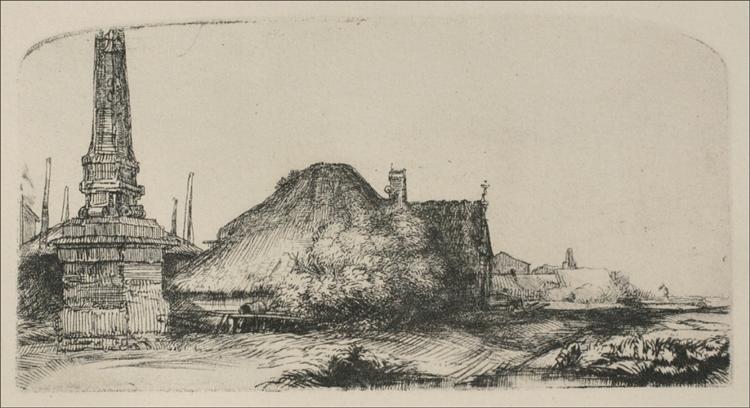
Rembrandt’s “Landscape with an Obelisk” (1650) is a compact etching that discovers grandeur in everyday ground. A tall, masonry obelisk rises at the left edge like a sentinel; a massive thatched structure swells at center; rutted tracks sweep into the distance across a low, bright field; and a pale sky holds everything in generous, breathable light. The sheet is small, but the space feels wide because Rembrandt gives air the leading role and lets a few purposeful forms carry the narrative. The obelisk is not courtly spectacle; it is a local landmark, a wayfinding post, a memory stone that sets the tempo for a countryside shaped by labor, weather, and time.
The Obelisk and the Drama of the Edge
The print’s most striking feature is the tall obelisk at the far left. It does not stand in central authority; it stakes the edge, shouldering into the frame like the first word of a sentence. Built from stacked blocks and capped with a tapering shaft, it is etched in dense vertical hatchings that give weight and age to the stone. A shallow canopy or plinth girdles its base, and the lower courses are nicked and shaded as if weathered by years of wind. Placing this monument on the margin creates a compositional aftershock: the eye feels a strong vertical and then, released, travels laterally across the breadth of the landscape. The column anchors the scene without dictating it, acting as a hinge between the viewer’s space and the world beyond the paper’s edge.
A Cottage as Counterweight
Across from the obelisk rises a great thatched volume, part house and part barn. Its roof is rendered with layered, slanting strokes that fray into burr, catching light like rough fur. The contour is irregular—sag here, lift there—registering repairs and the slow settling of years. A small chimney pricks the ridge, and a scattering of posts and timbers suggest workaday structures tucked behind. This built mass provides the picture’s horizontal counterweight to the obelisk’s vertical insistence. Together they act like chords struck on different strings: stone and straw, commemorative permanence and daily shelter.
The Path and the Logic of Use
From the foreground, cart ruts and footpaths sweep diagonally into the right distance, where fields thin out toward reeds and a low horizon. Rembrandt draws these tracks with broken, confident lines that fatten and narrow with the land’s slope. The paths are not simple lines of composition; they are records of repeated decisions—how to skirt a wet patch, where the ground holds firm, which direction lines up with the well or the ferry. The viewer reads the countryside as a negotiation rather than a plan, a place walked into usability.
Chiaroscuro as Weather
The plate’s tonal design is meteorological rather than theatrical. Deepest shadow gathers under the obelisk’s canopy and within the hedge that wraps the thatched building. Mid-tones stretch across the track and scrub; distance dissolves into the palest values beneath a clean sky. This gradient reads as a fair day, with sun strong enough to model the obelisk’s planes but not so low as to carve dramatic shafts. Rembrandt uses darkness to cool the viewer in patches and brightness to widen the air. The result is a day fit for work, a weather of competence and ease.
The Sky and the Ethics of Reserve
Most of the sky is unmarked paper, its slight tone coming from a delicate wipe rather than from crosshatching. That reserve is a deliberate ethics of looking. It resists the baroque temptation to perform with clouds and instead trusts emptiness to hold time. Against the quiet sky, the obelisk’s silhouette becomes legible at a glance and the thatch breathes. The landscape gains dignity not through spectacle but through the right to be spacious.
Line, Burr, and the Tactility of Surfaces
Rembrandt’s needle speaks different textures with startling economy. Stone is a stack of short, firm strokes that meet at crisp edges; thatch is a tangle of slanting cuts that bunch into velvety burr; low scrub is a skitter of loops and flicks; and rutted ground is a mesh of long strokes broken by lifted points. Where he wants depth, he presses to raise burr so shadows print as soft, dark velvet; where he wants light, he lets the copper barely graze the needle, leaving the paper bright. The technique matches subject: a country made of tough materials handled with care.
The Obelisk’s Meaning Between Past and Present
What purpose the obelisk served—boundary mark, commemorative post, wayfinder—matters less than the work it does in the image: it brings history into conversation with use. The thatched building tells the present tense of chores; the monument speaks the pluperfect of memory. Seen together, they form a compact theology of place: life continues under the gaze of what has been. Rembrandt avoids romance; the stone is neither ruin nor idol. It is simply there, keeping time and direction while carts pass and roofs get patched.
Rhythm, Repetition, and the Music of the Field
The print is full of quiet rhythms. The courses of the obelisk repeat as stacked rectangles; the thatch repeats in staggered diagonals; fence posts, stakes, and chimneys prick a beat across the middle distance; and the ruts of the road pulse in paired stripes that converge and spread. These repetitions create a music that the eye follows unconsciously. The landscape hums rather than declares, singing a steady work song of materials and habits.
The Foreground’s Invitation
Rembrandt sets a small bank and a tuft of vegetation in the front right corner. Their darks and coarse strokes lift the lower edge into tactile presence, inviting the viewer to step in. Because the obelisk touches the left frame and the track slides toward the right, the composition feels as if it continues beyond the paper. The sheet is not a wall but a window you could lean on.
Season, Time of Day, and the Soundtrack of Light
Leaf masses appear full; thatch looks dry; no snow or bare branches intrude—signals of late spring or summer. Shadows sit short and comfortable, implying mid-morning or mid-afternoon. The acoustic is modest: the faint grind of cart wheels, a breeze through straw, perhaps the distant thud of a mallet. The monument itself is silent, which is its function: to make the rest audible by contrast.
Human Scale Without Staffage
There is no large figure in the foreground. If a person appears at all, it is as a small signal in the middle distance. The absence is telling. Rembrandt keeps the world’s measure in buildings and tracks rather than in costumed staffage. The viewer understands scale by imagining a body at the thatch’s door or at the obelisk’s base. This approach respects the land’s integrity; people belong here without needing to dominate the image.
The Middle Distance and the Civic Horizon
Beyond the cottage, rooflines diminish, a low tower or mill pricks the horizon, and fields feather into reeds. Rembrandt uses fewer and lighter marks here so that the far ground reads as breath rather than detail. The suggestion of a village yokes the farmstead to a civic web—church bells, market days, neighborly errands. The landscape becomes not a lonely idyll but a participant in a network of places.
The Obelisk as Graphic Device
As much as it is a subject, the obelisk is a drawing instrument. Its verticality allows Rembrandt to calibrate every other stroke: roof slopes, track diagonals, and field striations derive energy by contrast with its up-and-down steadiness. The monument also solves the problem of starting the eye’s journey; by thrusting into the frame at left, it catches attention and releases it across the sweep of the plate. In purely graphic terms, it is the downbeat.
The Path as Narrative of Choice
Follow the ruts and you learn the land’s story. They split, rejoin, and widen where carts have met or where mud forced a wider path. They carry you past the obelisk without asking permission, then ease around the thatched mass where shade gathers and work takes place. Nothing is diagrammed; everything is inferred from how wheels, hooves, and feet prefer to move. The narrative is humble but complete: from marker to shelter to open field.
The Ethics of Modesty
The print’s beauty lies in the refusal to overstate. Rembrandt doesn’t invent a dramatic sky or crowd the road with picturesque figures. He trusts the eloquence of an obelisk’s stony persistence, a roof’s patient patchwork, and a track’s habitual bend. This modesty is ethical as well as aesthetic. It accords dignity to ordinary structures and the labor that maintains them, aligning with the Dutch Republic’s civic ideals of usefulness and restraint.
Kinship with Rembrandt’s Long-Format Landscapes
“Landscape with an Obelisk” sits comfortably among Rembrandt’s long, low etchings from the late 1640s and early 1650s. Many feature a single anchoring motif—a ruined tower, a long boat, a flock of sheep—around which space and daily life organize themselves. The obelisk is this print’s organizing pillar. What distinguishes the sheet is the way the monument activates the left edge, lending the whole view the feel of a glance caught mid-walk rather than a staged prospect.
Printmaking as Weather Control
Rembrandt’s wiping of plate tone can change the day. A faint haze left in the upper corners rounds the sky into a soft vault; a cleaner wipe makes the air crisper and the track brighter. Extra tone at the base of the obelisk deepens its shadow, turning noon to mid-afternoon; lifted tone around the thatch lightens the mood. The same drawing thus carries multiple weathers across impressions, mirroring the changeable Dutch day.
Lessons for Looking
The etching teaches the viewer to locate meaning in relations rather than in spectacle. Notice how the vertical stone and sloped thatch balance; notice how the road links them; notice how open sky makes room for both. The image suggests a way of seeing that is also a way of living: keep markers that remember, maintain shelters that serve, leave space for air and movement.
Why the Image Feels Contemporary
Despite its age, the print reads like a modern poster for intelligent land use. It foregrounds infrastructure (marker, road), working architecture (thatch and lean-tos), and ecological edges (reeds, ruts, bank). The space is uncluttered; the forms are direct. Designers and photographers still rely on exactly these devices—strong edge anchors, big sky reserves, and one or two honest materials—to create clarity and calm.
Conclusion
“Landscape with an Obelisk” turns a handful of elements into a lasting meditation on place. A stone column keeps memory; a thatched roof keeps weather; a road keeps habit; a wide sky keeps peace. Rembrandt gives each the right allotment of line and light, then lets space do the rest. The result is a landscape that does not shout but steadies—a picture that feels like pausing beside a marker you’ve passed all your life, seeing it afresh, and understanding that the ordinary contains the enduring.
