Image source: wikiart.org
Introduction to Rembrandt’s “Landscape with a Man Sketching a Scene” (1645)
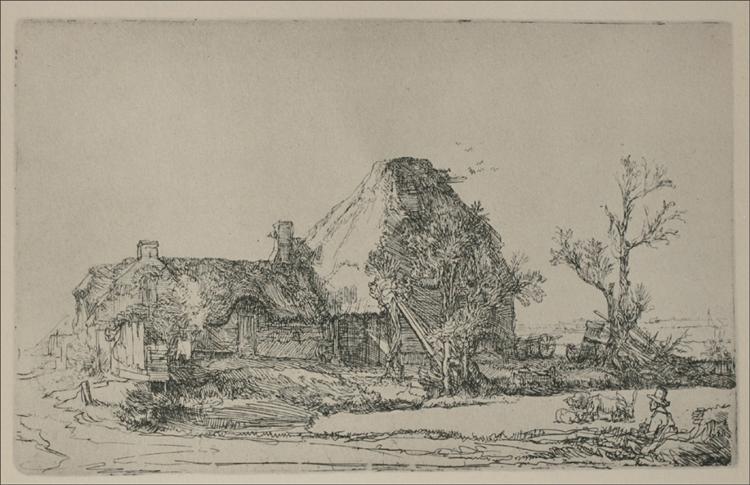
Rembrandt’s “Landscape with a Man Sketching a Scene” belongs to the mature moment when his landscape etchings expand from topographic notes into meditations on looking itself. The plate shows a thatched farmstead ringed by trees, with low water in the foreground and open countryside stretching to the right. Near the lower edge, a tiny figure sits or kneels with a portfolio, intent on drawing. This modest motif becomes a statement about the act of seeing, the practice of art in the open air, and the Dutch idea that everyday land—marshy, cultivated, and human-scaled—could carry the weight of poetry.
The Landscape as a Theater of Looking
Rembrandt composes the scene so that the artist-figure occupies the liminal zone between viewer and motif. We, like the figure, face the farm and trees framed against a generous sky. The placement is crucial: the sketcher is close enough for us to sense his concentration yet small enough to remain a humble participant in a larger order. By inserting a draughtsman into the view, Rembrandt asks us to notice not just the landscape but the process by which landscapes are made visible. The picture becomes reflexive—a landscape about landscape-making.
A Rural Ensemble of Structures and Growth
The eye first meets the thatched mass at center left, formed by two clustered buildings whose rooflines step gently downward. The thatch, rendered with tight, tufty strokes, rises into an irregular silhouette that catches the faintest play of light. Adjacent trees thrust upward in broken verticals, their trunks etched in wiry contour and their foliage suggested by quick, broken curls. The contrast between masonry, thatch, and living wood produces the scene’s fundamental rhythm: human shelter and the slow architecture of growth cohabit without hierarchy.
The Sky as Spacious Reserve
Unlike some of Rembrandt’s densely bitten plates, this sky is largely unworked, a luminous reserve of paper that introduces breath into the composition. The emptiness is not neglect; it is strategy. The open field of light amplifies the small, dark network of lines below, conferring scale and weather without insisting on cloud forms. A handful of birds, barely suggested, punctuate the emptiness and confirm atmospheric depth. The sky’s restraint is also psychological, granting the landscape the kind of quiet in which careful drawing can occur.
The Foreground Water and the Logic of Dutch Ground
The shallow water or mudflat in the foreground, rendered by spare horizontal strokes and little ripples, establishes the terrain as distinctly Dutch: low, managed, and reflective. It separates the viewer from the buildings, staging the composition like a proscenium. The eye crosses it almost without noticing, a process mimicking the sketcher’s imaginative crossing as he translates distance into line. This physical interval emphasizes that all landscapes are acts of mediation—spaces traversed by attention before they are traversed by bodies.
The Man Sketching as Emblem and Witness
The small figure at lower right is both an emblem of the artist and a witness to the world’s unassuming dignity. Hat tilted, legs tucked, portfolio resting on the knees, he is absorbed in the task. His presence allows us to infer scale and to identify a vantage. He faces the farmstead squarely, echoing our own frontality. Rembrandt resists idealizing him. There is no flourish, no cloak flying in the wind, only the practical posture of a draughtsman outdoors. In this, the figure validates the notion that beauty can be learned by sitting still before ordinary things.
Etched Line as Weather and Time
The plate’s language is the etched line—varied, elastic, and alive with the speed of a moving hand. Rembrandt assigns different functions to different line types. Long, nearly parallel hatches knit the shadowed flanks of the buildings; twitchy, abbreviated marks conjure scrub and reed; bolder, jagged contours articulate tree trunks and the edges of the thatch. These decisions do not merely describe surfaces; they measure time. We read the briskness of a gust in the edgy foliage, the patience of labor in the steady thatch, the slowness of geology in the low, banked earth. Line becomes a chronometer that registers multiple tempos within one field of view.
Spatial Depth Without Classical Perspective
Depth is achieved by layers rather than by a single vanishing point. The left cluster of buildings sits forward and dark; the larger thatch rises behind it and recedes by lighter biting; the tree on the right stands a little closer, its cross-hatching more emphatic; a far horizon slips away into light. This stacking encourages a walk through the scene without the coercion of linear perspective. Rembrandt’s landscape space is experiential rather than diagrammatic—built from the eye’s path rather than from geometry’s command.
Human Labor and the Poetics of Maintenance
A Dutch farm is a machine for living and for keeping water at bay. Rembrandt’s etched marks gather this work into an unobtrusive poetry. The fences, the strapped tree, the ditch-lines, and the cart or timber pile near the right margin all announce maintenance as a daily art. Nothing is picturesque in the sense of staged ruin. Instead, the world is in usable repair. The small figure of the sketcher recognizes that such repair is worthy of attention; by recording it, he says that the patient craft of keeping land and shelter intact belongs to art’s domain.
The Tree as Counterpoint and Measure
The right-hand tree, with its exposed branches and a clutch of leaves, counters the mass of thatch and masonry on the left. It supplies vertical music and a delicate sense of season—likely late spring or summer, given the partial leaf. The tree’s lean is subtly answered by the oblique shore-line and by props bracing the hayrick-like structure at center. These reciprocities lend the sheet a sensed geometry, an invisible scaffolding of diagonals and verticals that holds the composition in equilibrium.
The Hayrick or Barn as Monument of Use
At the center stands a high, conical stack—often read as a hayrick or a thatched barn—propped with timbers. Its scale dwarfs the people and even the trees, turning stored labor into a monument. Rembrandt lavishes attention on the thatch’s serrated edge and on the props’ linear tension. The structure’s very impermanence—straw that will be consumed—becomes a metaphor for a living economy in which forms are replenished and remade. Landscape here is not a fixed vista but a cycle of use.
The Narrative of the Ground Plane
The ground is a story in itself, animated by low ditches, an irregular path, and patches of rough vegetation. Rembrandt’s thin, meandering strokes let the viewer feel the small decisions of feet choosing firmness over wetness. The sketcher sits on a slight rise above a lower patch, a practical choice that also maximizes his view. By plotting these micro-topographies with a few lines, Rembrandt grants the ground the dignity of character rather than treating it as filler.
The Social Scale of the Scene
Humans appear small but not insignificant. The seated draughtsman, a distant figure near the farm, and what may be a cow or dog at right register life at a humane, non-heroic scale. This social sizing resists the temptation to monumentalize people or to reduce them to decorative staffage. The land holds them; they work upon it; and the artist, one of them, records the pact. The result is an ethic of mutual belonging: eye, hand, and earth collaborate.
The Plate as a Field of Experiment
Rembrandt’s 1640s landscape etchings are laboratories where he tests how far suggestion can go. Here, the sparseness of the sky, the openness of the mid-ground, and the tight knit of the building masses yield a score that an attentive viewer can “hear” without being told every note. The plate encourages imagination to supply the rest—the light on a July afternoon, the smell of hay, the faint sound of water at the ditch. Such invitation is not vagueness; it is hospitality. The image trusts the viewer’s own memory of the world.
Comparison with Rembrandt’s Other Landscapes
Compared to the tempestuous “The Three Trees,” this sheet is calmer, domestically scaled, and less theatrical. Where “The Three Trees” dramatizes weather and sublimity, “Landscape with a Man Sketching a Scene” meditates on observation and dwelling. Yet both share a belief that etched line can carry atmosphere and that the Dutch countryside is worthy of grand attention. The presence of the sketcher here aligns the print with other reflexive works where figures behold or measure the land, making explicit the artist’s long-standing interest in the very activity of depiction.
The Philosophy of Attention
The act of sketching outdoors in the seventeenth century involved choosing what mattered in a complex field. Rembrandt makes that act the subject. The draughtsman’s task is not to transcribe every blade of grass but to discern the structure of the scene—the rise of thatch, the counterweight of trees, the division of land from water, the scale of human occupation. The print thereby models a philosophy of attention in which seeing becomes a disciplined generosity. To look well is to give time and order to what might otherwise pass unnoticed.
The Mood of Workday Serenity
The sheet’s overriding mood is serenity tempered by alertness. No storm gathers, no catastrophe intrudes. The world here requires care but is not in crisis. That tone aligns with Dutch Golden Age values of sobriety, thrift, and civic responsibility. The artist-figure fits naturally within that ethic: he is a worker among workers, his craft another form of maintenance, preserving the land in memory even as others preserve it in fact.
The Role of Negative Space and Breathing Edges
Rembrandt allows the composition to “breathe” at the margins. The left and right edges loosen into blank paper, as if the world continued beyond the frame. This openness keeps the view from feeling trapped and allows the central ensemble to settle without heaviness. The negative space at top right also directs the eye to the small figure of the sketcher, whose silhouette is legible against the light. Such control of voids is a hallmark of his printmaking, creating a rhythm between said and unsaid.
Time of Day and Theatrical Light Without Shadow
Because the sky is unshaded, one might assume neutral noon; yet the modeling on roofs and trees implies a raking light, perhaps morning or late afternoon. Rembrandt does not darken large passages; instead, he modulates with density of stroke, letting the whiteness of the paper serve as ambient illumination. This restraint keeps the plate fresh and allows the sensation of air to persist above every grounded mark.
The Artist Within the Artist
Including a figure who sketches is a gentle self-portrait in the third person. Without claiming identity, Rembrandt acknowledges his presence as the one who looks, selects, and renders. The little draughtsman is the conscience of the composition, reminding us that landscapes are ethical choices as much as visual records. What we attend to becomes what we value; by attending to a humble farm and the geometry of fields and ditches, the artist proposes a civic love note to the land and those who tend it.
Legacy and Modern Resonance
Modern viewers, accustomed to plein-air practice and quick on-site studies, will recognize in the print a precursor to later traditions. Yet its modernity lies less in technique than in attitude. The sheet assumes that truth resides in the everyday and that the most faithful praise we can offer the world is careful notice. In an era of spectacle, the image’s quietness feels radical. It proposes that to sit beside a ditch and draw a thatched roof is to enter a conversation with time.
Conclusion: A Compact Manifesto of Seeing
“Landscape with a Man Sketching a Scene” may be small, but it reads like a manifesto. It affirms that art begins with presence, that presence flourishes in restraint, and that line—when varied, honest, and alert—can carry weather, labor, history, and care. The farmstead stands, the tree leans, the water lies low, and a man looks long enough to make the place endure on copper and paper. Through him, and through Rembrandt’s hand, we are invited to look likewise, to take our place on the bank, and to let attention turn ordinary ground into lasting memory.