Image source: wikiart.org
Introduction
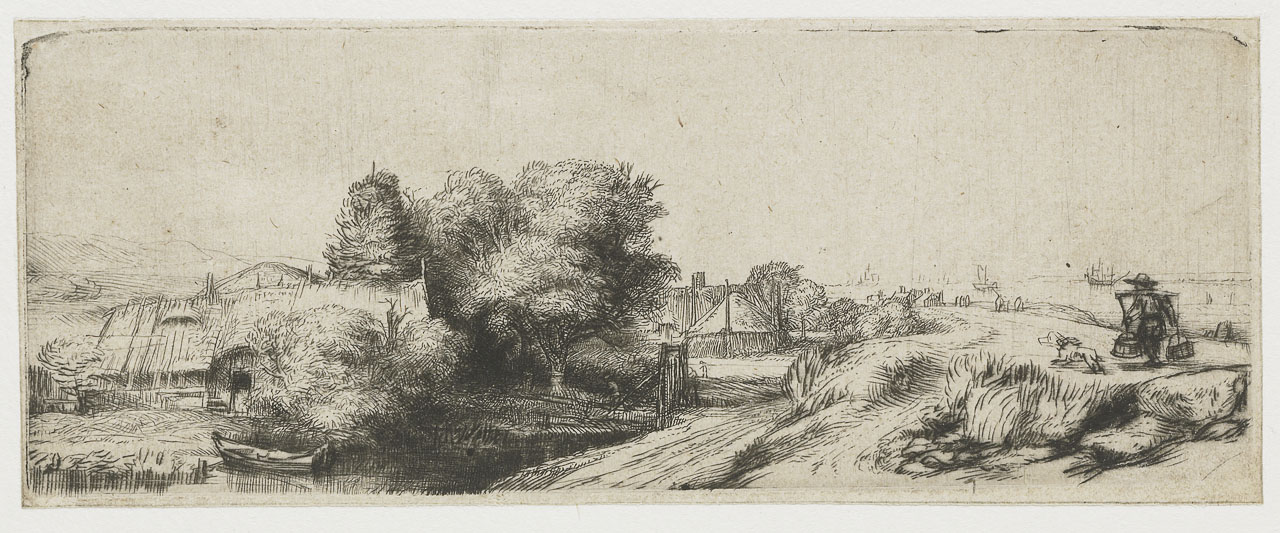
Rembrandt’s “Landscape with a Fisherman” (1652) is a small etching that feels expansive, a modest rectangle turned into a stretch of Dutch earth where water, road, trees, and sky strike a quiet balance. At first glance, it is an uncomplicated pastoral: a lone figure sits to the right with rod and creel, a dog nearby; a rutted track curls in from the foreground; a stand of trees thickens at center; behind them, roofs, fences, and sheds knit a hamlet together; in the left foreground, a moored boat noses into dark water. The plate is generous with air—half of the sheet is softly open, letting the light tone of the paper stand in for summer sky. Yet the longer one looks, the more this landscape reveals itself as an essay in how attention turns ordinary ground into lived place. Every mark counts. The fisherman becomes a pretext for a study of nearness and distance, stillness and motion, solitude and community.
The Composition’s Two Worlds
Rembrandt divides the sheet into two interlocking worlds: the dense, leafy enclave at the left and center, and the breezier, open terrain at the right. The clump of trees and buildings forms a compact, breathing mass of darker tone; the eye reads it as shelter—shade, moisture, garden, tools, the regular life of a homestead. From this nest, a track joins the open ground at right, a sandy bank slightly elevated above the river. There the fisherman sits, his silhouette a dark punctuation in all the air and light. The composition’s intelligence lies in how the two worlds speak to each other. The shaded enclave offers depth and privacy; the open bank offers prospect and breeze. The fisherman is situated at the seam, harvesting from the river what the settlement cannot provide by cultivation alone.
The Road As Time And Invitation
The rutted track, turned in the plate by a few parallel strokes and broken hatching, is the print’s narrative engine. It approaches from the lower right corner, sweeps left toward the trees, passes a little gate, and disappears between the cottages. That movement is the image’s temporal flow. You feel the road underfoot—soft and dry where the wind has lifted sand, compacted and darker in the dips—and you sense how the track governs the workday: carrying tools, eggs, and gossip to and fro. The line of the road is an invitation. It makes the viewer an imaginary walker, someone who could greet the fisherman, then follow the curve into shade to borrow a jug or mend a net.
The Fisherman And The Ethics Of Smallness
Rembrandt refuses to grandly stage the title figure. The fisherman is small, almost an afterthought in the sweep of sky and bank. He sits solidly, as if his weight were part of the land’s geometry. The creels and bucket are drawn with quick, decisive strokes; the rod is a taut diagonal, lightly etched yet authoritative enough to hold the eye. The dog nearby is a little wedge of black with a few sparks for ear and tail. Their unpretentious scale is an ethical statement: in this world, labor done without fuss is its own dignity. Fishing becomes the visual rhyme of Dutch practicality—quiet attention, patience, and intimate knowledge of place.
Trees, Fences, And The Intimacy Of Work
The central copse is a joy of etched language. Rembrandt’s needled lines tighten and loosen to conjure species without botanical pedantry. The upper foliage is a flight of curved hatchings that catch light; deeper masses are compact and velvety. Trunks sprinkle the shade with verticals. A fence, drawn as a rhythm of posts and crossbars, threads through undergrowth like a rural melody. The left side shows trellised frames leaning over a garden plot—perhaps fruit canes or bean poles—a reminder that cultivation here is a community practice, not simply a private chore. The settlement looks worked, not posed, and that sanity of effort gives the print its moral center.
Water As Mirror And Margin
The water at left is quiet, nearly black where plate tone has pooled and Rembrandt’s scrapes have kept reflections soft. A little boat rides the bank; its blunt bow, a handful of strokes, feels as convincing as a carpentry drawing. The channel is both mirror and margin: it doubles the trees into shimmer while holding the settlement like a moat of stillness. By keeping the fisherman downstream on the right, Rembrandt avoids the obvious symmetry of placing him by the dark pool; instead, he lets water serve two functions—work to be done (fishing, transport) and depth to be contemplated (reflection, shade).
Air, Sky, And The Luxury Of Paper
Half the beauty of the sheet lies in what Rembrandt leaves alone. The high pale sky is mostly untouched, aside from the ghosting of plate tone and a few incidental scrapes at the plate’s edge. This restraint is not laziness; it is the luxury of confidence. The emptiness makes the land breathe and keeps the fisherman’s scale honest. Air occupies the right half of the plate like a calm sea, pressing lightly on the bank’s grasses that Rembrandt renders with brisk, blade-like hatches. The sparser the marks, the more the paper’s own warmth becomes sunlight.
The City On The Horizon
Far to the right, barely legible, steeples and roofs faintly stitch the skyline. The marks are so modest that they hover between fact and memory. Yet their presence rescues the print from pastoral isolation. The fisherman and the hamlet belong to a civic economy; goods will be carried upriver; bells will tint the air on Sunday. That tiny city registers as obligation and opportunity, reminding us that quiet labor at the water’s edge undergirds the visible competence of the town.
Light As Structure
Light in the plate moves across surfaces like a hand testing textures. It makes the track flare, slides over the wind-ruffled grasses, creases into the garden’s trellises, and presses into the chinks of roof and fence. The left mass is built with darker values and small reserves; the right bank is built with openness. That alternation of value is the print’s architecture. Without a single theatrical contrast, Rembrandt builds a compelling continuum from shade to glare, and our eyes traverse it naturally—as if the weather, not the artist, arranged the light.
Technique: The Music Of Etched Marks
The variety of Rembrandt’s marks deserves its own reading. In the trees, short curved strokes and stipples accumulate into breathable thickness. In the grasses, quick splayed lines crackle like dry straw. The fences are a set of sturdy, straight marks; the boat, a handful of wedge-shaped hatches; the dog, compact, even scratchy. When he wants the soft, uncertain transitions of distance—the far roofs, the horizon—he opens his line, thinning it until it is barely there. The plate tone, left deliberately in places, becomes atmosphere. The whole reads like chamber music: a few instruments, many textures, one mood.
The Human Scale Of Dutch Landscape
Seventeenth-century Dutch landscapes often celebrated management: polders measured into rectangles, rivers bridged, mills harvesting wind. “Landscape with a Fisherman” sits within that civic pride yet shifts emphasis from grand infrastructure to personal competence. We are at the scale of a person who knows when the fish take the bait, who mends the gate hinge, who recognizes the change of wind by the grain of ripples. This intimacy of scale keeps the image modest and therefore trustworthy. It offers not a claim about glory but a description of enough.
Sound, Weather, And The Sensory Temperature
Look long and you begin to hear: the small clack of a hook tin, the soft bump of the boat against the bank, a single bird from the copse, the periodic hush of a breeze through reed and grass. The weather feels warm and fair—no plate-tone storm, no storm-blown trees—just a steady day of work and air. The sensory temperature anchors the scene in a specific season, likely late spring or early summer, when foliage is full but not yet heavy and water sits black in shade.
The Fisherman’s Posture And The Drama Of Waiting
Rembrandt loved moments before or after the obvious action. The fisherman is not hauling in a catch; he is waiting—watchful patience turned into posture. His hat angles to shade his face; the body leans forward slightly; the rod extends at the ready. The pose teaches a small doctrine: much of life is done in the preparedness between motions. Etching is an apt medium for the lesson—the needle draws waiting into line, and the printer’s careful wiping becomes a counterpart to the angler’s care.
Domestic Labor And The Hidden Households
Although the print foregrounds the solitary angler, traces of domestic labor are everywhere. The trellises imply pruning and tying, the fences mending, the boat caulking, the gate latching at dusk. Smoke is not etched, but you can imagine how it would lift among the trees. A figure walks on the far track, almost erased by distance; the viewer’s mind populates the hamlet with more bodies: someone setting a pot, another washing a bucket, a child running the bank. Rembrandt trusts the viewer to complete the village with memory, which is why the scene feels inhabited without being crowded.
Space, Depth, And The Art Of Overlap
Depth in the print is achieved by the most economical means: overlaps and alternating intensities. The boat slides in front of the bank, which in turn overlaps the dark pool; the trees mask roofs; the gate interrupts the road; the bank’s curve hides the fisherman’s lower legs. This sequence of hidden-and-seen tricks the eye into believing space without laborious perspective. The result is credible and quick, like an experienced walker’s sketch made on the spot.
Comparisons Within Rembrandt’s Landscapes
Compared with the panoramic “Goldweigher’s Field” or the riverine views of the Amstel, this landscape is more intimate in massing and more narrative in mood. It shares with those plates the high sky and the economy of marks, but here the central tendril of trees and the single human act (angling) give the sheet a heartbeat. It is kin, too, to the cottage-and-tree studies where Rembrandt builds a world out of one clump of foliage, one roofline, one strip of water—proof that he could make localness vivid without the punctuation of a city silhouette or a mill.
The Viewer’s Place And The Act Of Loitering
Where are we placed? On the bank itself, a few paces behind the angler, high enough to see the road’s undulations and the water’s darkness, close enough to hear the dog give a small sneeze in the sun. The vantage invites loitering. We are not rushed through the scene; we are invited to pause, watch the float, and let the countryside’s measured time recalibrate our own. That is the plate’s quiet gift: a license to be still in company with work that looks like rest.
The Meaning Of Restraint
Perhaps the strongest feature of “Landscape with a Fisherman” is its restraint. Nothing is overdrawn. The trees accept their smallness; the fisherman is a mark among marks; the sky is nearly untouched. This economy corresponds to an ethic: a good life needs enough—enough shade, enough road, enough water, enough skill. The print offers that sufficiency to the eye. By refusing spectacle, it makes clarity.
Close Looking At Key Passages
Spend a moment with the moored boat: the inside is suggested by two curved strokes that instantly read as ribs; a single diagonal shadow underneath persuades of weight. Inspect the gate: a few short uprights and a crossbar, the axis slightly crooked; it is the crookedness that makes it feel used. Study the fisherman’s hat: two or three dark wedges and a nick of light for brim are sufficient to give him character. Trace the grasses at the lower right: Rembrandt turns his wrist to make splayed, blade-like marks that seem to move even in this still image. Finally, look at the far skyline: dots and notches hover at the edge of legibility, perfectly balancing specificity with distance.
Why The Image Still Speaks
Contemporary viewers recognize the longing encoded here: the wish to sit quietly at the edge of ordinary life, to do a task that asks for patience and rewards attention, to feel a community behind one’s back and a wide sky before one’s face. The etching models a sustainable pleasure—place-based, season-aware, modest in means, rich in return. Its relevance is not nostalgic; it is instructive.
Conclusion
“Landscape with a Fisherman” is a meditation on enoughness rendered in ink. With a pocketful of marks and a generous allowance of air, Rembrandt composes a place where a person can work, wait, and breathe. The dense enclave of trees and sheds, the coaxing road, the quiet water, the open bank, the small city on the horizon, and the tiny figure absorbed in his task—all these elements interlock to make a world. The plate’s restraint is its eloquence. It asks nothing flashy of the land; it honors labor without romanticizing it; it gives attention the same dignity it gives action. In a career rich with miracles and crowds, this little sheet shows Rembrandt’s other miracle: the power to make the ordinary inexhaustible.