Image source: wikiart.org
Introduction
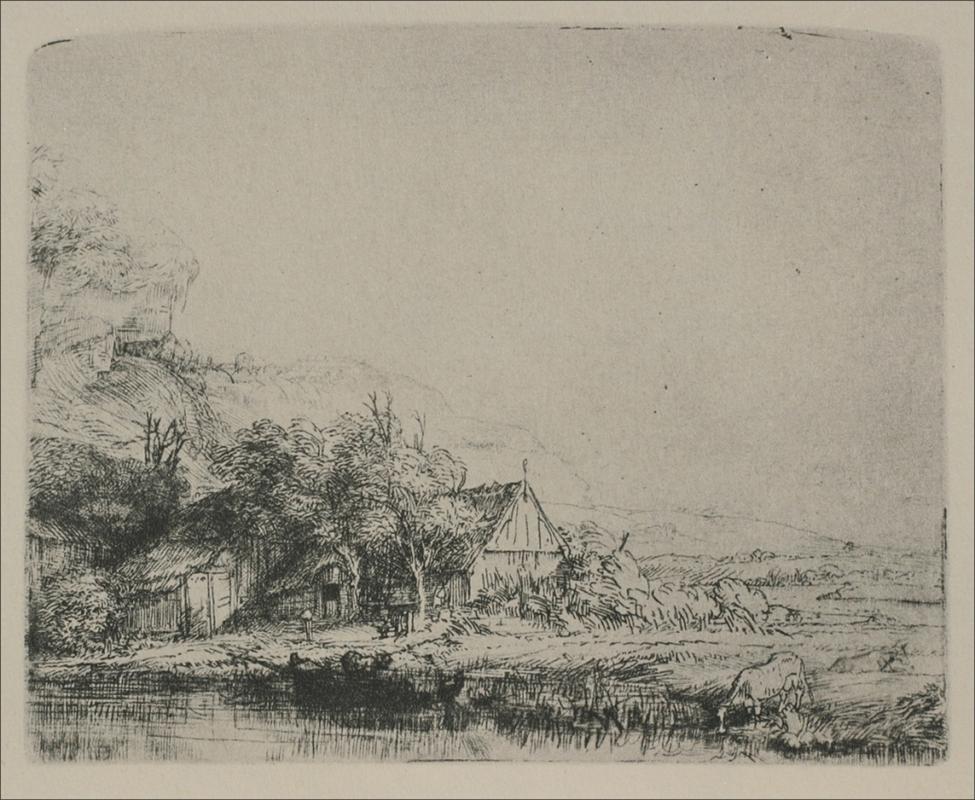
Rembrandt’s “Landscape with a Cow Drinking” (1649) is a small etching that opens onto a world of big quiet. In a few square inches of copper the artist sets a thatched cluster of farm buildings on the left, lets scrubby trees hold the middle ground, and allows a single cow on the right to put its muzzle to the water. Above it all stretches a vast, almost blank sky whose emptiness makes the low land feel intimate and true. Nothing spectacular happens; that is precisely the point. The print turns ordinary countryside into an event of attention, balancing stillness and detail so delicately that the viewer can almost hear insects and the faint ripples at the bank.
The Composition’s Breath and Balance
Rembrandt designs this sheet as a conversation between weight and air. The dense, etched darks gather at the left: cliff-like banks or a wooded rise, shadowed barns, and trees drawn with a cross-hatched thicket of lines. From that visual gravity the land relaxes across the picture toward the right, dissolving into open fields where marks thin to a whisper. At the far edge the cow lowers its head; a second little creature—perhaps a calf—huddles near the bank. The reflection band along the foreground water stabilizes the scene like a quiet bass note. The great reserve of white in the sky isn’t emptiness; it’s breath, the volume that lets the smaller motifs speak.
The Cow as Punctum
The title’s cow is physically small but compositionally decisive. Its bowed head and angled legs provide the only clear diagonal outside the architecture, and that diagonal anchors the right half of the sheet. Without the animal, the open acreage might feel ornamental; with it, the space becomes narrative. The cow converts landscape into a moment: thirst met, routine honored, day continuing. Rembrandt’s line is economical here—just a few short strokes modeling back and belly—but the gesture reads instantly. The animal is no rustic prop; it is the measure of life in the fields.
Light, Chiaroscuro, and Atmospheric Depth
As in many of Rembrandt’s prints, depth is orchestrated by values rather than by strict perspective. The left-side masses are dark and heavily bitten; mid-tones describe the trees around the cottages; and the right and far distances are rendered with faint, airy touches. That gradation produces a kind of atmospheric chiaroscuro: the eye moves from dense shade to sunlit openness the way one’s pupils adjust when stepping out from under trees. The wide, pale sky heightens this effect, bathing the fields in a thin, even light that feels unmistakably northern.
The Architecture of Dwelling
Look closely at the farm buildings under the trees. A gate hangs slightly ajar; a thatch roof sags with use; vertical boards patch together a shed; a thin gable, almost church-like in its triangle, rises modestly at the center. Rembrandt’s marks here are compact and practical—short, blunt strokes for timbers, tighter cross-hatching for shadowed doors, lighter threads for thatch. Nothing is idealized. These are buildings built for weather and labor, the kind that absorb noise and give back warmth. Their scale also fixes the human measure of the landscape; against them, the cow’s size and the reach of the fields make sense.
Trees as Timekeepers
The trees around the cottages are drawn with Rembrandt’s characteristic mixture of notation and feeling. Trunks are quick verticals with a few burr-rich kinks; foliage clusters into irregular puffs, some almost scribbled, others carefully massed. They do more than frame the architecture. They mark time—years of growth—and provide wind memory in the etched line. The irregular top silhouettes, when set against the empty sky, make the air legible. We sense weather: a light moving day with occasional gusts, the kind that wrinkles water but never threatens storm.
Water as Quiet Stage
The horizontal band of water in the foreground is rendered with calm strokes and a few darker accents for reflections. It acts as a stage apron between viewer and land, a reflective pause before the eye steps into the fields. The cow’s drinking makes the water’s role explicit: the stream or ditch isn’t scenic; it sustains. Its mirror surface also doubles the left-hand darks, visually counterweighting the pale openness to the right. The ripple at the animal’s mouth is a single moment of animation that suggests the soundscape of the print: a gentle lapping, distant birds, the muffled domestic noises of the farm.
Plate Tone and the Breath of the Print
Rembrandt often manipulated plate tone—residual ink on the copper—to control atmosphere. In strong impressions of this etching, a faint haze softens the sky near the upper corners while leaving the center clearer, as if light were thinning cloud. The darker wiping along the left edge enriches the wooded bank and draws the eye to the cottages; a cleaner right side gives the sense of air and distance that lets the cow sit in sunlight. These subtle decisions turn technical residue into weather.
Movement and Stasis
Although the scene is quiet, it isn’t static. The eye moves in a lovely loop: from the dark cliff and trees at left, along the roofline and the fringe of shrubs, out across the thinly etched fields, down to the cow and its reflection, and back along the water’s mirrored band. That rhythm keeps the viewer engaged without forcing a narrative. The feeling is of a day that breathes: work paused, animals tending themselves, the land resting between chores.
Dutch Place, Human Measure
“Landscape with a Cow Drinking” is deeply Dutch in its modesty and its respect for managed nature. The flat fields, the watercourse, and the stitched-together farmstead speak of a landscape made livable by steady hands. Rembrandt withholds grand mountains and theatrical storms. Instead he gives a care-full geography where cultivation and habit shape beauty. The cow’s ordinary thirst is elevated to emblem status: life depends on simple continuities—grass, water, shade, shelter.
The Sky’s Emptiness and the Art of Leaving Out
Many seventeenth-century landscapists filled skies with billowing clouds, sunbeams, and birds. Rembrandt leaves most of his sky blank. This “emptiness” is a disciplined decision that does several things at once. It pushes attention to the low world of people and animals. It expands the felt space beyond the copper’s edges, as if the air continues in all directions. And it makes the few lines at the horizon—tiny scratches suggesting distant buildings or dikes—sound louder. The quiet sky is a lesson in how omission can be eloquent.
The Print as Field Note
Rembrandt’s landscape etchings often feel like field notes from walks beyond Amsterdam’s city edges. This sheet carries that immediacy. The line never becomes fussy; marks remain legible as marks. You can sense the artist deciding where to thicken a clump of shadow, where to let paper stand for light, where to abbreviate reeds into a few strokes. That honesty draws the viewer in. We aren’t presented with a polished spectacle but invited to share the act of looking.
Scale, Intimacy, and the Viewer’s Position
In the hand, the etching is small. That scale asks for closeness. You lean in, the landscape fills your peripheral vision, and the faintest lines begin to register as reeds, paths, and ruts. The cow—so small on a wall reproduction—asserts itself as a real body bending to drink. This intimacy rewrites the typical relationship between viewer and landscape. Instead of surveying, we visit.
Comparisons within Rembrandt’s Landscapes
Compared to turbulent plates like “The Three Trees,” this etching is gentler, more horizontal, more about dispersed light than about storm drama. Compared to rustic panoramas populated with travelers and mills, it is pared down, almost monastic in its devotion to a few motifs. The difference shows Rembrandt’s range: he could make weather roar or let a cow’s quiet thirst command a composition. Here he chooses the low voice and lets silence carry.
The Ethics of Attention
At the heart of this print is an ethic: the ordinary deserves our best seeing. The cottager’s fence, the line of willows, the animal at the stream—none are romanticized, none mocked. They are rendered with a respect that stems from familiarity. In a culture that prized industriousness and neighborly care, Rembrandt’s landscapes operate as visual proverbs. They remind viewers that work, water, and patience are the republic’s true splendors.
Tactile World, Tactile Line
Rembrandt’s etched line is tactile. The roof’s thatch seems to catch a fingernail; tree bark feels fibrous; the cow’s hide, though barely indicated, reads as weight and warmth. This physicality partly results from burr—the slight ridge of copper raised by the needle—left to print as a softening halo in darker strokes. It’s also the product of a maker who loved matter. Even in a world of air and light, the print never lets us forget the heft of timber, the damp of earth, the satiny drag of water on muzzle.
Time of Day and Season
Though no sun is pictured, the long band of reflected light suggests late afternoon or morning when water acts like a mirror. Foliage is full but not heavy, hinting at late spring or summer. The cows graze and drink with unhurried appetite; people, if present at all, remain inside or out of view. This temporal quiet reinforces the picture’s mood: a daily hour when labor eases and land, animal, and water keep their own time.
Why It Endures
“Landscape with a Cow Drinking” endures because it perfects the modest. With minimal means Rembrandt achieves depth, narrative, and atmosphere. The print asks nothing more of us than attention, and it repays that attention with a feeling of contentment that is anything but simpleminded. The world is not spectacular here, yet it is fully alive. The smallness of the sheet belies its hospitality; each return viewing opens another path across those fields.
Conclusion
In 1649 Rembrandt turned a strip of Dutch countryside into a meditation on sufficiency. Dark farmstead, breathing trees, broad sky, reflective water, and a single animal at the bank—these ingredients, arranged with perfect tact, produce a landscape that feels both observed and loved. The cow’s lowered head anchors the right-hand space and embodies the print’s ethic: attend to what sustains you. The left-hand density answers with shelter and history; the sky answers with room to think. Between them, a day continues. Few landscapes say more with less.