Image source: wikiart.org
Introduction
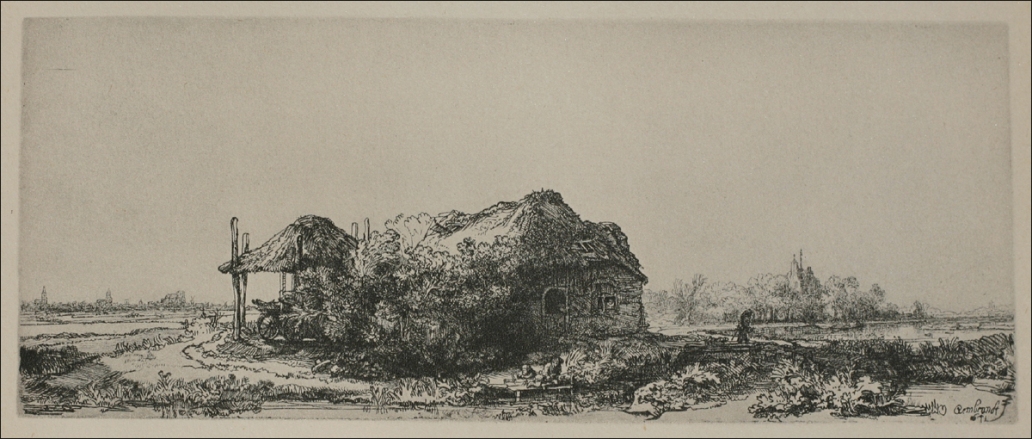
Rembrandt’s “Landscape with a Canal and Swan” (1650) is a long, low etching that turns a modest corner of the Dutch countryside into a complete world. At center stands a dense cluster of structures—a thatched cottage shouldered by foliage and an open, pole-built shelter that shades a cart and farm gear. A slim canal threads the foreground, its banks tufted with reeds; a little plank or culvert crosses a drainage cut; and in the quiet water a swan glides, a bright accent against the dark scrub. Beyond, low fields push to a pale horizon pricked by a distant church. The sky is a wide reserve of paper that lets the scene breathe. Nothing is theatrical, everything is lived. With a few hundred strokes Rembrandt composes a hymn to use—shelter, water, work, and the calm presence of an animal that reads as grace.
The Panoramic Composition and Its Quiet Drama
The etching adopts an extreme horizontal format, encouraging the eye to travel at walking pace. Rembrandt anchors the composition slightly left of center with the massed cottage and lean-to, then releases space to the right where fields open and a narrow path accepts a solitary figure. The canal’s low curve at the front edge provides a soft proscenium, introducing us to the stage of daily life. This arrangement creates a gentle drama, not of storm or architecture, but of approach and attention: we enter by water and vegetation, pause with the buildings, and drift outward into air and distance.
The Cottage, Lean-to, and the Architecture of Use
Rembrandt draws rural buildings with the affection of someone who understands why they look the way they do. The cottage’s roof is a thick, uneven pelt of thatch; walls are patched and low; the entrance is a dark oval sunk into shadow. The adjacent shelter—four or five poles sunk into earth, thatch laid light—keeps rain off a cart and tools. These are not picturesque inventions; they’re solutions to weather and work. Short, frayed strokes render thatch; steadier lines describe posts and cart hoops; a darker knit of hatching deepens the cavities where the eye would feel coolness. The architecture isn’t posed to be admired; it’s in the middle of doing its job.
The Canal as Lifeline
In Dutch land the canal is not scenery but infrastructure. Here it is etched as a broad, slow belt of horizontal marks that thicken into reflections near the far bank. Little cuts and cross-hatchings become reeds and water plants; a tiny plank or sluice explains how feet dry-shod the ditch. The canal both drains and connects: it carries excess water off the polder and gives back a pathway for boats and wildlife. Rembrandt’s decision to place it in the foreground gives the entire print the feeling of a first sip of air—the world opens with water.
The Swan as Luminous Accent
Amid the tough textures of thatch and scrub, the swan reads as a small miracle of clarity. A few pale reserves and a contour line lift its body from the dark water. It’s not a heraldic emblem, not an allegory, simply a creature at home in the canal. Yet its whiteness is compositional gold: it punctuates the foreground, balances the heavy cottage mass, and carries the eye toward the quiet middle ground where the path and fields begin. The bird’s calm motion injects time into the image—slow, gliding time that suits the print’s long format.
Chiaroscuro as Weather
Rembrandt’s tonal structure creates meteorology. The cottage and hedging are the darkest mass, a pocket of shade like a clump of cloud fallen to earth. Around them the values loosen into mid-tones of field and path; farther still, trees and the far village thin into pale air. The sky remains mostly untouched, a large reservoir of light that sets the mood as late morning or late afternoon on a fair day. Chiaroscuro here is not theatrical spotlight; it is the lived difference between shade under thatch and openness over water.
Line, Burr, and the Tactility of Surfaces
The etcher’s needle speaks many dialects on this plate. For thatch and scrub Rembrandt uses clustered, broken strokes that raise burr and print as velvety darks; for posts and cart rims he chooses tough, straight lines that feel like wood planed and handled; for watery edges he lets the line soften and wander, barely grazing the copper so that ink sits lightly like a film on the paper. The variety grants each material its own voice. You can sense the rasp of straw, the weight of timber, the slickness of mud, and the cool skin of the canal.
The Path, the Figure, and Human Scale
To the right of the buildings a slender path draws a thin S across the field. A lone figure walks it—just a few marks, yet unmistakable. This person’s smallness is not an afterthought; it is the measure of the world. The print refuses to turn the figure into staffage; instead it leaves their identity open, letting viewers imagine a farmer, a neighbor, or someone headed toward the church pricking the horizon. The path’s presence confirms the place as social—lived, crossed, remembered by feet—and the human scale keeps the grandeur of space from becoming emptiness.
Distant Towers and the Time Signature of Place
On the far horizon, softened by air, sits a clustered village with a church tower just visible through the middle haze. This distant architecture isn’t there to crown the landscape with status; it anchors time. Bells would ring from this tower, keeping fields, chores, and market days in rhythm. Its faintness communicates honest distance, a reminder that the scene we inhabit is part of a wider web of places. Rembrandt’s landscapes often make this connection: the intimacy of a farm joined to a civic horizon.
The Ethics of Emptiness
One of the plate’s most moving decisions is the amount of paper Rembrandt leaves unmarked. The sky is a broad plain of light. The mid-right field is open enough for air to move. The canal’s surface holds long lanes of pale paper between darker strokes. This restraint is not sparseness; it’s hospitality. Emptiness gives room for the mind to breathe, for the swan’s glide to feel unhurried, for the eye to rest before it travels again. In an age that often stacked prints with detail, such confident omission reads as modern.
Season, Time of Day, and the Soundtrack of the Scene
Foliage is full and relaxed; thatch looks dry; field edges are tidy but not newly cut—signals of late spring or summer. Shadows are present but not long, implying sun moderately high. If you imagine sound, it is low: wind close to the ground, water licking at reeds, a cart settling under the lean-to, a distant dog, the quiet conversation of someone on the path. The swan’s small wake barely touches the bank. The print’s acoustics come from value design: denser tones gather sound, open paper releases it.
The Social Intelligence of Rural Design
The farmstead sits exactly where it should: on slightly higher ground where drains run off without bogging, beside water for stock and transport, with a view across fields for orientation and safety. The lean-to faces the path for convenience, and the thick hedge shields the cottage from prevailing winds. Rembrandt’s lines record these practical choices with respect. He does not romanticize poverty or prettify labor; he shows the intelligence that arranges a life around land and water.
From Foreground to Horizon: A Guided Walk
The print invites a specific journey. First, you notice the swan and the glinting channel in the foreground. Your gaze steps across the culvert and into the dark foliage where farm gear sleeps. You then round the cottage’s shadowed flank and join the path that carries you through middle fields toward a lighter, more delicate register of marks. Finally, you arrive at the hazy village and release your attention into the clean sky. The walk is paced by Rembrandt’s shifts in line and value; the etching becomes choreography.
The Poetics of the Lean-to
That simple shelter of poles and thatch is a poem of economy. Nothing more than necessity holds it together; nothing less than care keeps it standing. The verticals rise with slight wobble; the roof sags where years have soaked it; the shadow underneath is almost luxuriant, a dark that keeps tools dry and animals cool. In a print where the ruined grand tower would be a cliché, this humble structure becomes the emblem of endurance.
Wildlife, Work, and a Harmonized Ecology
The title singles out the swan, and for good reason. Its presence says that the farm and the canal are not at war with nature; they’re part of a working ecology. Reeds filter water, banks hold together, birds feed and nest, and people pass without scattering the world’s composure. Dutch land at mid-century depended on such harmony. Rembrandt’s decision to make the bird bright, small, and unafraid affirms that possibility without propaganda.
Printmaking as Weather Control
Impressions of the plate would vary with wiping. A whisper of plate tone left across the sky turns the day slightly overcast; a cleaner wipe makes the air crystalline. Heavier tone around the cottage pushes the building forward and deepens the pocket of shade; lighter tone lets the right-hand field breathe wider. This variability means the same drawing can feel like different hours—late morning in one pull, late day in another—mirroring the natural life of the place.
Kinship with Rembrandt’s Landscape Suite
The etching belongs with the artist’s powerful run of long-format landscapes from the late 1640s and 1650—works that include views with ruined towers, dike roads, and moored boats. All trust emptiness, honor humble structures, and make one practical motif carry emotional weight. Here the swan takes the role that a cow, a milk-seller, or a freight boat plays elsewhere: a living center around which the eye and the land organize.
How the Etching Teaches Us to Look
The plate is a quiet masterclass in editing and emphasis. It shows how a few posts can ground an entire farm, how a single bird can key a composition, how a pocket of darkness can make air feel large, how a narrow path can humanize an expanse. It teaches that attention is a moral act: when you look well at modest things—thatch, culvert, reed—you find dignity waiting.
Contemporary Resonance
The scene’s relevance has not faded. In a world that often treats land as spectacle or commodity, this print models a gentler relationship: use without arrogance, maintenance without preening, beauty emerging from right relations between water, shelter, animals, and people. Its wide sky and patient water act like a balm. Viewers recognize themselves not as tourists but as neighbors standing on the bank for a moment’s rest.
Conclusion
“Landscape with a Canal and Swan” is a small republic of calm. A farmstead leans into its hedge; a canal carries water, light, and a bright bird; a path receives a walker; a far tower counts the hours; and a generous sky holds everything together. The print has no rhetoric and no hurry. It trusts the eloquence of use, the poetry of space, and the grace of a creature gliding where people have made room for water. Rembrandt’s genius here is to let the ordinary be enough—and, in being enough, to become inexhaustibly interesting.