Image source: wikiart.org
Introduction
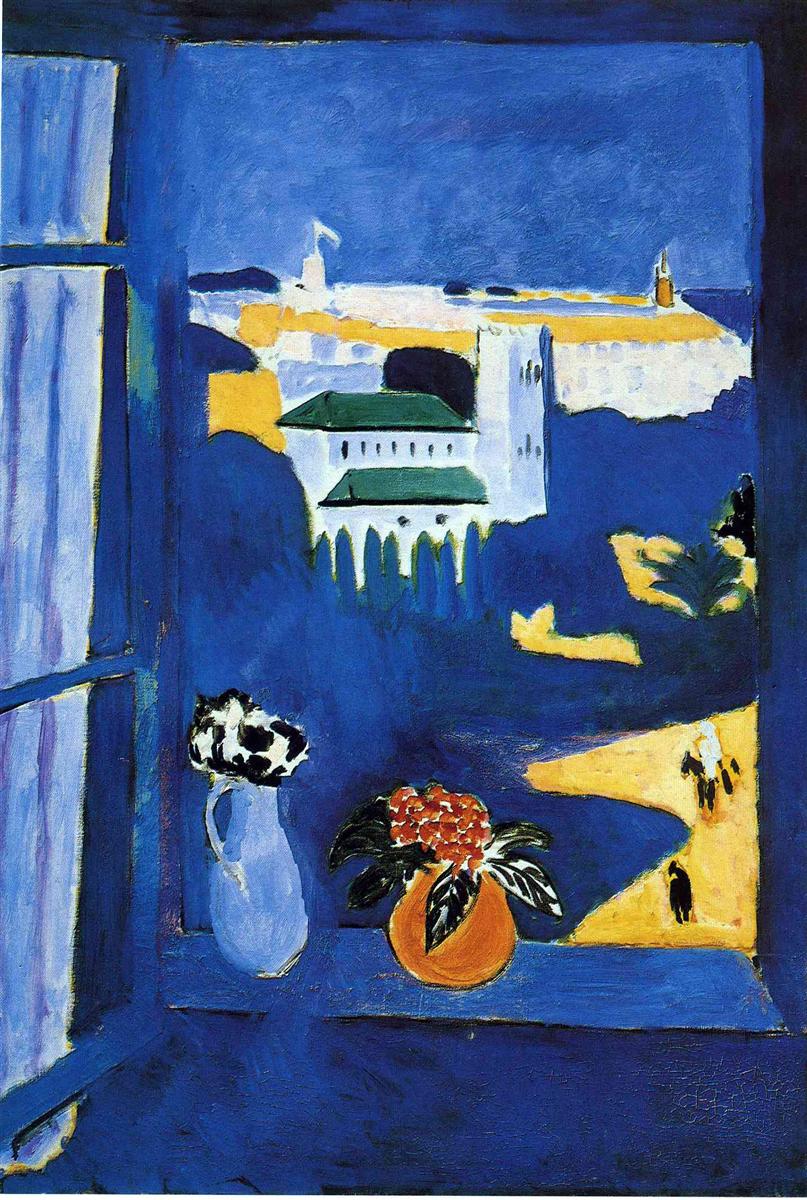
Henri Matisse’s “Landscape Viewed from a Window” (1913) captures the sensation of standing at an interior threshold and letting the outside world flood in as pure color. A deep ultramarine frame, the wooden window and sill, encloses a vista of white architecture, green roofs, and bright yellow roads. On the ledge rest two domestic notes—a pale blue pitcher holding a black-and-white bloom and an orange pot of red flowers—quiet anchors that make the open view feel both intimate and vast. The painting is less a transcription of a single scene than a complete visual system where inside and outside, object and view, are bound by a unified key of blue.
Historical Context and Place
The year 1913 finds Matisse in the afterglow of his North African journeys and in the midst of deep research into how color structures space. Travel to Tangier in 1912–1913 refreshed his palette and sharpened his sensitivity to the sun’s high contrast: white-washed walls, enamel-blue shadows, palm fronds, cypress spires, and ochre paths all appeared with a clarity that invited simplification. While Cubism was altering form through faceting and multiple viewpoints, Matisse pursued another path to modernity—flattened planes, strong contours, and color relationships that generate depth without traditional modeling. This canvas is a distilled result of that pursuit.
The Window as a Generative Motif
Windows recur throughout Matisse’s career, functioning as both subject and device. A window is an image inside an image, a ready-made frame that lets a painter test how interior objects and exterior vistas can coexist on a flattened surface. Here, the thick left jamb, the top rail, and the sill are painted in the same saturated blue that pervades the entire scene. The window does not disappear; it asserts itself as a structural member of the composition. By painting the frame in the same chromatic family as the shadows of the city beyond, Matisse fuses the two worlds. The viewer reads the open casement not as a boundary but as a color bridge.
First Impressions and Visual Walkthrough
The eye meets a sea of blue. The frame, sill, and much of the city’s shadowed masses are keyed to vigorous ultramarine. Within this field spark accents of lemon yellow that chart sunlit roofs and pathways. White architectural blocks—walls, towers, and parapets—sit like cut stones against the blue. Green roofs cap key buildings, punctuating the view in cool harmonies. In the foreground, at the lower left, a blue pitcher carries a black-and-white flower; at center-right, an orange pot holds a dense cluster of red blossoms with glossy, dark leaves. Along the right edge, a wedge of yellow path slips into the foreground, where small dark figures move like notes on a staff, animating the surface without pulling the scene into anecdote.
Composition and the Framing Device
The composition is built around nested rectangles: the canvas itself, the window frame, the sill, and the blocks of architecture outside. This nesting creates stability, but Matisse avoids rigidity through asymmetry. The window’s left jamb is wide and close; the right side is open, allowing the yellow path to slide into the foreground like a luminous triangle. The two vessels on the sill act as counterweights. Their placement encourages the eye to bounce between near and far, from pottery to tower, from flower-head to patch of sun. The horizon is high; the city rises steeply as if pressed up to the glass. This compression compresses time as well as space, letting the present of the room and the ongoing movement outside share the same moment.
Color Architecture and the Key of Blue
A single chromatic decision controls the painting: blue is treated not as a background or a shadow tone but as a constructive medium that organizes everything else. It floods the frame, darkens the trees, cools the far sea, and pools in the street shadows. Rather than add blues to objects, Matisse builds objects out of blues. The complementary opposition to yellow does the rest. When the sunlit ground appears, it reads as a charged countercolor, vibrating against the blue expanses. Green, made of blue and yellow, mediates between the rivals and signals specific elements—the rooftops—that help the eye locate architectural anchors. Black is sparingly used as an accent and a contour; white is wielded as solid, unmodulated light.
Light and Mediterranean Atmosphere
The painting describes light without reliance on cast shadows modeled in gradation. Sun is a color choice: yellow or white. Shade is another color choice: blue. Because the boundaries between those fields are kept crisp, the effect is of high, dry brightness typical of coastal midday. The sea seems present even if only implied; the far sky and far water share an equal, saturated register. Built surfaces gleam without texture, like sun-struck lime. This is not meteorology; it is a compact grammar for the sensation of bright air.
The Sill Objects and the Tactile Nearness of Home
The humble pitcher and the orange pot give the painting its human scale. They establish distance by providing a clear near plane, and they introduce rounded, graspable forms inside a composition dominated by rectangles. Their colors are carefully chosen. The pale blue jug belongs to the frame’s chromatic family, a near object melted into the painting’s primary key, while the black-and-white flower head introduces a small zone of patterned contrast. The orange pot is the warmest local note in the entire picture; it stands at the border between room and view like a glowing ember, warming the blues around it and echoing the yellow of the sunlit roads beyond. The red flowers deepen the chord, linking pot to petals to distant figures, all in small, dense accents.
Brushwork, Surface, and the Evidence of Making
Matisse’s handling is economical but varied. Broad, loaded strokes scaffold the window and the large blue fields, leaving bristle traces that keep the surface alive. The yellows are laid in more thinly in places, allowing the underpaint to influence their temperature. The white architectural forms are reserved as flat shapes rather than brushed volumes, which keeps them luminous. On the vessels, paint thickens slightly to give them presence. The overall surface is mobile without being fussy, the kind of clarity that comes from decisive revisions and the refusal to smooth everything into anonymity.
Depth, Flatness, and Modern Pictorial Space
The painting toggles between deep view and ornamental flatness. The city recedes, but it never breaks the surface tension created by the window-frame grid. The far towers appear like emblems rather than perspectival constructions. The figures on the path are black dashes—marks more than bodies—yet they convincingly signal distance by their vanishing scale. Matisse achieves space without sacrificing the integrity of the painted surface. The window is therefore not a neutral lens but an active plane, a partner that keeps the view from dissolving into illusion.
The Role of Cropping and Selective Description
Cropped forms—a half-seen pane at left, a clipped vase base, a truncated edge of path—declare that the painting is a slice of a larger world. Selective description is everywhere: trees are simplified to dark masses, crenellations on the building are indicated by rhythm rather than detail, and the sea is compressed into a single, tonally coherent band. This selectivity is not shorthand; it is emphasis. It directs attention to what matters for the painting’s logic: the meeting of blue and yellow, the cadence of rectangles and wedges, the balance between near objects and far architecture.
Dialogue with the Earlier “Open Window” and with Cubism
Matisse had painted “Open Window, Collioure” in 1905, a Fauvist blaze of small strokes and vibrating colors. Here, eight years later, the approach is more monumental and simplified. Flicker gives way to fields; small optical mixtures give way to broad complementary contrasts. At the same time, the work quietly addresses Cubism’s challenge. Without shattering objects into facets, Matisse questions conventional recession by granting the window frame equal pictorial status to the city beyond. He also deploys color as structure rather than as skin, a position Cubism often achieved through planar design. The result is a parallel modernity—decorative, lucid, and architectonic.
Rhythm and Movement Across the Picture Plane
The viewer’s gaze moves like a figure on the sunlit path. From the cool left border the eye slips to the pitcher’s dark bloom, jumps to the orange pot, then glides outward along the bright triangular road to the tiny walking marks. From there it rides the serrated line of trees and buildings before resting on the distant towers and returning via the sea’s cool band to the frame. This circuit is reinforced by recurring shapes: rectangles of wall and window, triangles of roof and road, ovals of vessel and flower head. Rhythm is built into the architecture of the picture.
Ornament Without Pattern
There are no wallpaper motifs or textile repeats here, yet the painting is deeply decorative. Ornament emerges from color blocks arranged with the economy of mosaic. The regularity of the window’s grid supplies a repeat; variations in the city’s shapes provide syncopation. The flower cluster is a small, tight rosette set against the large, open masses, much like a brooch on a garment. Matisse treats the entire view as a designed surface that is pleasurable to read line by line and shape by shape.
The Psychology of the Threshold
Standing at a window is a specific kind of looking. It is contemplative but separated, engaged yet protected by the barrier of glass and ledge. The two vessels emphasize this situatedness; they are the viewer’s companions on the sill. The painting channels that psychology. The blue frame is almost enveloping, a room-color that keeps the viewer partially inside even as the bright outdoor triangle invites a step outward. The tiny walkers hint at a social world, yet the overall mood remains serene, interior, and reflective.
Material Culture and Cultural Encounter
The architecture outside—with its white blocks, green roofs, and tower forms—evokes Mediterranean and North African structures encountered by Matisse during his Tangier sojourns. Yet the painting avoids ethnographic detail. Instead, it extracts a vocabulary of luminous walls, shadowed gardens, and crisp silhouettes, folding them into the universal grammar of color and shape. The window becomes an ethical device as well as a formal one: it acknowledges the painter as a visitor looking out, translating a place through his own language rather than claiming to inhabit it fully.
Time of Day and the Sense of Weather
The high-key yellows and stark blues imply unclouded midday. Shadows are dense and cool; sunlit areas are unambiguous. Human figures shrink under the heat, simplified to quick marks. Yet the painting resists the documentary; it feels like many midday experiences compressed into one archetype. Matisse builds a timeless noon rather than a recorded hour. The strange neutrality of the sea, equal in value to the sky, adds to this feeling of suspended time—an elemental strip of coolness balancing the city’s sun.
The Discipline of Simplification
One of the painting’s achievements is the discipline with which it omits. There is no fussy railing, no panes of glass, no ornament on the pottery, no bricks or tiles. Such omissions are not losses; they are gains in clarity. They allow the color scheme to resonate without interference and the geometry to read with authority. Simplification also gives the viewer’s imagination more to do. We fill in the ambient sounds and textures—a sea breeze, footsteps on sunlit dust—while remaining aware that the painting’s power comes from what it refuses to describe.
Place in Matisse’s Oeuvre and Legacy
“Landscape Viewed from a Window” belongs to the sequence of interior-exterior orchestrations that run through Matisse’s practice, from early Fauvist windows to the odalisque interiors of the 1920s and, ultimately, to the cut-outs where color and shape alone carry the experience of light. Its insistence on color as structure and on framing devices as active players influenced generations of painters—from color-field artists who used large chromatic planes to contemporary painters who prize the decorative as a serious mode. The picture remains a touchstone for how an artist can synthesize travel impressions, domestic quiet, and formal rigor.
What the Painting Teaches About Looking
The canvas instructs the viewer to read a picture as a set of decisions rather than as a transcription of facts. It shows how a single key color can unify a complex scene; how objects in the extreme foreground can stabilize a view; how complementary contrast can suggest sunlight; how cropping and simplification can generate drama without narrative. It also models a patient kind of looking: the longer one stays, the more relationships appear—between blue shadow and blue frame, between orange pot and yellow road, between tiny walkers and clustered blossoms.
Conclusion
“Landscape Viewed from a Window” turns a simple act—standing at a sill and looking out—into a complete pictorial statement. The ultramarine frame embraces a world outside that is no less designed than the interior itself. Vessels in the near zone moor the eye while the bright path promises movement. White architecture gleams, green roofs steady the chord, and the sea presses like a cool band at the horizon. Matisse fuses all of this into a single, resonant order where color is structure, geometry is rhythm, and the threshold between home and world becomes a place of lucid joy.