Image source: wikiart.org
A hillside scored by wind and light
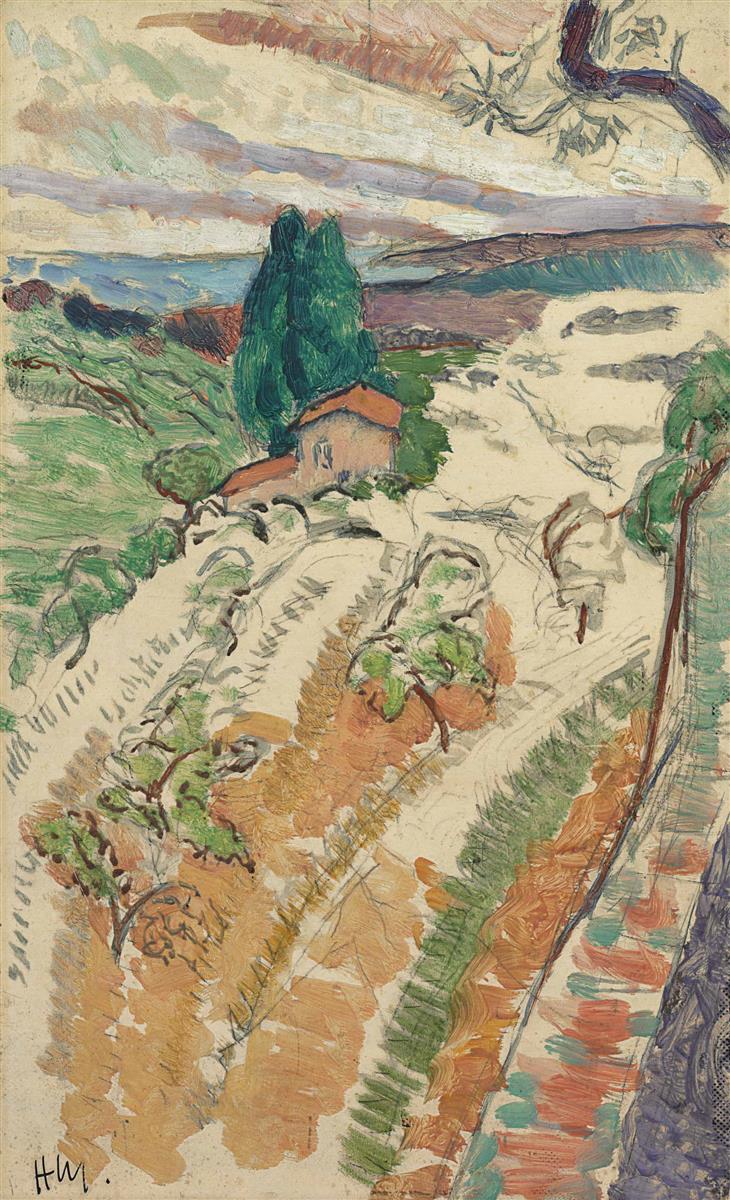
“Landscape, St. Tropez” from 1904 captures Matisse at the lip of a breakthrough. The view is Mediterranean, but what seizes attention is not topographical fidelity; it is the sensation of a hill slope cut by paths and terraced plantings, a house nestled under cypress, a sea line stacked beneath an unsettled sky. Everything is simplified, accelerated, and set into motion by the brush. Long, calligraphic lines race like gusts across the surface. Strokes of color arrive as small, decisive deposits—greens, terracottas, mauves, and sea blues—while large reserves of the light ground are left unpainted to stand for stone, glare, and dry soil. The result is a landscape that feels breathed onto the sheet rather than built brick by brick: quick, windy, and truthful to what coastal light does to form.
A Saint-Tropez crossroads in Matisse’s development
By the summer of 1904, Matisse had begun to unlearn studio habits and relearn vision in the open air among Neo-Impressionist friends along the Var coast. Saint-Tropez offered two indispensable tutors: a merciless sun that bleached detail and sharpened temperature contrasts, and a circle of painters experimenting with divided color. “Landscape, St. Tropez” absorbs both lessons while remaining unmistakably Matisse. Divisionist influence appears in the way he breaks a color field into short, parallel touches, yet he refuses to become a methodical pointillist. Instead of building a mosaic of uniform dots, he lets strokes vary in length and pressure, allowing drawing and color to merge. At the same time, the picture retains the structural heft he admired in Cézanne: tilted planes, firm axial paths, and shapes locked into a clear geometry. This hybrid—divisionist sparkle riding on Cézannian bones—points directly toward the fauve chord he will strike in Collioure the following year.
Vertical format and the tilt of the land
The first surprise is the upright format. Landscapes are often horizontal, but Matisse chooses a vertical rectangle that lets the slope fall away from the viewer. A serpentine track or terraced band starts high at left and sweeps down toward the bottom edge, pulling the eye forward like gravity. The house with its orange roof tucks into the middle distance, guarded by two dark cypresses that act as a hinge between near and far. At the right margin a pine branch arcs in, a gestural brace that keeps the composition from spilling over the edge. The horizon compresses into a cool strip of sea and distant headland; above it the sky opens into layered bands that repeat and invert the rhythms of the ground.
Drawing with reserves and speed
A defining pleasure of the picture is its fearless economy. Instead of filling the sheet, Matisse leaves swathes of ground visible. Those unpainted zones are not negligence; they are light. On a Mediterranean afternoon, chalky dust and pale stone bounce illumination upward. By letting the support speak, Matisse imports that glare into the picture. Where he does paint, he often uses fast, elastic lines that swoop, hook, and double back. Many are drawn wet-into-wet, so pigment feathers at the edges; others are crisp, as if added after the underlying color had tacked. The mix of line qualities reads like wind over varied surfaces—soft where grass bristles, sharp where branches snap.
The house, the cypress, and the syntax of shapes
The terracotta roof and paired cypress provide the picture’s grammatical subject. Their warm–cool complement anchors everything else. The cypress trunks are nearly black-green, stacked with vertical dashes that evoke the cedar-scented density of Mediterranean evergreens. The roof is a compact trapezoid of orange and red, electrified where it meets the flanks of the trees. Around this cluster, Matisse spins a series of elliptical, almost calligraphic tree crowns—each a few loops of the wrist with a pool of green dragged inside. Those loops are not botanical description; they are the painter’s shorthand for volume and foliage under bright sun. Just as a poet relies on meter and rhyme to compress language, Matisse relies on these repeated signs to compress seeing.
Color as temperature, not description
Although the view is recognizable, local color has been loosened from strict duty. The sea is not a postcard blue; it is a thin belt of bluish lavender that takes its value from the surrounding warms. The earth’s reddish tracks are not iron-oxide literal; they are temperature counters to the spreading greens. Purples appear in shadows where a realist might hunt for brown. Small seams of teal or emerald reappear unexpectedly, knitting zones together. This is Matisse’s transitional color logic: hues are chosen less to label objects than to balance temperatures across the surface. That logic will become radical within a year, but even here it quietly rules the picture.
The sky as a ledger of movement
Bands of brushy cloud sweep left to right at the top, laid in with long, horizontal passes of rosy ochre, lilac, and grey-green over a pale, unpainted ground. The strata echo the terraces below and register the maritime air moving across the hill. Between these broad bands, slim licks of cyan appear, clearing little windows of sky. Matisse does not overmix, so these layers remain legible as separate notations. The sky thus reads as a time-based record—strokes equal seconds, bands equal weather—rather than a single painted curtain.
Spatial construction without classical perspective
Depth is carried by overlapping bands, tilted planes, and aerial shifts, not by a vanishing-point grid. The near path is drawn sharply, while the distance dissolves into stacked color fields. The coolness of the horizon chills the receding space; the warmth at the lower edge pushes forward. Compositional diagonals team up—one from the lower right rising to the house, another from the left descending through the terraces—to create a shallow X that stabilizes the tilt. The result is a space you feel in your ankles more than you measure with your eyes.
Stroke variety and the tactility of place
Notice how many kinds of marks populate the picture. There are quick, parallel hatches dragged dry over tooth to suggest scrub. There are syrupy, rounded daubs that make up tree crowns. There are fine, nervous filaments that doodle in the pine branch at upper right. There are broader, planing strokes that level off the sea. This variety is not gratuitous; it assigns tactility to zones. Hill slope feels abrasive; tree masses feel gummy and dense; water feels planar and slick; the sky feels aerated. Put simply, Matisse paints how each part would touch the hand.
The courage to leave out
One of the picture’s modernities is its trust in omission. Fences are signaled by a few dark ticks. Stones are mapped by negative shapes. Buildings in the distance reduce to flat wedges. You understand the landscape through the logic of its parts, not through inventory. This is not poverty of information but wealth of decision. By refusing to cram detail into every corner, Matisse ensures that what remains is active and necessary. Your attention is never trapped in illustrative dead ends; it flows freely along the structural arteries of the view.
Mediterranean light as a governing system
Everything in the painting votes for light. The dominance of the pale ground, the pallor of the sky, the bleaching of mid-distance color, the hard darks of the cypress and pine, the terracotta notes burning at angles—all are symptoms of southern illumination. The Mediterranean does not reward modulation; it favors clean intervals and abrupt temperature jumps. Matisse respects those terms. When warm terraced bands run beside cooler greens, the seam between them vibrates; when a lilac sea meets the peach of the sky’s lower band, the air itself seems to flicker. The painting feels sun-ruled, not studio-ruled.
Echoes of Cézanne, Signac, and Japanese design
Without quoting any single predecessor, Matisse converses with several. From Cézanne he borrows the sense that a landscape is a system of inclined planes and cylinders, seen from a body that stands and breathes. From Signac and Cross he borrows the belief that color, divided and juxtaposed in small strokes, can build clarity and luminosity without heavy modeling. From Japanese prints he borrows the pleasure of a vertical format, the license to crop with a tree branch at the edge, and the idea that a path can be a sweeping calligraphic gesture as much as a literal road. These influences do not cage him; they give him a set of tools with which to articulate his own sensibility.
Why this is not yet Fauvism—and why it almost is
Look at the restraint in the palette: it is bold but not yet blazing. The sky’s lilacs and greens, the earth’s oranges, the trees’ deep greens all belong plausibly to a coastal afternoon. Yet the painting already behaves like a fauve work. Color lays down the architecture; drawing rides on chromatic edges; speed and sensation trump local description; unpainted ground becomes an active, bright participant. Within a year, Matisse will push the same relationships into higher voltages—emerald against vermilion, mauve against chrome yellow—without losing the underlying scaffold rehearsed here.
Narrative hints and lived scale
Although no figures stand in the view, human presence saturates it. The cultivated terraces step carefully down the hill. The house wears its cypress guardians like shoulders. The path has the width and fall of a track made by feet, not a road for wheels. Everything is scaled to the walker. You can imagine the crunch underfoot, the aloe and rosemary scent rising as the heat lifts, the quick flicks of shadow under wind. The landscape is not a spectacle viewed from afar; it is a place you could cross in a handful of minutes.
The look of a drawing-painting hybrid
Another modernity is the hybrid character of the surface. Some passages behave like drawing, others like painting, and the boundary between them is porous. In the pine bough, linear articulation reigns; in the terraces, color planes do the talking. The loose, almost sketchbook energy of the sheet suggests the work may have been made rapidly on location and then adjusted either in the same sitting or later. The confidence to let such a “working” surface stand as a finished statement is part of what makes early Matisse feel fresh today.
The choreography of the eye
Matisse proposes a route for the gaze. You drop into the lower right where the path begins, follow its arc up the slope past the rhythmic bumps of small trees, arrive at the cypresses and roof, then glance beyond to the lavender sea and the braided bands of sky. From there your gaze slides back along the top edge, catches on the pine branch, and descends once more to the slope—completing a loop. That loop turns the vertical format into a kind of visual rondo; the painting lasts as long as it takes to make each circuit.
Material intelligence and the feel of the support
Because so much of the ground remains exposed, the support’s grain participates in the imagery. Dry-brushed strokes catch on its tooth and leave open meshes of pigment. Where color is pulled thin, the ground’s warmth modifies it from beneath, increasing the sensation of heat and dust. Thickest paint appears in small highlights—on the roof ridge, the cypress crest, or the leading edge of a terrace—where a single loaded stroke can flip a plane toward the sun. This measured impasto keeps the surface lively without turning the sheet into a relief.
How to look closely and not miss the music
From a distance, read the picture’s three great registers: earth, sea, and sky, stitched by a dark vertical accent of trees. Step nearer to see the repetitions that make it musical: the S-curves of the path echoed by the cloud bands, the alternating light-dark pattern of terraces mirrored by the pale-dark layers in the atmosphere, the small scalloped outlines that recur in both foliage and cloud edges. Those repetitions move the painting from description to rhythm, so that even if you forgot the name “Saint-Tropez” you would still feel the picture as coordinated movement.
Why it matters
“Landscape, St. Tropez” matters because it shows Matisse exchanging academic finish for sensuous structure while retaining clarity. He is learning to trust intervals more than details, temperatures more than names, and the power of a few decisive shapes to carry an entire place. In these coastal experiments he discovers that the eye, when given clean coordinates and breathable surfaces, will do a surprising amount of reconstruction on its own. That discovery is one of the engines of twentieth-century painting, and this sheet is among its earliest, most persuasive sparks.