Image source: wikiart.org
A twilight laboratory of color
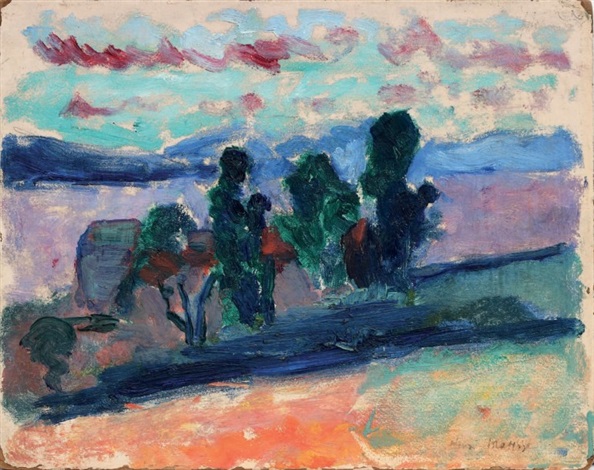
Painted in 1904, “Landscape of Saint-Tropez at Dusk” sits at a hinge-point in Henri Matisse’s development, poised between the tonal naturalism of his 1890s training and the high-voltage chromatic thinking that would ignite Fauvism in 1905. The picture captures the falling light over the Var coast, yet it reads as much like an experiment in color-logic as a record of place. Dusk, an hour when forms simplify and local color loosens its grip, gives Matisse permission to rethink how sky, land, and water are built on canvas. Blue-violet bands stack the horizon. Warm embers flicker across the foreground like the last heat in a hearth. A sparse procession of trees rises as dark vertical chords, their silhouettes punched into the cooling air. The sensation is coastal and specific, but the true subject is the recalibration of sight: how the eye, under waning light, takes broad coordinates and lets color finish the map.
Where the painter stands and what the eye is given
The viewpoint is slightly elevated, as though the artist is looking over a terrace or low rise toward the Gulf of Saint-Tropez. Distance has been compressed. The water is a lavender sheet that meets a ridge of blue hills; above that, an unusually active sky sweeps across the top third. The foreground is a shallow apron of earth that glows with oranges and salmon pinks, turning toward green at the far right where the ground cools into shade. A low wall or path runs diagonally, functioning like a hinge that tips the scene gently toward us. This simple staging—warm apron, cool mid-band of water, animated sky—provides a clear scaffold for color contrasts to work at full force.
Composition as coordinated blocks and accents
Matisse divides the field into large, legible blocks that read from a distance and reward close viewing with variation. The foreground is one broad plane, but its edges bloom with half-mixed notes that suggest scrub, sand, and reflected sky. The mid-zone of water is a single, unifying stripe, intentionally quiet so that sky and foreground can speak more loudly. The vertical trees break the horizontals, staging a rhythmic counterpoint that keeps the eye cycling rather than sliding out of the frame. Each tree is handled like a chord, not a specimen. Their spacing feels musical—near-unison in the central cluster, a pause to the left, a trailing echo to the right—so that the viewer reads the landscape as rhythm as well as view.
Drawing with color masses rather than outlines
There is very little linear drawing in the academic sense. Edges are discovered where one color meets another, not imposed with hard contour. The leftmost tree’s outline is a negotiation between green-black and the lilac air behind it. A low stone form near the center-left is resolved by a few angled strokes of slate and teal pressed against the surrounding pink ground. This is Matisse’s abiding method: let adjacent temperatures do the drawing. The approach keeps the painting oxygenated; forms breathe into each other the way they do at dusk, when shadows soften and boundaries dissolve.
Chromatic language poised on the brink of Fauvism
The palette is limited but highly strategic. A cool family—ultramarine, cobalt blue, blue-violet, and minty blue-greens—runs through the sky, water, and cast shadows. A warm family—cadmium orange, vermilion, rose, and peach—runs through the earth and cloud undersides. The trees are the dark pivot, constructed from deep greens punched with smudges of warm red, as if the day’s heat still glows within their foliage. What matters is not the individual hue but the temperature choreography. Warm and cool toggle across the surface in a steady rhythm, and each crossing sets a small electrical exchange in motion. This sets the stage for the “wild beasts” moment to come, when Matisse will push these temperatures into higher, less naturalistic keys without abandoning the underlying structure.
The sky as a stage for movement
Look long at the upper third. The sky is not a passive backdrop; it is the most energetic actor. Creamy turquoises are swept with broad, horizontal scrubs. Small cloudlets, their undersides lit with rose or coral, march like phrases across the field. The handling is fast and open, allowing the canvas to show through at points so that air reads as a living medium rather than a painted ceiling. The sky’s cool mass also disciplines the picture: because it is simultaneously active and tonally light, it keeps the darker trees from seizing too much authority and prevents the foreground’s warmth from overrunning the scene.
Trees as vertical chords in a horizontal song
The tree group at center-right does crucial compositional work. Their vertical thrust cleaves the stacked horizontals, adding a pulse that moves forward and back. Matisse builds them with stacked, short strokes—green-black laid over blue, a note of viridian flashing at a turn, a brick-red ember imbedded like a remembered sun. They are both volumes and signs, legible as trees and effective as abstract structures. The openwork among branches allows shards of sky to pierce the mass, a classic Matisse strategy for keeping dark shapes buoyant rather than blocky.
Dusk as a system, not an effect
Many paintings treat dusk as theatrical lighting. Here it functions as a system that governs every relation. In low light, the eye edits. Detail is dropped; contrast climbs; local color weakens; relative temperature does more work. Matisse seems to embrace those rules. The stone on the left becomes a barely-perceptible block. The path is not a diagram of pebbles but a single, cool, directional sweep indicating slope. The water is not a catalog of ripples but a single tonality with subtle adjustments for depth and breeze. Because dusk is systemic, harmony arises from obedience to its logic, not from decorative balancing.
Surface and touch as carriers of meaning
The picture’s surface is a map of decisions. In the foreground, the brush is often loaded and dragged, laying down fat notes that retain their edges. In the water, strokes are longer and more even, creating a span of relative calm. In the sky, the brush scumbles and flicks, and the paint goes on thinner, making the support participate in the brightness of the air. These changes of pressure and load tell us that Matisse is not merely describing external textures; he is assigning tactile values to zones of the picture—earth heavy, water fluid, air quick. Touch becomes a form of depiction.
The role of simplification and the ethics of leaving out
A powerful aspect of the painting is what it refuses to show. Saint-Tropez in 1904 was a bustling harbor, yet buildings and boats are absent or pushed to the edge of legibility. Matisse chooses the permanent themes—ground, water, sky, trees—over the incidental ones. That choice is not an evasion of reality; it is fidelity to experience at dusk when the mind reaches for big categories to stabilize perception. The decision also clears a space where color can act without being harnessed to anecdote. Simplification is therefore ethical as well as aesthetic: it respects the ways seeing actually happens.
Kinship with the Collioure breakthrough
Within a year of this picture Matisse would reach Collioure and trigger his Fauvist break. The “Landscape of Saint-Tropez at Dusk” anticipates that turn in three obvious ways. First, color is already doing the structural work of drawing and space. Second, the need to record fleeting light has become an opportunity to test how far a hue can depart from local color and still persuade. Third, brushwork has been allowed to keep its identity as mark rather than being suppressed into invisible finish. When the color patches of 1905 become pure chords—emerald next to orange, carmine against viridian—the grammar rehearsed here will allow the explosion to sound coherent rather than arbitrary.
Likely palette and material intelligence
The physicality of the paint suggests a working set of reliable, saturated pigments. Lead white provides opacity and body. Ultramarine and cobalt build the blues; a red lake or alizarin warms cloud undersides; cadmium orange and yellow flash through the foreground; viridian or terre verte establishes the cool greens that slip toward blue in shadow. A small amount of ivory black may be mixed into the tree mass to deepen it without dulling. Crucially, mixtures are not overworked. Matisse prefers adjacency to blending. Instead of stirring orange into blue to make grey, he sets them near each other and lets the eye do the mixing across a small distance, preserving the vibrancy of each pigment.
The choreography of the viewer’s gaze
The painting offers a clear itinerary. The eye lands in the glowing foreground, where pinks and oranges still hold warmth from the vanished sun. From there, the dark diagonal of path or wall draws vision to the center where the tree cluster stands like a group of figures. The viewer then lifts into the violet water whose calmness provides a visual exhale. Finally, the gaze rises to the mottled sky and tracks the clouds as they echo the warm-cool syncopation below. By the time the eye returns to the foreground, the whole surface has been read as a cycle. The picture feels larger than its physical size because this circuit expands time within it.
The whisper of narrative without illustration
There is a faint narrative hum: the day’s heat trading places with maritime cool; human traces hinted by the wall and pruned bushes; a town just out of frame. But Matisse keeps story at the periphery. He is not interested in describing who passed along the path or which boat cut the last wake across the gulf. Instead he asks what it felt like in that minute to stand in the dwindling light, to see large forms knit together by color temperatures, and to accept that paint could catch that knitting without becoming photographic.
Emotional temperature and the quiet of resolve
The mood is contemplative but not somber. Dusk can tip toward melancholy in art, yet here it feels resolute, even expectant. The warm strip of ground is a reservoir of energy; the trees, though dark, do not brood; the sky’s mint and lilac suggest fresh air rather than closing night. The emotional tone comes from the balance of complements. Where other painters whip dusk into storminess, Matisse steadies it into a poised chord, as if listening for the transformation of landscape into pure pictorial order.
Place within Matisse’s Mediterranean imagination
Saint-Tropez is more than a location in Matisse’s career; it is an early chapter in his lifelong Mediterranean project—the hunt for a light that would justify radical color. Years later in Nice and Vence he would flatten interiors and exteriors into panels of sun-struck color, but the grammar for those panels is rehearsed here. The sea teaches him a horizontality on which he can hang vertical accents. The sky instructs him in making air with thin paint and allowing the support to glimmer. The scrubby foreground trains him to scumble warm notes so that they vibrate without turning muddy. The Mediterranean is not exotic content; it is a teacher whose lessons Matisse keeps.
How to look for maximum reward
Spend time adjusting your distance. From across the room, the picture resolves into a classic tripartite landscape—earth, water, sky—plus the tree punctuations. Step closer and it dissolves into tesserae of saturated color, each stroke an autonomous decision. Approach again and you will see small, crucial modulations: a blue-violet nudge at the shoreline to suggest a shallow shelf, a greenish whisper near the right-hand tree that releases it from the background, a thread of rose threaded into the sky to echo the foreground’s warmth. The painting is not a single statement; it is a sequence of tuned decisions that your eyes can re-enact in slow motion.
What endures
“Landscape of Saint-Tropez at Dusk” endures because it treats landscape not as spectacle but as structure. It teaches that a few well-placed temperature contrasts can carry distance, mood, and time of day. It argues for the dignity of omission. It shows that paint, left to be itself—thick here, thin there—can deliver air, ground, and water without mimicry. And it anticipates a revolution while remaining firmly anchored in observation. It is, in short, a quiet manifesto in coastal light, a picture that understands dusk as both an hour of day and a threshold in art.