Image source: wikiart.org
Historical Context And Why This Landscape Matters
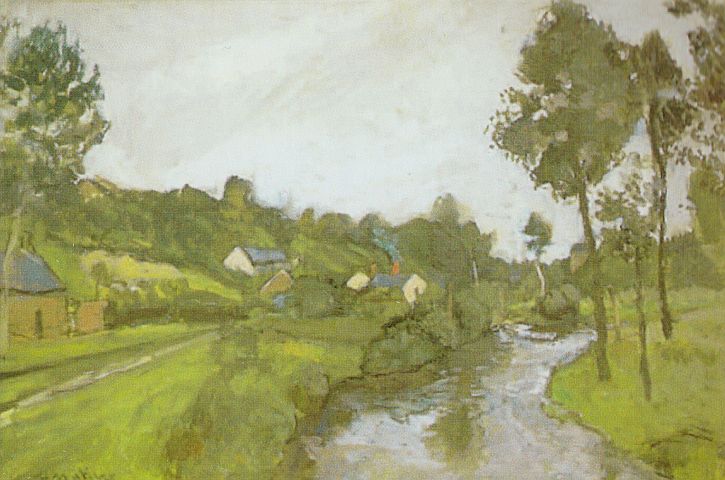
Painted in 1903, “Landscape Lesquielles St Germain” captures Henri Matisse on the threshold between rigorous academic training and the chromatic freedom that would soon ignite as Fauvism. In these years he often returned to northern France—Picardy’s hedgerows, canals, and small river valleys—because familiar terrain let him strip a motif to its essentials and test how far color, value, and touch alone could carry a picture. This canvas is a perfect example. Rather than fireworks, Matisse gives us a quiet bend of river gliding past a hamlet, under a high, milky sky. The restraint is deliberate: he’s calibrating relations, learning to draw with patches of color instead of line, and compressing depth into a decorative field that still breathes. What looks modest is, in fact, foundational for everything that follows.
First Impressions: A River Threading A Soft Green Valley
At first glance the painting feels like a single breath of air. A silvery stream enters from the lower right, curves gently through the middle ground, and slides toward a low horizon. On the left slope, several pale-roofed cottages tuck into trees; a narrow track runs along the meadow; and a small ochre building anchors the foreground. To the right, tall trees stand like sentinels, their crowns dissolving into the sky. Most striking is the sky itself: a huge, high-value field that occupies nearly half the surface, tinting everything beneath it with clean daylight. Nothing shouts. The picture whispers, and the whisper is about atmosphere, scale, and the way place arranges itself when viewed with a calm eye.
Composition As An S-Curve Held By Vertical Screens
Matisse organizes the rectangle with exemplary clarity. The river supplies the main S-curve, leading the viewer from the front edge to the distance. That curve is flanked by two vertical screens of trees—the loftier, more leggy group at right and a lower, massed band across the left hillside. Between them a triangular valley opens like a stage, and the cottages, each simplified to a few planes, step down the slope toward the water. The big white sky establishes a high “ceiling,” while the dark treetops puncture it in a syncopated rhythm. Nothing is superfluous: the right-hand trees check the rush of the river; the ochre house checks the drift of the left hillside; the sky’s emptiness balances the ground’s activity. The result is a landscape that reads instantly at any distance.
The Sky As A Painted Climate
Many paintings treat sky as backdrop; here, it is a protagonist. The expansive, milky field creates the day’s weather: soft, dry light without glare; air that reduces contrasts and relaxes shadows; a veil that cools greens and lifts the river’s surface. Matisse scumbles this area thinly so the canvas grain participates, which keeps the plane breathing and avoids a dead, flat white. Near the horizon, faint warms creep in, while higher up the tone cools—a minimal gradient that still suggests distance. Because the sky is understated and dominant, everything beneath must be tuned precisely to it, and that discipline becomes the painting’s quiet power.
Color Architecture: A Northern Chord Of Greens, Ochres, And Silver
The palette sits well below Fauvist blaze, but it is never neutral. Meadow greens are tempered with yellow ochre, sometimes pushing to a springlike yellow-green on sunlit patches, other times sinking toward olive in shadow. Tree masses read as mixtures of viridian and ultramarine moderated by earths, with the deepest notes appearing where foliage overlaps trunk. The cottages carry cool creams and pale yellows for walls, modest blues for roofing, and just a hint of orange or red where chimneys warm the mix. The river is built from lead white infused with blue-gray and thin green glazes, reflecting banks and sky in long, horizontal pulls. Because Matisse avoids raw black, even the darkest accents keep chromatic life. Temperature, not saturation, models forms: cools advance where air is deep, warms flicker where light catches.
Light As Even Day Instead Of Spotlight
Everything here is lit by one condition—an even, cloud-filtered day—and that constancy lets Matisse explore how forms turn without theatrical contrast. The right-bank tree trunks have pale, chalky sides where they catch the general light and cooler, greener flanks where they face into foliage. The walls of the cottages warm slightly where the earth reflects up and cool toward the sky. The river does not sparkle; it registers the day as a broad value and temperature field. This approach isn’t just observational; it is pedagogical. It teaches the eye to read small shifts, which is precisely the skill Matisse will deploy when his hues intensify two years later.
Brushwork: Knitted Foliage, Level Water, Breathing Sky
Touch changes with material. Trees are knitted from short, stacked strokes that never count leaves yet create convincing foliage. The meadow is brushed in longer, slightly diagonal pulls that show slope and grass. The river surface is leveled with horizontal sweeps and translucent veils so underlayers shimmer like depth. The sky, as noted, is scumbled thinly, giving the sense of airy diffusion. Cottages are summarized with decisive, planar strokes, just enough to feel their volumes without sinking into detail. This orchestrated variation—tight in foliage, steady in water, airy in sky, planar in buildings—produces a tactile map of the scene that you feel in your eyes.
Drawing Through Adjacency Rather Than Outline
Edges arise where tones meet, not from dark lines circling shapes. The boatless river bank is “drawn” where pale water abuts a darker green strip; a roofline appears because a cool gray touches a warm wall; a tree crown resolves where olive leaves meet the sky’s milky breath. The few linear accents—a fence suggestion, a trunk seam—are calligraphic flicks quickly reabsorbed into neighboring color. This adjacency method keeps the surface unified: the painting reads as one fabric of decisions rather than a colored drawing.
Space: Persuasion Without Aggressive Perspective
Depth persuades through recession of scale, value compression, and temperature cooling rather than through aggressive linear perspective. The cottages shrink and pale as they step back; greens cool and gather blue; the river narrows and loses contrast. Yet Matisse refuses a tunnel effect. The right-hand trees press forward like a screen, and the left hillside behaves as a single decorative mass. That tension between spatial plausibility and planar design is central to his developing modernism. The rectangle remains sovereign even as it hosts a believable world.
The Hamlet And The Human Measure
No figures appear, but the hamlet supplies scale and human presence. Each cottage is a handful of planes: a light wall, a roof wedge, a chimney note. Their simplicity makes them rhythmic units rather than anecdotes, and their staggered placement across the hillside animates the valley without clutter. You sense gardens, footpaths, kitchen fires—the textures of rural time—yet the painting stays serenely general. That balance of type and particular is a Matisse hallmark.
The River As Route And Mirror
The river provides both a path for the viewer’s gaze and a mirror for the day’s color. Its S-curve choreographs a slow look: enter at the lower right, follow the bright bank to the bend, rest at the widened midstream light, then drift toward the horizon. Along the way, the water collects soft reflections—greens from the banks, a suggestion of gray from the sky—never literal ripples but tuned bands that read as depth and gentle current. The eye’s route thus echoes the river’s flow, and the painting becomes an experience of moving through air, not just an image of a place.
Materiality And Likely Pigments
The harmony suggests a practical 1903 palette built from durable, mixable colors. Lead white forms the sky and the river’s high values; a touch of zinc may cool certain passages. Yellow ochre, raw sienna, and Naples-like mixed tints warm meadows and cottage walls. Viridian (or terre verte) tempered with ochre and ultramarine generates a broad family of greens. Ultramarine and cobalt inform blue roofs and cooler shadows. Raw and burnt umbers ground tree trunks and bank edges. Ivory or bone black is used sparingly to weight the darkest notes without killing chroma. Paint alternates between lean scumbles (sky, distant slopes) and fuller, buttery strokes (tree masses, roofs), creating a physical rhythm that suits material differences.
Dialogues With Tradition And Peers
This landscape speaks to a lineage. From Corot and the Barbizon painters Matisse inherits a taste for subdued chords and the poetics of filtered light. From Pissarro and Sisley he takes the pleasure of modest rivers and working countryside. From Cézanne he learns to build volume and space from abutting patches rather than from blended chiaroscuro. Yet the temperament is unmistakably his: a preference for serenity over drama, for design over anecdote, and for a surface that remains a coherent, breathing plane even when the subject wants detail.
The Ethics Of Omission
One of the most modern aspects of the painting is what it leaves out. There are no counted leaves, no textured roof tiles, no fence posts meticulously aligned, no figure leading a cow by the stream. The sky holds vast, unbroken acreage. The river is described without sparkles. These omissions are not lack; they are discipline. By refusing descriptive distraction, Matisse protects the picture’s chord: a clear design of sky, trees, hamlet, and water tuned to one light. Your memory supplies specifics; the painting supplies relations that make those specifics believable.
How To Look Slowly
Begin by receiving the big structure: the white sky, the two flanking tree screens, the S-curve of river, and the diagonal of cottages down the left hillside. Once that scaffold holds, move closer. Watch edges form by adjacency—pale water meeting olive bank, cool roof touching warm wall, soft foliage dissolving into sky. Track temperature shifts: greens warming where grass opens to sun, cooling under trees; walls warming near the ground, cooling near the eaves. Notice the different speeds of brushwork across materials. Step back again until the valley resolves in one breath—an arrangement that feels inevitable. This near–far oscillation mirrors Matisse’s own process of tuning relations until the whole locks into place.
Place Within Matisse’s 1903 Arc
Seen alongside his 1903 interiors and canal scenes, “Landscape Lesquielles St Germain” clarifies the artist’s goals. He is learning to let the sky act as climate; to compress depth so the rectangle stays strong; to model with temperature changes rather than heavy shading; and to summarize objects into rhythmic units. Within two years he will apply these structural lessons to far more saturated color in Collioure and Paris. Those later canvases feel serenely inevitable because paintings like this one supplied the armature.
Enduring Significance
“Landscape Lesquielles St Germain” endures because it turns a modest river valley into a durable harmony. The painting offers the sensation of walking a quiet path in good air: the lull of water, the shelter of trees, the neighborly scatter of houses, the high, friendly sky. It shows that modernity in Matisse is not only a matter of blazing color; it is equally a matter of exact relations, of knowing what to omit, and of shaping a surface that is at once a world and a design. Long after specific villages blur, this arrangement of sky, valley, and stream remains memorable—an early, essential chapter in Matisse’s search for calm intensity.