Image source: wikiart.org
Overview of Lamentation of Christ by the Virgin Mary and St John
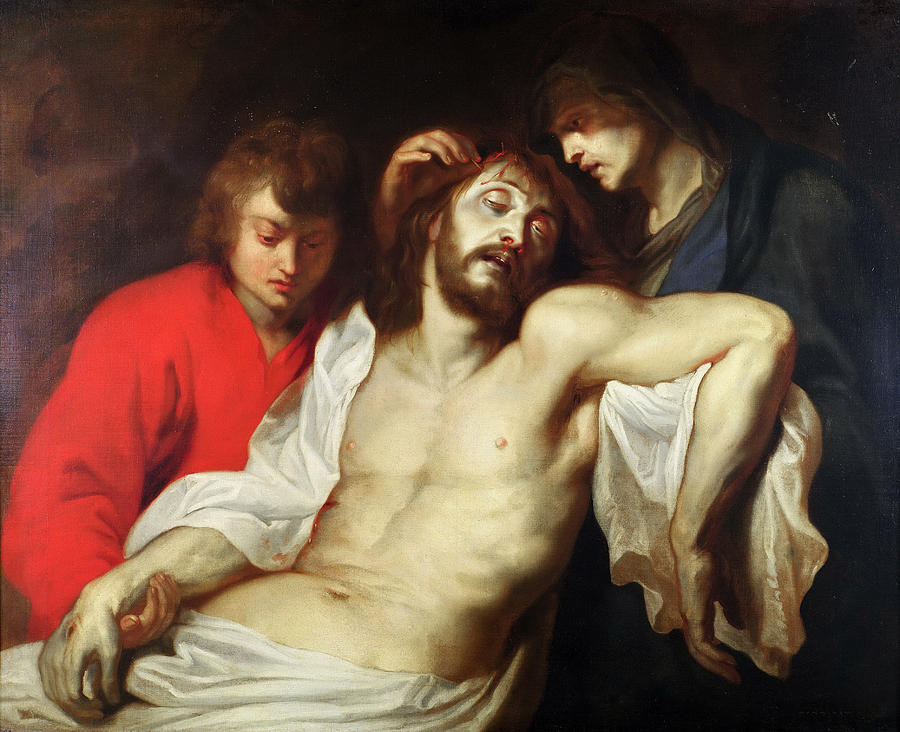
“Lamentation of Christ by the Virgin Mary and St John” by Peter Paul Rubens is a deeply moving meditation on grief, sacrifice, and love. The painting presents the lifeless body of Christ immediately after the Crucifixion, supported tenderly by the Virgin Mary and Saint John the Evangelist. Instead of a crowded scene with multiple mourners, Rubens focuses on an intimate triad, bringing the viewer close to the emotional core of the Passion story.
Christ’s body, pale and luminous against the dark background, forms the central axis of the composition. His head tilts back, eyes closed, mouth slightly open, the crown of thorns still pressing into his brow. Mary and John lean in from either side, their faces filled with a quiet, inward sorrow rather than theatrical outcry. Mary’s hand gently touches the thorns as if to comfort her son even in death; John delicately supports Christ’s arm and shoulder, his own youthful features clouded with sadness.
The simplicity of the arrangement intensifies its impact. There are no distractions, no elaborate architectural elements or distant landscapes. Rubens wanted the viewer to stand at the edge of the scene and share the raw immediacy of this moment, when the weight of Christ’s sacrifice is finally, fully felt by those who loved him most.
Composition and the Triangle of Compassion
Rubens structures the composition around a powerful triangular arrangement. Christ’s torso and outstretched arms form the base of the triangle, while the heads of Mary and John create its upper points. This triangular structure lends stability to a scene that is otherwise charged with emotional turmoil. It also subtly echoes the symbol of the Trinity, linking the human sorrow of the Lamentation to the divine mystery of Father, Son, and Holy Spirit.
Christ’s body slumps diagonally across the canvas, from lower left to upper right. This diagonal movement suggests the downward pull of death, yet it is countered by the slightly upward tilt of his chest and the careful support of his companions. Mary, cloaked in dark garments with a hint of blue, bends over him from the right. Her head is close to his, almost as if she wants to cradle him, but she restrains herself, holding his crown instead with a sad tenderness.
John stands on the left, wrapped in a striking red garment. The rich red forms a strong color block that anchors the composition and draws attention to his role as witness and beloved disciple. His body leans subtly toward Christ, and his lowered gaze directs ours back to the center of the scene. Together, these elements create an inward-turning circle of attention. The painting feels like a closed space of shared grief, into which the viewer is invited as a silent fourth presence.
The Figure of Christ: Sacrifice and Stillness
Christ’s portrayal is both physically convincing and spiritually charged. Rubens renders his body with the anatomical knowledge he had honed through years of studying classical sculpture and life models. Muscles are softly defined, the ribcage visible beneath the skin, the abdomen relaxed in death. The color of the flesh is pale but not cold, suggesting that the life has only recently left him.
His head rests against Mary’s hand, the beard slightly disheveled, hair falling in loose strands. The crown of thorns, rather than being an aggressive symbol of pain, becomes an object of maternal care as Mary touches it gently. Blood marks on the forehead and at the wounds are present but understated; Rubens emphasizes Christ’s humanity more than graphic suffering.
The position of Christ’s arms is especially poignant. One arm stretches downward, the hand lying limp and open near the viewer, allowing a clear view of the pierced palm. The other arm falls back, the hand draped over a fold of white cloth, its fingers relaxed. These open hands feel like the last gesture of blessing, even in death. The overall pose recalls traditional depictions of the Pietà, where the dead Christ rests on Mary’s lap, but here he is partly supported by both Mary and John, creating a shared act of devotion.
Mary’s Grief and Silent Strength
Rubens represents the Virgin Mary not as a collapsing, hysterical mother, but as a figure of contained, dignified sorrow. Her face is turned toward Christ, her eyes shaded by the hood of her dark garment. The shadows around her features lend them a sculptural seriousness. We sense intense emotion, but it is inwardly held.
Her hand touching the crown of thorns is a key detail. Rather than removing it, she seems to cradle it, acknowledging the suffering her son endured and accepting it as part of the divine plan. This gesture also echoes her traditional role as co-sufferer, the one who stands at the foot of the cross and shares in Christ’s redemptive pain.
The deep, muted colors of Mary’s clothing—dark blues, blacks, and browns—contrast with the pale body of Christ and the bright red of John’s robe. These tones underscore her role as the sorrowful mother, enveloped in mourning. Yet a faint glimmer of blue near her neck hints at her traditional heavenly color, reminding us that she is not only a grieving parent but also the exalted Queen of Heaven.
Saint John: The Youthful Witness
On the left side of the painting, Saint John provides a different emotional note. He is young, with soft features and auburn hair, his youthful face flushed with sorrow. Clad in a vibrant red garment, he serves as a visual counterpoint to Mary’s dark presence. Red here suggests love, sacrifice, and the intensity of his devotion to Christ.
John’s expression is one of contemplative sadness. His eyes are lowered, not in avoidance but in thoughtful grief, as if he is absorbing the significance of what has happened. His hands support Christ with gentle care. One hand touches Christ’s wrist, the other steadies the cloth that covers his lower body. John’s touch is practical and tender, embodying the role of the friend who remains faithful to the end.
In Christian tradition, John is both the beloved disciple and the author of a Gospel that emphasizes love and spiritual insight. Rubens’s portrayal reflects this identity: John is not only distressed but also reflective, as though already transforming the horror of the Crucifixion into a deeper understanding of its meaning. His red robe also connects him visually to later martyrdom and witness, since red is the color of blood and testimony.
Light, Color, and Baroque Drama
Light in this painting is sharply focused and theatrical, a hallmark of Baroque art. The background is a deep, warm darkness that threatens to engulf the figures, yet a strong, directional light breaks through to illuminate Christ’s chest, face, and arms. This divine light also touches the faces of Mary and John, though more softly. The effect is to highlight the sacred body at the center while keeping the surrounding space somber and introspective.
The colors are carefully chosen to reinforce the emotional tone. The white cloth that cradles Christ creates a luminous base, contrasting with the darker hues around it. This white suggests purity, innocence, and the shroud that will later wrap his body in the tomb. The pale flesh tones of Christ’s body glow against the cloth, making him the visual and spiritual focus.
The bright red of John’s robe, placed next to the pallor of Christ’s side, intensifies both hues. It also acts as a bridge between the warm flesh tones and the cooler shadows surrounding Mary. The interplay of red, white, and dark blue subtly echoes traditional Christian symbolism: red for love and sacrifice, white for purity, blue for heaven and Marian devotion.
Rubens achieves a remarkable balance between subtle modulation and dramatic contrast. He avoids harsh, artificial lighting and instead uses gradations of tone to lead the eye from one element to another. The result is a painting that feels both intimate and monumental, as if the shutter of the world has closed around this single, luminous moment.
Gesture, Emotion, and the Language of Hands
Hands play a crucial role in the emotional communication of this scene. Christ’s hands are open and relaxed, displaying the wounds without aggression. These open palms invite contemplation and recall his teachings about offering himself freely for humanity’s salvation.
Mary’s hand, lightly touching the thorns, is careful and reverent. There is a sense of caress in her gesture, as if she cannot help but comfort her son even after death. At the same time, the touch of her fingers on the crown shows her courage in facing the instruments of torture. She does not turn away from suffering but confronts it with love.
John’s hands, positioned under Christ’s arm and near his wrist, reveal his supportive role. They are firm enough to hold the weight but gentle enough not to disturb the dead body. His fingers curl slightly rather than gripping tightly, suggesting tender respect. Through these subtle differences in hand positions, Rubens tells a story of roles: Christ as sacrificed savior, Mary as grieving yet accepting mother, John as faithful friend and witness.
Devotional Function and Viewer’s Participation
Rubens painted at a time when religious art was expected to move the viewer’s heart and strengthen faith. This Lamentation is perfectly suited to such a role. The close-up viewpoint makes the scene feel almost tangible; Christ’s body is very near, his wounds visible, his expression one of both suffering and peace. Mary and John serve as models of different responses to Christ’s sacrifice, inviting the viewer to join them in contemplation.
The painting is not filled with dramatic gestures or loud expressions of grief. Instead, the sorrow is quiet, dignified, and profoundly human. This restraint allows viewers to project their own feelings onto the scene. They can imagine themselves in the place of John, supporting Christ; in the place of Mary, caressing his wounds; or simply as a silent observer sharing in their mourning.
The dark background enhances this devotional function by stripping away distractions. The figures seem to emerge from a spiritual darkness, illuminated only by divine light. This creates a sense that the Lamentation is not simply a historical moment but an ongoing reality, accessible to believers in prayer and meditation.
Rubens’s Baroque Style and Influences
“Lamentation of Christ by the Virgin Mary and St John” exemplifies Rubens’s mature Baroque style, in which emotional intensity, robust anatomy, and luminous color work together to communicate spiritual truths. His attention to the living body, even in death, recalls the influence of Italian masters such as Titian and Caravaggio. From Titian he learned the subtle use of color and atmosphere; from Caravaggio he absorbed the power of dramatic chiaroscuro and close-up compositions.
Yet Rubens infuses these influences with his own distinctive warmth and dynamism. Unlike Caravaggio’s often brutal realism, Rubens’s figures retain a certain idealized beauty, even when depicting suffering. Christ’s body is heroic yet vulnerable; Mary and John are individualized yet harmonious. The overall effect is not harsh but compassionate.
The painting also shows Rubens’s deep understanding of the human psyche. He does not merely depict recognizable biblical characters; he creates believable people experiencing real grief and love. This attention to psychological truth is a key reason why his religious scenes remain so compelling centuries later.
Theological Meaning and Symbolic Resonances
Beyond its emotional appeal, the painting carries rich theological meaning. The Lamentation marks a crucial point in the Christian narrative: Christ has accomplished his sacrifice, but the Resurrection has not yet occurred. It is a moment of desolation and hope mingled together.
Christ’s relaxed, lifeless body reminds viewers of the reality of his human death. At the same time, the slight upward tilt of his head and the gentle illumination on his face hint at the coming victory over death. Mary’s presence testifies to her role as the faithful disciple who remains even when all seems lost. John’s youth and red garment suggest the carrying forward of Christ’s message into the future Church.
The white cloth can be read not only as a shroud but also as an altar cloth, linking the sacrifice of the cross to the sacrifice of the Eucharist. The painting thus becomes a visual meditation on the mystery of redemption, connecting the historical event of Calvary to ongoing spiritual reality.
Lasting Impact and Contemporary Relevance
Today, “Lamentation of Christ by the Virgin Mary and St John” continues to resonate with viewers of many backgrounds. Even those who do not share the Christian faith can recognize the universal themes of loss, compassion, and solidarity in suffering. The tenderness of the figures and the seriousness of their grief speak to experiences of mourning that are common to all humanity.
At the same time, for believers, the painting provides a powerful aid to meditation on the Passion. It encourages reflection not only on Christ’s physical suffering but also on the love that motivated it and the human bonds that surrounded it. Rubens reminds viewers that the story of salvation is not abstract theology but a drama involving real people and real emotions.
The painting’s balance of drama and intimacy, of physical realism and spiritual suggestion, has ensured its enduring appeal. It exemplifies the capacity of Baroque art to draw the viewer into a scene and invite a personal response—intellectual, emotional, and spiritual.