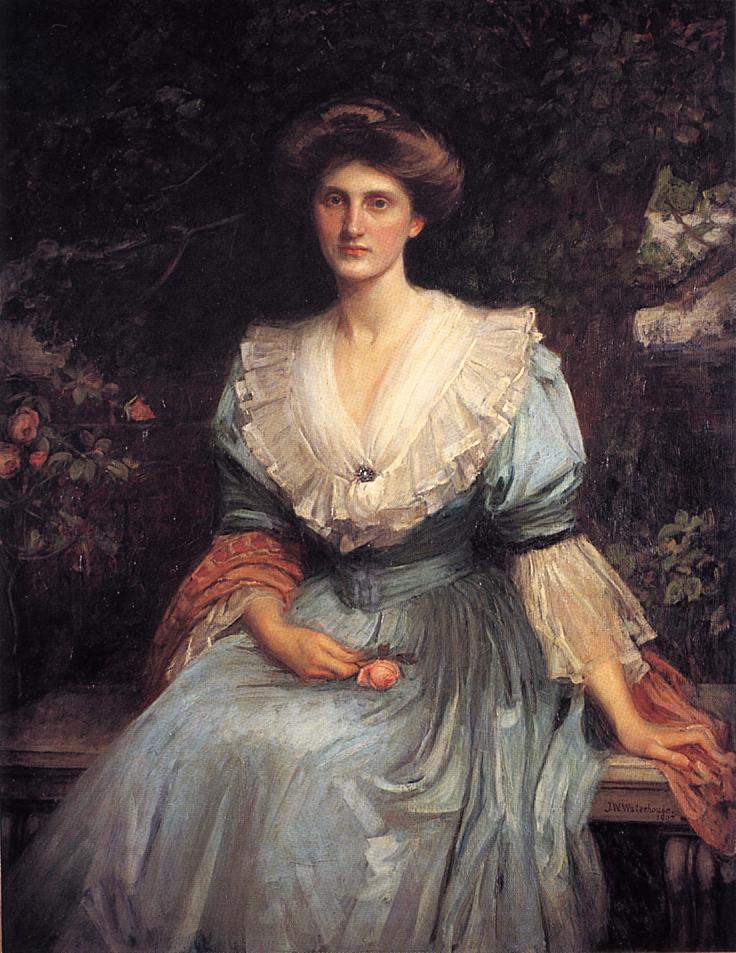
Image source: wikiart.org
Introduction: A Modern Portrait with a Poetic Aftertaste
John William Waterhouse’s Lady Violet Henderson (1907) sits at an intriguing crossroads in his career. By the early twentieth century, Waterhouse was celebrated for his literary and mythological scenes, yet he continued to produce portraits that carry the same sense of mood and inward narrative found in his larger, story-driven canvases. This painting appears, at first glance, to be a straightforward society portrait: a young woman seated outdoors, elegantly dressed, meeting the viewer’s gaze. But Waterhouse rarely leaves a figure as a mere record of appearance. Here, the pose, the surrounding foliage, the softened light, and the quiet symbolism of the rose work together to create something more suggestive than documentary. The sitter becomes a presence, not just a person, poised between intimacy and formality, between the cultivated world of the portrait and the private realm of reverie.
What makes the painting compelling is its balance of immediacy and restraint. Lady Violet is close enough to feel psychologically accessible, yet the setting and compositional choices keep her slightly removed, as if she belongs to the same half-shadowed garden as the roses and leaves behind her. Waterhouse builds a portrait that is both social and lyrical: the sitter is presented with dignity, but the atmosphere carries a hint of melancholy, the kind that lingers in many of his imaginative works. The result is a painting that can be read as an image of Edwardian refinement and, at the same time, as a study in quiet emotional depth.
Waterhouse in 1907: Late Style and a Softer Intensity
By 1907, Waterhouse had developed a late style that often favors gentle transitions and a more concentrated emotional tone. Even when depicting richly costumed figures, he avoids harsh contrasts that would pin the subject down too definitively. Instead, he lets the face and hands emerge from a surrounding field of deep, velvety color. In Lady Violet Henderson, that strategy is central. The background is dark, leafy, and textured, functioning almost like a stage curtain made of foliage. It frames the sitter while also suggesting the natural world as a space of contemplation, privacy, and subtle drama.
This period also reflects a broader shift in taste. Portraiture in the early 1900s was negotiating between traditional grand manner approaches and newer sensibilities that prized psychological nuance. Waterhouse’s contribution is distinctive because he brings the poetic aura of Pre-Raphaelite and Romantic feeling into a portrait format. The painting does not rely on flashy bravura brushwork or overt social signaling. Instead, it uses a controlled harmony of color and a carefully moderated expression to create a sense of inner life. In that way, it feels less like a public announcement of status and more like a quiet encounter.
Composition: A Calm Triangle of Presence and Poise
The composition is organized with clarity and grace. Lady Violet is seated, angled slightly, her torso facing forward while her arms create a gentle sweep across the lower half of the canvas. The arrangement forms a stable triangle: the head at the apex, the broad skirt and forearms spreading into a base that anchors the figure. This triangular structure is a classic tool in portraiture because it communicates steadiness and composure. Waterhouse uses it to emphasize dignity without stiffness.
The bench and the figure’s placement also create a subtle sense of enclosure. Her right hand rests outward, touching the bench, while her left hand holds a rose near her lap. These two points of contact guide the eye across the painting and reinforce the idea that she is settled within this space, not passing through it. The dark background pushes the figure forward, but it does so softly. There is no sharp outline separating her from the environment; instead, she seems to be gently lifted out of shadow by the paler tones of her dress and skin.
The gaze is crucial. Lady Violet looks directly at the viewer, and Waterhouse positions her face in a region of relative light. That directness creates immediacy, yet the expression remains composed and thoughtful. The painting invites attention without demanding it, as if the sitter’s confidence is quiet rather than performative.
The Figure and the Gaze: Social Presence and Interior Life
The sitter’s expression is one of the most carefully calibrated elements of the work. Waterhouse avoids a bright smile or any exaggerated emotion. Instead, her face carries a poised neutrality with a hint of seriousness. This emotional restraint was often valued in formal portraiture, but Waterhouse turns it into something more evocative. The lack of overt expression makes room for the viewer’s interpretation. Is she calm, reflective, slightly distant, or simply composed for the painter? The ambiguity is part of the portrait’s lasting appeal.
Her gaze meets ours, but it does not feel intrusive. The eyes are steady, the mouth relaxed, and the head slightly tilted, suggesting both attentiveness and self-possession. Waterhouse models the face with gentle tonal shifts rather than hard lines, giving the skin a natural softness. The light does not blaze; it glows. That glow makes her feel present and human, not carved into an ideal.
The posture supports this psychological tone. She sits upright but not rigidly. The shoulders and arms are relaxed, and the drape of fabric emphasizes a natural ease. This is a portrait of a person who belongs to her world and is comfortable within it, yet still carries a private inwardness that the painting does not fully disclose.
Color Harmony: Blue, Cream, and the Language of Quiet Luxury
The color palette is built around a few key harmonies: the cool blue of the dress, the creamy white of the ruffled neckline, the warm coral and rose tones of the shawl, and the deep greens and browns of the background. Waterhouse’s sense of balance is evident in how he distributes these colors. The dress dominates the lower portion of the painting, creating a large field of muted blue that feels calm and spacious. The neckline, bright and textured, draws attention upward toward the face. The shawl introduces warmth, preventing the palette from becoming too cool or austere.
The background is darker and more complex, with foliage rendered in layered, earthy tones. This darkness is not simply a backdrop; it is an atmosphere. It gives the impression of a garden shaded by trees, a space where light is filtered and softened. That softened environment intensifies the sitter’s presence. Her pale skin and the white ruffles become luminous by comparison.
The color story also carries symbolic resonance. Blue often suggests serenity, loyalty, or introspection, while the rose tones can hint at affection, vitality, or the blush of emotion. Waterhouse does not push these associations in an obvious way, but the palette encourages the viewer to feel that this is a portrait of refined calm with a warm, living core.
Fabric and Texture: Ruffles, Sheen, and Painterly Control
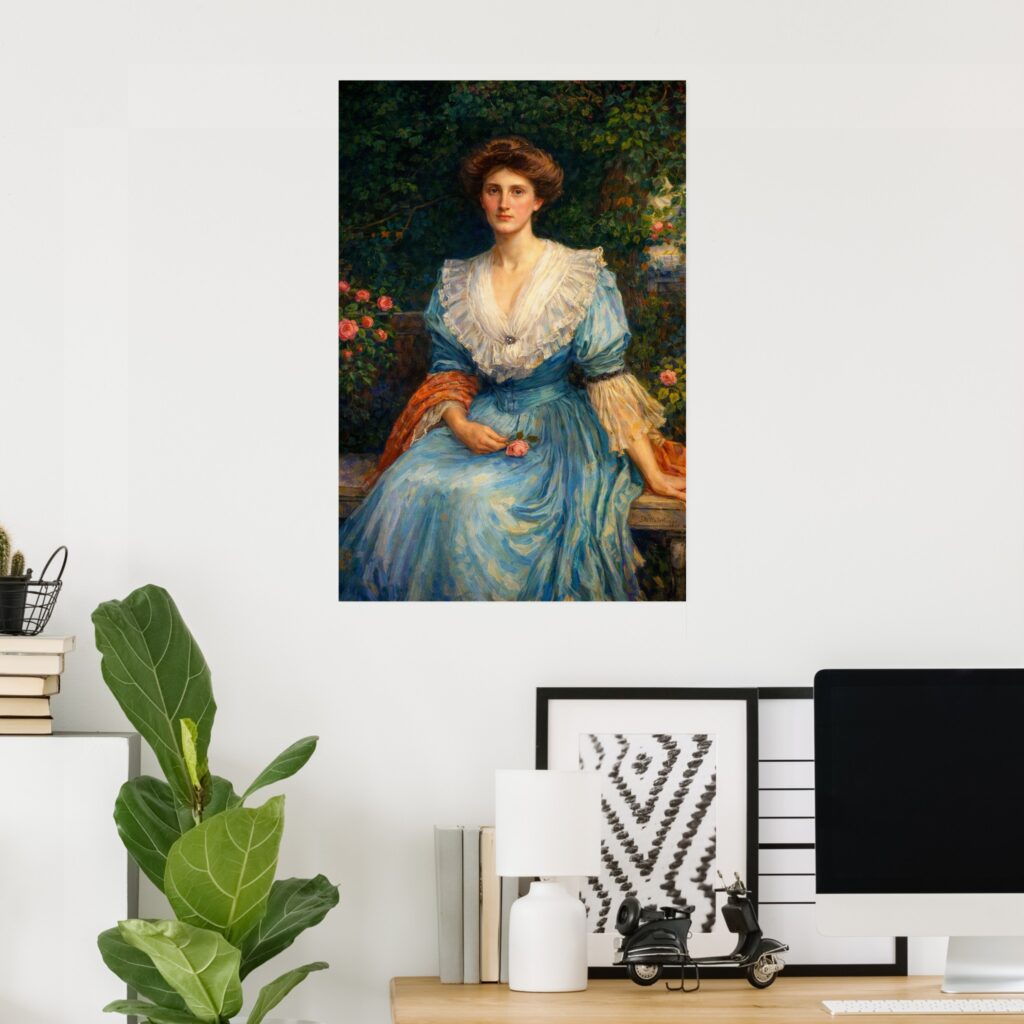
Waterhouse’s handling of fabric is both descriptive and expressive. The ruffled white neckline is a focal point, painted with attention to layering and translucency. The folds catch light unevenly, creating a lively rhythm of highlights and shadows. This texture contrasts with the smoother, heavier drape of the blue dress, whose broad planes feel steady and quiet. The dress’s waistline and the subtle gathering of fabric suggest structure beneath softness, reinforcing the sitter’s composed elegance.
The shawl, with its warm hue and looser drape, functions as a counterpoint. Its texture feels slightly rougher or more matte, and it introduces a sense of casual warmth. It also frames the sitter’s hands, drawing attention to gesture. Waterhouse uses tactile variety to keep the composition alive: crisp ruffles, flowing skirt, and the softer fall of the shawl create a choreography of surfaces.
The brushwork is controlled but not overly polished. In the background, the paint becomes freer and more suggestive, allowing leaves and blossoms to emerge from darkness without being individually cataloged. This contrast between the detailed figure and the atmospheric setting heightens the portrait’s emotional effect. The sitter feels real and specific, while the garden feels like a mood.
The Garden Setting: Nature as an Emotional Frame
The outdoor backdrop is not merely decorative. Gardens in portraiture often carry connotations of cultivation, refinement, and a controlled relationship with nature. Here, the garden seems shaded and intimate, with roses and foliage surrounding the sitter like a natural halo. The darkness behind her may suggest depth and privacy, a space where thoughts might deepen away from public scrutiny.
The setting also echoes Waterhouse’s broader artistic interests. He frequently places figures in environments that feel like thresholds: riverbanks, forest edges, shadowed groves. Such spaces are visually rich and psychologically charged. In Lady Violet Henderson, the garden performs a similar function. It suggests that the sitter exists not only within society but also within an inner landscape. The contrast between her bright clothing and the dark leaves evokes a gentle tension between visibility and concealment, between the social self and the private self.
Roses are especially meaningful in this context. They can symbolize beauty, fleetingness, affection, or even a quiet sorrow, depending on how they are presented. Waterhouse includes them without melodrama, letting their presence hover as a poetic undertone rather than an explicit message.
The Rose and the Hands: Gesture as Narrative
One of the most intimate elements in the painting is the sitter’s interaction with the rose. The flower is small but significant. It introduces a narrative hint: she is not only posing, she is holding something, attending to it, perhaps thinking while she holds it. The gesture is calm, not theatrical. That calmness makes it feel sincere, as if the rose is a companion to her thoughts rather than a prop.
Waterhouse pays careful attention to the hands, traditionally one of the most expressive and difficult features in portraiture. The left hand, near the lap, feels gentle and contained, while the right hand extends outward, resting on the bench. This outward hand suggests stability and contact with the physical world, while the inward hand suggests tenderness and contemplation. Together, they create a subtle psychological map: groundedness paired with sensitivity.
The placement of the rose near the center-lower portion of the painting acts as a visual hinge between the sitter’s face and the sweeping fabric of the skirt. It helps link the emotional focal point, the face, to the compositional anchor, the dress, without making the image feel static.
Light and Atmosphere: A Portrait Painted in Half-Shadow
The lighting in Lady Violet Henderson is neither harsh nor dramatically directional. It feels like filtered daylight, perhaps late afternoon, slipping through leaves. This kind of light has a particular emotional effect. It softens edges, encourages contemplation, and creates a sense of time passing quietly. Waterhouse uses it to avoid the blunt clarity of a studio setting. Even if the portrait was planned and formal, the atmosphere makes it feel like a moment encountered rather than staged.
Light concentrates on the sitter’s face, neckline, and hands, guiding the viewer to the places of identity and expression. The rest of the painting falls into quieter tones, especially the background. This distribution keeps the emotional focus precise. We are drawn first to the eyes, then to the ruffles, then to the hands and rose, before drifting into the dark garden. That movement mirrors the experience of conversation: attention on the person, then a wandering sense of what surrounds them, then back again.
The half-shadow quality also contributes to the painting’s mystery. Waterhouse is not offering a complete inventory of the environment. He is offering a mood, a sense of protected space where the sitter’s presence can feel private even as it is displayed.
Edwardian Elegance and Waterhouse’s Romantic Temperament
As an image of Edwardian femininity, the portrait conveys refinement, fashion, and social grace. The dress is elegant without being ostentatious, and the sitter’s pose communicates composure. Yet Waterhouse’s temperament gives the portrait a slightly different register than a purely fashionable commission might. There is a romantic seriousness here, a sense of quiet gravity. He does not flatter through exaggeration or sentimental sweetness. He dignifies through atmosphere and attention.
This approach aligns with Waterhouse’s broader practice of portraying women as complex presences rather than decorative figures. Even in his mythic paintings, his heroines often feel psychologically grounded. In Lady Violet Henderson, the sitter is not cast as a character from literature, yet the painting still carries a narrative potential. The viewer senses that she has thoughts and experiences beyond the canvas, that her life is not reducible to costume and setting.
The portrait can be admired for its beauty, but it also rewards sustained looking. The longer one studies it, the more the subtle emotional tension becomes apparent: the direct gaze paired with a guarded expression, the luminous dress against the dark garden, the warm shawl against the cool blue fabric. These contrasts create a quiet complexity that feels distinctly Waterhouse.
Why the Painting Endures: Presence, Restraint, and Mood
The lasting power of Lady Violet Henderson comes from its equilibrium. Waterhouse captures a convincing likeness while also shaping an atmosphere that feels timeless. The painting does not rely on novelty; it relies on precision of feeling. It is intimate without being intrusive, formal without being stiff. The sitter’s direct gaze creates connection, but the shaded setting and reserved expression preserve a sense of privacy.
Waterhouse’s technique supports this emotional balance. He orchestrates color so that calm and warmth coexist. He uses texture to differentiate surfaces and guide attention. He treats the background as a psychological space rather than a mere setting. And he invests small details, like the rose and the hands, with narrative possibility. These elements combine to create a portrait that feels like more than a commission. It feels like a quiet poem in paint.
In the end, the painting offers the viewer a particular kind of encounter: a moment of stillness, a face held in softened light, an elegant figure surrounded by leaves and roses. It invites the viewer to look carefully, not for spectacle, but for presence. That invitation is where the portrait’s beauty and meaning converge.