Image source: wikiart.org
Introduction to “King David Playing the Harp”
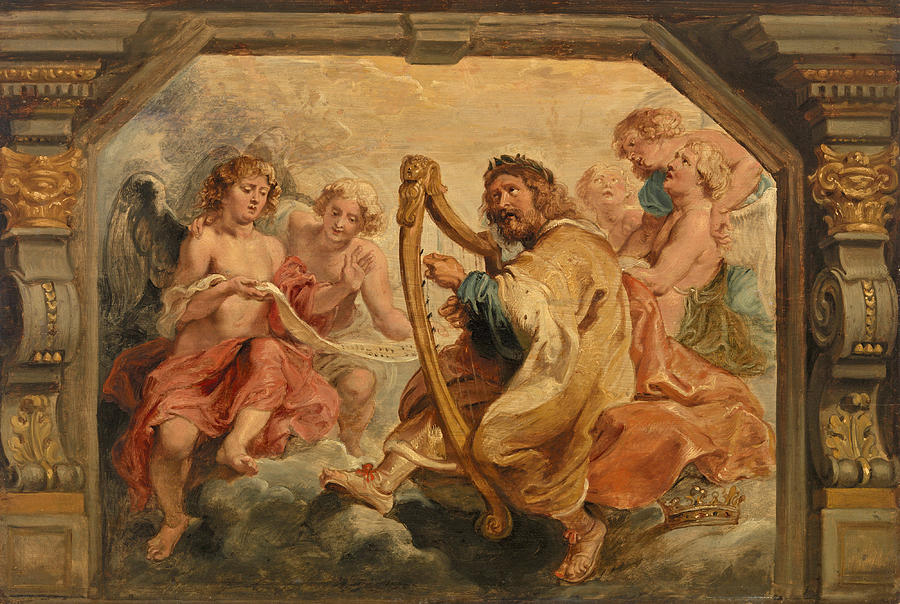
“King David Playing the Harp” by Peter Paul Rubens is an intimate yet regal vision of the biblical king as poet, musician and inspired prophet. Seated at the center of the composition, David turns slightly toward the viewer, fingers poised on the strings of his harp, while a cluster of angels and putti surround him with attentive devotion. Instead of presenting David as a distant monarch on a throne, Rubens portrays him as a living, feeling man whose royal authority flows from his closeness to God and his gift for sacred song.
The scene is framed architecturally, as though we are looking up at a painted relief or ceiling panel. Carved columns, gilded ornament and heavy stone moldings enclose the group, enhancing the sense that this image might originally have been conceived as part of a larger decorative cycle. Within this rich frame, the figures sit on clouds, occupying a luminous realm where earthly kingship and heavenly praise mingle.
Composition and Framing Device
Rubens’s composition is carefully controlled within the faux architectural frame. The shape resembles a flattened arch or niche, its heavy sides and top decorated with scrolls, capitals and gilded foliage. This frame does more than simply enclose the scene; it creates the illusion of depth, as if David and the angels inhabit a shallow space just behind a sculpted opening above the viewer’s head.
David sits slightly off center to the right, his large harp forming a vertical axis that anchors the composition. On the left, two youthful angels occupy the foreground, one holding a long scroll of music or text, the other leaning in with attentive concentration. On the right, another group of putti presses toward David, their faces turned toward him in admiration and wonder. The figures form a gentle arc from left to right, guiding the viewer’s eye toward the king and his instrument.
The lower edge of the frame cuts across David’s feet and the clouds on which everyone sits, heightening the sense of a window into another realm. The overall effect is theatrical: Rubens invites us to witness a heavenly performance staged within a gilded proscenium.
King David as Musician and Psalmist
David is identifiable not only by his harp and crown but also by his demeanor. He does not appear as a warrior in armor or as a stern judge, but as a contemplative artist. His head turns slightly toward the viewer, eyes engaged, as if we have just caught his attention in the midst of song. His beard and wavy hair give him a mature, dignified presence, yet there is a softness to his features that suggests humility before the divine.
The harp, almost as tall as his seated figure, rests on the ground and arcs upward in a graceful curve. Rubens depicts the instrument with enough detail to make it convincing, yet not so much that it distracts from David’s expression. The king’s right hand plucks the strings, while his left steadies the frame. The position of his hands and the tilt of his head convey the feeling that he is midway through a melody, perhaps one of the Psalms traditionally attributed to him.
In Christian art, David’s music symbolizes inspired scripture and foreshadows the harmony of the New Covenant. By surrounding David with angels, Rubens connects his earthly compositions to celestial worship, underscoring the belief that the Psalms are both human prayer and divine word.
The Angels and Putti: Heavenly Audience and Choir
The angels around David function both as audience and as fellow musicians. On the left, the angel with the scroll likely holds the text of a psalm or musical notation. His companion leans forward, reading or singing along. Their bare feet rest lightly on the clouds, emphasizing their ethereal nature, while their soft, curly hair and youthful faces radiate innocence.
On the right, three putti cluster together, their bodies overlapping in a tangle of limbs and drapery. Two appear to sing, mouths open and heads tilted upward. Another rests a hand on a companion’s shoulder in a gesture of camaraderie. These small figures embody the joy and exuberance of heavenly praise. Their presence also creates a lively counterbalance to the more solemn focus of David himself.
The interaction between King and angels suggests a kind of sacred collaboration. David initiates the song, but heaven responds, picks up the melody, and amplifies it. For viewers, this makes David’s music not merely a private devotion but an act of worship that resonates across the divide between earth and heaven.
Color, Light and the Warm Baroque Palette
Rubens employs a warm, golden-brown palette that unifies the scene and complements the architectural frame. The king’s cloak is a rich ochre-gold, echoing the gilded ornament around him. Beneath this cloak, a blue garment peeks out at the sleeves, introducing a cool note that keeps the harmony from becoming monotonous.
The angels are dressed in softer hues—rosy reds, pale greens, creamy whites—that glow against the neutral background. The red drapery of the angel holding the scroll is especially prominent, its ample folds cascading across the lower left of the composition and balancing the warm tones of David’s cloak on the right.
Light seems to fall from the upper left, illuminating the faces and shoulders of the figures and casting gentle shadows that model their forms. This light is not harsh or dramatic, but suffused and tender, appropriate to a scene of musical contemplation rather than violent action. The use of highlights on hair, cheeks and fabric edges gives the painting a jewel-like sparkle, enhancing its decorative function.
Gesture, Expression and Emotional Tone
Although the painting is small and intimate, Rubens infuses it with expressive life. David’s head is slightly turned, his gaze directed outward, but his hands remain absorbed in playing. This dual orientation suggests that his attention is simultaneously on God, on the music and on the unseen worshippers beyond the frame.
The angels respond with a range of emotions. Some appear serious and focused, eyes cast down toward the scroll, embodying concentration and reverence. Others, particularly the putti on the right, show open-mouthed delight and exuberant singing. The variety of expressions creates a sense of polyphony, as if different voices and harmonies are interweaving in sound, just as different attitudes and ages are interwoven visually.
Body language further enriches the emotional texture. One angel leans gently against his companion’s shoulder, another rests his hand on David’s cloak, and the putti seem almost to tumble over one another in their eagerness. These gestures convey affection and shared joy, implying that sacred music unites those who participate in it.
Iconography: Crown, Harp and Scroll
Several key symbols clarify the theological meaning of the image. David’s crown, resting slightly behind him on the cloud and partly hidden by his cloak, signals his status as king. Interestingly, it is not prominently displayed. By partially obscuring the crown, Rubens suggests that David’s royal dignity, while real, is secondary to his role as Psalmist and servant of God. The position of the crown near his feet may also evoke humility—he does not cling to earthly power, but kneels before the divine.
The harp stands as the central instrument of David’s identity. In biblical tradition, he played to soothe King Saul’s troubled spirit, and his psalms have been sung in worship for centuries. Here the harp’s elegant curve echoes the arching forms of the architecture and the flowing drapery, visually embedding music into the very structure of the image.
The scroll held by the angel is equally important. It represents the written word—either the text of the Psalms or musical notation. Its winding shape, unfurling across the angel’s lap, suggests the unfolding of prophecy and praise through time. By giving the scroll to an angel, Rubens underlines the belief that scripture originates with divine inspiration and is entrusted to humanity as a gift.
Architectural Setting and Decorative Purpose
The elaborate framing of the scene is a reminder that this panel may have been designed as a modello—a preparatory sketch—for a larger decorative scheme, perhaps a ceiling or wall program in a church or a private chapel. The painted stonework, gilded capitals and flanking pilasters make the image appear as part of a grand architectural ensemble.
This contextualizes the subject: King David, patron of liturgical song, would be an ideal figure to crown a space where music and prayer regularly took place. Positioned above a choir loft or near an organ, such a painting would visually affirm the connection between the musicians’ work and the biblical tradition of psalmody. The viewer standing below would look up at David and the angels, hearing human voices echo their perpetual heavenly music.
The illusionistic frame also reflects Baroque interest in dissolving the boundaries between painting, sculpture and architecture. Rubens engages this taste by making the painting appear like a sculpted relief suddenly infused with color and life. This integration of media enhances the sense of sacred space enveloping the worshipper.
Rubens’s Style: Movement, Warmth and Humanity
“King David Playing the Harp” embodies many of Rubens’s stylistic signatures in miniature. There is a characteristic sense of movement even in a relatively static subject. Drapery swirls, clouds billow, heads tilt and hands gesture; nothing is rigid. This subtle animation keeps the viewer’s eye in constant motion and suggests that the music we cannot hear is living and active.
Rubens’s handling of flesh is also notable. The angels’ skin is soft and luminous, with warm undertones that convey health and vibrancy. Even David, older and bearded, has a ruddy complexion that hints at physical vitality. This emphasis on the warmth of living bodies reflects Rubens’s broader celebration of embodied existence, even in spiritual contexts.
At the same time, the painting is suffused with humanity. David is not idealized into an aloof, unmoved icon; he appears thoughtful, engaged, and perhaps slightly introspective. The angels, especially the younger putti, show small idiosyncrasies—a tilt of the jaw, a curl of hair, a playful nudge—that make them feel like real children. Rubens thus bridges the gap between the celestial and the everyday, inviting viewers to see their own emotions reflected in this sacred gathering.
Theology of Music and Devotion
Beyond its visual appeal, the painting communicates a rich theology of music. In the biblical tradition, David’s psalms represent a spectrum of human feeling—joy, lament, thanksgiving, repentance—all offered to God through song. Rubens condenses this variety into a single harmonious moment where instruments, voices and hearts align.
By placing David among angels, the artist suggests that true worship erases the barrier between heaven and earth. Music becomes a bridge, allowing human praise to join the eternal chorus of the heavenly host. The presence of the scroll signals that this worship is grounded in sacred text, not mere emotion; yet the exuberant expressions of the putti show that it is anything but cold or mechanical.
For viewers encountering the painting in a religious setting, this image would serve as encouragement and instruction. It models a posture of devotion—thoughtful, joyful, communal—and reminds musicians and congregants alike that their songs participate in a tradition stretching back to the biblical king whose harp first gave voice to so many prayers.
Conclusion
“King David Playing the Harp” is a compact yet richly layered work that demonstrates Peter Paul Rubens’s ability to unite theology, artistry and human feeling. Through careful composition within an architectural frame, warm color harmonies and expressive gestures, he presents David as both regal and humble, a king whose true glory lies in his musical communion with God.
The angels and putti around him form a heavenly choir, their varied expressions capturing the joy and seriousness of worship. The harp, crown and scroll anchor the scene in biblical symbolism, while the decorative framing hints at its intended role in a larger liturgical or domestic setting.
Ultimately, the painting invites viewers to imagine the sound of sacred music echoing through the space where it hangs and to see their own acts of song and prayer mirrored in David’s example. In this way, Rubens transforms a small panel into a powerful meditation on how art and music can draw believers into the presence of the divine.