Image source: wikiart.org
An Intimate Portrait of Juliet in Waterhouse’s Imagination
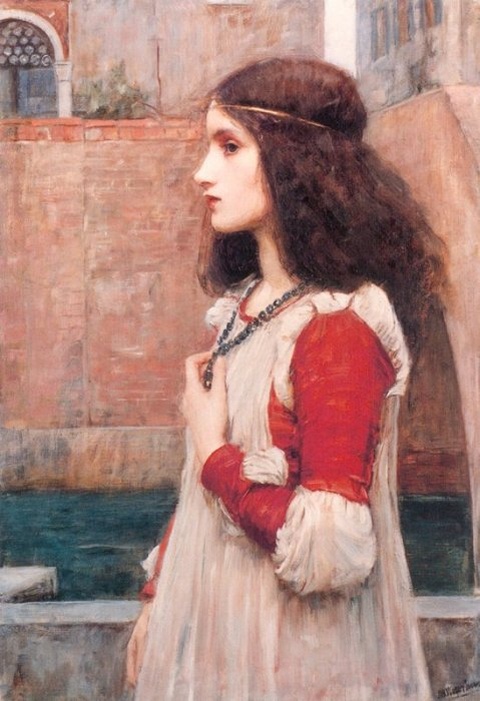
In Juliet (1898), John William Waterhouse turns Shakespeare’s most famous heroine into something quieter than theatrical romance and more private than stage drama. Rather than showing a climactic scene, he offers a moment of suspended feeling, the kind that sits between thought and action. Juliet appears alone, seen in profile, her gaze fixed beyond the frame as if she is listening for news that has not yet arrived. The painting asks you to lean in, not because it is small in emotional ambition, but because its power comes from restraint. Waterhouse builds an atmosphere where longing is not declared, it is held.
This approach fits Waterhouse’s special talent for painting narratives without turning them into illustrations. He often paints the instant when a character’s inner life becomes visible on the surface of the body. Here, Juliet’s story is suggested through pose, costume, setting, and color, all arranged to make us feel the weight of anticipation. Even if you know nothing about Romeo and Juliet, the image reads as a portrait of a young woman on the brink of change, guarded, luminous, and intensely alert.
What You Notice First: Profile, Stillness, and a Held Breath
Juliet is presented in a clean side profile, her face pale against a warm field of masonry. Waterhouse positions her so that her features are almost sculptural: the straight line of the nose, the curve of the lips, the slope of the chin. The profile format is important because it suggests both distance and clarity. We cannot meet her eyes directly, and that lack of direct access makes her seem more self-contained. She is not posing for us. She is thinking past us.
Her right hand rests at her chest, lightly gripping the fabric near her collarbone, close to a dark beaded necklace. It is a gesture that can mean many things at once: self-protection, affection, nerves, devotion, or simply the unconscious touch of someone waiting too long. Because the gesture is small and believable, it gives the painting psychological credibility. It reads as an authentic habit of the body rather than a symbol forced into place.
The stillness does not feel empty. It feels charged. Waterhouse creates the sensation that Juliet is holding her breath. The quiet becomes an emotional instrument, making the viewer supply the missing sound: footsteps, a distant voice, the soft slap of water, or the inner noise of her own thoughts.
Composition and Framing: A Figure Set Against Walls and Water
The composition is vertically oriented, with Juliet placed slightly to the right, her face and upper torso commanding the center of attention. Behind her, a brick wall forms a broad, simplified backdrop that keeps the image from becoming busy. The architecture functions like a stage set, but without spectacle. It is there to create enclosure, to make the scene feel like a courtyard or terrace where private emotions can exist without interruption.
A strip of water appears along the lower portion of the image, separated from the viewer by a pale stone edge. That narrow band of canal or river introduces a second kind of space. The wall is solid and protective, while the water is open and uncertain. Juliet stands between these two elements, which subtly mirrors her situation in the story: a young woman constrained by family and tradition, yet drawn toward risk, movement, and the unknown.
Waterhouse’s framing gives Juliet room in front of her. The direction of her gaze creates an invisible extension of space, as if the most important part of the painting is what she sees or imagines. This is a classic strategy for portraying anticipation. The body is present, but the mind is elsewhere.
Color and Light: Warm Brick, Cool Water, and the Glow of Skin
The palette is delicate and controlled. The wall behind Juliet is rendered in soft warm tones, dusty rose, terracotta, and sun-faded peach. These colors suggest age, heat, and human habitation, the accumulated warmth of stone that has held sunlight for centuries. Against this, the water reads as cooler and deeper, a muted teal-green that feels calm but also slightly heavy. That cool strip acts like a visual counterweight to the warm masonry, balancing the composition while adding emotional contrast.
Juliet’s clothing introduces the strongest color accent: the deep red of her sleeves. Red here does not shout. It glows through a veil of softened paint, like embers under ash. Waterhouse uses that red as a pulse of life, a signal of passion held beneath restraint. The rest of her dress is pale, creamy, and translucent in feeling, which makes the red sleeves feel even more intimate, like a private truth beneath a socially acceptable exterior.
Light in the painting is gentle and diffused. There is no dramatic spotlight. Instead, illumination seems to settle across surfaces, especially Juliet’s face and the folds of her garments. Her skin is rendered with a porcelain clarity that sets her apart from the textured wall. This makes her appear both fragile and iconic, a living figure with the visual purity of a legend.
Costume, Hair, and Jewelry: Medieval Echoes with Victorian Sensibility
Juliet wears a pale gown with a soft drape, layered over a red undergarment visible at the sleeves. The costume reads as historically flavored rather than strictly archaeological. It evokes a romantic medieval or Renaissance past, the kind of past that Victorian artists loved because it allowed them to speak about desire, virtue, fate, and rebellion at a slight distance. The dress is modest in structure but expressive in texture, with fabric that seems light enough to move with a breath.
Her hair is long, dark, and abundant, falling in a thick wave down her back. A thin band circles her head like a simple circlet, reinforcing the period mood and also suggesting restraint. Hair in Waterhouse often functions as more than ornament. It can indicate vitality, sensuality, and the pull of instinct. Here, the hair’s volume and softness contrast with the clean geometry of the architecture. It is nature beside stone, impulse beside rule.
The necklace is dark and prominent, hanging at the center of her chest where her hand rises. It becomes a focal point, not only visually but emotionally. It feels like an object of significance, perhaps a gift, a token, or a personal anchor. Even if it is not tied to a specific Shakespearean detail, it acts like a symbol of attachment, something she touches when she needs steadiness.
Setting and Atmosphere: A Courtyard of Quiet Confinement
The architectural background is spare but suggestive. A brick wall dominates, with hints of windows and a small arched opening to the upper left. The setting does not loudly announce Verona, but it evokes an Italianate environment. The warm masonry, the suggestion of a canal or waterway, and the pale stone parapet create a sense of old-world urban intimacy. The space feels enclosed, private, and slightly removed from public life.
This matters because Romeo and Juliet is a story of love pressured by social structures. Walls in that story are not just physical objects. They are boundaries between families, between public and private, between what is permitted and what must be hidden. Waterhouse uses the wall not as a literal reference to a specific scene, but as an emotional environment: a place where feelings can be contained but not erased.
The water adds a subtle note of movement and time. Even when painted calmly, water implies change. It reflects light differently every moment, it carries sound, it connects places. In a painting about waiting, water becomes a quiet metaphor for the way time continues to flow even when a person feels stuck inside a single moment.
Juliet’s Expression: Thoughtfulness Instead of Performance
Juliet’s face is composed, almost solemn. Her lips are closed, her gaze steady, her brow calm. This is not the Juliet of frantic action or theatrical despair. It is the Juliet of inward resolve, the one who thinks, weighs, and feels deeply before she moves. Waterhouse’s Juliet appears young, but not childish. There is a maturity in her stillness, as if she is already aware that love is not merely sweetness, but consequence.
The profile view intensifies this. We read the line of her mouth and the angle of her chin as signs of determination. Her posture is upright, and her neck is elongated, giving her a quiet dignity. Even her vulnerability is controlled. She is not collapsing into emotion. She is holding it with care, which makes the emotion feel stronger, not weaker.
That balance between fragility and strength is part of why Waterhouse’s heroines remain compelling. They are often caught between worlds: between innocence and knowledge, safety and desire, ritual and rebellion. Juliet is painted at precisely that threshold.
Symbolism in Small Gestures: Hand to Heart, Red to White, Stone to Water
Waterhouse relies on understated symbolic contrasts rather than obvious props. The most direct is Juliet’s hand to her chest. This gesture places the emotional center of the painting exactly where the viewer’s eye naturally goes. It suggests sincerity, longing, and self-awareness. The hand also introduces touch into a scene where nothing else is touched. Juliet is alone, and so she touches herself, not in vanity, but as a way of making the inner world tangible.
Color contrast reinforces the emotional story. The red sleeves under the pale outer garment can be read as passion beneath propriety. The pale fabric suggests purity, social expectation, and the public version of Juliet, while the red suggests private desire and vital feeling. Waterhouse does not make this contrast harsh. He blends it, implying that Juliet’s innocence and passion are not opposites, but intertwined.
The setting contributes another contrast: stone and water. Stone stands for family structures, law, tradition, and immovable consequences. Water suggests change, fate, and the flow toward something irreversible. Juliet’s placement between these elements makes her feel like a figure caught between what holds her and what calls her.
Waterhouse and the Pre-Raphaelite Legacy: Beauty in Service of Emotion
Although Waterhouse is often associated with the Pre-Raphaelite tradition, his relationship to it is both close and personal. He inherits the movement’s love of literary subjects, careful surface beauty, and the elevation of female figures into symbolic presence. Yet his handling is usually softer, more atmospheric, and more psychological than the crisp, jewel-like intensity of earlier Pre-Raphaelite painting.
In Juliet, you can feel that inheritance in the emphasis on narrative suggestion and in the idealized features of the figure. Juliet has the calm, refined beauty of a heroine meant to be contemplated. But Waterhouse also modernizes the tradition by allowing ambiguity. This Juliet is not pinned to a single moment of plot. The painting is less about identifying the scene and more about embodying a state of feeling.
That approach makes the work resonate with viewers who come to Shakespeare not only for story but for emotional truth. Waterhouse is less interested in depicting a famous line or dramatic conflict and more interested in what it feels like to live inside the tension that the story creates.
Shakespeare’s Juliet Reimagined: The Pause Before the Tragedy
Juliet in Romeo and Juliet is often remembered for youthful passion, but the character is also marked by rapid growth and startling courage. Waterhouse’s portrayal emphasizes the contemplative dimension of that growth. This is Juliet before the decisive step, before the world narrows into crisis. She stands in a space that suggests privacy and waiting, which aligns with the story’s secret meetings and hidden plans.
The painting’s mood is not celebratory. It is tender, but edged with seriousness. That tonal choice fits the tragedy’s structure. Romeo and Juliet is full of beauty, but beauty in that play is always shadowed by danger. Waterhouse’s Juliet seems to sense that. She appears as someone who understands that love can be luminous and costly at the same time.
Even the calmness feels precarious. The stillness reads as a fragile bubble, a moment that can be punctured by news, by footsteps, by the sudden arrival of consequence. In that way, the painting becomes an emotional prelude, a portrait of a heart poised over a turning point.
Technique and Surface: Soft Edges, Delicate Transitions, and Controlled Detail
Waterhouse’s technique here favors smooth transitions and softened edges. The wall is painted with enough texture to feel real, but it does not compete with Juliet. The face and hair receive more delicate attention, with subtle modulation that makes the skin look luminous and the hair dense and tactile.
The garment is handled with a careful balance between specificity and suggestion. The folds are readable, but not overdrawn. The fabric seems to breathe. Waterhouse often uses this kind of handling to keep the figure from becoming stiff. Juliet’s clothing feels worn, inhabited, and responsive to her body.
The overall surface has a gentle haze, as if the scene is filtered through memory. That atmospheric quality contributes to the painting’s psychological impact. It feels like a recollection of Juliet rather than a factual record. This suits the subject because Juliet is a cultural memory as much as a character. Waterhouse paints her as both individual and emblem.
Why This Painting Endures: A Universal Image of Longing and Resolve
Part of the lasting appeal of Waterhouse’s Juliet is how the painting operates on two levels at once. On one level, it belongs to the rich tradition of Shakespearean art, where artists return to famous characters as a way of exploring ideals of love, beauty, and fate. On another level, it functions as a standalone portrait of a human emotion that requires no prior knowledge: the experience of waiting while the heart leans forward into the future.
Juliet’s solitude makes her relatable. Many depictions of romantic heroines emphasize interaction, the gaze exchanged between lovers, the dramatic gesture addressed to another person. Here, Waterhouse emphasizes what happens when the lover is not present: the inward concentration, the self-quieting, the touch to the chest that anchors feeling in the body.
The painting also endures because it refuses to reduce Juliet to a single stereotype. She is not merely innocent, nor merely passionate. She is a young woman in the act of becoming. The visual language of red and white, of stone and water, of profile and distance, all supports the idea that her identity is forming under pressure. That makes her not just a symbol of romance, but a symbol of choice.