Image source: wikiart.org
Introduction
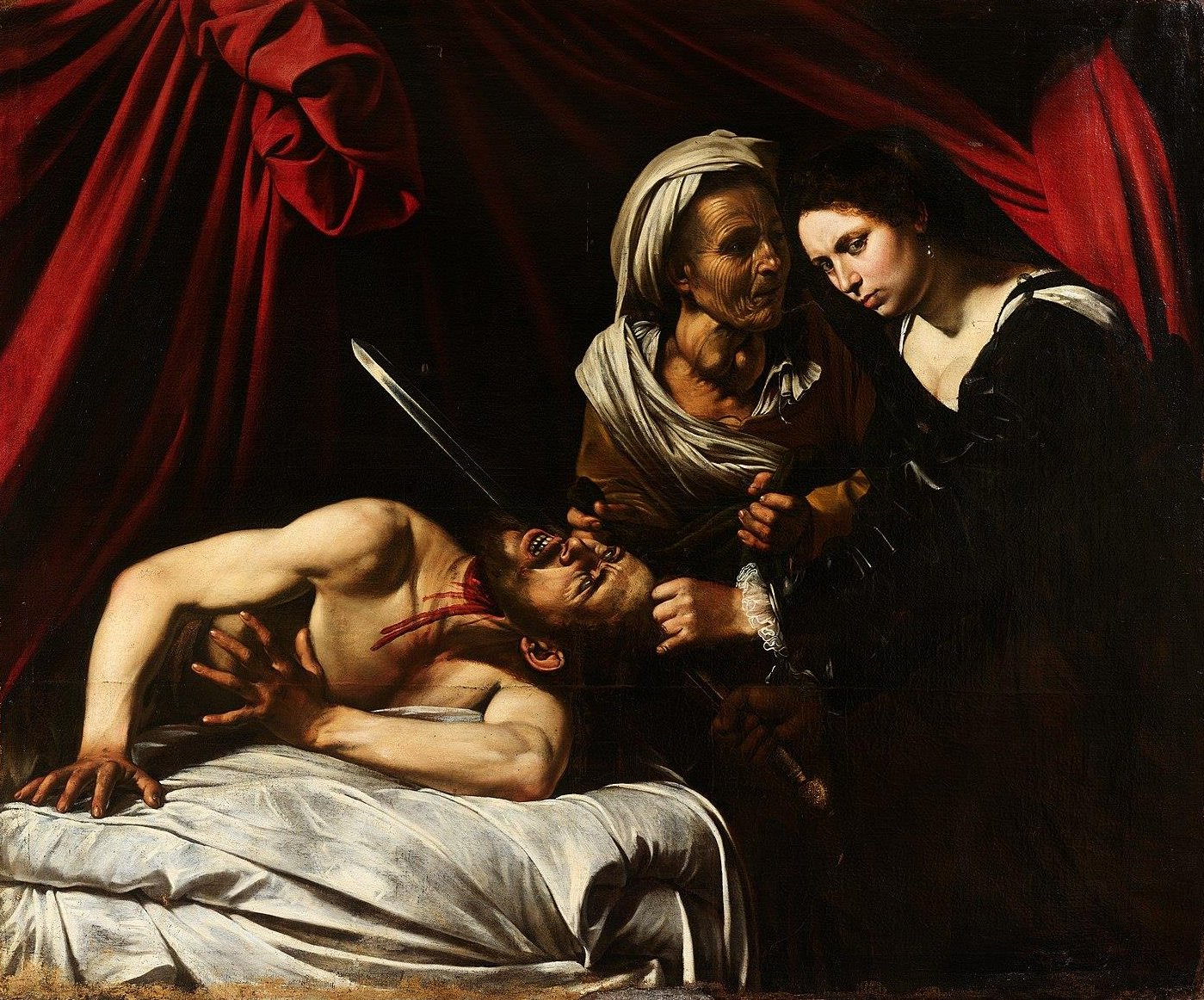
Caravaggio’s “Judith Beheading Holofernes” is one of the fiercest images of the early seventeenth century. Painted around 1610 at the end of the artist’s turbulent life, it captures the instant when the young Jewish widow Judith, aided by her servant Abra, cuts the Assyrian general’s throat. The story comes from the Book of Judith, a tale of courage and stratagem that had long inspired artists, yet Caravaggio renders it with an immediacy that still startles. What shocks is not merely the subject’s violence but the painting’s composure: the cool intelligence in Judith’s face, the concentrated force in her arms, the splintered jet of blood, and the heavy red drapery that turns the bedchamber into a tense theater. Everything is close, lit by a single beam, and nothing feels ornamental. It is a picture about decision, agency, and the cold clarity required to perform a deed on which a people’s survival depends.
Historical Context and the Late Caravaggio
By 1610 Caravaggio had lived through exile, imprisonment, escape, and pursuit. He painted in Naples and Sicily while seeking a papal pardon for the Roman homicide that had forced him to flee years before. The late canvases concentrate drama into compressed spaces and concentrate light into narrow, blade-like beams. The figures are carved from darkness with a severity that suggests both artistic discipline and biographical pressure. “Judith Beheading Holofernes” belongs to this final, distilled phase. The subject allowed Caravaggio to revisit the theme of sacred violence that haunted his work—David with Goliath’s head, the Sacrifice of Isaac—yet now the protagonist is a woman who acts with calm necessity. The painting thus folds together the artist’s late style and a narrative of political deliverance carried out through decisive personal action.
Composition as Event
Caravaggio builds the scene from a simple triangle of bodies and a rectangle of bed. At left, Holofernes writhes across the white sheet, his torso thrust forward by surprise and pain, his right hand clawing a last reflex against the mattress. At the center, Judith leans in with her arms extended, a sword angled across the picture plane and a line of crimson cutting across the general’s neck. Her body does not lunge; it extends, as if steadiness were as important as strength. At the right, Abra anchors the action, gripping Holofernes’s head and pulling it upward so that the blade can work. The entire event is staged within a few feet of the picture plane, as though the viewer has stepped into the tent at the moment the act becomes irrevocable. The bed’s white sheet, the red drapery, and the dark void beyond supply the simplest of stages on which will and flesh collide.
Light as Moral Emphasis
A single light enters from above and to the left, catching the sheen of the blade, Judith’s pale forehead and hands, the folds of the white sheet, and the musculature of Holofernes’s torso. Darkness swallows everything that does not matter. Caravaggio’s light does not sentimentalize; it selects. By setting Judith’s face and hands in brightness, he makes her thinking and her doing equally visible. The shadowed background prevents narrative distraction. You are asked to attend to the deed itself, to the terms under which a woman’s resolve reshapes history. The light renders judgment by clarity: what we can see, we must reckon with.
The Red Drapery and the Theater of War
The great red curtain that fills the upper half of the canvas folds like a stage’s proscenium and glows like spilled blood. Its weight presses down on the small arena of action, intensifying the claustrophobia of the bedchamber. In earlier Renaissance depictions, tents and curtains created a courtly setting; Caravaggio transforms the textile into a psychological instrument. It frames the violence, amplifies it chromatically, and suggests that the private act is staged for public consequence. The red also connects Judith to the political body she defends: it is not only her blade that will save Bethulia but the courage that can endure the color of crisis surrounding her.
Judith’s Face and the Discipline of Resolve
Caravaggio refuses the easy trope of righteous fury. Judith’s face is composed, even cool, her brow faintly furrowed, her lips pressed in concentration. She looks not at Holofernes’s eyes but at the line she is cutting, as though accuracy were an ethical requirement. Her youth is unmistakable, but it is not naïveté. The pearls in her ear and the lace at her cuff hint at refinement, yet the steadiness of her hands and the alignment of her wrists declare competence. This is not rage; it is resolve. The psychological charge comes from the friction between the horror of the act and the measured calm with which she performs it.
Abra as Coauthor of the Deed
The old servant Abra is not a bystander. Her weathered hands secure Holofernes’s head; her eyes track Judith’s movement; her mouth is set in a line that reads as both urgency and instruction. She is midwife to the moment, a witness whose age suggests that courage is also a memory. Caravaggio often inserts an older companion into his scenes to supply practical wisdom; here Abra’s presence grounds the painting in a community of women who know what must be done and how to do it. The intergenerational partnership converts Judith’s act from singular heroism into a coordinated, necessary labor.
Holofernes as Human and Threat
Holofernes is not an abstract monster. His body is vigorously alive, with the tautness of a soldier used to exertion. The shock in his eyes is real, the mouth open around a beginning cry. Blood jets in a harsh angle, both factual and emblematic, a graphic index of power brought low. Caravaggio gives him human complexity to insist that Judith’s act is not easy. The painting does not require us to pity him, but it requires us to acknowledge his personhood, which increases both the gravity of the deed and the admiration for the courage it demands.
The Sword, the Sheet, and the Geometry of Force
The blade forms the composition’s principal diagonal, an iron line that slices across flesh and divides the canvas into zones of will and resistance. The white sheet acts as a reflective plane, heightening the visibility of bodies and doubling as a symbolic field of violated purity now weaponized for liberation. The contrast between the inert drapery and the hard line of the sword turns the entire bed into a device of focus. Caravaggio wants the viewer to feel the mechanics of the act—the strain in Judith’s forearms, the torque of Holofernes’s shoulder, the pulling counterforce in Abra’s hands—so that the miracle of deliverance is felt through physics.
Tenebrism and the Ethics of Looking
Caravaggio’s tenebrism is more than stylistic bravura. Darkness itself becomes ethical space, a field against which moral clarity is cut. The women’s faces and hands are illuminated with chilly precision, while the rest sinks into near-black. The lighting prevents voyeurism from becoming spectacle; it enforces attention. We are not given a panoramic war story or a decorative tent interior. We are given the moral nucleus of the narrative, the two seconds when everything hangs in the balance. The rigors of the light demand the same rigor from the viewer’s gaze.
Gesture, Hands, and the Language of Agency
Caravaggio often places expressive emphasis on hands, and in this painting, they govern the drama. Judith’s hands encircle the grip, one near the guard and one further down the hilt for leverage; Abra’s hands fix the head and hair; Holofernes’s hands react in panic—one clawing the sheet, the other hovering open as if grasping for air. These hands narrate the action more clearly than any facial expression could. Through them Caravaggio articulates the grammar of agency: intention becomes movement, movement becomes force, and force becomes political consequence.
Chastity, Seduction, and the Paradox of Virtue
The biblical Judith defeats Holofernes by accepting his invitation and biding her time until he is drunk and vulnerable. The painting retains this paradox: a virtuous woman must enter the perilous economy of seduction in order to save her city. Caravaggio registers the paradox quietly. Judith’s neckline is modest, her expression sober, yet the black satin of her dress and the pearl at her ear signal elegance. She has walked into danger armed with beauty and exits it armed with resolve. The painting refuses to moralize this complexity; it shows a woman using the means available to defeat violence without becoming its mirror.
Blood as Line and Truth
Caravaggio’s depiction of blood is disciplined, neither gratuitous nor coy. The stream issues in a taut, linear spray, catching the light in a way that reads as both material and graphic. It marks the passage from threat to liberation. The painter does not immerse the scene in gore; he sets a precise sign of rupture, a witness to the sword’s path and to the cost of deliverance. The red of the curtain echoes and deepens that sign, allowing the eye to register the act without numbing detail. This restraint heightens the horror and the dignity in equal measure.
The Bedchamber as Political Arena
The setting is intimate: a mattress, a curtain, a few feet of floor. Yet the action determines the fate of a city. Caravaggio shrinks the stage in order to enlarge the stakes. The lesson is as old as tragedy: politics is decided in rooms, by people more vulnerable and more courageous than public ceremony can acknowledge. The bed here is paradoxically both place of seduction and place of justice. By compressing the political into the personal, the painting asks viewers to measure their own rooms for the acts that history may one day demand.
Comparisons with Earlier Judiths
Artists before Caravaggio often showed Judith with the severed head in a triumphal mood or processed the act into a tableau of virtue rewarded. Caravaggio chooses the action itself, neither elevated nor allegorized. The decision gives the subject a terrifying honesty and aligns it with the painter’s larger project of bringing sacred history into human proximity. Unlike decorative Renaissance versions, this Judith speaks to the body’s memory of effort and fear. The drama occurs not in the realm of symbols but in tendons, wrists, and breath.
The Feminine Hero and the Baroque Imagination
Baroque art often turned to women as protagonists of decisive acts—Jael, Delilah, Salome, Judith—sometimes with misogynist implications. Caravaggio’s Judith resists such caricature. She is neither vamp nor saintly abstraction. She is a citizen with a task. The painting’s thrill does not lie in eroticized violence but in competence. The feminine hero emerges as a figure of intelligence and resolve whose action is necessary and just. This sober portrayal influenced later artists, who either amplified its theatricality or tried to reclaim its psychological poise.
Technique, Surface, and the Evidence of the Brush
Caravaggio’s paint handling is taut. The satin of Judith’s dress absorbs light in deep pools; the linen sheet records brisk, confident strokes that turn fabric into luminous topography; the sword gleams with a few decisive highlights. Holofernes’s skin is modeled with warm, living tones that deepen toward the throat where the cut occurs. The brush is almost invisible where illusion demands it and quick where energy is needed, especially in the folds of the drapery and the crispened edges of the sheet. The surface radiates a painter who knows exactly where to labor and where to let the eye complete the truth.
The Viewer’s Position and the Ethics of Witness
Caravaggio places the viewer at bed-side distance. We are neither safely across the room nor abstractly above. We stand close enough to feel the blade’s cold light and the breath in Holofernes’s open mouth. That proximity makes the viewer a witness, not a passive spectator. The painting does not ask for glee or horror alone; it asks for judgment. Is this act necessary? Can such composure coexist with compassion? The viewer’s moral response completes the scene, fulfilling the Baroque ambition to engage not only the eye but the conscience.
Meaning for a Modern Audience
The painting continues to resonate because it treats courage as disciplined action rather than mere feeling. It shows a woman who prepares, calculates, and executes under impossible pressure. In an age saturated with spectacle, Caravaggio’s economy feels bracing. He refuses distraction, directing attention to hands, blade, blood, and thought. The image speaks to contemporary conversations about agency, resistance, and the complexity of moral choice. It suggests that history sometimes hinges on those who can concentrate amid fear and act without narcissism.
Conclusion
“Judith Beheading Holofernes” is a masterpiece of concentrated drama. Within a few feet of canvas Caravaggio stages a battle of will and flesh that transforms a biblical tale into an event you can feel in your shoulders and throat. Light sharpens purpose; a red curtain turns a room into a tribunal; a young woman’s face and hands become instruments of justice. The late Caravaggio is at once severe and humane, refusing both sensationalism and sentimentality. What remains after the shock is not the violence but the poise—the knowledge that courage can be as quiet as a measured breath, and that deliverance sometimes arrives with a steady wrist and a blade held straight.