Image source: wikiart.org
A Threshold Scene of Grief and Deceit
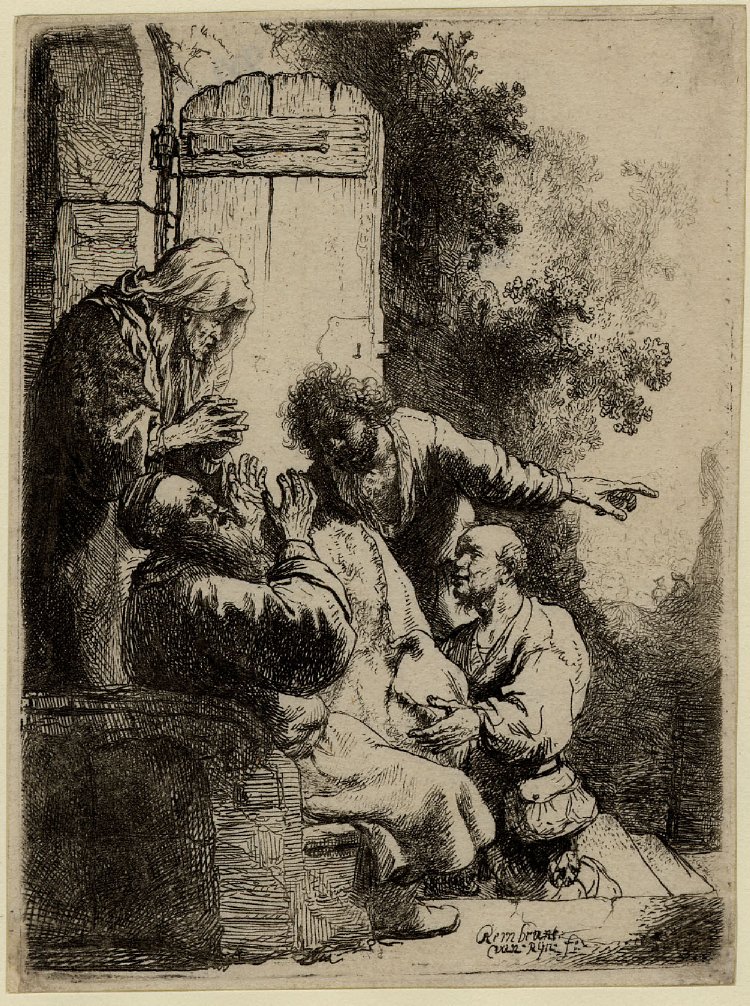
Rembrandt’s “Joseph’s Coat Brought to Jacob” compresses a biblical earthquake into a doorway-sized space. Jacob sits at the left on a rough bench as his sons crowd the threshold with an object we cannot fully see but instantly feel—the torn and bloodied coat of Joseph. One son kneels, another leans in with a forceful gesture, a third older figure raises clasped hands in a prayer that also reads as shock. The stone steps, the timbered door, and a small wedge of landscape to the right frame the confession without relieving it. The drama is intimate, tactile, and devastating, rendered in a network of lines that makes sorrow legible to the fingertips.
The Biblical Moment and Why It Matters
The episode comes from Genesis 37. After selling Joseph into slavery, his brothers bring Jacob the multicolored coat dipped in goat’s blood, implying a fatal mauling. The patriarch recognizes the garment and collapses into mourning. Rembrandt selects the instant when deceit meets love—before truth comes to light, before forgiveness and reunion. The print therefore centers on the emotional cost of a lie and the loneliness of a father at the edge of irreversible loss. By choosing the threshold, Rembrandt indicates the moral threshold the brothers are crossing, and the spiritual threshold Jacob is forced to enter.
Composition as Moral Geometry
The composition is triangular and tight. Jacob’s bulk establishes the left base, the kneeling son forms the right base, and the pointing, leaning figure at center rises to an apex that drives the eye toward the open air. The door’s vertical planks and the step’s horizontal blocks create a gridded architecture against which the bodies register as agitation. This geometry organizes the competing forces—confession, concealment, persuasion, shock—into legible vectors. The lines push and pull around Jacob, making him the true center of gravity even though his head bends away from the triangle’s peak.
The Doorway as Stage and Symbol
Rembrandt’s door is both literal furniture and symbolic device. As a stage, it funnels the brothers toward Jacob; its hinge and latch are shown with artisanly accuracy that localizes the scene in tactile reality. As symbol, it separates inner household from outer world, truth from rumor, belonging from banishment. The brothers carry the story from outside to inside, while Jacob—seated on the house-side of the jamb—receives a narrative that will unhouse him. Threshold architecture becomes theology: decisions made here will reconfigure a family and echo down a nation’s history.
The Orchestration of Hands
Few artists can make hands speak like Rembrandt. Jacob’s hands are raised not in theatrical despair but in a reflex of protection and prayer, the fingers tightening over a void. The kneeling son’s hands steady the garment, a serviceable grip that betrays guilt by its carefulness. The central brother’s outstretched hand cuts the space like a blade; it is part pointing, part explanation, part cover story. These hands choreograph the psychology: Jacob’s withdrawal, the brothers’ intrusive reporting, and the pressure to accept a narrative that erases the beloved.
Faces That Carry Weather
Jacob’s face is a weathered map of incredulity. The brows knit, the mouth purses, the beard merges with the coarse textures of cloak and bench. The kneeling son tilts his head upward in a plea for belief; the central brother’s features concentrate into a knot behind his wild hair; the elder figure at far left, sometimes read as a servant or attendant, supplies a counter-expression of piety and alarm. There is no caricature. Each face registers a different temperature of the same storm—shock, calculation, complicity, and grief.
Etching Technique as Emotional Language
The print’s language is the burr and bite of line. Cross-hatching thickens around Jacob’s lap and the door’s plank, creating a weight that visually anchors the sorrow. Looser, feathery strokes describe the shrubbery and the wedge of sky at right, letting a little breath into a suffocating moment. Drypoint burr (where present) gives velvet depth to key shadows, while controlled bitten lines hold the architecture together. The range—from velvety blacks to whispering greys—mirrors the range of feeling, from choking grief to the thin hope that this might somehow be untrue.
Light and Shade as Judgment
Although monochrome, the etching carries a distinct lighting scheme. The brightest area pools around the clothed bundle in the brothers’ hands and along Jacob’s sleeves, making recognition rather than spectacle the focal event. Deeper shade cloaks the door and the recess by the bench, converting the domestic interior into a chamber of trial. The small, clear patch of sky beyond the figures is not consolation so much as distance; calm exists, but far away. The chiaroscuro reads like judgment: truth is trying to surface where the lines thin; deception thickens where darkness gathers.
The Coat as Absent Presence
Curiously, Rembrandt refuses to parade Joseph’s coat as a sensational object. It is partially obscured by crouched bodies and folded fabric. That restraint respects the narrative’s moral angle. The coat’s power lies not in its decoration but in its effect on the father. The “multicolored” splendor that once provoked jealousy is reduced to texture and shape. The print lives in the aftermath of favoritism, not its flamboyance. The garment becomes an instrument through which love is wounded and a test through which character is revealed.
Sound, Touch, and the Sensorium of Sorrow
This small print seems to carry sound and touch. The scrape of sandals on the step, the creak of the latch, the hush of rushed voices, the rasp of wool as the coat is unrolled—these are suggested by the tactile pressure of lines. One almost feels the coarse weave of Jacob’s cloak under a palm, the polished wear of the step under a foot, the brittle edges of the door’s planks. Rembrandt’s etching turns grief into something the body recognizes through multiple senses.
Time Suspended Between Two Sentences
The story pivots between two sentences: “This we found” and “It is my son’s coat.” Rembrandt finds the hinge between them. Jacob’s face holds the last moment before certainty crystallizes into mourning. The brothers’ gestures, already pushing toward a conclusion, demonstrate how narrative often outruns evidence. By suspending time here, the artist makes the viewer feel the cost of that single acknowledgment and the weight words will carry once spoken.
The Ethics of Deception Written in Posture
Guilt and control leak through the brothers’ postures. The kneeling figure adopts the most submissive pose, yet his forward knee and firm hands indicate the assertive intention to guide Jacob’s interpretation. The central brother’s spreading arms simulate openness even as they stage-direct perception. The older attendant’s raised palms, by contrast, register unpremeditated shock. Posture becomes moral handwriting. The print asks us to read it carefully.
The Door Hardware and Rembrandt’s Love of Fact
Rembrandt lavishes attention on the hinge, latch, and nail heads. Such facts are not pedantry; they are ethical commitments. A world detailed in its small furniture convinces us that the emotional claims made inside it are real. When the hardware is true, the heartbreak feels true. This is Rembrandt’s credo throughout the 1630s: the more faithfully he renders the visible, the more credibly he can speak about the invisible—love, betrayal, remorse.
Old Age Drawn With Tender Exactness
Jacob’s age is everywhere: the bend of the spine, the slackness of the sleeve around a thin forearm, the heavy slipper that barely lifts from the floor. Rembrandt dignifies age not by idealizing it but by admitting its mechanics. The old man’s body responds to news differently than a young man’s would; grief travels along different routes. By taking time with the folds and joints of age, the etching honors the cost paid by a lifetime when tragedy arrives late.
Space, Air, and the Open Right Edge
That sliver of landscape at right matters. It keeps the scene from becoming a claustrophobic knot and suggests the distance Joseph now occupies—a horizon from which he will one day return. Shrubs and a lightly worked sky establish a second world beyond the door, the world of providence that still moves while the household freezes. The open edge also lets light leak in across the kneeling son’s back, subtly staging the conflict between true and false reports.
Narrative Compression and the Art of Omission
Rembrandt omits the flock, the goat, the pit, and the caravan—everything that the biblical narrator recounts before this moment. That compression increases emotional voltage. By removing external plot, he brings us to the ethical nerve: a father facing a coat. The omission of flamboyant detail—no grand architecture, no exotic props—prevents distraction. The print behaves like a prose sentence stripped to its essentials, where each phrase lands with unavoidable force.
The Work Within Rembrandt’s 1633 Output
The year 1633 was a season of narrative ambition for Rembrandt, who was then newly established in Amsterdam and experimenting with how etching could shoulder the weight of big stories. “Joseph’s Coat Brought to Jacob” demonstrates his early mastery of tonal variety and his gift for threading human psychology into tight spaces. The print belongs with other intimate dramas from the same period in which doorways, thresholds, and benches carry more pathos than palaces.
Theological Resonances Without Preaching
The etching vibrates with theological undertones—envy, deception, providence, and ultimate reconciliation—while refusing sermonizing. Jacob’s grief is honored without being instrumentalized. The brothers’ deceit is exposed without caricature. The print trusts viewers to feel the wrongness of the act and, if they know the story’s arc, to sense the mysterious route by which this wrong will eventually be redeemed. Rembrandt understands that spiritual power increases when art respects the dignity of persons and the complexity of time.
Modern Eyes and the Family Drama
Contemporary viewers meet an instantly recognizable scene: an elder blindsided by devastating news, children managing a narrative, a household flooded with uncertainty. The print speaks to the fragility of trust and the violence done to a parent’s heart by false reports. In a world jostled by rumor and curated stories, the quiet insistence of this etching—look, listen, read the signs—feels bracing and necessary.
Closing Reflection on Rembrandt’s Art of Compassion
“Joseph’s Coat Brought to Jacob” shows Rembrandt at his most compassionate. He refuses spectacle and instead composes an ethics of attention: textured facts, honest posture, disciplined light, and a space small enough for sorrow to be heard. The brothers’ deception will not have the last word in the broader narrative, but in this moment the print invites us to sit beside Jacob, to honor the wound before any healing, and to recognize, line by line, how art can carry the weight of human truth.