Image source: wikiart.org
Introduction to “Joseph with Infant Christ” by Bartolome Esteban Murillo
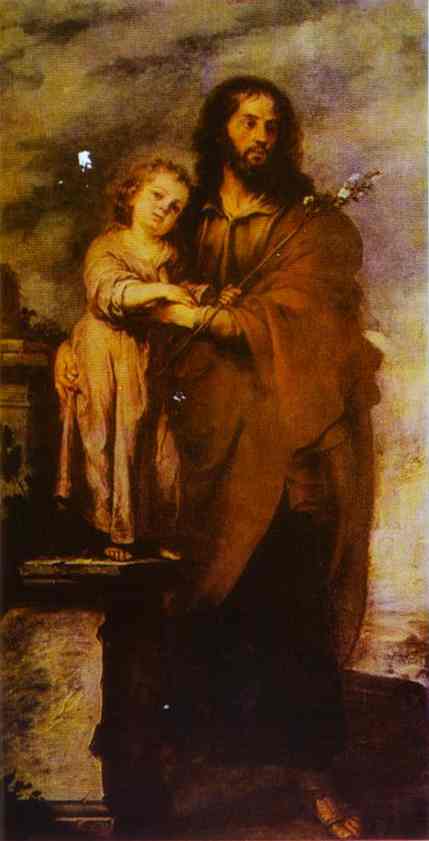
“Joseph with Infant Christ,” painted by Bartolome Esteban Murillo in 1666, is a deeply tender vision of fatherhood and divine protection. Known primarily for his Madonnas and scenes of childhood, Murillo here turns his attention to Saint Joseph, presenting him not as a distant guardian but as a gentle, loving parent who cradles the Christ Child with quiet strength.
In this vertical composition, Joseph stands, wrapped in a warm brown cloak, while the young Christ rests close to him, one arm encircling Joseph and the other extended outward. The two figures are locked in a close embrace that immediately draws the viewer into their intimate bond. Around them, a softly lit architectural setting and a moody sky provide a dignified yet humble backdrop, reinforcing the painting’s spiritual depth.
The work belongs to Murillo’s mature period, when his handling of light, color, and human emotion reached an extraordinary refinement. “Joseph with Infant Christ” encapsulates much of what makes Murillo so beloved: a warm humanity, a luminous palette, and an ability to bridge everyday affection with the mysteries of faith.
Reimagining Saint Joseph as a Tender Father
One of the most striking aspects of this painting is Murillo’s treatment of Saint Joseph. Earlier Christian art often depicted Joseph as elderly, passive, or somewhat peripheral to the sacred drama. Murillo, however, chooses to present a relatively vigorous and youthful Joseph, a man capable of hard work, emotional warmth, and spiritual responsibility.
Joseph’s features suggest a life of labor and quiet resilience. His hair and beard are somewhat unkempt, his brow slightly furrowed, and his stance solid and protective. Yet his gaze is soft, directed lovingly toward the child by his side. The subtle tension between strength and gentleness is central to the painting’s emotional impact. Joseph appears both guardian and nurturer, embodying an ideal of fatherly devotion.
The Christ Child leans into Joseph with complete trust. This closeness emphasizes the humanity of Jesus, portraying him as a vulnerable child who needs love and protection. At the same time, Joseph’s respectful, almost reverent handling of the child maintains a sense of the boy’s divine identity. The result is a beautiful balance between domestic intimacy and sacred reverence.
Composition and the Intimate Vertical Format
Murillo composes “Joseph with Infant Christ” within a tall, narrow format that accentuates the figures’ upright posture and spiritual elevation. Joseph occupies much of the height of the picture, with the child gathered at his side, creating a vertical axis of protection.
The composition is anchored by Joseph’s cloak, which flows in broad swaths of brown and reddish tones, wrapping both figures into a single visual mass. This shared drapery is not merely a technical device. It visually unites Joseph and Christ, symbolizing their intertwined roles in the history of salvation. The broad folds of cloth, painted with Murillo’s characteristic softness, add weight and stability to the group, assuring the viewer of Joseph’s steady guardianship.
A ledge or pedestal at the left and architectural blocks near the bottom provide a structural base, grounding the figures in space. These forms, though simplified, suggest the solid world of carpentry, stone, and daily labor. Above and behind, lighter tones in the sky and distant background lift the scene, hinting at divine presence without resorting to elaborate clouds or rays. The overall composition moves the eye gently from Joseph’s face down to the child and then back up along the staff he holds, guiding the viewer into a quiet contemplation of their relationship.
Light, Shadow, and the Spiritual Atmosphere
Murillo’s mastery of chiaroscuro is central to the emotional tone of this work. The light falls predominantly from the left, illuminating the faces and upper bodies of Joseph and the child while leaving much of the surrounding space in a soft, velvety shadow. This selective lighting creates a visual focus on the central figures and heightens the sense of intimacy.
The child’s skin glows with a delicate radiance, emphasizing innocence and purity. Joseph’s features, though more rugged, are similarly bathed in gentle light that brings out the warmth of his expression. The interplay of light and shadow along Joseph’s cloak highlights its voluminous folds, adding a sculptural dimension to the painting.
The background, by contrast, dissolves into a hazy, atmospheric darkness. Rather than describing specific details, Murillo allows the setting to recede, so that the viewer’s attention never strays far from the emotional connection between father and child. The dark ground around their feet emphasizes the illumination of their faces, creating an almost theatrical spotlight that suggests divine favor.
This use of light does more than model forms. It functions symbolically, presenting Joseph and Christ as beacons of faith within a world of uncertainty and hardship. The glow that surrounds them whispers of grace and quiet miracles.
Color Harmony and Murillo’s Warm Palette
Color plays a crucial role in shaping the mood of “Joseph with Infant Christ.” Murillo relies on a palette of warm browns, soft ochres, muted reds, and gentle flesh tones, all harmonized within a subtle, golden atmosphere. These colors evoke the earth, wood, and fabric of everyday life in seventeenth century Spain, grounding the sacred story in familiar material reality.
Joseph’s cloak is perhaps the most prominent area of color. Its rich, earthy tones suggest warmth and shelter, reinforcing his role as protector. The garment wraps around his body and partially envelops the child as well, like a visual metaphor for Joseph’s care. Underneath, hints of a more subdued tunic introduce tonal variety without distracting from the main harmony.
The Christ Child’s drapery is lighter, typically in whitened tones that connote purity and divinity. Against Joseph’s darker clothing, this pale fabric stands out, symbolizing the child’s spiritual nature while also emphasizing the human tenderness of the embrace.
Subtle touches of color in the background and architectural elements help to frame the figures without competing with them. Murillo’s skill lies in his ability to maintain a restrained overall palette while still creating richness and depth. The result is a painting that feels both modest and sumptuous, intimate and luminous.
Gesture, Expression, and the Language of Emotion
The emotional core of “Joseph with Infant Christ” resides in the gestures and expressions of its two main figures. Murillo excels at capturing small, telling details that reveal inner states of mind.
Joseph holds the child in a firm yet gentle way, his arms embracing without constricting. His eyes look slightly afar, as if contemplating the responsibilities entrusted to him. There is a quiet seriousness in his face, but also unmistakable affection. This duality suggests a man simultaneously aware of the child’s divinity and deeply attached to him as a son.
The Christ Child appears relaxed yet attentive. Depending on the exact version of the painting, he may rest against Joseph’s chest or stand partially supported by him. In either case, the child’s body language conveys trust. His gaze, which often meets the viewer or turns upward, introduces a bridge between the intimate scene and the viewer’s own spiritual reflection.
Hands are particularly expressive here. Joseph’s hand, which holds the staff or gently guides the child, appears strong but not tense. The child’s hands, smaller and softer, either clutch Joseph’s garment or extend outward in a subtle gesture of blessing. These small choices give the painting a sense of living movement and emotional authenticity.
Symbolism and Theological Meaning
Although “Joseph with Infant Christ” is a tender family scene, it is packed with symbolic meaning. Murillo was painting for an audience steeped in Catholic devotion, and his imagery would have been readily understood in religious terms.
Joseph’s staff is one of the key symbols. Often associated with his role as protector and provider, the staff here also recalls the pilgrim’s walking stick, hinting at the journeys and hardships Joseph will share with his family, such as the flight into Egypt. In broader Christian iconography, a staff can also signify spiritual guidance and authority.
The child’s presence, of course, is central. As the incarnate Son of God, Christ is both fragile child and eternal savior. Murillo’s decision to emphasize his vulnerability, rather than depicting him enthroned or glorified, underscores the mystery of the Incarnation. The image invites viewers to consider how divinity can dwell within the ordinary human experiences of dependence and love.
The architectural hints in the background, possibly including a low pedestal or column, connect the scene with the Church and its traditions. They root Joseph and Christ in a continuity of faith that stretches from biblical history to Murillo’s own seventeenth century Spain.
Subdued halos or subtle glows around the heads of Joseph and Christ may be present, depending on the version, lightly affirming their sanctity without overwhelming the naturalism of the scene. Murillo’s symbolic language remains gentle and integrated, allowing the viewer to engage both emotionally and spiritually.
Murillo’s Devotional Style and Seville in the Seventeenth Century
To fully appreciate “Joseph with Infant Christ,” it helps to place it within Murillo’s broader career and the religious climate of Seville in the mid seventeenth century. This was a city deeply shaped by Counter Reformation Catholicism, where art was expected to move the heart, educate the faithful, and encourage pious reflection.
Murillo became one of the leading painters in Seville precisely because he mastered the art of devout yet accessible imagery. His saints and biblical figures are not distant icons but approachable, often humble, and filled with compassion. He had a special gift for depicting children and domestic scenes that resonated with ordinary believers while still satisfying theological expectations.
“Joseph with Infant Christ” reflects this mission perfectly. Rather than portraying complex doctrinal narratives, the painting draws viewers into a quiet encounter with the Holy Family. It presents Joseph as a model for fathers, workers, and those who serve in silence. For worshippers in Murillo’s time, the image would have encouraged trust in divine providence and reverence for family life as a place where holiness can flourish.
Murillo’s style also bears the influence of earlier masters such as Titian, Van Dyck, and Rubens, whose works he studied and admired. From them he absorbed a love of rich color, soft modeling, and dramatic yet controlled lighting. In “Joseph with Infant Christ,” these influences are filtered through his own gentle sensibility, resulting in a uniquely Sevillian blend of warmth and spirituality.
Comparison with Murillo’s Other Holy Family Paintings
Murillo returned to the theme of the Holy Family many times throughout his career. Comparing “Joseph with Infant Christ” to some of his other works reveals what is distinctive about this painting.
In many Holy Family compositions, Mary holds the child while Joseph stands in the background or to the side, occupying a secondary role. Here, however, Joseph is the primary caregiver, with Mary absent from the scene. This intentional focus on Joseph allows Murillo to explore his character in depth and to highlight his often overlooked importance.
The tone of the painting is also more introspective than some of Murillo’s larger, more crowded religious works. There are no bustling angels, no elaborate architecture, and no bright bursts of supernatural light. Instead, the painting relies on the emotional conversation between two figures, a choice that enhances its contemplative power.
At the same time, the work shares with Murillo’s broader output a preference for soft edges, glowing skin tones, and compositions that emphasize tenderness and human connection. For viewers familiar with his Madonnas and genre scenes of children, “Joseph with Infant Christ” feels like a natural extension of his artistic concerns.
Legacy and Contemporary Appeal
Today, “Joseph with Infant Christ” continues to speak to modern viewers for several reasons. First, its portrayal of fatherhood feels surprisingly contemporary. In a time when discussions about paternal involvement, emotional openness, and nurturing masculinity are increasingly important, Murillo’s Joseph offers a compelling visual model of a father who is both strong and gentle.
Second, the painting’s modest scale and intimate focus invite a personal response. Even viewers who are not religious can appreciate the tenderness of the embrace and the quiet dignity of the figures. The work celebrates caregiving, protection, and trust, values that transcend specific traditions.
For those with a devotional connection to the subject, the painting offers a powerful image for prayer and reflection. Joseph’s attentive presence encourages trust in divine guidance during times of uncertainty, while the child’s serene posture hints at a peace that can be found in that trust.
Art historians also value “Joseph with Infant Christ” as a prime example of Murillo’s late style, where his brushwork becomes softer, his tonal harmonies more refined, and his compositions increasingly focused on emotional resonance. It stands as a testament to how Baroque art could be both dramatic and deeply humane.
Conclusion
“Joseph with Infant Christ” by Bartolome Esteban Murillo is far more than a charming religious picture. Painted in 1666, it is a meditation on fatherhood, trust, and the quiet heroism of everyday care. Murillo’s luminous palette, carefully controlled light, and sensitive modeling of faces and hands all serve the central theme of loving protection.
By placing Joseph at the center of the composition and showing the Christ Child nestled confidently at his side, Murillo rebalances the visual hierarchy of many traditional Holy Family scenes. Joseph is no longer a marginal figure but a man whose faithfulness, strength, and tenderness are indispensable to the story of salvation.
The painting’s enduring appeal lies in its ability to make the sacred feel close, warm, and human. It invites viewers not only to admire the skill of Murillo’s brush, but also to reflect on their own experiences of being protected, of caring for others, and of seeking light amid the shadows of life. In its gentle way, “Joseph with Infant Christ” remains a radiant example of how Baroque art could unite theological depth with heartfelt emotion.