Image source: wikiart.org
Historical Background of Murillo and the Theme
Bartolome Esteban Murillo was one of the leading painters of seventeenth century Spain, celebrated for his tender religious scenes and his humane, sympathetic portraits of everyday people. Working in Seville, a city shaped by intense Catholic devotion, Murillo produced countless images intended for private chapels, monasteries and lay confraternities. Although he is best known today for serene Madonnas and charming street children, he also tackled dramatic Old Testament subjects that allowed him to explore powerful emotion and moral conflict.
“Joseph and Potiphar’s Wife,” painted around 1665, belongs to this more dramatic part of his production. The story, taken from the Book of Genesis, tells how the young Joseph, sold into slavery in Egypt, entered the service of Potiphar, an important official. Potiphar’s wife became infatuated with Joseph and tried to seduce him. When he refused her advances and fled, she seized his garment and later used it as false evidence to accuse him of attempted assault.
The theme had long fascinated artists because it combined intense physical movement with clear moral lessons about virtue, temptation and false accusation. For patrons in Counter Reformation Spain, it was an ideal narrative to promote chastity, honesty and trust in divine providence. Murillo takes this familiar subject and invests it with his own blend of theatricality and psychological nuance.
The Biblical Story in a Single Arrested Moment
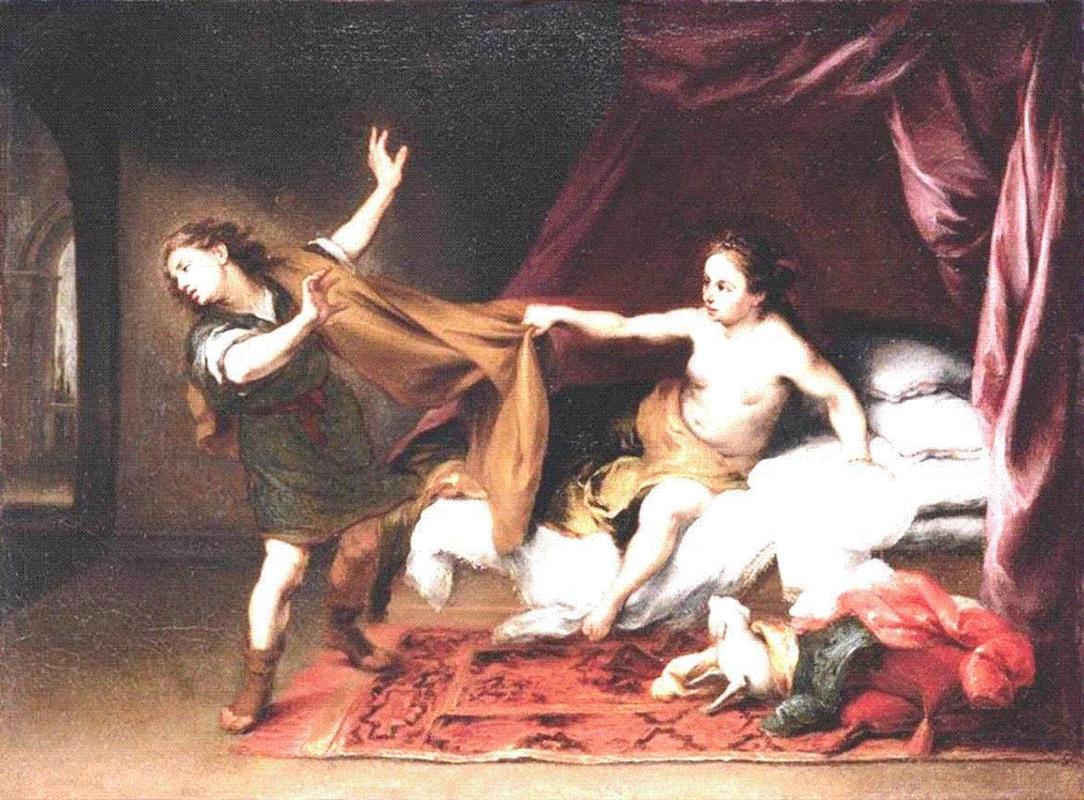
Murillo selects the pivotal instant when the situation turns from temptation to accusation. On the right, Potiphar’s wife sits on the edge of a luxurious bed, her body uncovered above the waist, one leg pressing into the mattress as she lunges forward. She grabs Joseph’s cloak with both hands, determined not to let him go. On the left, Joseph twists away in alarm, arm flung back, feet already stepping toward the doorway. Between them, the cloak stretches like a visual tether that still binds them for a brief second.
This is the moment the biblical text describes when Joseph leaves his garment in her hands and flees. Murillo’s painting suspends that second of decision. The viewer knows that in the next instant the cloak will slip from Joseph’s shoulders, remaining with the woman who will use it to destroy his reputation. By freezing the narrative here, Murillo captures both the courage of Joseph’s refusal and the dangerous intensity of Potiphar’s wife’s desire.
Composition and the Direction of Movement
The composition is organized around a strong diagonal that runs from the dark doorway at left to the glowing bed and canopy at right. Joseph’s body follows this diagonal. His upper torso leans away from the bed, while his legs push forward, giving a sense of sudden flight. The arch of his back and the raised hand create a sweeping curve that pulls the viewer’s gaze toward the exit.
Potiphar’s wife forms a counter diagonal. Her body is oriented toward Joseph, her arm extended to grab the cloak. Together, the two figures create a dynamic X shape across the center of the canvas. This crossing of diagonals expresses the conflict between resistance and desire, escape and entrapment.
The bed dominates the right side of the painting. Its heavy curtains, deep red in tone, frame the woman and intensify the sense of an intimate, private space. The light colored sheets spill over the edge, forming bright masses that contrast with the darker floor and walls. At the bottom, a richly patterned carpet extends toward the viewer, anchoring the scene and emphasizing the domestic luxury of Potiphar’s house.
Murillo also uses empty space cleverly. The left side of the painting is comparatively bare, with only the doorway and dim background, symbolizing the unknown world Joseph runs toward. This emptiness contrasts with the crowded fabrics and pillows around Potiphar’s wife, suggesting that sin and temptation are wrapped in sensory excess, while virtue is aligned with simplicity and obscurity.
Light, Color and Dramatic Atmosphere
As in many Baroque works, light is a primary tool for drama. Murillo directs a warm beam from the upper left, which falls across Joseph’s face and arm, then streaks across the cloak and illuminates the body of Potiphar’s wife and the white bedding. This strong light isolates the central action from the darker surroundings, almost like a spotlight on a stage.
The palette is dominated by earthy browns, warm flesh tones and deep reds. Joseph’s garments in greenish brown and soft white are relatively subdued, linking him to the shadowed side of the room. The woman’s yellow skirt and the glowing red curtains, by contrast, catch the eye with saturation and warmth, associating her with sensuality and passion. The white sheets create striking highlights, drawing attention to the bed as the locus of temptation.
Murillo’s handling of paint is fluid and soft, typical of his mature style. The contours of the figures are clear, yet transitions between tones are gentle rather than harsh. This softness lends the scene a sense of immediacy and human warmth even as it depicts moral danger. It also allows the light to appear natural, as though filtering into a real room.
The Character of Joseph
Joseph is portrayed as a youthful, almost boyish figure. His face is smooth, his hair loose and slightly disheveled as he turns away. The expression is a mixture of fear, surprise and moral resolve. His gaze, directed toward the left, avoids Potiphar’s wife entirely, signaling his rejection of her invitation.
His pose is remarkable for its energy. One foot is planted on the carpet, the other lifted as he pivots. His torso twists sharply, and one arm is flung behind him in a defensive gesture. The cloak clutched by the woman appears to pull him backward, yet his whole body strains in the opposite direction. This tension suggests the internal struggle between human vulnerability and a virtuous will.
Murillo dresses Joseph in a short tunic belted at the waist, with a white shirt and sturdy boots. The costume evokes a humble servant rather than a nobleman, underscoring Joseph’s status as a slave in a foreign land. The simple clothing and the earnest expression make him a credible moral exemplar for viewers. He is neither remote nor idealized but a believable young man faced with a difficult choice.
The Character of Potiphar’s Wife
Potiphar’s wife is shown in a state of emotional and physical agitation. Sitting on the edge of the bed, she leans forward with her torso bare, supported by her extended arm. The strong light highlights her chest and face, emphasizing both her sensuality and her determination. Her expression is not merely seductive. It combines frustration, anger and desperation as she realizes Joseph is escaping her control.
The arrangement of her body conveys both vulnerability and aggression. One leg is bent under her, the other extended, showing that she has just surged toward Joseph from a reclining position. Her hands clutch the cloak forcefully. Even as she loses him, she retains a piece of his garment that will soon become a weapon of accusation.
Murillo does not demonize her with caricature. She is not ugly or monstrous. Instead, she appears as a young woman consumed by passion and wounded pride. This nuanced portrayal adds psychological depth to the story. Viewers can sense how quickly desire turns into vindictiveness when thwarted.
Textiles, Setting and Symbolism
The luxurious textiles in the painting are not mere decoration. They intensify the narrative and carry symbolic meaning. The red canopy and curtains envelop the bed, creating a rich, sensuous environment. Red suggests passion, lust and eventually guilt. It also frames Potiphar’s wife like a stage curtain, as though her actions belong to a drama of moral testing.
The white bedding symbolizes the purity that is threatened. The way the sheets spill toward Joseph and over the edge of the bed carries a sense of disorder introduced by temptation. At the foot of the bed, a jumble of colorful garments lies on the carpet, perhaps the clothing she has hastily discarded. Their disarray reflects moral chaos.
The cloak becomes the most important textile of all. Stretched between the two figures, it is both physical object and symbolic bond. For Joseph, it is something he must relinquish in order to escape. For Potiphar’s wife, it is the only piece of him she can possess and later manipulate. In the biblical narrative she uses it as evidence, claiming he left it when he tried to violate her. Thus the garment represents misused power, distorted truth and the fragility of reputation.
The room itself is largely undefined, but the glimpse of an arched corridor or exterior space on the left suggests that the world of public judgment lies just beyond. Joseph runs toward that world, trusting that God will vindicate him in the long term, even though immediate consequences will be harsh.
Moral and Emotional Impact
Murillo’s painting operates on several emotional levels at once. On the surface it is a lively, almost theatrical scene full of movement and dramatic tension. Viewers can feel the urgency of Joseph’s flight and the desperation of Potiphar’s wife. The interplay of gazes, gestures and fabrics creates a choreography that is visually engaging.
At a deeper level, the work conveys a serious moral lesson. Joseph is a model of chastity and loyalty who chooses to risk false accusation rather than betray his master or his God. Potiphar’s wife embodies the destructive power of unchecked desire and resentment. The painting therefore invites viewers to reflect on their own responses to temptation and wounded pride.
Yet Murillo treats all participants with a measure of compassion. Joseph is not triumphantly heroic. He looks frightened and distressed, aware that his refusal will not protect him from suffering. Potiphar’s wife is not depicted as inherently evil. Instead she appears as a person caught in her own emotional turmoil. This nuance encourages viewers to consider how easily anyone can fall into wrongdoing and how dependent they are on grace to maintain integrity.
Relationship to Murillo’s Other Works
Murillo painted the subject of “Joseph and Potiphar’s Wife” more than once. Earlier versions show similar compositional ideas but differ in detail and tone. The 1665 painting reflects his mature style, with softer modeling, more complex light and a heightened psychological focus. Compared with his serene Madonnas or charming street scenes, this work demonstrates his range. He was capable of both tenderness and dramatic intensity.
The painting also connects to Murillo’s series on the Prodigal Son and other narratives of sin, repentance and divine providence. In those works, as here, he emphasizes the human side of biblical characters. They are not distant figures from a remote past but people whose emotions and struggles are instantly recognizable.
For patrons in Seville, “Joseph and Potiphar’s Wife” would have complemented images focusing on charity and mercy. The story of Joseph does not end with this scene. Eventually he becomes a powerful figure in Egypt and forgives his brothers who wronged him. Murillo’s painting invites viewers to remember that God can transform unjust suffering into a path toward greater good.
Lasting Legacy for Modern Viewers
Today, “Joseph and Potiphar’s Wife” speaks to concerns that remain relevant. Issues of consent, power imbalance, sexual manipulation and false accusation continue to shape contemporary debates. Murillo’s painting, while emerging from a seventeenth century religious context, dramatizes these themes vividly.
Joseph’s choice to flee rather than stay and negotiate highlights the importance of personal boundaries and moral clarity. Potiphar’s wife’s subsequent misuse of the cloak points to the dangers of twisting evidence for personal revenge. The scene encourages viewers to consider how easily narratives can be manipulated and how vulnerable the innocent can be.
Beyond the specific biblical story, the painting captures the universal experience of being caught in a moment of crisis when one must decide between immediate gratification and long term integrity. Murillo’s dynamic composition, expressive lighting and rich symbolism turn that decision into a powerful visual experience. Viewers are not passive spectators. They are invited to feel the pull of both directions and to ask themselves which path they would take.
Through this work, Murillo demonstrates that art can be both visually captivating and morally thoughtful. “Joseph and Potiphar’s Wife” remains a compelling example of Spanish Baroque painting that combines narrative clarity, emotional depth and a subtle yet firm ethical message.