Image source: wikiart.org
Introduction to “Joseph and Potiphar’s Wife”
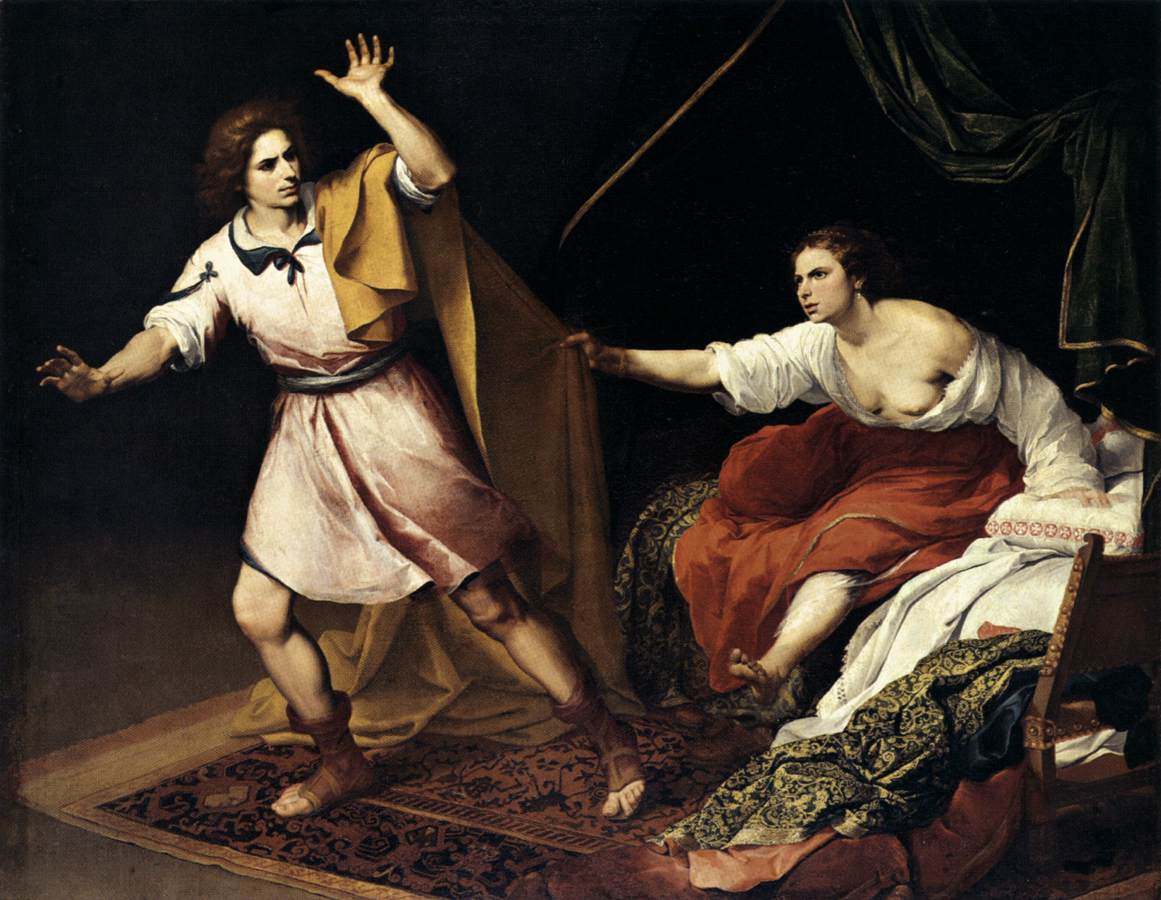
“Joseph and Potiphar’s Wife,” painted by Bartolome Esteban Murillo in 1648, is a powerful Spanish Baroque interpretation of one of the most dramatic moments in the Book of Genesis. The painting captures the instant when Joseph, servant in the house of the Egyptian official Potiphar, flees from the advances of Potiphar’s wife. She clutches his cloak as he twists away, leaving behind the incriminating garment that will soon be used to accuse him unjustly.
Murillo transforms this biblical scene into a vivid psychological drama. With only two figures, a carpet, and a bed draped in heavy textiles, he creates a charged atmosphere filled with tension, desire, fear, and moral resolve. The painting offers not only a narrative from Scripture but also a meditation on virtue, temptation, and the human capacity to choose integrity even under pressure.
The Biblical Narrative Behind the Painting
The story of Joseph and Potiphar’s wife appears in Genesis 39. Joseph, sold into slavery by his brothers, becomes a servant in the household of Potiphar, captain of Pharaoh’s guard. Blessed with wisdom and reliability, Joseph rises to a position of trust. Potiphar’s wife, attracted to the young Hebrew, repeatedly tries to seduce him. Joseph refuses, insisting that he will not betray his master or sin against God.
One day, when the house is empty, she grabs his garment and demands that he lie with her. Joseph tears himself away and runs outside, leaving the garment in her hand. Enraged and humiliated, she uses the cloak as false evidence and accuses him of attacking her. Joseph is thrown into prison, although his innocence is later recognized when he rises to power in Egypt.
Murillo chooses the crucial turning point of the story. He does not show the courtroom scene or Joseph in prison, but the exact second when Joseph escapes and the wife seizes his cloak. By focusing on this moment of decision, the artist emphasizes the moral core of the narrative, the clash between temptation and loyalty.
Composition and Theatrical Drama
The composition of “Joseph and Potiphar’s Wife” is built on a diagonal movement that runs from the lower right corner, where the woman sits on the bed, to the upper left corner, where Joseph’s raised hand reaches into the dark background. This diagonal organizes the entire painting and conveys a sense of rapid motion.
Joseph occupies the left side of the canvas. His body twists, one foot planted back on the carpet while the other steps forward. His arms extend in opposite directions: one hand open behind him as if pushing away the danger, the other reaching forward in escape. The tension of his body communicates both inner conflict and physical strain.
Potiphar’s wife sits on the bed on the right, leaning forward with one knee on the mattress and one foot planted on the floor. Her torso bends toward Joseph, arm outstretched to seize his cloak. The folds of her red skirt and white blouse echo the dynamism of her gesture. Her extended body mirrors Joseph’s, turning the scene into a visual tug of war between two opposing wills.
The large dark background isolates the figures and eliminates distraction. Murillo uses an almost stage like setting, with the action taking place in front of heavy drapery and on a richly patterned carpet. This theatrical arrangement focuses the viewer’s attention on the encounter itself.
Light, Color, and Emotional Atmosphere
Murillo’s use of light in this painting intensifies the drama. A strong illumination falls from the left, catching Joseph’s face, arms, and legs, as well as parts of Potiphar’s wife and the bed. The background remains dark, creating a high contrast that enhances the sense of urgency.
Joseph’s tunic is painted in soft pink tones with a blue collar and belt, while a golden cloak flows from his shoulders. These warm yet modest colors mark him as the central figure of virtue. Potiphar’s wife wears a white blouse that slips from her shoulder and a deep red skirt that spreads across the bed. The white and red create a striking contrast and carry symbolic associations with seduction and danger.
The luxurious textiles the carpet, the bedspread with gold patterns, the heavy dark green curtain contribute to the atmosphere of wealth and sensual comfort. They contrast with Joseph’s moral austerity. The overall palette, dominated by rich reds, golds, and dark greens against a black void, creates a sense of enclosed heat, appropriate to a scene of temptation and struggle.
Joseph as a Model of Integrity
Murillo’s portrayal of Joseph emphasizes both his youth and his moral strength. His features are handsome, almost idealized, with a strong profile and determined mouth. His gaze is turned away from Potiphar’s wife and directed upward and outward, as if he is concentrating on escaping not only her grasp but the sin she represents.
The tension in Joseph’s hands is especially telling. His left hand, closest to the woman, opens with fingers spread, indicating rejection and alarm. His right hand, raised above his head, seems to ward off an unseen danger. His entire body leans away from her, yet he has not yet fully escaped, which allows the viewer to feel the immediacy of his decision.
Murillo depicts Joseph’s garments as still partly tangled with the woman’s grasp. The cloak that she tears from him flows behind his back like a golden trail. This cloth not only connects the two figures physically but also foreshadows its role as false evidence. In visual terms, the cloak becomes the hinge of the story, the object that transforms private temptation into public scandal.
Potiphar’s Wife as Agent of Temptation
Potiphar’s wife appears as a complex figure. She is not a caricature of evil but a woman whose desire has turned aggressive. Murillo emphasizes her beauty: her hair loosely gathered, her skin pale and luminous, her posture energetic and determined. Her blouse slips off one shoulder, revealing part of her chest. This exposure is not gratuitous; it signals both her seductive intent and the loss of modesty that contrasts with Joseph’s restraint.
Her expression is intense and focused. She leans forward, eyes fixed on Joseph, lips compressed in determination. Her outstretched arm and grasping hand reveal that she is not passively alluring but actively pursuing him. At the same time, there is a hint of desperation in her pose. She is about to lose him and with him the object of her desire and perhaps her sense of power.
Murillo allows the viewer to feel the pull of her energy while also emphasizing its moral danger. The red of her skirt, dominating the right side of the painting, suggests both passion and the potential for violence, anticipating the false accusation that will follow Joseph’s escape.
Symbolism of Space and Objects
The spatial arrangement and objects in the painting carry symbolic meaning. The setting is an interior chamber, likely part of Potiphar’s residence. The rich carpet under Joseph’s feet and the ornate textiles on the bed highlight the world of luxury in which the scene occurs. This environment represents worldly success and sensual comfort, the kind of life Joseph has achieved in Egypt but must not abuse.
The open darkness behind Joseph can be read as both physical space and moral horizon. By fleeing into this shadowy area, he chooses uncertainty and possible danger over the security of his position in Potiphar’s house. The decision reflects his trust in God rather than in human power.
The bed, partially visible on the right, symbolizes both legitimate marital intimacy and the illicit desire of Potiphar’s wife. It is the stage of temptation. Murillo does not show a disordered room; the bedding is rich but not chaotic. The sin lies not in the objects themselves but in the misuse of them. This nuance aligns with Christian teaching that material goods are not evil in themselves but can become occasions of sin.
Murillo’s Style and the Spanish Baroque Context
“Joseph and Potiphar’s Wife” belongs to Murillo’s early mature period. It reveals the influence of Italian and Spanish Baroque painting, especially in the dramatic lighting, the strong diagonal composition, and the emphasis on emotional tension. At the same time, it already shows Murillo’s characteristic softness in facial expressions and his interest in psychological nuance.
Seville, where Murillo worked, was a major artistic center in seventeenth century Spain. Religious orders and confraternities commissioned paintings that combined doctrinal clarity with emotional resonance. Although this painting depicts an Old Testament story, its message fits perfectly with Counter Reformation aims, serving as a visual lesson in chastity and fidelity.
Murillo’s ability to integrate narrative, morality, and visual richness made him an ideal artist for such commissions. The painting demonstrates his skill in rendering fabric, anatomy, and movement, as well as his sensitivity to the inner life of his characters.
Moral and Emotional Impact on the Viewer
The emotional impact of “Joseph and Potiphar’s Wife” comes from the viewer’s position as witness to a critical choice. We see Joseph in the instant before he fully escapes and Potiphar’s wife in the moment before she cries out and sets in motion the accusation. The painting invites us to identify with Joseph’s struggle, to feel the pull of temptation and the effort required to resist.
At the same time, it allows us to understand the consequences of both virtue and vice. Joseph’s choice to flee will cost him his status and freedom for a time, yet it preserves his integrity and eventually leads to his exaltation in Egypt. Potiphar’s wife, by contrast, yields to passion and pride, using deception to protect herself, and becomes an example of moral failure.
Murillo achieves this moral effect without didactic inscriptions or overt symbolism. The viewer learns through empathy. The tension in Joseph’s muscles, the expression in the woman’s eyes, the swirling fabrics, and the dramatic light all work together to make the story emotionally vivid.
Legacy and Contemporary Relevance
Over the centuries, “Joseph and Potiphar’s Wife” has remained a compelling image of ethical decision making. Its theme resonates beyond religious contexts, touching on issues of power, consent, and integrity that continue to be relevant. The painting highlights the vulnerability of someone in a subordinate position facing unwanted advances from a person of higher status, a topic that speaks strongly to modern discussions of abuse of authority.
At the same time, the work illustrates the complexity of moral choice. Joseph’s escape is not easy or cost free. Murillo shows the fear in his face and the risk he takes. The painting thus encourages viewers to consider courage as an essential component of virtue.
In the history of art, Murillo’s interpretation stands alongside works by Italian and Northern European artists who also tackled this story. What distinguishes his version is the psychological realism and the sense of physical immediacy. The scene feels less like an allegory and more like a moment that could unfold before our eyes.
Conclusion
“Joseph and Potiphar’s Wife” by Bartolome Esteban Murillo is a richly layered exploration of temptation, integrity, and human freedom. Through dynamic composition, dramatic light, vivid color, and carefully crafted expressions, Murillo brings to life the biblical episode in which Joseph flees the advances of his master’s wife. The painting captures the split second of decision, transforming a scriptural text into a living drama.
Beyond its narrative interest, the work serves as a moral mirror, inviting viewers to reflect on their own responses to pressure and desire. It demonstrates how Baroque art could combine technical brilliance with profound ethical and spiritual reflection. Even today, Murillo’s painting speaks with clarity about the power of conscience and the cost, yet also the nobility, of choosing what is right.